
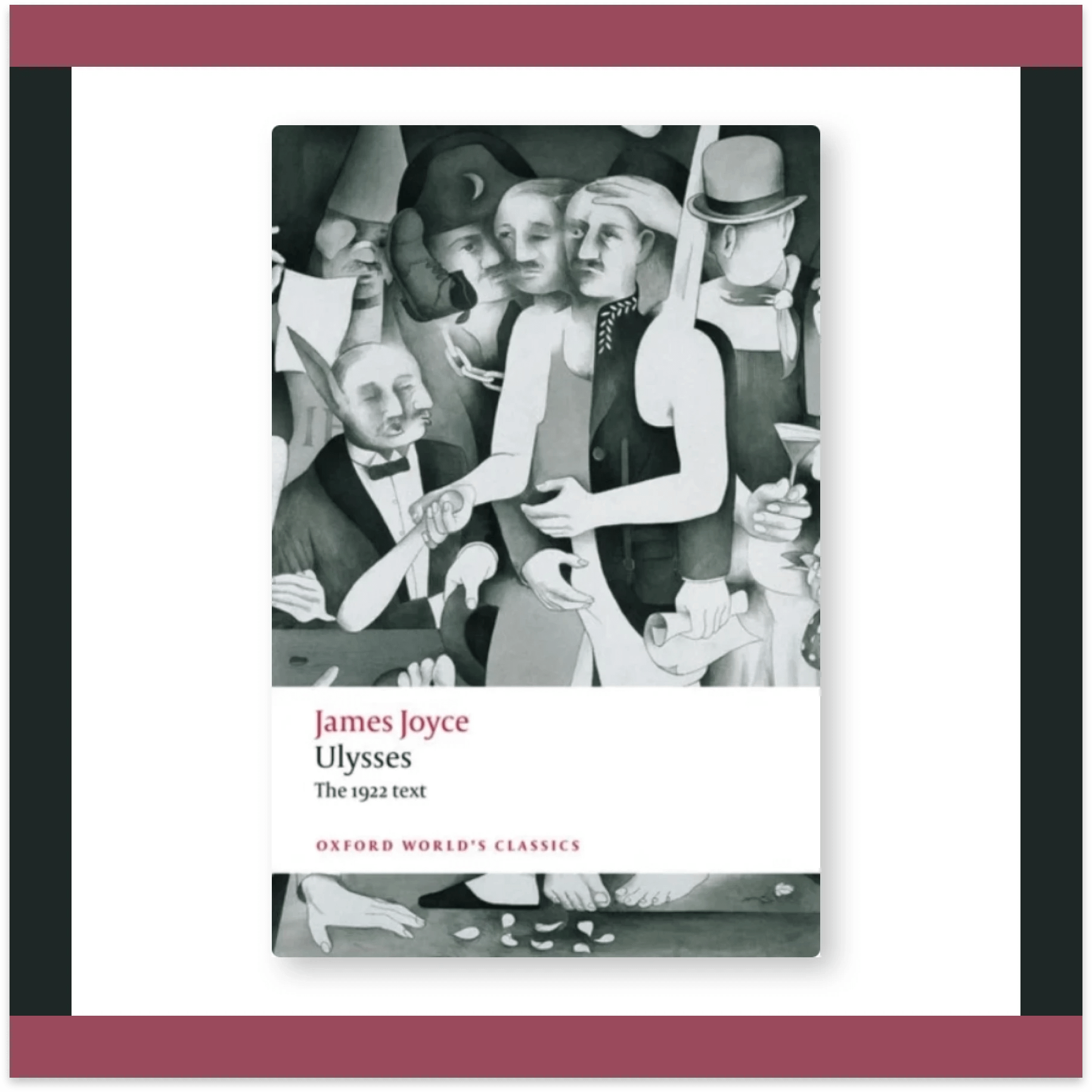
Ulysses by James Joyce
Last updated: 3 October 2026
Ulysses by James Joyce follows three Dubliners through a single day, 16 June 1904, and maps their errands, conversations and thoughts onto Homer's Odyssey. It came out in Paris in 1922 and was banned in the UK until 1936. The Oxford World's Classics paperback, edited by Jeri Johnson, has the notes most first-time readers need. On 3 October 2026 it was £9.46 on Amazon UK and £10.44 on Bookshop.org.
Buy on Amazon UK, £9.46 Buy on Bookshop.org, £10.44
The Amazon and Bookshop.org links on this page are affiliate links. If you buy through one, I earn a commission at no extra cost to you.
What happens in Ulysses
Very little, in terms of plot. Leopold Bloom, who sells newspaper advertising space, spends the day walking around Dublin. He goes to a funeral, visits a newspaper office, eats lunch in a pub and worries that his wife Molly is having an affair. Meanwhile Stephen Dedalus, a young teacher and would-be writer, drifts through the same city. The two men finally meet late at night.
The novel is split into three parts and 18 episodes. Each episode matches a book of the Odyssey: Bloom is Ulysses, the Latin name for Odysseus, Stephen is his son Telemachus and Molly is Penelope. You do not need to know Homer to follow it, but the notes in a good edition point out the parallels as they come up.
Why it is hard, and how to read it
Joyce changes style in almost every episode. One is written like a newspaper, with headlines. Another is a play script, and the last is a single stream of Molly's thoughts with almost no punctuation. As a result, a reader who settles into one style is soon thrown by the next.
The practical answer is to read one episode at a time and use the notes. When a passage loses you, read on, because the next page often makes the last one clearer. Listening to an audiobook alongside the text also helps with the Dublin voices.
Publication, the ban and Bloomsday
Joyce wanted the book out on his 40th birthday, and Sylvia Beach's Paris bookshop, Shakespeare and Company, published it on 2 February 1922. Extracts had already led to an obscenity prosecution in the US. A US court cleared the book in 1933 and an appeal court upheld that in 1934. The UK ban lasted until 1936.
Joyce set the book on 16 June because it was the date of his first outing with Nora Barnacle, who later became his wife. Fans now mark that date every year as Bloomsday, with readings and walks around Dublin in Edwardian dress. The James Joyce Centre in Dublin runs the main festival.
The edition we recommend
The Oxford World's Classics second edition came out in February 2022, for the novel's centenary. Jeri Johnson edits it, and it prints the 1922 text with an introduction and detailed notes. It is a thick paperback at 1,088 pages. Avoid cheap unannotated editions for a first read, because the notes are what make the references manageable.
Ulysses on Amazon UK Ulysses on Bookshop.org
Key facts
- Author: James Joyce
- First published: 2 February 1922, by Shakespeare and Company in Paris
- Setting: Dublin, 16 June 1904
- Structure: three parts and 18 episodes
- This edition: Oxford World's Classics second edition, edited by Jeri Johnson, 10 February 2022, 1,088 pages, ISBN 9780192855107
- Price: £9.46 on Amazon UK, with 12 left, and £10.44 on Bookshop.org on 3 October 2026
- Ratings: 4.1 out of 5 from 3,576 ratings on Amazon UK
Who it suits
- Patient readers: people who enjoy language and do not mind rereading a page.
- Visitors to Dublin: many of the streets, pubs and shops in the book still exist.
- Book clubs with time: taken at two or three episodes a week, it fills about two months.
The limits
Ulysses is long and slow, and some episodes are hard going even with notes. Readers who want a story with momentum will find it frustrating. The Oxford edition is also heavy at around 1kg, so it is not a commuting book. For a classic that reads in a weekend, The Great Gatsby is under 200 pages.
FAQs
What is Ulysses by James Joyce about?
It follows Leopold Bloom, Stephen Dedalus and Molly Bloom through one day in Dublin, 16 June 1904, with each episode based on a part of Homer's Odyssey.
Do I need to read the Odyssey first?
No. The parallels add a layer, and an annotated edition explains them as you go.
Why was Ulysses banned?
Authorities in the US and UK judged parts of it obscene. A US court cleared it in 1933, and the UK ban ended in 1936.
What is Bloomsday?
Bloomsday is 16 June, the day the novel takes place. Readers mark it every year, mainly in Dublin, with readings and walks.
Which edition of Ulysses should I buy?
For a first read, the Oxford World's Classics second edition edited by Jeri Johnson, because its notes explain the references. It was £9.46 on Amazon UK on 3 October 2026.
More from CoolCuration
- Gifts for bookworms: presents for people who already own too many books.
- Bookshop.org audiobooks: how buying audiobooks through Bookshop.org works in the UK.
- Reading books candle: a £35 soy wax scented candle for book lovers.
- Audible UK: the plans, the prices and how the free trial works.
- 1Blocker: an ad and tracker blocker for iPhone, iPad and Mac.
Prices and availability change. The affiliate links on this page earn a commission at no extra cost to you, and brands do not choose what we feature.





Follow us: Instagram
Copyright 2026 CoolCuration | Privacy Policy | Cookie Policy | Affiliate Disclosure | Cool Factor
-----------
We are proud supporters of a safer more private internet via encouraging people to use Brave browser and are actively taking on Spammers as part of ProjectHoneypot. This site is hosted on servers that run on 100% renewable energy in the UK thanks to GreenWebHosting.
This site contains affiliate links, including to Amazon.com and Amazon.co.uk. We may earn a commission if you make a purchase or sign up for a service via these links, at no extra cost to you. All offers and promotions are accurate at the time of publication but are subject to change or withdrawal by the businesses featured. We cannot guarantee their continued availability. Read our full affiliate disclosure.
Reviews and opinions on CoolCuration reflect the personal experience of our writers at the time of publication. They are not professional endorsements and your experience may differ. Scores use our Cool Factor rating system and are given independently of any commercial relationship.
All content on CoolCuration is provided for informational and entertainment purposes only. It does not constitute financial advice, investment recommendations or an endorsement of any product or service. We are not authorised by the Financial Conduct Authority and do not offer personalised financial guidance. You should always do your own research or consult a qualified financial advisor before making any financial decisions.