
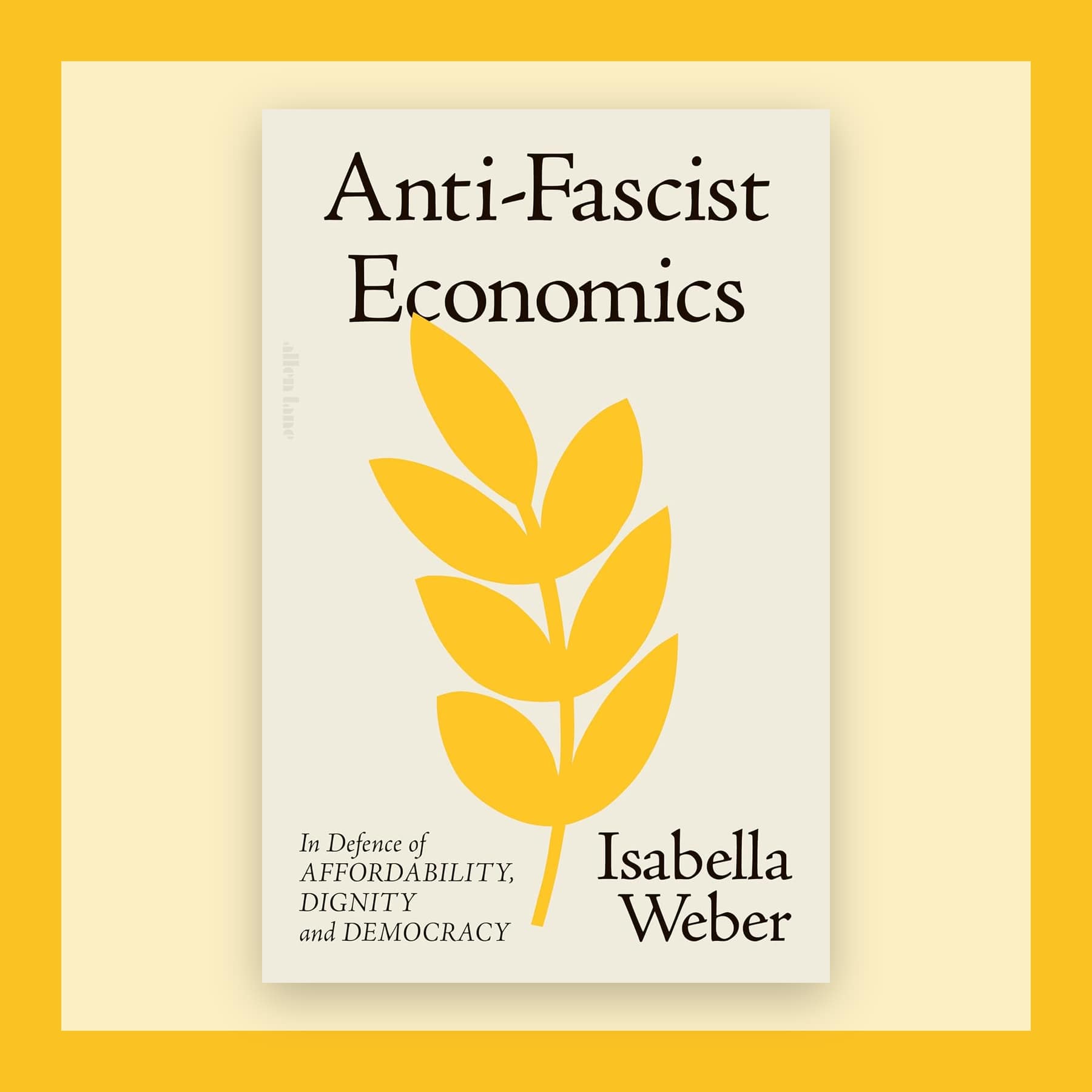
Anti-Fascist Economics by Isabella Weber
Last updated: 19 October 2026
Anti-Fascist Economics is Isabella Weber's argument that the far right grows when people can no longer afford the basics. To protect democracy, she says, governments should keep food, energy and housing affordable. Weber is the German economist who argued for price controls during the 2021 inflation and was mocked for it. A year later, Germany's gas price brake grew out of a proposal of hers. Allen Lane published the 400-page hardback on 20 October 2026 at £25. Amazon UK has it for £19.30 and Bookshop.org for £23.75.
Buy from Amazon, £19.30Buy from Bookshop.org, £23.75
The Amazon and Bookshop.org links on this page are affiliate links, which are paid links. If you buy through one, I earn a commission at no extra cost to you.
What Anti-Fascist Economics argues
Weber starts from the post-war promise of "never again". After 1945, governments in Europe and the US treated secure jobs and affordable essentials as a defence against fascism. Her case is that this ambition was dropped, and that markets were put ahead of what voters chose.
In her account, the cost of living crisis, weaker democratic institutions and the rise of the far right are connected. When the price of food, heating and rent can wreck a household, people stop trusting the parties that let it happen. So she argues that keeping essentials affordable is a political job as well as an economic one.
The second half sets out what she would do instead. Governments would secure affordable essentials, guarantee dignified work and build economies that can cope with climate change, new technology and conflict between countries. The publisher's page at Penguin has the full description.
Who Isabella Weber is
Weber was born in Nuremberg in 1987 and is an associate professor of economics at the University of Massachusetts Amherst. Her first book was How China Escaped Shock Therapy. It looks at how China moved to a market economy step by step rather than overnight. It won the Joan Robinson Prize from the European Association for Evolutionary Political Economy.
In December 2021 she wrote a Guardian article, "Could strategic price controls help fight inflation?". In it she argued that targeted limits on prices could slow inflation without costing jobs. The reaction from other economists was fierce, and Paul Krugman called the idea "truly stupid", then apologised for his tone.
In 2022 she sat on the German government's gas price commission. The Berggruen Institute describes the gas price brake Germany adopted that winter as a proposal she first put forward. She also writes about "sellers' inflation", where firms with market power use a crisis to raise prices. Her answer includes windfall taxes on the profits that follow. We cover the UK version of that debate in our post on an energy profits cap.
After the US election in November 2024 she posted: "Can we now finally have a serious conversation about an anti-fascist economics?" The book is her full answer to that question, and her own site lists the UK, US and German editions.
What other economists say about it
The publisher's page carries 10 endorsements, all of them supportive. James K. Galbraith writes: "There has been nothing quite so clear, on-point, and powerful for at least a generation." Mariana Mazzucato calls it "a well-written and necessary book for anyone who believes the economy must deliver for the benefit of all." The philosopher Lea Ypi describes it as "forward-looking, and, strangely, hopeful."
The economics writer Noah Smith is one of her critics. He argues that the evidence for sellers' inflation is weaker than her supporters claim, and that Germany's gas price brake worked as a subsidy rather than a price control. He set out that case in "Price controls: Too early for a victory lap". Reading him alongside the book gives you both sides of the argument.
Key facts
- Title: Anti-Fascist Economics: In Defence of Affordability, Dignity and Democracy
- Author: Isabella Weber
- Publisher: Allen Lane, an imprint of Penguin
- Published: 20 October 2026
- Format: hardback, 400 pages, also as an ebook and an audiobook
- Size: 242 x 164mm, about the size of a standard hardback novel
- Weight: 620g, a little more than a full 500ml bottle of water
- Price: £25 list price
- ISBN: 9780241796757
Who the book suits as a gift
It suits anyone who follows the cost of living debate and wants an argument rather than a news summary. It also works for economics and politics students, because the book draws on history and on Weber's own part in the recent inflation debates. If the person you are buying for enjoyed Yanis Varoufakis's Another Now, this is a natural next read.
Our gifts for bookworms have more ideas for people who read.
The limits of the book
The book is a political argument from one side of a live debate. A reader who wants a neutral textbook on inflation will not get one. The title will also put some readers off before they open it. That matters if you are buying it for someone whose politics you do not know.
At 400 pages it is a long read for a policy book. The ebook (£13.99 on Kindle) is the cheaper way in, and Amazon lists the audiobook at £8.99. There is no paperback yet, so the hardback is the only print edition for now.
Where to buy Anti-Fascist Economics in the UK
Amazon UK sells and ships the hardback itself for £19.30. Bookshop.org has it for £23.75 and passes most of its profit to independent bookshops.
Buy from AmazonBuy from Bookshop.org
I checked the prices at Amazon and Bookshop.org on 19 October 2026.
FAQs
What is Anti-Fascist Economics about?
Isabella Weber argues that the rise of the far right is linked to an economy where people cannot afford the basics. She sets out a plan built on affordable essentials, dignified work and economies that can withstand shocks.
How much does Anti-Fascist Economics cost in the UK?
The list price of the hardback is £25. On 19 October 2026 Amazon UK had it for £19.30 and Bookshop.org for £23.75, and the Kindle ebook was £13.99.
When was Anti-Fascist Economics published?
Allen Lane published it in the UK on 20 October 2026, the same day as the US edition. The German edition came out a week earlier, on 13 October.
Who is Isabella Weber?
She is a German economist and an associate professor at the University of Massachusetts Amherst. She is known for her work on inflation and price controls, and for proposing the idea behind Germany's 2022 gas price brake.
Is there a paperback?
Not yet. The hardback is the only UK print edition, alongside the ebook and the audiobook.
More from CoolCuration
- Making Art During Fascism: Beth Pickens's short zine on keeping a creative practice going in hard political times.
- The Future in Our Past: our Book of the Month on the nine days of the 1926 General Strike.
- Energy price cap October 2026: what the latest rise adds to a typical bill.
- Subprime Attention Crisis: Tim Hwang on the online advertising bubble.
- Gifts for students: presents that help on a student budget.







Follow us: Instagram
Copyright 2026 CoolCuration | Privacy Policy | Cookie Policy | Affiliate Disclosure | Cool Factor
-----------
We are proud supporters of a safer more private internet via encouraging people to use Brave browser and are actively taking on Spammers as part of ProjectHoneypot. This site is hosted on servers that run on 100% renewable energy in the UK thanks to GreenWebHosting.
This site contains affiliate links, including to Amazon.com and Amazon.co.uk. We may earn a commission if you make a purchase or sign up for a service via these links, at no extra cost to you. All offers and promotions are accurate at the time of publication but are subject to change or withdrawal by the businesses featured. We cannot guarantee their continued availability. Read our full affiliate disclosure.
Reviews and opinions on CoolCuration reflect the personal experience of our writers at the time of publication. They are not professional endorsements and your experience may differ. Scores use our Cool Factor rating system and are given independently of any commercial relationship.
All content on CoolCuration is provided for informational and entertainment purposes only. It does not constitute financial advice, investment recommendations or an endorsement of any product or service. We are not authorised by the Financial Conduct Authority and do not offer personalised financial guidance. You should always do your own research or consult a qualified financial advisor before making any financial decisions.