
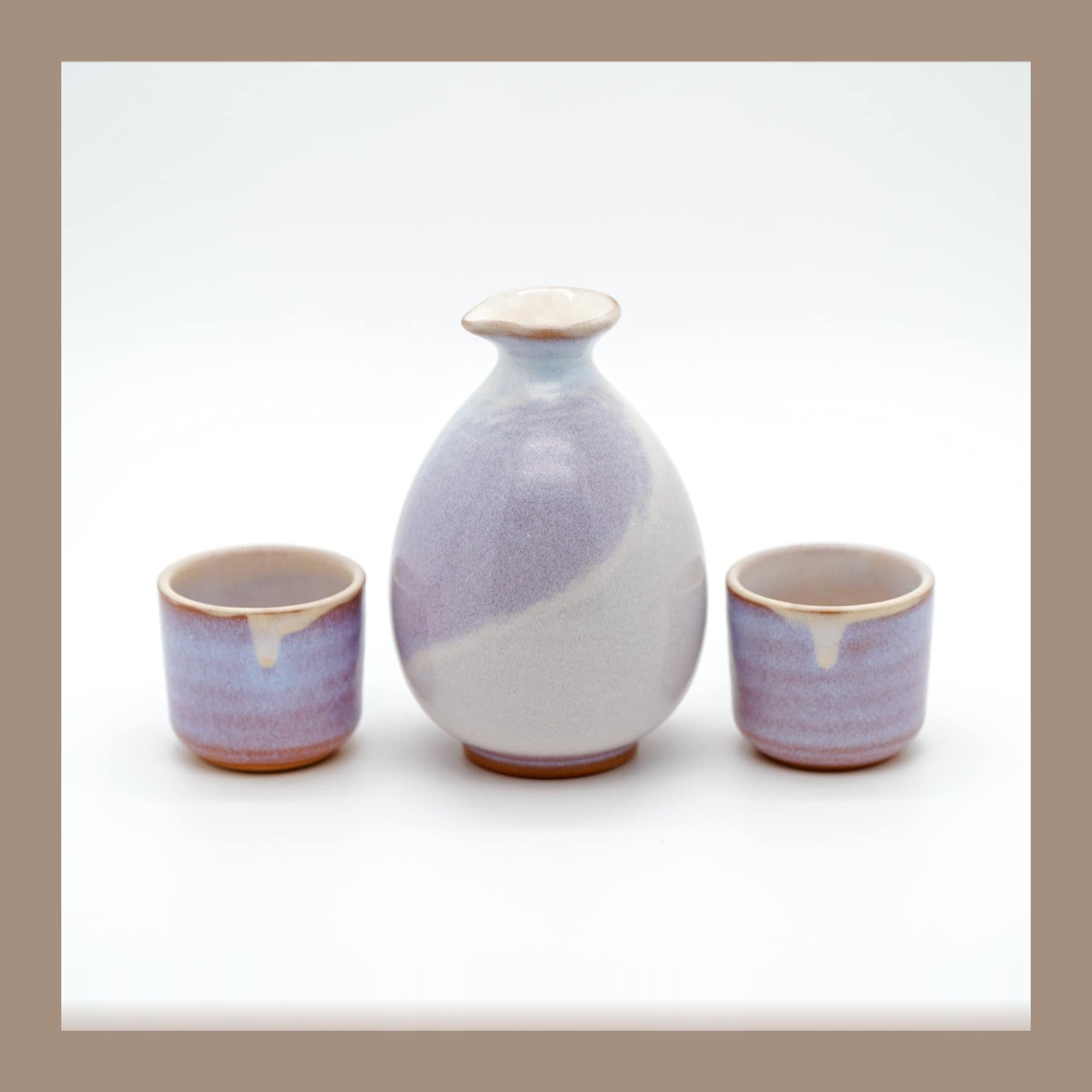
Hagi Ware Sake Set, Tsubakishu Kiln
Last updated: 18 October 2026
The Hagi ware sake set from Tsubakishu Kiln is a carafe and two cups in a lavender-to-cream drip glaze, made in Hagi City in Yamaguchi Prefecture. Hagi pottery is prized for something it does after you buy it: the glaze carries a fine crackle that sake gradually works into, so the colour shifts over years of use and no two cups age the same way. Potters call it nanabake, the seven changes. It is £32 at Iromizu, supplied in a gift box, with a 300ml carafe and two 70ml cups. Price checked on 6 September 2026.
The seven changes
Hagi ware is fired at a relatively low temperature with a soft, thick glaze over a coarse open-bodied clay. As the pot cools, the glaze and the clay contract at different rates, and the glaze crazes into a network of fine cracks. Potters call that crackle kannyu.
Those cracks are open. Over months and years of use, tea or sake seeps in and stains the glaze from underneath. The surface darkens and warms, and the crackle shows as a web of fine lines. Potters call the change nanabake, the seven changes, and it is why people who care about Japanese ceramics rate Hagi so highly.
Two things follow. A Hagi cup is not finished when you buy it, because the person who drinks from it is the one who finishes it. And after a year it will not look like the photograph, which is the intention rather than a defect.
Where it comes from
The craft began in Hagi during the Keicho era, roughly 1596 to 1615. Two Korean potter brothers, Ri Shakko and Ri Kei, established a kiln there as the official kiln of the Mori domain, making tea ware in the Korai style. Hagi has been a tea-ceramics town ever since.
Tea practitioners rank the wares in a saying, ichi Raku, ni Hagi, san Karatsu: first Raku, second Hagi, third Karatsu. Being placed second only to Raku, the ware made for the tea ceremony itself, is about as high a standing as a Japanese pottery tradition holds.
This set comes from the Tsubakishu Kiln at Hagi Toen, in Hagi City, Yamaguchi Prefecture, on the Sea of Japan coast of Honshu.
What you get for £32
| Detail | Figure |
|---|---|
| Product | Hagi ware sake set, carafe and two cups |
| Price | £32.00 at Iromizu, in stock on 6 September 2026 |
| Maker | Tsubakishu Kiln, Hagi Toen, Hagi City, Yamaguchi Prefecture |
| Carafe | Tokkuri, approx. 8cm diameter x 12cm high, 300ml |
| Cups | Two, approx. 5.5cm diameter x 5cm high, 70ml each |
| Glaze | Soft lavender fading to cream, drip finish, with kannyu crackle |
| Presentation | Gift box |
| Tradition dates from | Keicho era, 1596 to 1615 |
Thirty-two pounds for three hand-finished pieces from a named kiln is unusually good value, and the reason is that Hagi is a working regional pottery rather than a luxury export. The glaze runs differently on every piece, so the lavender falls across the cream in a different place on each cup.
Three pieces, not one
A lot of what gets sold as a sake gift is a single cup in a box. This is a service: a tokkuri to pour from and two cups to pour into, which is how sake is actually drunk, because in Japan you fill the other person's cup and they fill yours.
That makes it a natural wedding or anniversary present, since it is explicitly a set for two people rather than an object for one. It also makes it a better housewarming gift than a single cup, for the same reason.
Using it, and looking after it
Sake is served cold, at room temperature or warmed, and a ceramic tokkuri handles all three. To warm it, stand the filled carafe in hot water rather than putting it near direct heat.
Wash by hand and let it dry fully before putting it away, because the open clay body holds moisture. A pot put away damp can develop a smell over time, and that is the one genuine maintenance point with Hagi ware. Rinse after use, dry properly, and the seven changes take care of themselves.
Do not scrub the crackle. The staining is the feature you paid for.
Hagi ware sake set FAQs
What is Hagi ware?
A Japanese pottery tradition from Hagi in Yamaguchi Prefecture, dating to the Keicho era, 1596 to 1615, and made for the tea ceremony. It is known for a soft crackled glaze over an open clay body.
What is nanabake?
The seven changes. It describes the way tea or sake works into the fine crackle in the glaze over years of use, shifting the colour and character of the pot so that a well-used piece looks quite different from a new one.
How much is the set and what is in it?
£32 at Iromizu for a 300ml carafe and two 70ml cups, in a gift box.
Is the crackle a fault?
No. It is created deliberately by the difference in how the glaze and the clay contract as they cool, and it is what allows the pot to change with use. A Hagi pot without crackle would be the odd one.
Can you put it in the dishwasher?
Hand wash, and dry it thoroughly before storing. The clay body is porous and holds moisture, so a piece put away damp can develop a smell.
Can you warm sake in the carafe?
Yes, by standing the filled tokkuri in hot water. Avoid direct heat, which is hard on any low-fired ceramic.
Will my set look like the photograph?
Broadly, but the glaze is applied as a drip and runs differently on every piece, so the line where the lavender meets the cream falls in a different place each time.
More from CoolCuration
- Gifts for Japan lovers: the full guide, past the obvious souvenirs.
- Wabi-Sabi: the book that explains why a crackled glaze counts as beauty rather than damage.
- Gifts for homebodies: presents for people whose best evenings happen indoors.
- Sentia Cask: something else to pour, for anyone drinking less.
- Non-alcoholic drinks compared: what to pour on the nights you would rather not drink.
Prices and stock change. Everything here was checked on 6 September 2026 against Iromizu's own product page, which is also the source for the kiln, the dimensions and the account of the Keicho-era founding.




Follow us: Instagram
Copyright 2026 CoolCuration | Privacy Policy | Cookie Policy | Affiliate Disclosure | Cool Factor
-----------
We are proud supporters of a safer more private internet via encouraging people to use Brave browser and are actively taking on Spammers as part of ProjectHoneypot. This site is hosted on servers that run on 100% renewable energy in the UK thanks to GreenWebHosting.
This site contains affiliate links, including to Amazon.com and Amazon.co.uk. We may earn a commission if you make a purchase or sign up for a service via these links, at no extra cost to you. All offers and promotions are accurate at the time of publication but are subject to change or withdrawal by the businesses featured. We cannot guarantee their continued availability. Read our full affiliate disclosure.
Reviews and opinions on CoolCuration reflect the personal experience of our writers at the time of publication. They are not professional endorsements and your experience may differ. Scores use our Cool Factor rating system and are given independently of any commercial relationship.
All content on CoolCuration is provided for informational and entertainment purposes only. It does not constitute financial advice, investment recommendations or an endorsement of any product or service. We are not authorised by the Financial Conduct Authority and do not offer personalised financial guidance. You should always do your own research or consult a qualified financial advisor before making any financial decisions.