
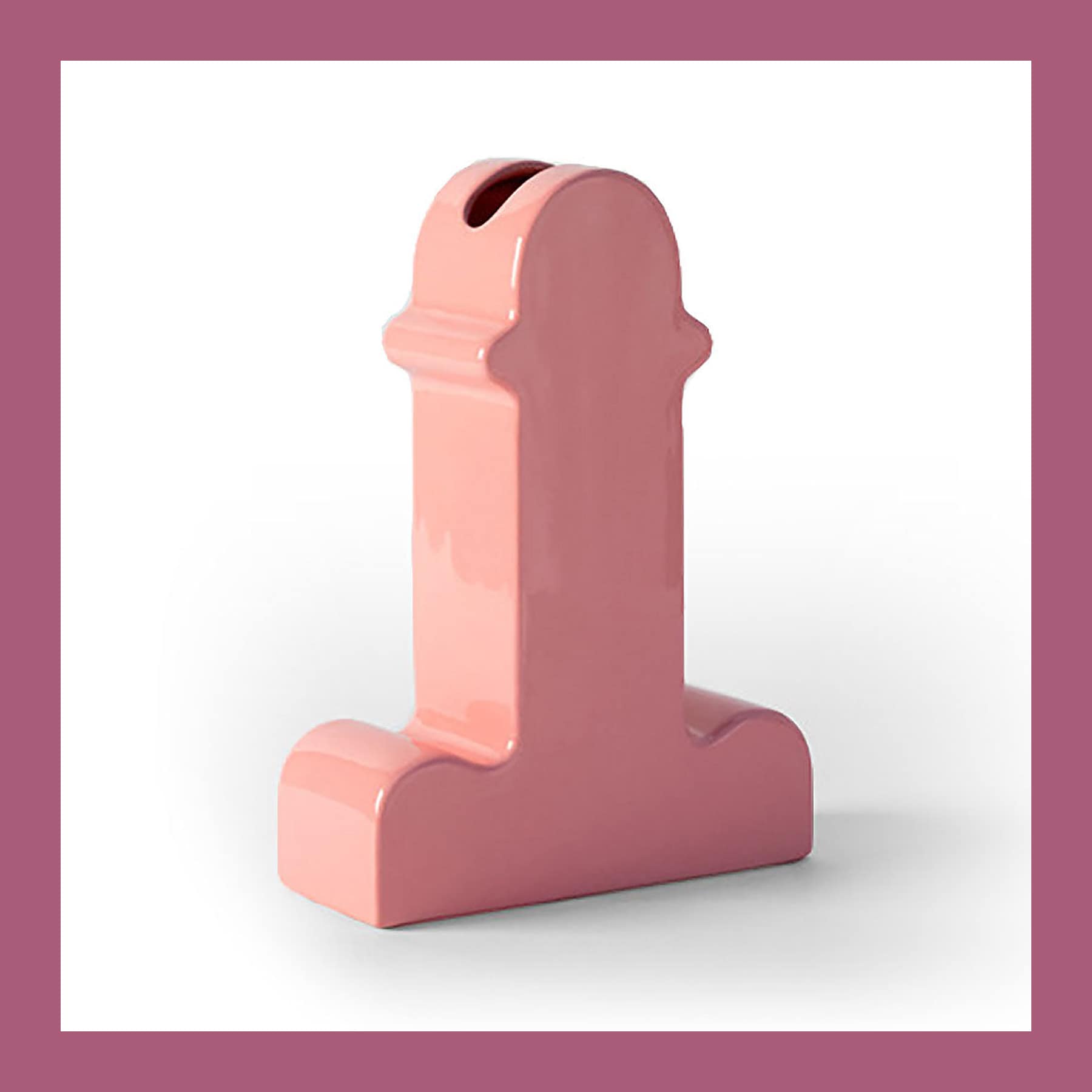
Sottsass Shiva Flower Vase
Last updated: 12 October 2026
The Sottsass Shiva vase is a 23cm column of pink glazed ceramic, and its shape is a phallus. Ettore Sottsass drew it in 1971 and it has been in production since 1973. MoMA, the Metropolitan Museum of Art and the Art Institute of Chicago each hold one. Aram in Covent Garden sells the pink ceramic version for £237, in stock and delivered within seven days. I checked the price and stock on Aram on 12 October 2026.
What the Sottsass Shiva vase is
It is a flattened column of pink glazed ceramic, 23cm tall. Across its widest point it measures 17cm, and it is only 7cm front to back. The glaze is a hot pink rather than a pastel one. The form is a phallus. BD Barcelona's own product page says the body references the phallic lingam, the form through which the Hindu god Shiva was often represented.
So the shape is not a rude reading the object picked up later. It was the design from the start. After he finished the Shiva, Sottsass wrote that he kept making "small, small, small architectures". He described them as "a little like monuments, a little like tombs, a little like the abandoned temples of the gods". BD Barcelona now calls the Shiva "a symbol of Ettore Sottsass and an icon".
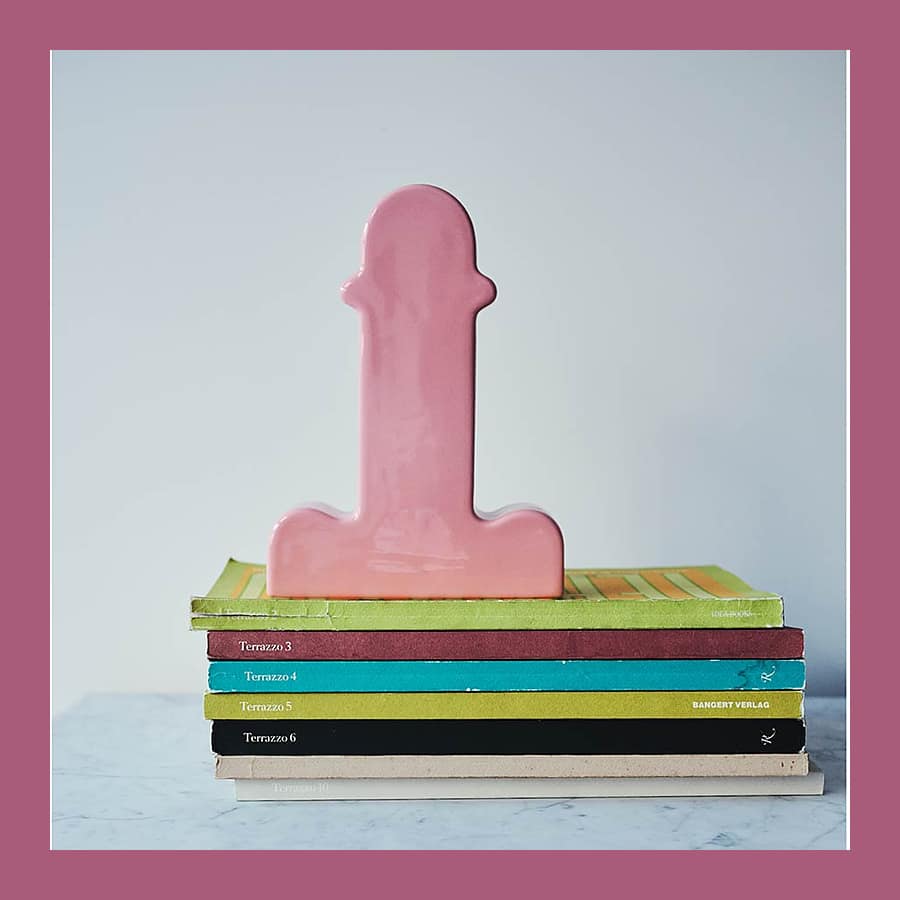 The vase is 23cm tall, which is about the depth of the book stack under it. Photograph: Aram.
Product photos rarely show the scale, because nothing in the frame gives you a reference. At 23cm it stands about as tall as a hardback set on its end. At 7cm deep it is narrower than a mug.
Sottsass made it to be looked at rather than filled, which is why the proportions read as sculpture first. If you are expecting a floor vase, the box will be much smaller than you think.
Ettore Sottsass, and what he was arguing against
Sottsass was born in Innsbruck in 1917 and died in Milan in 2007. From 1958 he spent nearly thirty years consulting for Olivetti's electronics division. There he cased the Elea 9003, Italy's first electronic computer, and won the 1959 Compasso d'Oro for it. In 1969 came the bright red plastic Valentine typewriter, which he called "a biro among typewriters".
The Shiva comes from a different idea, which Sottsass repeated in different words all his life. "When I was young, all we ever heard about was functionalism, functionalism, functionalism," he said. "It's not enough. Design should also be sensual and exciting."
The Shiva puts that idea into ceramic: it holds a single stem, and its shape matters more to it than the flowers. In 1980 Sottsass went on to form Memphis in Milan. It put bright colour, plastic laminate and suburban kitsch in front of the design press. That collective is what made him famous outside Italy.
Where the form comes from
Sottsass travelled in India through the 1960s, first in 1961. What he found there ran through the rest of his work.
The vase takes its name and its shape from the lingam. The lingam is the aniconic form through which Shiva is worshipped in Hindu practice. It is a devotional object, found in temples and shrines across India, and it has been for many centuries. Sottsass did not invent the resemblance. He made a run of ceramics out of what he had seen. One is a set of plates from 1964 titled Offerta a Shiva, and the M+ collection in Hong Kong holds one of them.
The Metropolitan Museum of Art holds a Shiva vase. It describes his method as "adopting, but at the same time subverting, traditional forms". It also says he chose the hot pink to echo the bright colours of Indian clothing and architecture. A sacred object would not usually take that colour.
BD Barcelona, and why a 1971 design is still made
BD Barcelona started in 1972, and by the company's own account it started in a nightclub. Young Barcelona architects and designers wanted to make their own work, and their friends' work, on their own terms. Sottsass was in that first catalogue, alongside Charles Rennie Mackintosh and Álvaro Siza.
The Shiva is not a reproduction from a firm that bought the rights decades later. BD Barcelona is the same company, now under collective ownership, with founder Oscar Tusquets still involved. BD also sells a separate blue Capsule Global edition, limited to 999 pieces. The pink one is the standard production piece. So it carries no edition number, no signature and no certificate.
| Detail | Figure |
|---|---|
| Product | Shiva Flower Vase, pink ceramic |
| Designer | Ettore Sottsass, 1917 to 2007 |
| Designed | 1971, per BD Barcelona. Original production from 1973, per Aram |
| Manufacturer | BD Barcelona Design |
| Material | Pink glazed ceramic. MoMA and the Art Institute record theirs as glazed earthenware |
| Size | 17 x 7 x 23cm |
| Price | £237.00 including VAT, in stock on 5 September 2026 |
| Sold by | Aram, 110 Drury Lane, Covent Garden, London WC2B 5SG |
| Delivery | Available stock usually within 7 days |
| Edition | Standard production piece, not a limited edition |
| In collections | MoMA 167.2012, the Met 2017.204, the Art Institute of Chicago |
Size, material and what it actually holds
The 7cm depth is the number that matters. It means a single stem, or two if they are thin. It will not take a bouquet, so if you want a vase for a bunch of flowers, this is the wrong one.
BD Barcelona publishes the dimensions and the material, but no water capacity. So there is no official figure to quote. The three museum records measure their own examples between 23.8cm and 24.1cm tall. Glazed ceramic shrinks a little in the kiln, so small differences are normal.
It chips like any glazed ceramic. On an object this size a chipped edge shows from across the room. If you want to grow something, our page on the Acorn Vase covers a far cheaper piece of glass. That one is built to hold a plant.
What it costs and where to buy it
£237 including VAT, from Aram. A carton-sized item like this falls into Aram's £4.50 to £15 delivery band. Furniture sits in the £75 band instead.
The £237 buys a licensed production of a documented design, rather than a lookalike. BD Barcelona has made it since the 1970s. I struggled to find another UK retailer that lists the piece, so Aram looks like the only option for now.
Aram has its own design history. Zeev Aram opened the shop in 1964 to bring modern design to Britain. It introduced Marcel Breuer, Achille Castiglioni, Shiro Kuramata and Eileen Gray to British buyers. Aram still holds the worldwide licence for Gray's designs. It stocks Cassina, Vitra, Flos, Carl Hansen & Son, USM and Artemide across four floors on Drury Lane. It is still family run.
Returns run to 14 calendar days, unused and in the original packaging, with the buyer paying return postage. Damage has to be reported within three days, by phone on 020 7557 7557. Signing up to Aram's newsletter takes 15% off, so sign up before you check out.
Buy the Shiva Flower Vase at Aram, £237
Dust, chips and a phallus on the shelf
Pink shows dust, and a glazed curve shows it more than a flat surface does. Ceramic chips, and this shape puts a rounded top and a narrow foot in the firing line. And it is a phallus on a shelf. Not everyone wants that in the room where they have people round.
So decide where it goes before it arrives. Think harder than usual about who you are giving it to. A leaving present for a colleague is the wrong occasion. Someone who already owns design books is the right one.
People buy Philippe Starck's Juicy Salif for the design rather than the juicing. It is better known as a talking point than as a lemon squeezer. The Shiva sits in the same category. If the Juicy Salif would sit happily on your worktop, this will sit happily on your shelf.
Sottsass Shiva vase FAQs
What is the Sottsass Shiva vase?
It is a 23cm vase in pink glazed ceramic, shaped as a phallus. Ettore Sottsass designed it and BD Barcelona Design makes it. The shape references the lingam, the form through which the Hindu god Shiva is worshipped. Sottsass encountered it on his travels in India.
Who designed it and when?
Ettore Sottsass, the Italian designer who founded Memphis. BD Barcelona dates the design to 1971 and Aram says original production began in 1973. MoMA, the Met and the Art Institute of Chicago all date their examples 1973.
How big is the Shiva vase?
17 x 7 x 23cm. So it is about the height of a hardback stood on its end, and narrower than a mug. The 7cm depth is the figure people misjudge, because product photographs give no sense of scale.
What is it made of?
Pink glazed ceramic, per BD Barcelona. Both MoMA and the Art Institute of Chicago record their examples as glazed earthenware.
Is the Shiva vase a limited edition?
No. The pink ceramic version is a standard production piece with no edition number, signature or certificate. BD Barcelona separately sells a blue Capsule Global edition limited to 999. The Capsule edition is a different product at a different price.
Where can you buy the Sottsass Shiva vase in the UK?
Aram, at 110 Drury Lane in Covent Garden, sells it for £237 and also ships. I struggled to find another UK retailer that lists it, so there is no price comparison to make.
Why does it cost £237?
Because it is a licensed production of a documented design, not a copy of the shape. The firm that makes it has made it since the 1970s. Ceramic production at this scale is also small-batch work rather than mass manufacture.
Is it an original or a reissue?
Neither word quite fits. It has never gone out of production. A Shiva bought today comes from the same maker as one bought in 1975. It is not a vintage piece and it is not a reissue by a different company.
More from CoolCuration
- Gifts for designers: the full guide, for anyone who buys objects for the thinking behind them.
- Woody and Spud ceramic dogs: hand-painted studio ceramics, at a fraction of the price.
- The Woody and Spud dogs at Charleston: how studio ceramics reached a Bloomsbury farmhouse.
- Nooka: Designing Time: our review of the monograph, for the same shelf and the same reader.
- New home gifts: presents for a place somebody has just moved into, priced from small to serious.
Prices, stock and delivery terms change. I checked the price and stock on 12 October 2026. The figures come from Aram's own product page and BD Barcelona's record for the Shiva. The collection records are at MoMA, the Metropolitan Museum of Art and the Art Institute of Chicago.





Follow us: Instagram
Copyright 2026 CoolCuration | Privacy Policy | Cookie Policy | Affiliate Disclosure | Cool Factor
-----------
We are proud supporters of a safer more private internet via encouraging people to use Brave browser and are actively taking on Spammers as part of ProjectHoneypot. This site is hosted on servers that run on 100% renewable energy in the UK thanks to GreenWebHosting.
This site contains affiliate links, including to Amazon.com and Amazon.co.uk. We may earn a commission if you make a purchase or sign up for a service via these links, at no extra cost to you. All offers and promotions are accurate at the time of publication but are subject to change or withdrawal by the businesses featured. We cannot guarantee their continued availability. Read our full affiliate disclosure.
Reviews and opinions on CoolCuration reflect the personal experience of our writers at the time of publication. They are not professional endorsements and your experience may differ. Scores use our Cool Factor rating system and are given independently of any commercial relationship.
All content on CoolCuration is provided for informational and entertainment purposes only. It does not constitute financial advice, investment recommendations or an endorsement of any product or service. We are not authorised by the Financial Conduct Authority and do not offer personalised financial guidance. You should always do your own research or consult a qualified financial advisor before making any financial decisions.