
Last updated: 22 March 2026
By Tristan · Arts, exhibitions and creative culture
This is an opinion piece. Views expressed are the author's own and do not constitute professional advice.
This article contains affiliate or referral links. If you click through and sign up I may earn a commission or referral bonus at no extra cost to you. It does not affect my editorial view.
Cool Factor: 4/5 - Stone cold
This Nooka Designing Time review breaks down Matthew Waldman's 200-page design monograph and gives our honest verdict. Part manifesto, part visual archive, Designing Time tells the full story of NOOKA, the futurist brand that dared to reimagine how we see time. We read it cover to cover. Here's what we thought.
What is Designing Time?
Designing Time: How NOOKA Changed The Way We Saw the Future is a 200-page retrospective of Matthew Waldman's cult design brand, NOOKA. Produced by Tokyo-based design lab SAN-Q LLC and printed in Japan on eco-friendly paper and ink, the book traces the brand from its origins in the late 1990s through to its lasting cultural influence on fashion and product design in the 2000s.
It features an introduction by Paola Antonelli, Senior Curator of Architecture and Design at the Museum of Modern Art in New York. Across its A4-sized pages, you'll find original sketches, renders, product photography, packaging concepts, and process images of unrealised projects. It was originally Kickstarter-funded in late 2022, with the first print run selling out. A second hardcover edition followed in late 2024.
First impressions
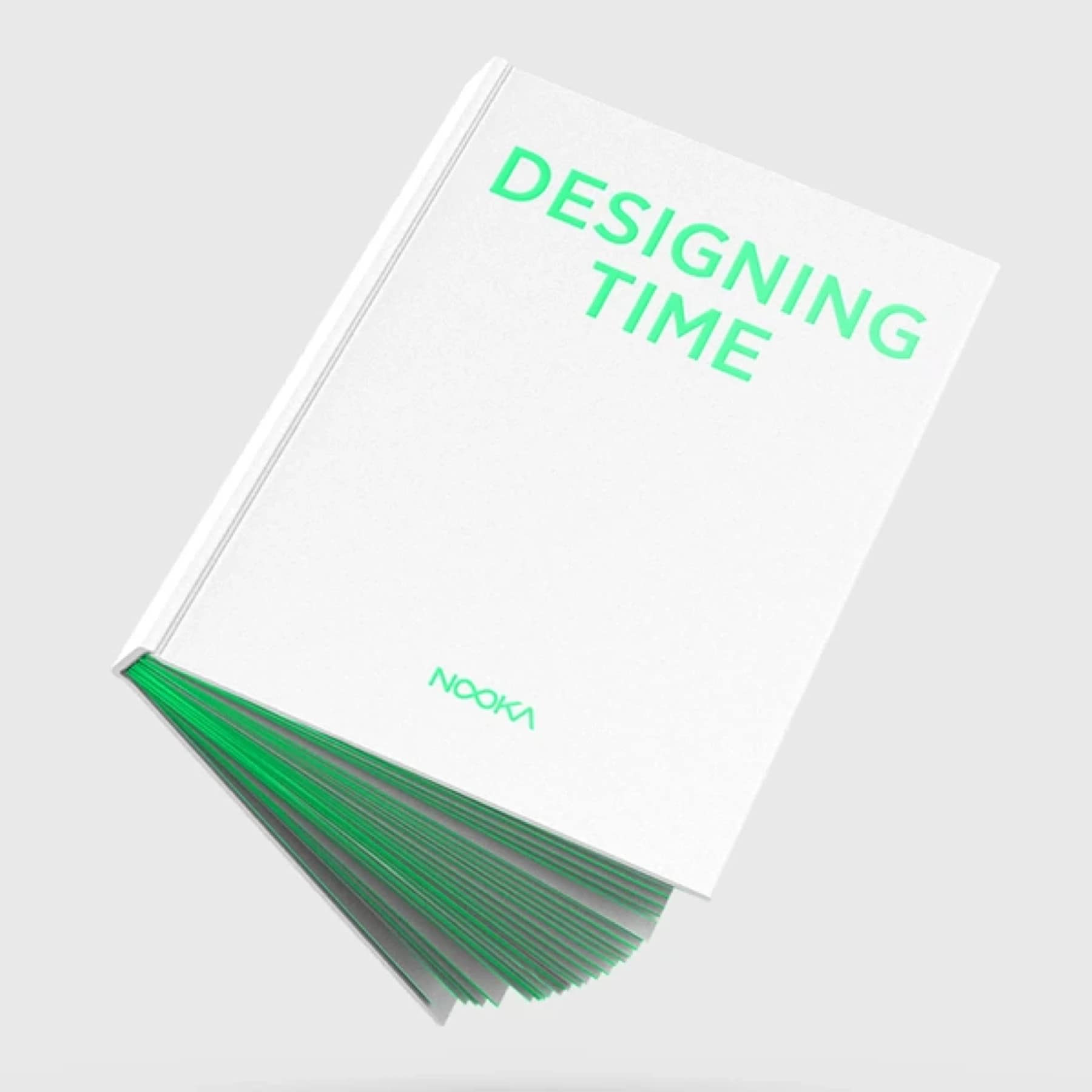
The book looks and feels premium. Bold, rounded typography on the cover immediately signals you're not in standard-coffee-table-book territory. Picking it up, it has real weight to it and the print quality is excellent throughout. The layout mixes full-bleed imagery with tighter editorial spreads, and it works. It feels considered rather than slapped together, which is exactly what you'd hope for from a brand built on visual precision.
If you're not familiar with NOOKA, the short version: Waldman founded the brand in the late 1990s and partnered with Seiko to produce timepieces that used grids, bars, and abstract shapes instead of traditional clock hands. NOOKA Inc. launched in 2004 at the MoMA design stores in both New York and Tokyo, and the brand eventually expanded into accessories, sunglasses, belts, and even fragrance. There were collaborations with FILA, Hello Kitty, and Fear of God along the way. All of that context is laid out early in the book, and it's genuinely fascinating even if you've never owned a NOOKA product.
The detail: design as philosophy
The real strength of this Nooka Designing Time review subject is its willingness to go beyond product photography. Waldman doesn't just show you the watches. He walks you through the thinking behind them, questioning why time has to look the way it traditionally does and proposing alternatives rooted in emotion, semiotics, and interface design. It's part visual essay, part brand manifesto.
There's a genuinely brilliant section on unrealised prototypes and discarded concepts. This kind of transparency is rare in brand retrospectives and makes the book far more useful for anyone interested in the realities of creative development. You see the failures alongside the successes, which gives you a much richer understanding of how the final products came to exist.
Waldman's own writing is scattered throughout: essays, interview extracts, and personal reflections on branding, user experience, and the limitations of mainstream design. He's a confident voice, occasionally bordering on self-mythologising, but it's largely backed up by original thinking. For designers, UX practitioners, or anyone curious about the intersection of philosophy and product, these passages are well worth your time.
Waldman is now a professor at Keio University's Graduate School of Media Design in Tokyo, focused on circular design and biodesign. That forward-looking sensibility runs through the whole book.
Value for money
At 200+ pages of high-quality printing, this sits in fair territory for a specialist design monograph. It's not cheap, but it's not overpriced either compared to similar titles from established publishers. The second-edition hardcover is the one to go for if it's still available. You can check the latest pricing and availability on the official NOOKA book page.
If you're buying for someone else, it's a properly impressive gift for design-minded friends. Head to our Nooka Designing Time detail page for the full overview, buying options, and key features, or check out the gift guide for designers for more ideas in the same vein.
Room for improvement
No Nooka Designing Time review would be complete without flagging the rough edges. The book's structure can feel fragmented. It jumps between product stories, brand philosophy, and visual content without always signposting where you are. Depending on your tolerance for that sort of thing, it's either charmingly scrapbook-like or a bit disorienting.
It's also heavily centred on Waldman's own perspective. There's very little external commentary, whether from critics, collaborators, or customers. A few outside voices would have given the narrative more depth and credibility, and stopped it from feeling quite so insular at times.
The verdict
Cool Factor
★★★★☆
4 out of 5
Designing Time is a bold, visually rich design monograph that does something most brand retrospectives don't bother attempting: it makes you think differently. The combination of honest process documentation, philosophical ambition, and genuinely striking imagery sets it apart from the usual coffee-table filler.
Overall, a solid 4/5 Stone cold. Designing Time earned its score through genuinely original thinking, the rare transparency of showing failed prototypes alongside finished products, and the sheer quality of its print production. It didn't quite reach Ice cold because the structure wanders in places, and the almost entirely Waldman-centric perspective left us wanting a few more critical outside voices. If you're into design that challenges convention rather than just cataloguing it, this one deserves a place on your shelf.
Get Designing Time - full details and buying optionsFrequently asked questions
Is Nooka Designing Time worth buying?
If you're into product design, UX, or brand strategy, yes. It goes well beyond a simple catalogue and offers real insight into the creative process. It's also a strong coffee table book in its own right. For casual readers with no particular interest in design, it may feel niche.
How many pages is Designing Time?
The book runs to over 200 pages, printed in A4 format on eco-friendly paper in Japan. The second-edition hardcover is the most widely available version.
Who wrote the introduction to Designing Time?
The introduction is by Paola Antonelli, Senior Curator of Architecture and Design at the Museum of Modern Art (MoMA) in New York City.
Where can I buy Nooka Designing Time in the UK?
Check our Nooka Designing Time detail page for the latest buying options and links. The book is sold through the official NOOKA website, and availability varies. The second-edition hardcover is the version to look for. UK shipping may apply.
Is Designing Time just about watches?
No. While NOOKA's timepieces are central, the book also covers the brand's accessories, packaging, sunglasses, collaborations, and broader design philosophy. There's a strong emphasis on semiotics, branding, and interface design thinking that goes well beyond horology.
How does Designing Time compare to other design books?
It sits somewhere between a traditional brand monograph and a design manifesto. Compared to more clinical retrospectives, it's messier and more personal, which is both its charm and its weakness. Books like Rick Rubin's The Creative Act share a similar philosophical ambition, though Waldman's is far more visually driven.
More from CoolCuration
- Rose Wylie at the Royal Academy review - Our honest take on one of the most talked-about art exhibitions of the year.
- David Hockney London exhibition - Another major show worth your time if you love bold, boundary-pushing visual art.
- Audible on CoolCuration - Prefer listening to reading? Here's how to get started with audiobooks and what Audible offers UK listeners.
- theprintspace discount code - If Designing Time inspires you to get your own work printed, this is a great place to start.
- Daylight Computer - A beautifully designed screen built for focused, distraction-free reading and working.
- The Creative Act by Rick Rubin - Another book that treats creativity as philosophy. A perfect companion read to Designing Time.
What's trending





Recent posts
- Quentin James McCaffrey at Alison Jacques Review
 Last updated: 6 October 2026 By Tristan · Arts, exhibitions and creative culture This is an opinion piece. Views expressed are the author's own and do not constitute professional advice. Cool Factor: 3/5 Quentin James McCaffrey's first UK solo show was on at Alison Jacques from 3 September to 3 October 2026. Comprising fifteen small… Read more: Quentin James McCaffrey at Alison Jacques Review
 - Premium Bonds Alternatives UK 2026: Prize Savings Accounts ComparedFour Premium Bonds alternatives open to new savers, with each provider's published odds, prize tables, access rules and protection.
- Best Audiobooks October 2026: 10 UK Listens RankedTen new audiobooks for October 2026, from a full-cast Dracula with Jonathan Bailey to Russell T Davies reading his own television memoir.


No Comments.