
Last updated: 28 June 2026
By Tristan · Arts, exhibitions and creative culture
Nine days that stopped Britain, retold for its centenary.
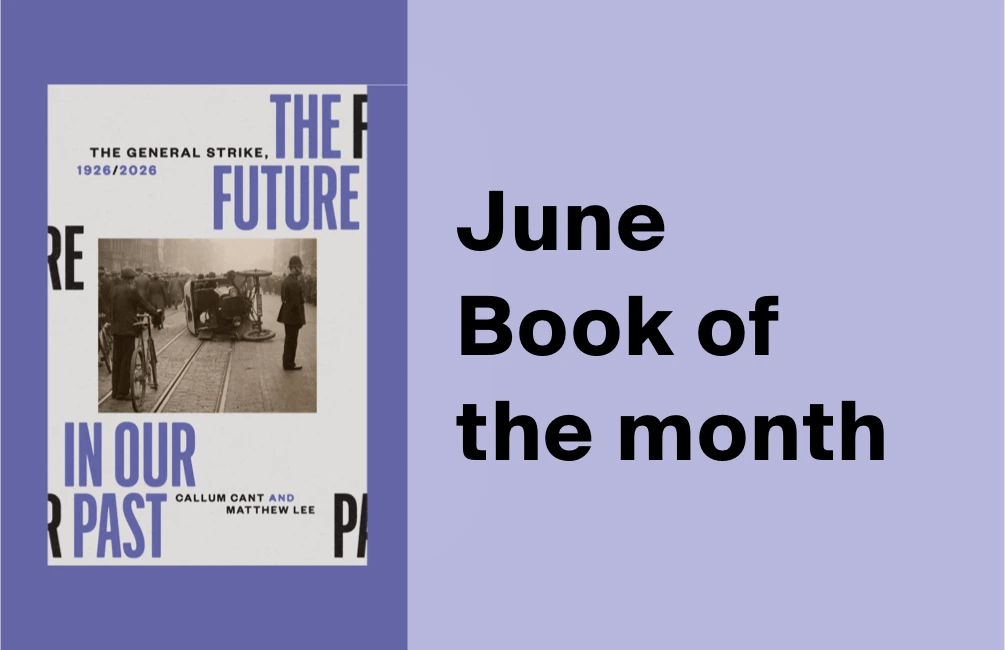
Looking for the one 1926 General Strike book to read this year? Our book of the month is The Future in Our Past by Callum Cant and Matthew Lee. It is a brisk, on-the-ground history of the nine days that brought the country to a standstill. Better still, it keeps one eye firmly on work and struggle today.
This post contains affiliate links. If you buy through them I may earn a small commission, at no extra cost to you. It does not change which books we feature.
Get the book
Out now from Verso for the centenary. You can grab a copy in seconds below.
Buy from Bookshop.org Buy on Amazon
One book a month. This was my June 2026 pick. Every edition so far, newest first, is on the Book of the Month hub.
What is The Future in Our Past?
The Future in Our Past: The General Strike, 1926/2026 is a fresh, accessible history from Verso, published on 23 June 2026. At 160 pages, it is deliberately short and punchy rather than a heavy academic doorstop. Callum Cant and Matthew Lee tell the story of the General Strike as it actually felt on the ground, then they ask what those nine days mean for us now.
Crucially, the authors do not stay stuck in the archive. Instead, they travel from the London docklands to the South Wales coalfields, and on to the railways and warehouses of middle England. As a result, the book reads as much like reportage as history. That blend is exactly why it is our pick this month.
The nine days that stopped Britain
First, a quick refresher for anyone hazy on the events of 1926. The Trades Union Congress called the strike from one minute to midnight on 3 May 1926, in solidarity with more than a million miners. Those miners had been locked out for refusing lower pay and longer hours. Over the following days, well over 1.5 million workers walked out across transport, printing, docks, gas and heavy industry.
However, the strike lasted only nine days. The TUC called it off on 12 May 1926, largely unconditionally, while Stanley Baldwin's government held firm. The miners then stayed out for months, before hunger forced a bitter return to work. For the full timeline, the National Archives keeps an excellent record of the period.
Then and now: 1926 meets 2026
So why revisit all this on the centenary? Because Cant and Lee draw a clever line between then and now. Alongside the historical account, they report from the same communities a century later. For example, they meet a Bangladeshi courier caught up in wildcat strikes on the Isle of Dogs. Likewise, they speak to the great-grandson of a Welsh miner facing redundancy at the Port Talbot blast furnaces.
Consequently, the past never feels sealed off. Instead, the book treats 1926 as a live question about power, solidarity and who keeps the country running. Indeed, that question feels sharper today, after years of strikes by nurses, posties, train staff and warehouse workers.
"It uncovers opportunities where others have emphasised weakness. It should be widely read."
Huw Beynon, co-author of The Shadow of the Mine, on The Future in Our Past.
Who wrote it?
Importantly, both authors know this terrain well. Callum Cant wrote Riding for Deliveroo and co-wrote Feeding the Machine, and he covers strikes and the future of work for the Guardian. Moreover, he is a senior lecturer at the University of Essex and a co-editor of Notes from Below, a journal of worker writing. Matthew Lee, meanwhile, is a librarian and independent researcher, and also co-edits Notes from Below.
Because of that background, the social reportage lands with real authority. You can read more about the pair, and the book's free ebook bundle, on the Verso Books page.
Why it is our 1926 General Strike book of the month
Above all, this is the rare history that you can finish in a weekend yet still think about for weeks. The writing is clear, the pace is quick, and the then-and-now structure gives it real bite. If you have ever wondered why labour history still matters, this is a brilliant way in.
That said, let me be honest about the trade-off. At 160 pages, it cannot be the definitive academic account of 1926. So if you want exhaustive footnotes and every regional committee mapped out, you may find it slim. Personally, though, I think the brevity is a feature, not a flaw, because it pulls in readers who would never touch a 600-page tome.
If the book sparks something, there is plenty more to explore. Yanis Varoufakis fans, for instance, might enjoy our take on Another Now, another book that reimagines how society could work. Alternatively, if you would rather listen than read, our best audiobooks this June roundup has more ideas. For the full facts, prices and formats, see our Future in Our Past book page too.
The Future in Our Past
One hundred years on, the General Strike still asks who really keeps Britain moving. Settle in for nine remarkable days, then look at the work happening around you now.
Where to buy The Future in Our Past
The paperback carries a recommended price of £14.99, although several retailers already discount it to around £12. There is also a Verso ebook for a few pounds, often bundled free with the paperback when you buy direct. Buying through Bookshop.org supports independent bookshops, which feels rather fitting for a book about collective effort.
Buy from Bookshop.org Buy on Amazon
FAQs
Is The Future in Our Past worth reading?
Yes, especially if you want an accessible way into labour history. Because it pairs the 1926 story with present-day reporting, it stays gripping throughout. Furthermore, two respected historians, Huw Beynon and Ralph Darlington, have praised its fresh approach.
How long is the book, and how quickly can I read it?
It runs to roughly 160 pages, so most readers will finish it across a couple of evenings. In short, it is built for momentum rather than for slow academic study.
When was it published, and how much does it cost?
Verso published it on 23 June 2026, timed for the centenary. The paperback lists at £14.99, though you can often find it for around £12, and a low-cost ebook is available too.
How does it compare to other 1926 General Strike books?
Many classic accounts are long and academic. By contrast, this 1926 General Strike book is short, journalistic and tightly focused on community. Therefore it works well as a first read, or as a fresh angle if you already know the history.
Who are Callum Cant and Matthew Lee?
Callum Cant is a writer and academic known for Riding for Deliveroo and for his Guardian coverage of work. Matthew Lee is a librarian and researcher. Together they co-edit Notes from Below, so worker-led history is very much their specialism.
More from CoolCuration
- Bookworm gift guide: sorted ideas for the reader who already owns everything.
- Poor by Caleb Femi: estate life and community, told in poems and pictures.
- Audible free trial: listen to your next big history read on the move.
- Black British music audiobooks: more listening, more culture, more stories.
- The Creative Act by Rick Rubin: a calm, clever guide to making things.
What's trending




Recent posts
- Frieze Week Exhibitions 2026: Nine London Shows to See Beyond the Fair
 Nine London exhibitions to see during Frieze week 2026, from Cindy Sherman at Hauser & Wirth to Robert Ryman at the Barbican. Seven are free.
 - Ha Chong-Hyun at Lisson Review: Six Decades of PaintLast updated: 14 October 2026 By Tristan · Arts, exhibitions and creative culture Exhibition reviewLisson, Bell Street Six decades of paint pushed through the back of the canvas. This is an opinion piece. Views expressed are the author's own and do not constitute professional advice. Cool Factor: 4/5 I went to the private view of… Read more: Ha Chong-Hyun at Lisson Review: Six Decades of Paint
- BFI London Film Festival 2026: What’s Worth SeeingTen BFI London Film Festival 2026 films for 14 to 18 October, the four that still had seats on 13 October, the sold-out titles, ticket prices and how the standby queue works.

No Comments.