
Last updated: 21 March 2026
By Tristan · Arts, exhibitions and creative culture
This is an opinion piece. Views expressed are the author's own and do not constitute professional advice.
The William Nicholson exhibition at Pallant House Gallery in Chichester is the first major survey of this extraordinary painter in more than 20 years. Spanning his entire career, from bold graphic posters to luminous still lifes and tender portraits, it makes a compelling case for Nicholson as one of Modern British art's most underrated figures. A friend who studied at the Royal College of Art tipped us off, and they were right. This is a show that rewards close looking, and Chichester itself makes for a brilliant day out.
Cool Factor: 4/5 Stone cold
Who was William Nicholson?
William Nicholson (1872–1949) was a British painter, printmaker, illustrator and theatre designer. He illustrated the beloved children's classic The Velveteen Rabbit in 1922 and designed the original sets and costumes for the very first production of Peter Pan in 1904. He was knighted in 1936. Despite all that, he's remained frustratingly overlooked, partly because he refused to align with any art movement and partly because the towering reputation of his son, the abstract painter Ben Nicholson, cast a long shadow.
As the Art Newspaper noted, Nicholson defies easy categorisation, which is exactly why he's been unfairly dismissed as a minor artist. This exhibition at Pallant House Gallery sets the record straight.
First impressions of William Nicholson at Pallant House
The show is arranged loosely in chronological order and opens with Nicholson's graphic work, including the bold posters he made with his brother-in-law James Pryde under the brilliantly named partnership "J. & W. Beggarstaff" in the 1890s. To modern eyes, these designs for Rowntree's cocoa and Kassama cornflour might look simple, but their flat colours and emphasis on silhouette were considered radical at the time. From there you move through his celebrated An Alphabet woodcuts (1897), a series of 26 wonderfully characterful prints featuring Victorian archetypes from B for Beggar to V for Villain.
It's a smart opening. It tells you immediately that Nicholson wasn't just a painter. He was a designer, a printmaker, a storyteller. The original illustrations for The Velveteen Rabbit are here too, quietly charming in a cabinet nearby.
The still lifes are the stars
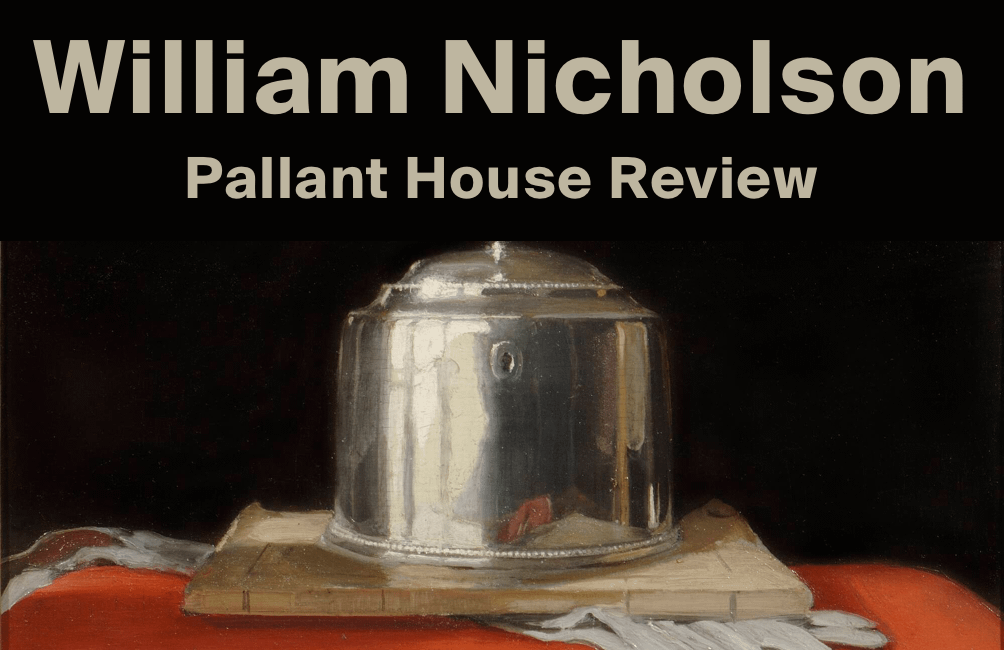
Let's cut to it. The still lifes are why most people will come to this show, and they do not disappoint. Nicholson had an almost supernatural ability to render the luminous qualities of glazed, polished and lustred surfaces. Silver gleams. Glass catches the light. Fabric folds with painterly weight. Standing in front of paintings like The Lustre Bowl with Green Peas (1911) and The Silver Casket and Red Leather Box (1920), you genuinely catch your breath. The surfaces shimmer. The brushwork is confident but never showy. These are paintings that are somehow both quiet and dazzling.
Gold Jug (1937), on loan from the Royal Collection (it's a favourite of the late Queen), is another highlight. It practically glows from the wall. Nicholson collected silverware by the 18th-century silversmith Hester Bateman, and in a lovely touch, the gallery has displayed the actual tea caddy depicted in The Silver Casket alongside the painting itself.
Then there's Miss Jekyll's Gardening Boots (1920), a painting of the famous garden designer Gertrude Jekyll's battered old boots. It's an object portrait that tells you more about its subject than any conventional likeness could. Several reviewers have compared it to Van Gogh's Shoes (1886), and the comparison holds up.
Nicholson's still lifes are often described as unrivalled in 20th-century British art, and having seen this show, it's hard to argue with that. His approach to rendering light and tone was, as Pallant House director Simon Martin has pointed out, essentially abstract. It's a direct creative thread between William's luminous everyday objects and the fully abstract work Ben Nicholson would later become famous for. Ben himself acknowledged this debt, attributing his interest in still life to his father rather than to Cubism.
The portraits and landscapes
The portraits are every bit as absorbing. Nicholson was a society painter of sorts, and his subjects included J. M. Barrie (the author of Peter Pan), the writer and caricaturist Max Beerbohm, and the actress Wish Wynne. There's a tenderness to these works that avoids the stiffness you might associate with Edwardian portraiture. A newly displayed portrait of his young son Ben at six or seven is especially moving.
Nicholson was a dandy who painted in a bow tie, yellow waistcoat, white trousers and polished patent leather shoes. That personality comes through in the work. Nancy in a Feather Hat (1910), showing his daughter in a magnificent ostrich-feather headpiece chosen from his studio dressing-up box, is full of theatrical warmth.
The landscapes, particularly scenes of the Sussex Downs and the coast around Rottingdean where he lived, bring the show to a contemplative close. They're looser and more gestural than the still lifes, but the same painterly intelligence is at work.
Value for money
Admission to Pallant House Gallery is £17 for adults, £5 for students, and free for under 18s. Art Fund members get in for £8.50. Your ticket covers all exhibitions, including the Caroline Walker: Mothering show which is also on at the moment and is well worth a look. The gallery also has an excellent art bookshop and a pleasant cafe. For an exhibition of this quality and scope, it's good value.
Make a day of it: Chichester Cathedral
One of the best things about visiting Pallant House is the excuse to spend a day in Chichester. The gallery is a short walk from Chichester Cathedral, which is free to visit (a £7 donation is suggested) and home to some genuinely world-class art of its own.
The Marc Chagall stained glass window (1978) is the big draw. Commissioned by Dean Walter Hussey and unveiled by the Duchess of Kent, it depicts Psalm 150 in Chagall's characteristically rich, festive style. The window is predominantly red, which is unusual for Chagall, who generally preferred blue. It features musicians, dancers, and the figure of King David playing his harp. It is one of only two Chagall windows in the whole of Britain (the other is at All Saints Church in Tudeley, Kent).
Then there's Graham Sutherland's Noli Me Tangere (1961), a striking painting displayed in the Mary Magdalene Chapel. It depicts the moment the risen Christ appears to Mary Magdalene, who mistakes him for a gardener. Sutherland painted Jesus ascending a staircase, wearing a hat (a motif borrowed from Rembrandt), while Mary reaches out below. The painting is full of clever symbolism, and the cathedral's own guide to the piece is brilliant at unpacking it. A second version of the same painting is held, fittingly, in Pallant House Gallery itself.
Finally, look out for Elisabeth Frink's bronze bust, Christ (1983), in the Chapel of St John the Baptist. Frink was one of the most important British sculptors of the 20th century, known for her powerful depictions of the human form. This piece shows Christ with eyes closed, conveying a profound calm and stillness that contrasts with the drama of the Sutherland nearby. Frink produced major commissions for Coventry Cathedral, Salisbury Cathedral and Liverpool Cathedral during her career.
Between Pallant House and the Cathedral, Chichester offers one of the best art days out in the south of England.
The verdict
This is a show that makes you wonder why William Nicholson isn't more widely celebrated. The breadth of work on display is remarkable, from playful woodcuts and theatre design to some of the finest still life painting Britain has ever produced. The still lifes alone justify the trip. They are luminous, quietly virtuosic, and utterly transporting. Nicholson painted everyday objects, including jugs, bowls, boots and caskets, with such sensitivity to light and surface that they become something close to revelatory.
The show also received four stars from The Times and the New Statesman called Pallant House's presentation immaculate. It is hard to disagree.
If you care about painting, specifically the craft of it, the handling of oil, the way light can be trapped on a surface, this is essential viewing. Nicholson was a painter's painter in the truest sense, and this exhibition finally gives him the spotlight he deserves.
Cool Factor
★★★★☆
4 out of 5
Overall, a resounding 4/5 Stone cold. The William Nicholson exhibition at Pallant House is a revelatory experience, particularly for anyone who loves the craft of painting. The still lifes are breathtaking, the curation is thoughtful, and the chance to pair it with Chichester Cathedral's own art treasures makes this one of the best cultural days out in the UK right now. It doesn't quite hit Ice cold only because the show's earlier graphic-design section, while interesting, takes a little while to build momentum before the paintings sweep you off your feet. But once they do, you won't forget it.
Frequently asked questions
How long is the William Nicholson exhibition at Pallant House on for?
The exhibition runs from 22 November 2025 until 10 May 2026. The gallery is open Tuesday to Saturday 10am–5pm and Sunday 10am–4pm. It is closed on Mondays.
How much does it cost to visit Pallant House Gallery?
Adult admission is £17 (includes a £2 Gift Aid donation). Students pay £5, under 18s go free, and Art Fund members pay £8.50. Your ticket covers all exhibitions on show.
Is the William Nicholson exhibition worth visiting?
Absolutely. It has received four stars from The Times and widespread praise from critics. It's the first major Nicholson survey in over 20 years, and the still lifes alone are worth the trip. If you have any interest in painting, this is essential viewing.
What is William Nicholson best known for?
Nicholson is celebrated for his luminous still life paintings, his graphic posters made as the Beggarstaffs in the 1890s, and his illustrations for The Velveteen Rabbit. He also designed the original sets and costumes for the first ever production of Peter Pan in 1904.
Is Chichester Cathedral free to visit?
Yes. Entry to Chichester Cathedral is free, though a donation of £7 per person is suggested. It is home to works by Marc Chagall, Graham Sutherland and Elisabeth Frink.
Can you see the Chagall window at Chichester Cathedral?
Yes. The Marc Chagall stained glass window is on permanent display and is one of only two Chagall windows in Britain. It was unveiled in 1978 and depicts Psalm 150 in predominantly red tones.
What other art is in Chichester Cathedral?
Alongside the Chagall window, highlights include Graham Sutherland's Noli Me Tangere (1961), Elisabeth Frink's bronze Christ (1983), and a John Piper tapestry behind the high altar. It's one of the best collections of modern art in any UK cathedral.
How do I get to Pallant House Gallery?
Pallant House Gallery is in the centre of Chichester, a 10-minute walk from Chichester train station. The gallery address is 8–9 North Pallant, Chichester, PO19 1TJ.
What's trending



Recent posts
- Premium Bonds Alternatives UK 2026: Prize Savings Accounts Compared
 Four Premium Bonds alternatives open to new savers, with each provider's published odds, prize tables, access rules and protection.
 - Best Audiobooks October 2026: 10 UK Listens RankedTen new audiobooks for October 2026, from a full-cast Dracula with Jonathan Bailey to Russell T Davies reading his own television memoir.
- Louis Fratino at David Zwirner ReviewLast updated: 4 October 2026 By Tristan · Arts, exhibitions and creative culture This is an opinion piece. Views expressed are the author's own and do not constitute professional advice. Exhibition reviewMayfair Saunas, subway cars and a lot of skin in Mayfair Louis Fratino at Zwirner is the American painter's first solo show in London,… Read more: Louis Fratino at David Zwirner Review


No Comments.