
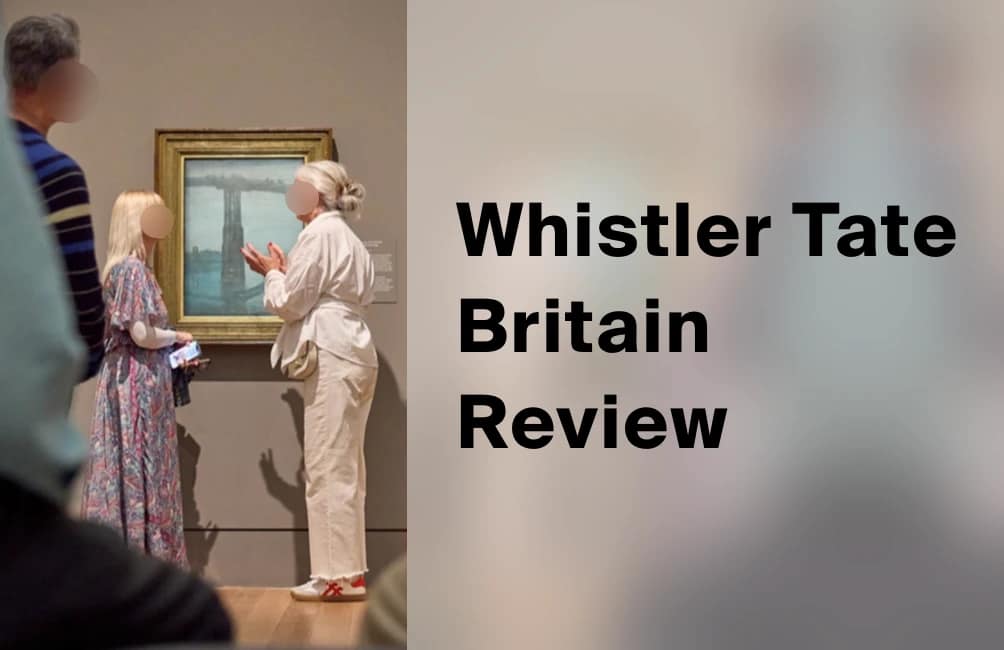
Last updated: 28 July 2026
By Tristan · Arts, exhibitions and creative culture
The Whistler Tate Britain survey is the fullest in thirty years. One visit will not cover it.
This is an opinion piece. Views expressed are the author's own and do not constitute professional advice.
Cool Factor: 5/5
Some exhibitions you walk through, but the James McNeill Whistler Tate Britain retrospective fills nine rooms on the lower floor and it runs until 27 September 2026. I went once. Then I started planning the second trip before I had reached the shop. That is not really a criticism. Even so, it is the first thing you should know.
Section 01 / The show
What is on: Whistler at Tate Britain
Nine rooms, roughly 150 works, and the first proper UK survey since 1994.
This Whistler Tate Britain retrospective, officially titled James McNeill Whistler, runs from 21 May to 27 September 2026, curated by Carol Jacobi with Isobel Muir and James Finch. Tate calls it the first major European exhibition of his work in thirty years. Jacobi has described it as only the fourth full survey since the artist died in 1903, and Britain's first since the Tate show of 1994. That gap matters. Most people under fifty have simply never had the chance to see this much Whistler in one building. The hang runs from the earliest notebooks to the late full-length portraits. Afterwards it travels to the Van Gogh Museum in Amsterdam, where it opens on 16 October 2026.
Section 02 / Millbank
The setting: Tate Britain is the right building
He lived a mile upriver, and the hang never lets you forget it.
Whistler settled in Chelsea in 1859 and stayed. Consequently the Thames is less a subject here than a home address. Tate Britain sits on Millbank, a short walk downriver from the stretch he painted again and again. Tate also owns several of the key works, including Nocturne: Blue and Silver, Chelsea and Nocturne: Blue and Gold, Old Battersea Bridge. Because of that, the Whistler Tate Britain hang never feels like a visiting circus. It feels like a homecoming. The lower-floor galleries help too. They go dark where the Nocturnes need it and open out where the big portraits demand room. If you are making a day of it, our Hurvin Anderson review covers another recent highlight from the same building.
Section 03 / Room one
First impressions: you begin in a workplace
Not a masterpiece. A studio, with the tools still in it.
The opening room is a studio, or a version of one. The Artist in his Studio, painted in 1865 and 1866 and lent by the Art Institute of Chicago, sets the scene. Around it sit Whistler's actual easel, palette, brushes and paintbox, most of them from The Hunterian at the University of Glasgow, which holds the bulk of the estate. These artefacts are nice enough to see, but they detract from the work themselves. Japanese prints and East Asian ceramics fill the cases. Immediately you understand the argument. Whistler did not simply paint pictures. He designed an entire world, then stood in the middle of it. Moreover the room quietly announces what is coming: the fans, the blue and white porcelain, the flattened space borrowed from Japan.
Section 04 / The Mother
The family wall, and the loan everyone came for
Arrangement in Grey and Black No. 1 has crossed the Channel.
The Musée d'Orsay has lent Whistler's Mother, and the picture earns its billing. Yet the smarter move is the company Tate gives it. Arrangement in Grey and Black No. 1 hangs near Whistler's own 1872 self-portrait and the portrait of his brother, Dr William McNeill Whistler. Seen together, the three read as a family group rather than an icon. In fact the Mother stops being a poster and becomes a painting again. Nearby, Harmony in Grey and Green: Miss Cicely Alexander shows how exhausting he could be to sit for. He kept the child standing through dozens of sessions. The result is one of the great British portraits of a bored child, a genre with fewer entries than you might expect.
Section 05 / Night
The Nocturnes room is the emotional centre
The largest gathering of them in over thirty years.
This is the room people will talk about. Tate has brought the Nocturnes together from the first, Nocturne in Blue and Gold: Valparaiso, begun in 1865 and finished around 1874, through to Nocturne: Blue and Gold, St Mark's, Venice of 1880. Lit properly and hung with space, they do something no reproduction manages. The paint is barely there. Whistler wanted it "like a breath on the surface of a pane of glass", and in front of Old Battersea Bridge you can see he meant that literally. Consequently the room asks for patience. Give the pictures ten minutes and the river arrives. Give them thirty seconds and you will see grey. This is masterful painting, almost contemporary to our eyes. All the more revolutionary when you consider Whistler was a Victorian.
Section 06 / Venice
Venice, and the room that quietly invented the white cube
The most radical thing in the building is a set of small prints.
The Venice trip was a rescue mission. After the Ruskin case bankrupted him, the Fine Art Society commissioned twelve etchings and advanced him £150 to get there. He arrived in September 1879 intending to stay three months. He left fourteen months later with around fifty etchings and close to a hundred pastels. The First Venice Set appeared in 1880, and a second set of twenty-six followed in 1886.
What he did next is the part that changed commercial galleries. For the 1883 Fine Art Society show, titled Arrangement in White and Yellow, he lined the walls in white felt, framed the prints in white, painted the mouldings yellow, laid yellow matting and hung the etchings low in a single line with wide margins. He even dressed the attendant to match. Nothing crowded, nothing stacked to the ceiling in the Victorian manner. Tate's own press material makes the link explicitly, noting that his lighter schemes and minimal furnishings anticipated the modern "white cube" aesthetic.
Now my rooms are pictures in themselves.
Whistler, quoted by curator David Park Curry
The Whistler Tate Britain room follows exactly that logic, and the effect is genuinely disorientating. You are standing inside the prototype of every contemporary gallery you have ever visited, roughly ninety years before Brian O'Doherty gave the format a name. If the idea appeals, our Katharina Grosse review looks at an artist doing her best to blow the white cube apart.
Section 07 / Ruskin
Battles for beauty: a farthing, and everything else
The libel win that finished him financially.
In July 1877 John Ruskin, writing in Fors Clavigera, accused Whistler of "flinging a pot of paint in the public's face". Whistler sued. The 1878 trial produced the exchange every art student knows. Asked whether he really wanted two hundred guineas for two days' labour, he replied: "No. I ask it for the knowledge I have gained in the work of a lifetime." He won, technically. The jury awarded a farthing in damages and no costs. By May 1879 he was bankrupt and the White House, his home in Tite Street, was gone. Venice followed directly. Later came the Ten O'Clock lecture of February 1885, The Gentle Art of Making Enemies in 1890, and the presidency of the Society of British Artists from 1886. Above all, he was an early master of the row as publicity. "Art should be independent of all clap-trap," he wrote, then spent decades generating clap-trap of his own.
Section 08 / The catch
Honest critical observations
Five stars is not a free pass, even for the Whistler Tate Britain show. Here is what nags.
It is too big for one visit. That is the central problem. Roughly 150 works across nine rooms sounds manageable, but the etchings and pastels need slow looking, and by room seven most people are running on fumes. Anyone paying £24 for a single ticket will not see it properly. Practically, the show is built for members, and it does not quite admit that.
Some famous pictures are missing. Nocturne in Black and Gold: The Falling Rocket, the painting that started the Ruskin case, has stayed in Detroit. Jacobi has confirmed as much. The Peacock Room appears as a full-scale reproduction. Both absences are understandable. Neither is invisible.
The personal effects are the weakest inclusion. The easel and brushes are pleasant to see. However, they add little. They tell you a man owned tools.
Not every critic surrendered. Laura Freeman in The Times enjoyed it but felt Tate could not resist flagging history's injustices at every turn. One Substack reviewer went further and called the whole thing dingy. I disagree with both.
Section 09 / Legacy
Why the Whistler Tate Britain show matters now
The first artist to treat the room as part of the work.
Whistler invented a great deal that we now take for granted. He designed his own frames, catalogues, installations and signature butterfly. Tate frames him as an ancestor of Dalí and Warhol, which sounds like a stretch until you stand in the Venice room. Furthermore his Japonisme was not decorative tourism. It reshaped how he built a picture. The market has never quite caught up: his auction record sits at around $1.2m, set at Christie's New York in 2021 for the small early Whistler Smoking, which is modest for an artist this influential. The influence, though, is everywhere. Every stripped-back gallery in London owes him something.
Section 10 / The maths
Value for money: one ticket, or membership?
The numbers are not close.
Adult tickets are £24, with concessions at £22. Anyone aged 16 to 25 can join Tate Collective and pay £5. Visitors on Universal Credit or Pension Credit also pay £5, as do children aged 12 to 18 on a family ticket, and under-12s go free. The smartphone audio guide costs £5, or £4.50 for members, and Jacobi leads it. The catalogue is £35 in paperback and £45 in hardback.
Here is the calculation that matters. Tate Membership starts at £84 a year, or £8 a month, and it includes unlimited free entry to every Tate exhibition with no booking. Four visits and you are ahead. For a show this dense, two visits are the realistic minimum, so membership pays for itself almost immediately if you go to anything else all year. Alternatively, if you would rather spread the benefit across other museums, our National Art Pass page covers that route.
Section 11 / Plan it
Practical info for your visit
Getting there, hours, access and the Amsterdam dates.
Planning a Whistler Tate Britain visit takes very little effort. Tate Britain is on Millbank, London SW1P 4RG. Pimlico is the nearest tube, with Vauxhall a short walk across the river. The exhibition sits on the lower floor and opens daily from 10.00 to 18.00. There is one late opening, on Friday 14 August, when the building stays open until 22.00. Non-members need to book. Members simply turn up.
Access is decent. The Atterbury Street entrance is step free, with a ramp and central handrails. Accessible, standard and Changing Places toilets are on the lower floor. Ear defenders are available at the ticket desk. Relaxed Hours run on the third Wednesday of the month from 10.00 to 11.00, and a large-print guide is downloadable. After 27 September 2026 the show moves to Amsterdam, opening at the Van Gogh Museum on 16 October.
Section 12 / Verdict
The verdict
Cool Factor
★★★★★
5 out of 5 · Ice cold
Go. Then go again. The Whistler Tate Britain exhibition is the most complete account of the artist that anyone in Britain has been able to see in over thirty years, and the Venice room alone justifies the ticket. It is beautifully hung, properly researched, and confident enough to let the Nocturnes breathe.
Overall, then, a 5/5 Ice cold. The Whistler Tate Britain survey earns the top score for scale, intelligence and that extraordinary etching room, which reframes Whistler as a designer of experiences rather than simply a painter of them. It is not flawless. The Falling Rocket is absent, the Peacock Room is a copy, the studio relics are padding, and the sheer volume means a single £24 ticket will short-change you. None of that dents the achievement. This is the show that finally puts Whistler back where he belongs, and if you only manage one exhibition in London this year, make it this one.
FAQs
Is the Whistler Tate Britain exhibition worth visiting?
Yes, comfortably. It is the first major UK survey since 1994 and gathers roughly 150 works across nine rooms, including the largest group of Nocturnes shown together in over thirty years. Just budget for two visits rather than one.
How much are tickets for Whistler at Tate Britain?
Adult tickets are £24 and concessions £22. Tate Collective members aged 16 to 25 pay £5, as do visitors on Universal Credit or Pension Credit. Under-12s go free, and Tate Members enter free without booking.
Is Whistler's Mother in the exhibition?
Yes. Arrangement in Grey and Black No. 1 is on loan from the Musée d'Orsay in Paris, and Tate hangs it alongside Whistler's 1872 self-portrait and the portrait of his brother.
Is Nocturne in Black and Gold: The Falling Rocket in the show?
No. The painting that triggered the Ruskin libel case has stayed at the Detroit Institute of Arts. Curator Carol Jacobi confirmed its absence before the show opened.
How long do you need for the Whistler Tate Britain show?
Allow at least two and a half hours for a first pass. Realistically, the etchings and pastels reward a second visit, which is why membership makes more sense than a single ticket.
Is Tate Membership worth it for this exhibition?
It depends on your habits. Membership starts at £84 a year, or £8 a month, and gives unlimited entry with no booking. Two visits to this show plus two other Tate exhibitions puts you ahead.
When does the exhibition close, and does it tour?
It closes on 27 September 2026. It then travels to the Van Gogh Museum in Amsterdam, opening on 16 October 2026 under a different title.
More from CoolCuration
- Tracey Emin at Tate Modern: our verdict on the other Tate blockbuster worth queueing for.
- Royal Academy Summer Exhibition: what actually stood out in this year's wall-to-wall hang.
- Gifts for Japan lovers: Whistler got there first, and so can your gift list.
- How to See: a book that changes how you walk round a gallery.
- theprintspace discount code: where to get your own prints made properly.
- Bayeux Tapestry tickets: how to actually get into the British Museum blockbuster, and when the next release lands.
What's trending




Recent posts
- Best Audiobooks October 2026: 10 UK Listens Ranked
 Ten new audiobooks for October 2026, from a full-cast Dracula with Jonathan Bailey to Russell T Davies reading his own television memoir.
 - Louis Fratino at David Zwirner ReviewLast updated: 4 October 2026 By Tristan · Arts, exhibitions and creative culture This is an opinion piece. Views expressed are the author's own and do not constitute professional advice. Exhibition reviewMayfair Saunas, subway cars and a lot of skin in Mayfair Louis Fratino at Zwirner is the American painter's first solo show in London,… Read more: Louis Fratino at David Zwirner Review
- What Is a Sprive Boost? Seven Days, and What It Actually PaysA Sprive boost lifts your cashback rate for seven days, and it arrives on its own. What mine paid, and why Supercharge is a display toggle rather than extra cashback.

No Comments.