
Last updated: 22 September 2026
By Stiv · Design, technology and personal finance
This is an opinion piece. Views expressed are the author's own and do not constitute professional advice.
This article contains affiliate or referral links. If you click through and sign up I may earn a commission or referral bonus at no extra cost to you. It does not affect my editorial view.
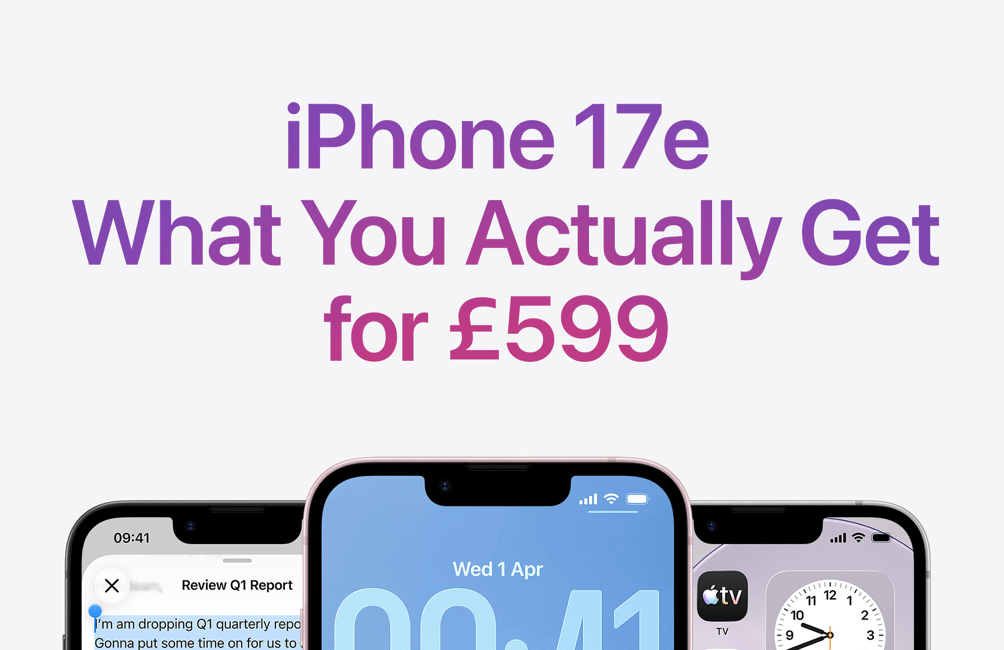
The iPhone 17e UK launch landed on 11 March 2026 at £599, the same price Apple charged for the 16e the year before. Apple has since raised it to £699, from 9 September 2026. Either way, you're getting double the storage, MagSafe, and a faster chip. It's not a revolution. It was never meant to be. Here's our honest take on what Apple's cheapest iPhone actually delivers and where it quietly cuts corners.
Comparing the 17e with the rest of the range? My iPhone guides hub has every iPhone guide in one place, plus Apple's current UK prices.
iPhone 17e UK: Nothing More, Nothing Less
Apple has a knack for making its budget phone feel like a sensible choice rather than a compromise, and the iPhone 17e UK release follows that playbook to the letter. You get meaningful upgrades in the places that matter most — storage, wireless charging, processor — and polite omissions everywhere else. It's a phone that knows exactly what it is.
Let's start with the headline: base storage has doubled to 256GB while the launch price stayed at £599. At launch, that made this year's model around £100 cheaper than the equivalent 16e configuration, which is a genuine win for anyone who's ever run out of space halfway through a holiday. A 512GB option is available too, though Apple hasn't made UK pricing for that tier easy to find at launch.
Design and Display
Physically, the 17e is near-identical to its predecessor. Same 6.1-inch OLED screen, same aluminium frame, same flat-edged silhouette. It comes in black, white, and a new soft pink with a matte finish that feels premium in the hand. The front glass is now Ceramic Shield 2, which Apple says offers three times better scratch resistance than the 16e — a welcome upgrade if you're the type to toss your phone into a bag with keys and loose change.
The display itself is perfectly fine. It's a Super Retina XDR panel with up to 1200 nits peak HDR brightness, which means streaming and outdoor readability are both solid. But it's still locked to 60Hz. No ProMotion. No Dynamic Island — you're stuck with the notch. If you've used any other current iPhone for more than five minutes, scrolling on the 17e will feel noticeably less smooth. For Apple's entry-level phone it's acceptable. For £699 in 2026, it's starting to feel like a hard sell.
Camera
Round the back there's a single 48MP Fusion camera with an f/1.6 aperture and optical image stabilisation. It shoots 24-megapixel photos by default, with the option to go full 48MP resolution when you need extra detail. The sensor also does a cropped 2x telephoto, which Apple cheerfully calls "optical-quality" — a phrase that does a lot of heavy lifting. Night mode, Deep Fusion, and the Photonic Engine all come along for the ride, and portrait mode has been improved with better background blur and the ability to adjust focus after the shot.
There's no Camera Control button, which is a small but noticeable omission if you've been using an iPhone 17 or 17 Pro. The front camera is a 12MP TrueDepth shooter with an f/1.9 aperture — the same unit found in last year's 16e. The rest of the iPhone 17 lineup has moved on to an 18MP Center Stage camera, so selfie enthusiasts may feel slightly short-changed here.
Video is a strong point. You get 4K Dolby Vision recording at up to 60fps, plus slow-motion at 1080p and 240fps. For most people shooting everyday clips, the 17e is more than capable.
MagSafe Finally Arrives
The biggest single upgrade is on the back: MagSafe, at last, on Apple's cheapest iPhone. Wireless charging jumps from 7.5W on the 16e to 15W here, and the phone supports Qi2 for cross-platform magnetic charging. If you've been eyeing up MagSafe wallets, car mounts, or battery packs, the 17e now plays nicely with the entire ecosystem. It's the kind of addition that should have been here from day one, but better late than never.
Performance and Connectivity
Under the hood sits the A19 chip — the same generation powering the standard iPhone 17, though this version has a slightly trimmed 4-core GPU instead of 5. In practice, you're unlikely to notice unless you're benchmarking or playing the most demanding AAA titles. The 16-core Neural Engine handles Apple Intelligence features smoothly, and day-to-day performance feels fast and responsive.
Apple's C1X modem replaces the first-generation C1 from the 16e. It's claimed to be up to twice as fast for 5G data, though real-world UK 5G speeds remain the usual mixed bag. Worth noting: the 17e is limited to sub-6GHz networks with no mmWave support, and wireless connectivity tops out at Wi-Fi 6. Not a dealbreaker for most, but the standard iPhone 17 gets Wi-Fi 7 and Bluetooth 6.
Battery life is quoted at up to 26 hours of video playback — identical to the 16e. Fast charging via USB-C gets you to 50% in about 30 minutes with a 20W adapter. The USB-C port is limited to USB 2.0 speeds, so don't expect rapid file transfers.
UK-Specific Details
Good news for anyone not ready to go fully digital: the iPhone 17e sold in the UK still supports a physical nano-SIM alongside eSIM, unlike the US model which is eSIM-only. It's also IP68 rated for water and dust resistance up to six metres for 30 minutes.
Pre-orders opened on 4 March, with general availability from 11 March through Apple, major carriers like EE and Vodafone, and retailers including Amazon UK. If you're upgrading from an iPhone 12 or older, this is arguably the sweet spot — you get four generations of improvements at a price that won't require remortgaging.
Should You Buy the 17e — or Grab a Refurbished 16e?
Here's the honest question most people should be asking: do you actually need the 17e right now? If MagSafe isn't a priority and you can live without the storage bump, the iPhone 16e is about to get significantly cheaper on the second-hand market. Refurbished platforms like Back Market already stock the 16e at well below retail, and you can grab an extra £10 off with our referral link. Give it a few weeks and early 17e trade-ins will start appearing there too — often at a hefty discount versus buying new.
For a full side-by-side breakdown of exactly what's changed (and what hasn't), we've put together a detailed iPhone 16e vs iPhone 17e buyer's guide that walks through every spec, feature, and trade-off so you can decide which one actually makes sense for your budget.
The Bottom Line
The iPhone 17e doesn't try to be exciting. It tries to be sensible, and it mostly succeeds. MagSafe, double the storage, a faster chip, and better scratch resistance are all genuine improvements that make the 16e feel dated by comparison. But the 60Hz display, the notch, and the unchanged front camera keep it firmly in "good enough" territory rather than "genuinely great."
For most people buying on contract or upgrading from something a few years old, the 17e will feel like a big step forward. For anyone cross-shopping with the standard iPhone 17 at £899, the extra £200 buys you a 120Hz display, a better front camera, and a larger screen — upgrades that are hard to ignore once you've seen them side by side.
If you're looking for more ways to save on tech, services, and everyday spending, have a browse through our service guides — we've got referral deals and discount codes on everything from broadband to investing apps.
All specifications referenced are taken from Apple's official UK newsroom announcement and product pages, accurate as of March 2026, with prices updated on 22 September 2026.
iPhone 17e UK: Frequently Asked Questions
How much does the iPhone 17e cost in the UK?
The iPhone 17e starts at £699 for the 256GB model on Apple's UK store, checked on 22 September 2026. It launched at £599 in March 2026, and Apple added £100 to the price on 9 September 2026.
When can I buy the iPhone 17e in the UK?
Pre-orders opened on 4 March 2026, with in-store and online availability from 11 March. You can buy it from Apple, Amazon UK, and all major UK carriers including EE and Vodafone.
Does the iPhone 17e have MagSafe?
Yes. This is the first time Apple has included MagSafe on its entry-level iPhone. It supports wireless charging at up to 15W and is compatible with Qi2 chargers and the full range of MagSafe accessories.
Does the iPhone 17e have Dynamic Island?
No. The iPhone 17e retains the notch design from the 16e. Dynamic Island is available on the standard iPhone 17, iPhone Air, and the Pro models.
What's the refresh rate on the iPhone 17e display?
The display runs at 60Hz. There's no ProMotion (adaptive 120Hz) on the 17e — that feature is reserved for the rest of the iPhone 17 lineup.
Is the iPhone 17e worth upgrading to from the iPhone 16e?
It depends on your priorities. MagSafe and the storage bump are the standout gains; the processor improvement is nice but unlikely to feel dramatic in daily use. If you're not fussed about MagSafe, you could save money by sticking with the 16e or picking up a refurbished model via Back Market at a discount. We break the whole thing down in our iPhone 16e vs 17e buyer's guide.
Can I get a refurbished iPhone 16e or 17e cheaper?
Yes. The 16e is already available refurbished on platforms like Back Market, where you can get £10 off with our referral link. Give it a few weeks after launch and early 17e trade-ins will start appearing there too — often well below Apple's retail price.
Does the iPhone 17e support a physical SIM card in the UK?
Yes. Unlike the US model, the UK version of the iPhone 17e supports both a nano-SIM and eSIM (dual SIM). You won't be forced into eSIM-only just yet.
What colours does the iPhone 17e come in?
It's available in black, white, and a new soft pink — all with a matte finish.
How does the iPhone 17e compare to the standard iPhone 17?
The main differences are the display (60Hz vs 120Hz ProMotion, notch vs Dynamic Island), the front camera (12MP vs 18MP), screen size (6.1" vs 6.3"), and wireless capabilities (Wi-Fi 6 vs Wi-Fi 7). The standard iPhone 17 starts at £899 in the UK, according to Apple's UK store on 22 September 2026.
More from CoolCuration
- iPhone 16e vs 17e Buyer's Guide — Full side-by-side comparison to help you decide which one's right for you.
- Back Market Referral Discount — Get £10 off refurbished iPhones and other tech.
- Service Guides Hub — Our full library of referral deals, discount codes, and "is it worth it?" reviews.
- Sprive Mortgage App Review — How to make automatic overpayments and pay off your mortgage faster.
- Octopus Energy Referral — Grab £50 credit when you switch to 100% renewable energy.
- CoolCuration Blog — More reviews, guides, and the odd opinion piece on tech and culture.
What's trending




Recent posts
- Philips OneBlade Review UK: 4/5 After Five Years
 Five years with the same Philips OneBlade. One handle, a new blade every four months, and blades that work out at £1.65 a month. Here is what wore out, which blade I stopped buying, and the one design flaw that will eventually kill it. #philipsoneblade #grooming #shaving #ukreviews #coolcuration
 - Best Smart Home Starter Kit UK 2026: Apple, Google or AlexaThree ways into a smart home and one box you replace if you change your mind. Apple, Google and Alexa priced side by side, plus the Matter kit that works with all three.
- Best Refurbished AirPods UK 2026: Where to Buy and What It SavesRefurbished AirPods UK prices at Back Market, Amazon Renewed and Apple, set against the cheapest new price at Argos, AO and Currys.


No Comments.