

Last updated: 8 October 2026
By Stiv · Design, technology and personal finance
This article contains affiliate and referral links, which are paid links. If you click one and buy or sign up, I earn a commission or referral bonus at no extra cost to you. Brands don't choose what I feature or what I say about them.
If you're booking train tickets in the UK, there's a good chance you've used Trainline. It's been around since 1997, and it's the name most people reach for first. But over the past few years, TrainPal vs Trainline has become a genuine debate. That's especially true for anyone who wants no booking fees and automatic split ticketing. So which app actually saves you more money? I've compared the two side by side to help you decide.
Want money off your first TrainPal trip?
TrainPal books UK trains with no booking fees in its app, and my referral page keeps the current new-user offer up to date.
TrainPal vs Trainline: what's the difference?
Both apps let you search, compare, and book UK train tickets from your phone. In addition, both support digital railcards, e-tickets, and routes across the country and into Europe. On the surface they look similar. However, the differences in fees, savings tools, and extras add up fast, particularly if you travel regularly.
Booking fees
This is where TrainPal pulls ahead straight away. TrainPal charges no booking fees on UK train tickets bought in its app, although it says fees may apply to some purchases on its website. Trainline, on the other hand, charges a variable booking fee. The exact amount depends on whether you book via the app or website, the ticket value, and when you purchase. It's not always huge, but it's there. As a result, it chips away at your savings over time.
Split ticketing
Split ticketing means buying two or more cheaper tickets for different legs of the same journey instead of one expensive through-ticket. You stay on the same train; you just hold multiple tickets. Both apps offer this feature automatically.
TrainPal checks for a cheaper split automatically when you search. Trainline's version, called SplitSave, works in a similar way. In practice, the savings vary by route and time, so compare both apps for any given journey.
Digital railcards
Both TrainPal and Trainline sell digital railcards that live inside the app. A railcard gives you a third off most eligible fares and costs £35 a year for most types, with a three-year option for £80 on some, such as the 16-25, as listed on the official Railcard website. The railcard types available are broadly the same on both platforms: 16-17 Saver, 16-25, 26-30, Senior, Family and Friends, Two Together, and Network.
The TrainPal Card
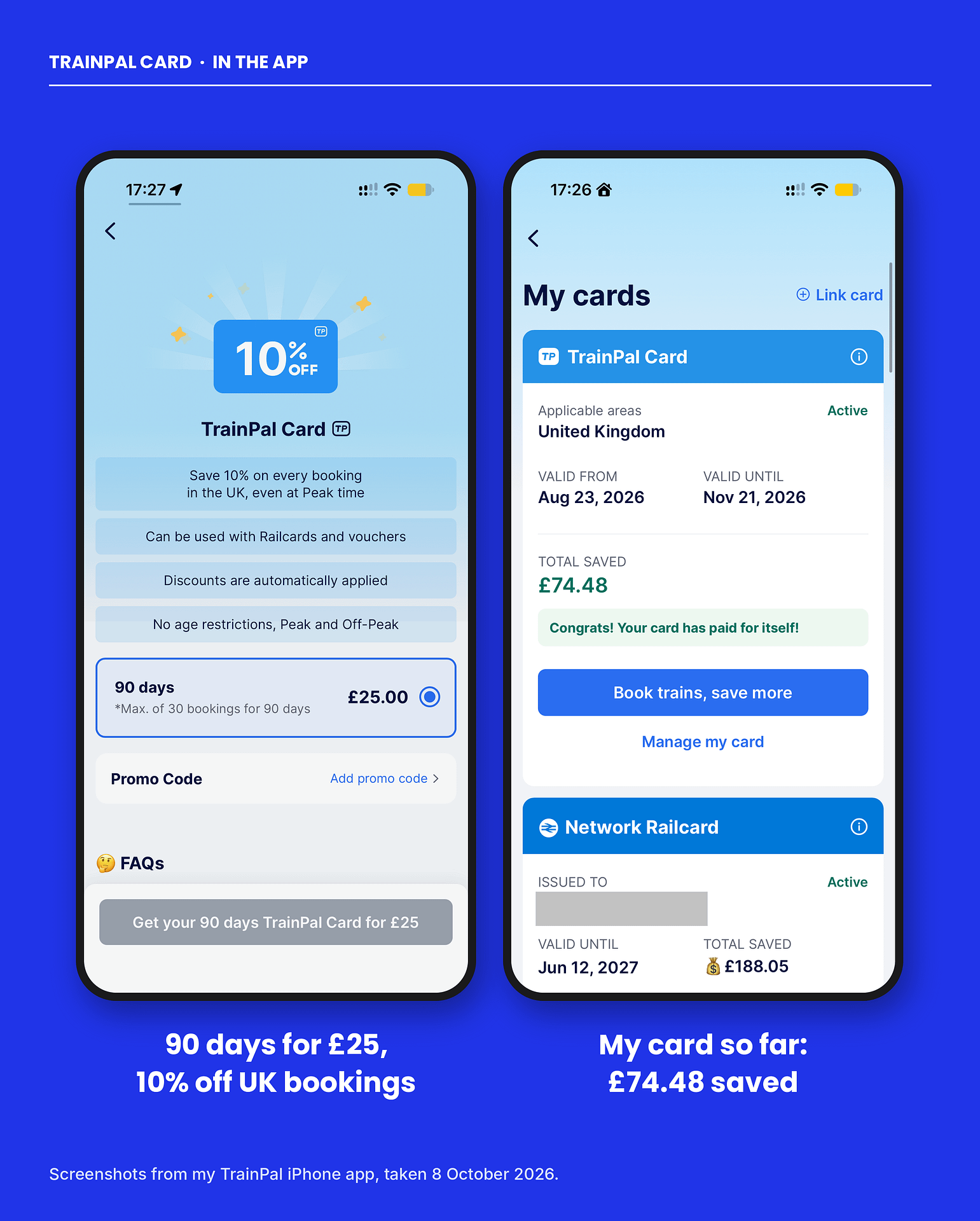
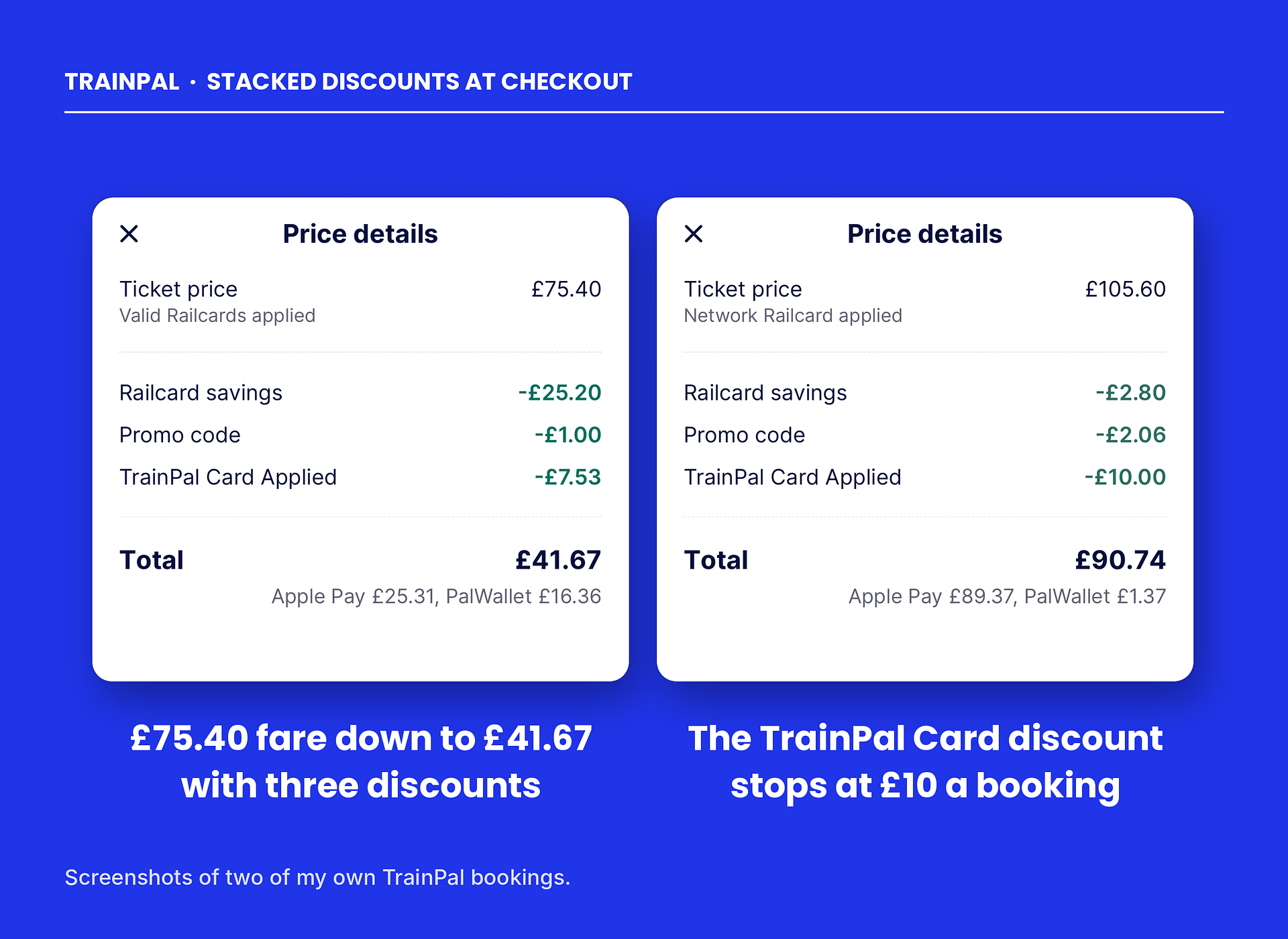
TrainPal has its own discount card, called the TrainPal Card, which sits under Railcards in the app. It costs £25 for 90 days and takes 10% off UK bookings, at Peak and Off-Peak times, up to £10 off any one booking and up to 30 bookings in the 90 days. TrainPal also sells a 15% version from time to time, which allows up to 70 bookings. It stacks on top of a Railcard and promo codes, and the discount comes off automatically. However, it doesn't renew on its own and you can't get a refund on it.
I buy a new card every 90 days, and my current one has saved me £74.48 so far against the £25 it cost. At 10% off, you need to spend £250 on tickets in 90 days to cover the price.
On top of that, TrainPal runs PalPoints. You earn 10 to 25 points for every £1 you spend, depending on your membership tier, and 750 points buys a 1% discount voucher for one journey. Higher tiers also pay cashback of up to 0.5% into your PalWallet, TrainPal's balance in the app. Trainline does not currently have an equivalent subscription or loyalty programme. For a deeper look at how PalPoints and the TrainPal Card work in practice, read my full TrainPal review.
All of these discounts combine on one TrainPal booking. On one of mine, a £75.40 fare came down to £41.67. My Network Railcard took off £25.20, a promo code £1 and my TrainPal Card £7.53, and I paid £16.36 of the rest from my PalWallet.
Monzo and Trainline: a railcard shortcut
The Monzo and Trainline partnership deserves its own mention because it's genuinely useful. On the Perks plan (£9 per month) or Max plan (£19 per month), you get a free annual railcard as part of your subscription. You also get a weekly Greggs treat, an annual Uber One membership, and a monthly Vue cinema ticket, among other perks.
Monzo changed its plan prices in 2026. My Monzo Perks price increase breakdown has every tier, the key dates and the maths.
To claim your railcard, go to the Perks or Max section in the Monzo app, select "Digital Railcard", and copy the discount code. You then redeem it on the Trainline website (not the app). The railcard is stored in Trainline, but you can use it with tickets bought anywhere.
If you don't already have a Monzo account, you can sign up using my Monzo referral link and pick a plan that suits you.
European travel
Both platforms cover European routes, including Eurostar and operators like SNCF, Renfe, Trenitalia, and DB. TrainPal works with more than 1,000 transport partners across Europe, and its coach network covers 47 countries. Meanwhile, Trainline covers 45 countries and more than 270 operators. For most UK-based travellers, the European coverage is broadly comparable.
Refunds and delays
Both apps let you manage changes and refunds in-app. TrainPal sends alerts when your train is delayed or cancelled, but in my experience a Delay Repay claim still means filling in the train operator's own form on its website. Trainline's app, meanwhile, tracks your journey and notifies you when you're eligible for compensation.
On the refunds side, advance tickets are generally non-refundable on either platform but can be amended. Off-Peak and Anytime tickets, on the other hand, are refundable until midnight on the day before you travel, and a retailer can charge up to £5 to process the refund.
So which one should you use?
Honestly, the best answer might be: both. If you're a Monzo Perks or Max customer, your free railcard lives in Trainline, so you'll want that app installed. But for the actual booking, TrainPal's lack of booking fees in the app, the TrainPal Card and PalPoints make it worth checking every time. As a result, plenty of people keep both apps and compare prices before committing.
If you're new to TrainPal, you can get money off your first trip using my TrainPal referral link.
For a deeper dive into how TrainPal works, including the PalPoints system and split ticketing in more detail, read my full TrainPal review.
Prices, offers, and plan details mentioned in this post were accurate at the time of writing (October 2026). Always check the latest terms directly with TrainPal, Trainline, and Monzo before booking or signing up. This is not financial advice.
TrainPal vs Trainline: frequently asked questions
Is TrainPal cheaper than Trainline?
In most cases, yes. TrainPal charges no booking fees in its app and applies automatic split ticketing, which often results in a lower total price. However, it's still worth comparing both apps for any given journey, since split-ticketing algorithms can produce different results depending on the route.
Can I use a railcard bought on TrainPal with Trainline?
Yes. A digital railcard purchased through TrainPal is a valid National Rail railcard. You can show it on your phone if asked by a ticket inspector, regardless of where you bought your ticket. The same applies in reverse for railcards bought via Trainline.
Is the Monzo free railcard worth it?
If you're already paying for Monzo Perks (£9 per month) or Max (£19 per month), the annual railcard is effectively free and saves you £35 a year. If you'd only be signing up for the railcard alone, the plan cost may not justify it unless you also use the other perks like the weekly Greggs treat, Uber One, and Vue cinema tickets.
Do both apps offer Delay Repay?
Both apps alert you when your train is delayed and point you towards Delay Repay. The last two times I claimed through TrainPal, though, I still had to fill in the train operator's own form.
Which app is better for European train travel?
Both cover Eurostar and major European operators. TrainPal works with more than 1,000 transport partners across Europe, while Trainline covers 45 countries and 270+ operators. For most UK travellers, the coverage is comparable.
More from CoolCuration
- Lightyear Review UK: My honest verdict on this commission-free investment app, including fees and how it compares.
- Octopus Energy Referral: Switch to Octopus and get a credit bonus on your energy bill with my referral link.
- Oura Ring 4: A sleek health and sleep tracker that fits on your finger. Great for frequent travellers.
- Gifts for Travel Lovers: Curated picks for anyone who's always planning their next trip.
- Chip App: Automate your savings and grow your money without thinking about it.
What's trending



Recent posts
- Figma Creator Micro Review: Beautiful, But Do You Need It?
 My Figma Creator Micro review: beautiful design and admirable build, but a price I found hard to justify. Cool Factor 3/5.
 - New on Mobbin October 2026: Jomo, Delphi, Lloyds and MoreNew on Mobbin October 2026: Jomo, Delphi, Lloyds and five more apps, with the consent, search and unlock screens worth studying.
- British Art Fair 2026 ReviewArt fairsSaatchi Gallery A Sickert study best in show, a Hockney for £800, and naff AI art Last updated: 28 September 2026. I checked every price and date in this British Art Fair review against the dealers' labels and the fair's own pages. By Tristan · Arts, exhibitions and creative culture This is an opinion… Read more: British Art Fair 2026 Review



No Comments.