
Last updated: 29 March 2026
A speaker is also the hub for everything else you add later, so it is worth reading it alongside our smart home guides.
By Stiv · Design, technology and personal finance
This article contains affiliate or referral links. If you click through and sign up I may earn a commission or referral bonus at no extra cost to you. It does not affect my editorial view.
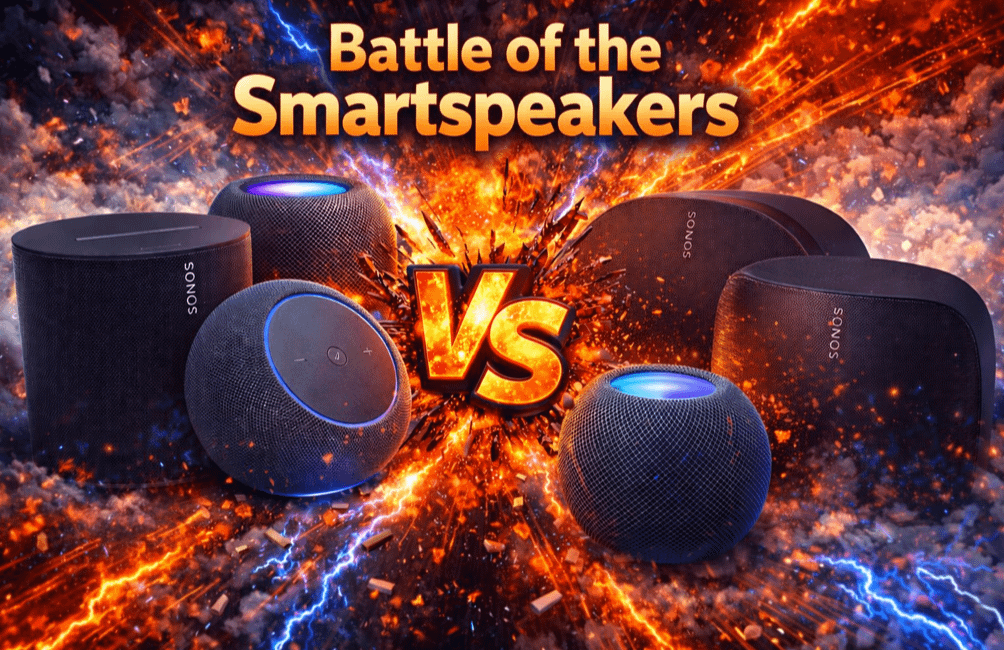
Choosing the best smart speakers UK buyers can actually get their hands on in 2026 is oddly complicated. Apple wants you all-in on Siri and AirPlay. Sonos wants you to forget about voice assistants and just listen. Amazon wants you to talk to Alexa about literally everything, including your shopping list. Three very different philosophies, three very different ecosystems, and a surprisingly wide range of prices.
This guide cuts through the noise. We compare every current speaker worth considering from Apple, Sonos and Amazon. In particular, we cover sound quality, stereo pairing rules, multi-room setups, app quality, ecosystem lock-in, future-proofing and genuine value for money. Whether you want a single kitchen speaker or a whole-home audio system, we will help you pick the right one.
The current lineups at a glance
Before we dig into the detail, here is what each brand is actually selling right now in the UK.
Apple HomePod range
Apple keeps things simple with just two models. The HomePod (2nd generation) costs £279 and packs an S7 chip, a high-excursion woofer, five beamforming tweeters, and support for Spatial Audio with Dolby Atmos. Meanwhile, the HomePod Mini sits at £99 with a single full-range driver and two passive radiators driven by an S5 chip.
Both use AirPlay 2 for streaming (no Bluetooth audio input), act as HomeKit smart home hubs, and support the Matter standard. Notably, a HomePod Mini 2 is widely rumoured for 2026 with an upgraded chip and improved Wi-Fi, though Apple has not confirmed anything yet.
Sonos range
Sonos offers more variety. The Era 100 (£199) is the compact all-rounder with Wi-Fi, Bluetooth, AirPlay 2 and Alexa built in. In addition, the brand-new Era 100 SL (£169, launching 31 March 2026) strips out the microphone for a cheaper entry point. The Era 300 (£449) is the flagship with six drivers and Dolby Atmos spatial audio.
Sonos also recently announced the Sonos Play (£299), a portable speaker with 24-hour battery life, IP67 waterproofing and full system integration. As a result, the lineup now covers almost every use case.
Amazon Echo range
Amazon refreshed its entire Echo lineup in late 2025. The Echo Dot (5th gen, around £55 but frequently on sale for £30) remains the budget entry point. The Echo Dot Max (£99.99) is a significant step up with the AZ3 chip and much-improved sound. Moreover, the redesigned Echo Studio (£219.99) delivers Dolby Atmos in a new spherical design that is 40% smaller than its predecessor.
Sound quality: who wins?
This is where the price gaps start making sense. The HomePod (2nd gen) is arguably the best-sounding smart speaker at its price point, earning back-to-back awards from What Hi-Fi? for its clear, weighty and energetic performance. Its room-sensing technology automatically tunes audio to your space without you lifting a finger. However, the HomePod Mini has physical limits in larger rooms despite punching above its weight for £99.
The Sonos Era 300 is the audiophile's pick. Its six-driver array and upward-firing tweeter create a genuinely immersive spatial audio experience. A stereo pair of Era 300s delivers what several reviewers describe as a holographic soundstage. Similarly, the Era 100 is excellent for its size, with a warmer presentation and surprisingly punchy bass.
Amazon's Echo speakers have never really been about sound-first. Even so, the new Echo Studio closes the gap considerably. With Dolby Atmos support and an improved driver arrangement, it is a serious contender for anyone who also wants Alexa front and centre. The Echo Dot Max is a revelation compared to older Dots, though it still cannot compete with a Sonos Era 100 or HomePod Mini on pure audio quality.
Stereo pairing: the rules you need to know
All three ecosystems let you pair two speakers for stereo. However, the rules differ in ways that catch people out.
Apple stereo pairing
You can stereo pair two HomePods or two HomePod Minis, but both must be the same model. You cannot pair a HomePod with a Mini, and you cannot pair a 1st-gen HomePod with a 2nd-gen. The pair is created in the Home app and both speakers must be in the same room. Once paired, the system treats them as one speaker.
Sonos stereo pairing
The same model rule applies here too. Two Era 100s can stereo pair, and two Era 300s can stereo pair, but you cannot mix models. Pairing is handled in the Sonos app. A stereo pair of Era 300s is one of the most impressive wireless audio setups you can build at home, with each speaker contributing six amplifiers and six drivers.
Amazon stereo pairing
Echo devices follow the same model pairing rule. Two Echo Studios or two Echo Dot Max speakers can form a stereo pair. On top of that, Amazon takes it further with Alexa Home Theatre: you can link up to five Echo Studio or Echo Dot Max speakers with a Fire TV Stick for a 5.1 surround sound setup. That is a genuinely unique offering at this price.
Multi-room audio: scaling up
This is where the best smart speakers UK buyers choose will really show their strengths and weaknesses.
Apple multi-room
Multi-room works via AirPlay 2. You can play music across any combination of HomePods and HomePod Minis in different rooms using Siri voice commands or the AirPlay picker on your iPhone. Apple does not publish a device limit, but users consistently report issues beyond six to eight HomePods playing simultaneously. It works, but it is not as bulletproof as Sonos.
Sonos multi-room
This is what Sonos was literally built for. The system supports up to 32 devices per household, and you can group any combination of speakers to play in sync or run different music in different rooms. Reliability is generally excellent. For whole-home audio, Sonos remains the gold standard.
Amazon multi-room
Echo speakers can be grouped into multi-room music groups through the Alexa app. Amazon has no published device limit and the system is generally reliable. The standout feature is Alexa Home Theatre mode, which lets you build a surround sound system with Echo speakers and a Fire TV Stick. No other ecosystem offers this at such a low entry cost.
The apps: a tale of three experiences
Your daily experience depends heavily on the app you are using. As a result, this is where opinions get very strong.
Apple's Home app is functional but limited. It handles basic playback and smart home control, but most people end up using the Control Centre AirPlay picker or just asking Siri. It works well enough if you are already deep in the Apple ecosystem, yet it offers little for anyone else.
The Sonos app went through a torrid period after a major redesign in 2024 that stripped out features and introduced significant bugs. Since then, the new leadership under CEO Tom Conrad has been rebuilding trust through steady updates. By early 2026, the app is substantially improved, with volume control, queue management and library browsing all working properly. It is not perfect, but it is functional and getting better with each update.
The Alexa app is mature and feature-rich. It handles music, smart home, routines, shopping lists and more. It can feel cluttered because it tries to do so much, but for controlling Echo speakers specifically it is straightforward. What's more, the Alexa+ AI upgrade launched in the UK on 19 March 2026, bringing more natural conversations and task-handling to compatible Echo devices. It is free for Prime members, or £19.99 per month without Prime.
Ecosystem lock-in: how trapped will you be?
This is worth thinking about before you commit to any ecosystem.
Apple lock-in
Apple's HomePod ecosystem is the most closed. You need an iPhone or iPad to set up, and Apple Music works natively. However, Spotify and other services require AirPlay streaming from your phone. There is no Bluetooth audio input either. If you leave Apple, your HomePods lose significant functionality. That said, if you are already an iPhone user with Apple Music, the integration is seamless.
Sonos openness
By contrast, Sonos is the most open. It supports Apple Music, Spotify, Amazon Music, Tidal, Deezer, YouTube Music and dozens more directly in the app. It also has AirPlay 2 and Bluetooth. You can switch phone platforms without losing anything. This makes Sonos the safest long-term bet if you are not sure where your allegiances will lie in five years.
Amazon middle ground
Amazon sits in the middle. Echo speakers work with most music services including Apple Music and Spotify. The smart home integration is the broadest of the three, with Alexa supporting thousands of devices. However, the best features increasingly push you towards Amazon's own services and Prime membership. Fortunately, Matter support helps future-proof things across ecosystems.
Future-proofing: what is coming next?
Apple is expected to refresh the HomePod Mini in 2026 with a faster chip and improved Wi-Fi. The rise of AI assistants means Siri improvements via Apple Intelligence could also make existing HomePods smarter over time.
Sonos has just shown its hand with the Era 100 SL and Sonos Play, signalling a return to form after a difficult 2024. Their philosophy of long-term software support means current speakers should remain relevant for years to come.
Amazon's new Echo hardware includes custom AI accelerator chips designed for Alexa+ capabilities. Now that Alexa+ has launched in the UK, these speakers can already take advantage of more natural conversations, advanced task-handling and deeper smart home integration. Amazon also fully supports the Matter standard, meaning your Echo speakers will work with future smart home devices regardless of brand.
Save money: buy refurbished smart speakers
Here is a tip that applies to all three ecosystems. Buying refurbished is one of the smartest ways to get premium speakers without paying full price. Smart speakers are simple devices with no moving screens or fragile hinges, which makes them ideal candidates for refurbished purchases. A factory-tested HomePod or Sonos Era performs identically to a brand-new unit.
Back Market is our go-to for refurbished tech in the UK. They grade every item, offer a minimum 12-month warranty, and pricing can be significantly lower than retail. You can find refurbished HomePod Minis, full-size HomePods, Sonos Era 300s and Echo Dots on the platform.
If you sign up through our Back Market referral link and create a new account, you can get £10 off your first order of £100 or more by entering our code at checkout. That is handy if you are buying a stereo pair or picking up a couple of speakers to fill different rooms. You can read our full Back Market review if you want the complete breakdown of how their grading system works.
Get £10 off at Back MarketBest setups by budget
Under £100: start small
An Echo Dot (often under £30 on sale) is the cheapest way in. For better sound at this price, the HomePod Mini at £99 is hard to beat if you use Apple Music. A refurbished HomePod Mini from Back Market can drop that price even further. Both make solid kitchen or bedroom speakers.
£100 to £250: the sweet spot
The Sonos Era 100 SL at £169 is the new best-value option for pure music listening. The Echo Dot Max at £99.99 gives you solid sound plus full Alexa smarts. Similarly, the Sonos Era 100 (around £199) adds Alexa and a microphone to the mix. For Apple users, two HomePod Minis in a stereo pair (£198 new, or less via Back Market) is a surprisingly capable setup.
£250 to £500: serious listening
The HomePod (2nd gen) at £279 is the best-sounding single smart speaker at this price. An Echo Studio at £219.99 gives you Dolby Atmos and Alexa. A stereo pair of Sonos Era 100s (around £400 on sale) delivers outstanding audio. If you want home cinema on a budget, two Echo Studios paired with a Fire TV Stick offers 5.1 surround for under £500.
£500+: the full experience
A stereo pair of Sonos Era 300s (£898 new) is the best standalone wireless stereo setup you can build. Buying one new and one refurbished from Back Market is a clever way to bring that total down. A HomePod stereo pair (£558) combined with an Apple TV 4K makes for an excellent home cinema alternative. For whole-home audio, a mix of Sonos speakers across rooms remains the most reliable multi-room system available.
The verdict
There is no single best answer here, because each ecosystem excels at different things.
For pure sound quality in a single speaker, the HomePod (2nd gen) wins. For the most flexible, future-proof multi-room system, Sonos is unmatched. For budget-friendly smart home integration with a capable voice assistant, Amazon's Echo range is hard to argue with.
The real question is: what do you already own? If you are an iPhone user with Apple Music, HomePods integrate beautifully. If you want platform freedom and the best multi-room reliability, go Sonos. If you want the cheapest way to fill your home with decent sound and smart features, Amazon's Echo lineup covers every room for a fraction of the price.
Whichever brand you pick, checking for refurbished options on Back Market before paying full retail is always worth a look. And if you are interested in other smart tech picks for your home, our Philips Hue Bridge Pro review covers another piece of the smart home puzzle.
Whatever you choose, just make sure you are buying into the ecosystem you are happiest living with. Switching later means starting from scratch.
Shop refurbished speakers on Back MarketFAQs
Can you use HomePod with Spotify?
Yes, but only via AirPlay from your iPhone, iPad or Mac. Spotify does not run natively on HomePod, so you cannot ask Siri to play a Spotify playlist directly. You need to start playback on your device first, then send it to the HomePod using AirPlay. By contrast, Sonos and Amazon Echo both support Spotify natively through their respective apps and voice assistants.
Is Sonos worth the extra money over Amazon Echo?
For sound quality, yes. Even the entry-level Sonos Era 100 SL (£169) outperforms Echo speakers costing a similar amount on audio quality alone. Where Echo wins is value for smart home features. You get a capable voice assistant, smart home hub and decent speaker for as little as £30 on sale. If music is your priority, Sonos justifies the premium. If voice control and smart home integration matter more, Echo offers better value.
Can you mix HomePod and HomePod Mini in a multi-room setup?
Yes. You can play the same music across any combination of HomePods and HomePod Minis in different rooms using AirPlay 2. However, you cannot stereo pair a HomePod with a HomePod Mini in the same room. Stereo pairing requires two speakers of the same model.
How many Sonos speakers can you have in one system?
Sonos supports up to 32 devices per household. Each speaker, subwoofer and component counts as one device. If you need more than 32, you can run multiple Sonos households on the same Wi-Fi network. For most homes, 32 devices is more than enough.
Do Amazon Echo speakers support Dolby Atmos?
The Echo Studio and Echo Dot Max both support Dolby Atmos and spatial audio. You can link up to five of these speakers with a compatible Fire TV Stick to create a 5.1 surround sound system. That makes it a genuinely affordable home cinema option. The standard Echo Dot does not support Atmos.
Is Alexa+ available in the UK?
Yes. Alexa+ launched in the UK on 19 March 2026 through an Early Access programme. It is free for Prime members, or £19.99 per month without Prime. Compatible devices include the Echo Studio (2025), Echo Dot Max, Echo Show 8 (4th gen) and Echo Show 11. Amazon also plans to offer Alexa+ through a web browser at alexa.co.uk.
Is the Sonos app fixed after the 2024 problems?
Mostly, yes. After a troubled redesign in 2024 that caused widespread frustration, Sonos has released steady updates throughout 2025 and into 2026. Core features like volume control, queue management and library browsing now work properly. Some users still report occasional issues, but the app is in a far better state than it was. Under CEO Tom Conrad, Sonos has committed to a more cautious approach to future updates.
Which smart speaker is best for a whole-home setup in the UK?
For the best smart speakers UK buyers can use in a whole-home setup, Sonos offers the most reliable and flexible multi-room experience, supporting up to 32 devices with consistent syncing. Amazon Echo is the most affordable way to fill a home with sound and smart features. Apple's HomePod system works well for smaller setups but can become unreliable beyond six to eight devices, based on community reports.
Can you buy refurbished smart speakers?
Yes, and it is a great way to save money. Platforms like Back Market sell refurbished HomePods, Sonos speakers and Echo devices with a minimum 12-month warranty and condition grading. Smart speakers have no delicate screens or moving parts, so refurbished models typically perform identically to new units.
More from CoolCuration
- Sonos app update UK — the latest on the Sonos app rebuild and what has changed since 2024.
- Back Market discount code — sign up through our link to get £10 off your first refurbished order.
- Echo Studio gift page — everything you need to know about Amazon's flagship speaker.
- Gift guide for audiophiles — curated picks for music lovers and audio enthusiasts.
- Brave browser — browse the web faster and more privately on all your devices.
- Eero mesh Wi-Fi review — solid multi-room Wi-Fi is the backbone of any smart speaker setup.
What's trending





Recent posts
- Philips OneBlade Review UK: 4/5 After Five Years
 Five years with the same Philips OneBlade. One handle, a new blade every four months, and blades that work out at £1.65 a month. Here is what wore out, which blade I stopped buying, and the one design flaw that will eventually kill it. #philipsoneblade #grooming #shaving #ukreviews #coolcuration
 - Best Smart Home Starter Kit UK 2026: Apple, Google or AlexaThree ways into a smart home and one box you replace if you change your mind. Apple, Google and Alexa priced side by side, plus the Matter kit that works with all three.
- Best Refurbished AirPods UK 2026: Where to Buy and What It SavesRefurbished AirPods UK prices at Back Market, Amazon Renewed and Apple, set against the cheapest new price at Argos, AO and Currys.

No Comments.