
Last updated: March 2026
By Stiv · Design, technology and personal finance
This is an opinion piece. Views expressed are the author's own and do not constitute professional advice.
This article contains affiliate or referral links. If you click through and sign up I may earn a commission or referral bonus at no extra cost to you. It does not affect my editorial view.
The Fairbuds XL review you didn't expect to go like this: Fairphone's over-ear headphones are not the compromise you'd assume. The sound is genuinely fun, the build is impressively sustainable, and there is a single control feature that every major headphone maker should have nicked by now and somehow hasn't. They're not perfect — the ANC and feature set have real limitations — but as a statement of intent about what consumer electronics could look like, these headphones are hard to argue with.
Cool Factor
★★★★☆
4 out of 5 — Stone cold
What are the Fairbuds XL?
The Fairbuds XL are Fairphone's flagship over-ear wireless headphones. The current version — released December 2025 — is a meaningful refresh of the 2023 original rather than a full sequel. Same name, similar silhouette, but with upgraded 40mm dynamic drivers, a breathable mesh headband and ear cushions, a new 30-minute auto-off feature, and a longer three-year warranty. Everything else stays: active noise cancellation, up to 30 hours battery life, aptX HD Bluetooth, dual-point connectivity, and the modular design that makes the whole thing worthwhile.
The modularity is the point. Battery, drivers, ear cushions, speaker covers — all swappable at home, all available as spare parts directly from Fairphone. Existing owners of the 2023 model can even buy just the new driver upgrade kit rather than replacing the whole unit. That's genuinely rare, and it's what separates these from every other pair of over-ears at this price.
For full specs and the option to pick them up refurbished via Back Market, head to our Fairbuds XL detail page.
First impressions
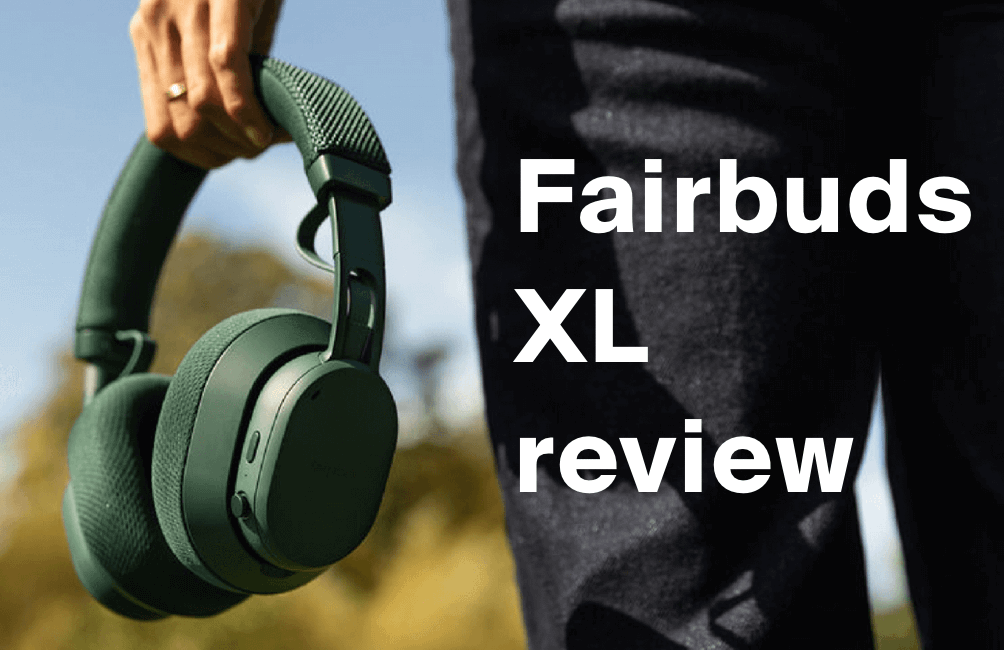
They look different. Not different in a trying-too-hard way, but in a "this clearly wasn't designed by committee" way. The fabric headband, the protruding plastic loops connecting the cups, the two-tier shape of the ear cups — it all adds up to something that feels considered rather than generic. The Forest Green colourway in particular has real character to it.
They're on the heavier side at 330g, but the padding is well distributed enough that it doesn't become a problem during longer sessions. The cups wiggle slightly to accommodate different head shapes, which helps. You can fold them for storage, though you can't rotate the cups flat, which is a minor frustration if that's something you care about.
In use: the joystick changes everything
Here's the thing about the Fairbuds XL. You can talk about sustainability, drivers, and ANC all day, but the feature that actually changes how you use headphones day-to-day is the joystick. A small physical joystick on the right cup handles everything: press and hold to power on, single press to play or pause, nudge up or down for volume, nudge left or right to skip tracks. That's it. It works every time, in the rain, with gloves on, without looking. No capacitive nonsense, no accidental pauses when you adjust the fit.
It sounds like a minor thing. It isn't. After a week with these, going back to touch-sensitive surfaces feels like a regression. Bose and Sony have had years to copy this approach. They haven't. That's baffling.
There's also a separate ANC button, which cycles through three modes: on, off, and ambient. You can't toggle ANC via the app, only via the button itself — a small annoyance. The ANC combined with the physical seal from the ear cups does a solid job in most everyday environments. Offices, commutes, coffee shops — all handled well. Wind is the weak point; it gets through more than you'd like, and call quality in breezy conditions suffers.
The companion app is functional but thin. The highlight is the equalizer, which offers presets plus a custom five-band mode called Studio. The default Amsterdam preset is the best of the bunch — louder and clearer than the alternatives. Beyond that, the app handles firmware updates and links to Fairphone's spare parts store. That last one might be more useful than it sounds in three years' time.
Sound quality
The sound is energetic and warm rather than analytical. Bass is punchy, mids hold up well, and the overall signature has a liveliness that makes pop, hip-hop, and anything with a solid groove genuinely enjoyable. Complex, layered tracks are where the cracks show — the soundstage isn't expansive enough to let busy arrangements breathe fully, and there's a slight loss of separation on tracks with intricate instrumentation.
That's a fair criticism, but it's also a bit like complaining that a great local restaurant doesn't have a Michelin star. For most listening — playlists, podcasts, daily commutes — the Fairbuds XL sound good. They just don't sound as nuanced as Sony's WH-1000XM6 or the Bose QuietComfort Ultra, both of which also cost more.
Sustainability: the actual credentials
The eco story is real, not just marketing. The 2025 model is built from approximately 50% fair and recycled materials by weight, including over 90% recycled aluminium, more than 80% recycled plastics, 100% recycled rare earth materials in the speaker magnets, and fair-mined copper, cobalt, and silver. Assembly uses 100% renewable energy and the product is e-waste neutral.
On the longevity side: Fairphone states the battery will last at least 500 full charge cycles before degradation — that's roughly 15,000 hours of listening. The warranty runs for three years. And because every part is replaceable, the headphones themselves have no obvious end-of-life. You just fix what breaks.
If you care about any of this, the Fairbuds XL is the only over-ear headphone on the market that takes it this seriously. If you're looking at alternatives in this price bracket, take a look at the Sonos Ace for premium audio or the Nothing Headphones (1) for a stylish, more affordable option.
Buy it if / Don't buy it if
Buy it if you care about the planet. The sustainability credentials here are the real deal — built from recycled and fairly sourced materials, assembled using renewable energy, and designed to be repaired rather than replaced.
Buy it if you want cans that last. Between the modular design, spare parts availability, and three-year warranty, these will outlive most of the competition by some margin.
Buy it if you like physical controls. The joystick is the best headphone control system available at any price point. It's that good.
Don't buy it if you're on a tight budget. £219 is a real commitment upfront, even if the long-term value stacks up. The refurbished route via Back Market is worth considering if you want to soften that cost.
Don't buy it if you're a serious audio tweaker. The equalizer is limited, the presets add little, and there's no spatial audio or listening test feature. If you want granular control over your sound profile, look elsewhere.
Value for money
At £219, these sit in genuinely competitive territory. Sony and Bose have headphones at similar or higher price points with better ANC and more refined sound. So on raw spec comparison, the Fairbuds XL can look like an ask.
The counter-argument is time. Sony and Bose headphones typically last two to three years before battery degradation or a broken hinge sends them to landfill. The Fairbuds XL are designed to last the decade — or longer. Factor that in and the maths shifts considerably. You're not just buying headphones; you're buying the last pair of headphones for a while.
The verdict
Cool Factor
★★★★☆
4 out of 5 — Stone cold
A solid 4 out of 5 — Stone cold. The Fairbuds XL earn it through a genuinely class-leading joystick control system, an eco build that goes well beyond badge engineering, and a modular design that genuinely extends the life of the product. What keeps them off Ice cold is the ANC, which struggles in wind and can't match the best-in-class noise floor of Sony or Bose, and the limited soundstage that holds back more complex recordings. If you're looking for the most technically capable headphones at £219, these aren't it. If you're looking for the most thoughtful pair — and the ones you'll still be using in 2030 — they might be exactly it.
Fairbuds XL Review: FAQs
Are the Fairphone Fairbuds XL worth it?
Yes, with caveats. If sustainability and longevity are priorities, they're among the most compelling headphones on the market. If you're optimising for pure ANC performance or sonic nuance, there are stronger options at similar prices.
How does the Fairbuds XL ANC compare to Sony or Bose?
It's decent but not class-leading. For offices, commutes, and coffee shops it handles most ambient noise well. Wind is a genuine weakness. If noise cancellation is your primary reason to buy, Sony's WH-1000XM6 or the Bose QuietComfort Ultra outperform it.
Is the Fairbuds XL sound quality good?
For everyday listening — playlists, podcasts, pop, anything with a bit of punch — yes. For complex, layered recordings where soundstage and separation matter, the Fairbuds XL shows its limits. It's a warm, energetic sound rather than a precise one.
Can you repair the Fairbuds XL yourself?
Yes. The battery, ear cushions, drivers, and speaker covers are all replaceable at home. Fairphone sells spare parts directly and existing owners of the 2023 model can buy a driver upgrade kit rather than replacing the full unit.
How long does the Fairbuds XL battery last?
Up to 30 hours per charge. Fairphone states the battery is designed to last at least 500 full charge cycles before degradation — and because it's replaceable, battery wear isn't an end-of-life event for the headphones.
Where can I buy the Fairbuds XL in the UK?
New from Fairphone's website at £219. The original 2023 model is also available refurbished via Back Market — see our Fairbuds XL detail page for both options, including how to get £10 off your first Back Market order.
More from CoolCuration
- Fairbuds XL UK — specs, pricing, and where to buy refurbished for less
- Our Back Market UK review — is the refurbished tech marketplace actually legit?
- Back Market referral code — get £10 off your first order on refurbished tech
- Sonos Ace — premium over-ear headphones if budget isn't a barrier
- Gift guide for music lovers — the best audio gear for proper audiophiles
- Best smart speakers UK — if you want great sound at home without the cans
What's trending






Recent posts
- Quentin James McCaffrey at Alison Jacques Review
 Last updated: 6 October 2026 By Tristan · Arts, exhibitions and creative culture This is an opinion piece. Views expressed are the author's own and do not constitute professional advice. Cool Factor: 3/5 Quentin James McCaffrey's first UK solo show was on at Alison Jacques from 3 September to 3 October 2026. Comprising fifteen small… Read more: Quentin James McCaffrey at Alison Jacques Review
 - Premium Bonds Alternatives UK 2026: Prize Savings Accounts ComparedFour Premium Bonds alternatives open to new savers, with each provider's published odds, prize tables, access rules and protection.
- Best Audiobooks October 2026: 10 UK Listens RankedTen new audiobooks for October 2026, from a full-cast Dracula with Jonathan Bailey to Russell T Davies reading his own television memoir.


No Comments.