
Last updated: 6 September 2026
By Stiv · Design, technology and personal finance
I have been using Sprive with my Nationwide mortgage since October 2021, making regular overpayments through the app. Everything below comes from more than four years of real, weekly use, including the new reloadable card. Every screenshot is from my own phone.
This article contains affiliate or referral links. If you click through and sign up I may earn a commission or referral bonus at no extra cost to you. It does not affect my editorial view.
This post is for information only and is not financial advice.
Your home may be repossessed if you do not keep up repayments on your mortgage. CoolCuration is not authorised by the Financial Conduct Authority and does not give personalised financial guidance.
Sprive gift cards used to mean a small chore. Previously, I made a fresh single-use card at the checkout every time. I worked out the exact amount, then did it again on the next shop. Now it is different. Sprive lets you create one reloadable gift card for a specific shop, such as Sainsbury's or Tesco. You load money onto it, then drop it into your Apple or Google Wallet. After that, you reuse the same card whenever you like. In short, it is one card per shop that you keep, not a new card every time. Below, I walk through it screen by screen: how the reloadable card works, how the three top-up settings differ, and the honest catches worth knowing first.
Want the Sprive sign-up bonus?
The current Sprive offer and the steps to claim it are kept up to date on our referral page.
Sorting out the reloadable card? The setup is below. For every Sprive guide in one place, see our Sprive guides hub.
Sprive · Reloadable cardWhat are Sprive's reloadable gift cards?
Sprive is a free app that helps you overpay your mortgage through everyday shopping. You buy a digital shopping card for a brand. You earn a cash reward. Then you pay that reward to your lender in one tap. New to it? My guide to how the Sprive app works walks through the basics. So far, so familiar. The change is the card itself, and it reshapes how Sprive gift cards work day to day. Each reloadable card is tied to one specific retailer, so you keep a separate card for Sainsbury's, Tesco or wherever you shop. You load money onto it from your bank, then keep using the same card. As a result, the weekly routine gets much lighter.
Finding it is easy. I tapped the "Shop" tab at the bottom of the app, then chose the brand as if buying a normal gift card. At that point, the app offered a reloadable card instead, and it created one automatically. So you do not have to dig through menus to switch it on.
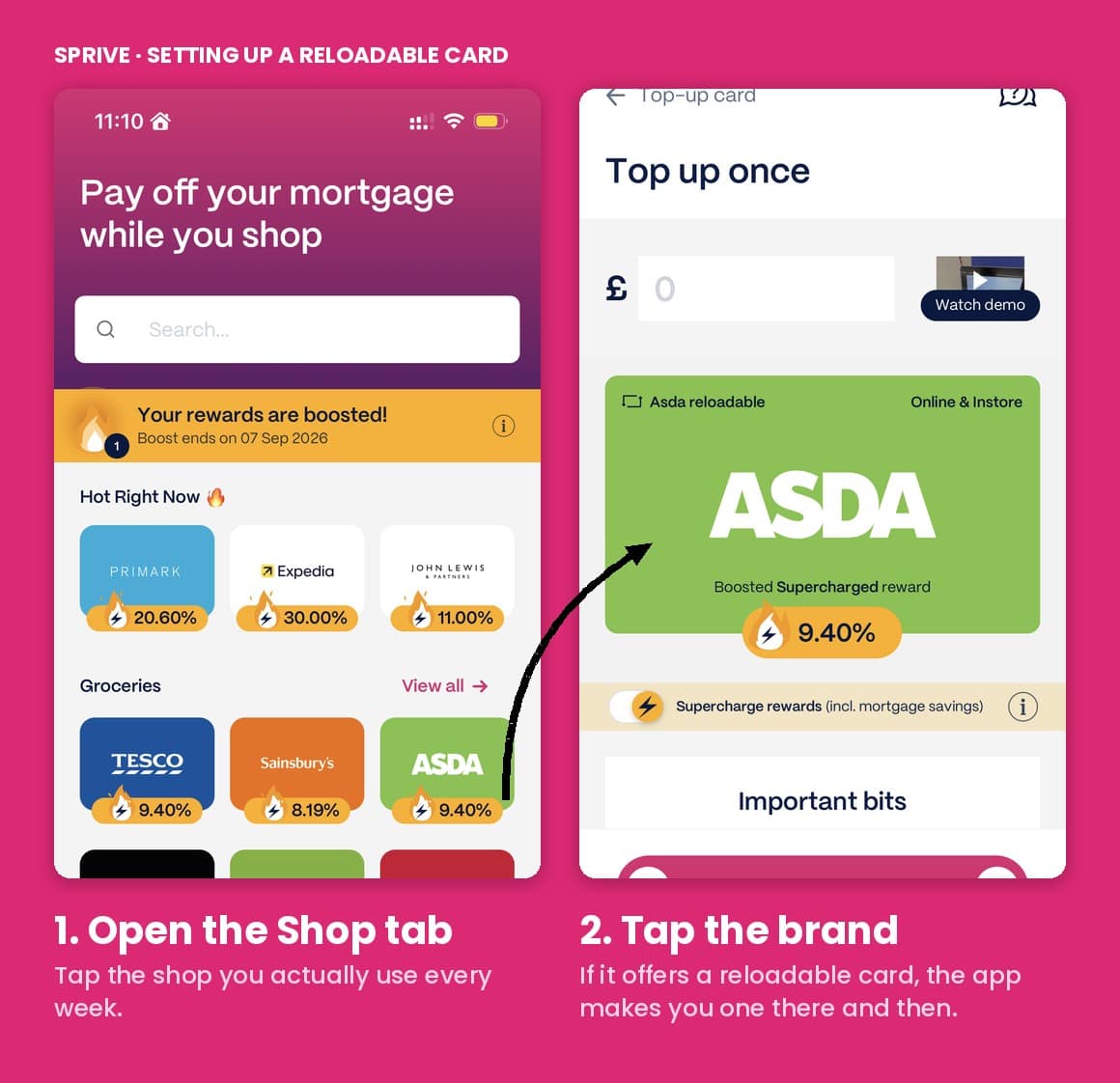
Reward rates vary by brand. Helpfully, the exact rate shows in the app before you buy. For context, Sprive's own shopping calculator assumes an average of about 4% cashback across a typical basket. Some brands sit higher, and some sit lower. So it always pays to check the rate first.
The shiftOne reusable card, not a new card every shop
Here is what actually changed for me. Before, each shop started with a fresh card. I had to open Sprive and pick the brand. Then I typed the amount and bought the card. Finally, I showed it at the till. Every single time. Now, by contrast, I set up the card once. After that, I simply reload it and reuse it. That is the real shift with Sprive gift cards. Because the reloadable card behaves like a normal stored-value card, the checkout friction basically disappears.
Want the wider picture? I cover the rewards mechanic in my guide to how Sprive cashback works. I also cover the supermarket angle in using Sprive for your grocery shop.
Card typesNot every brand offers a reloadable card
This is the bit that caught me out at first, because the Shop tab does not tell you until you tap in. Three different things hide behind those tiles, and Sprive gift cards only come in reloadable form on some of them.
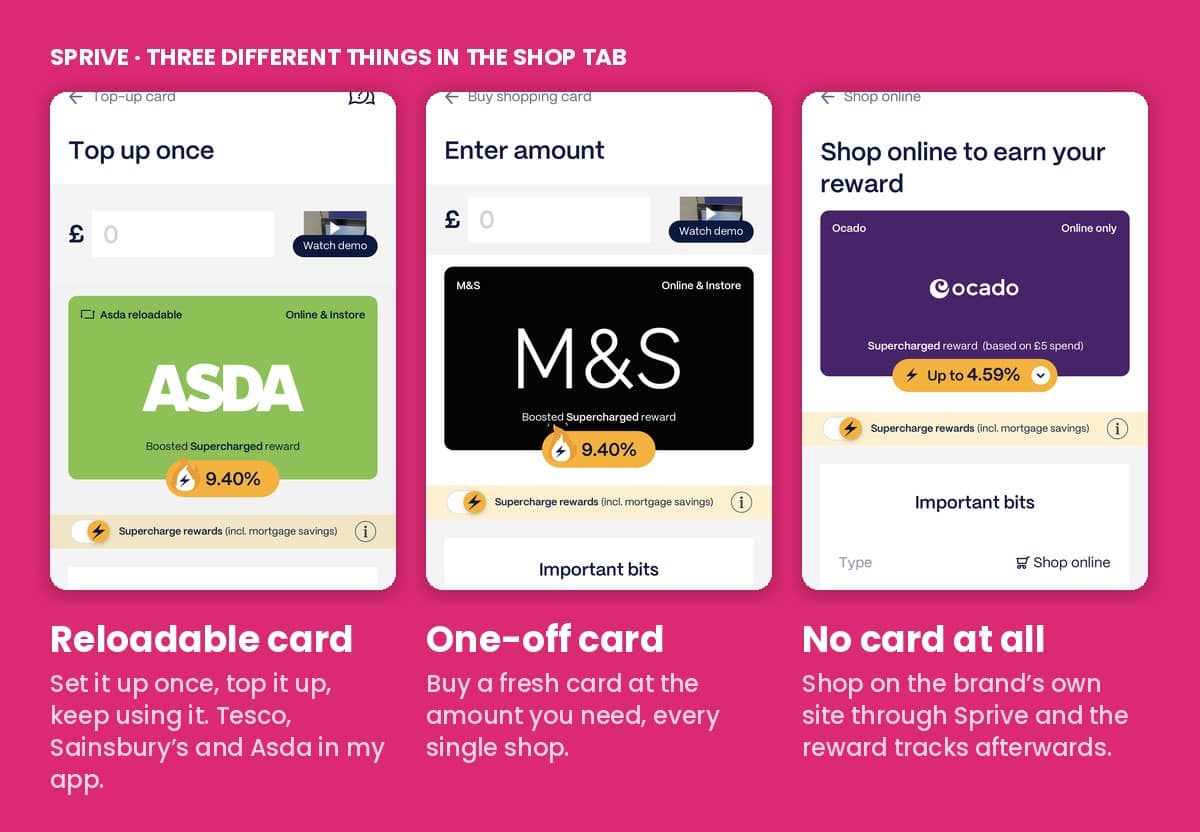
The header at the top of the screen gives it away. In my app, Tesco, Sainsbury's and Asda open on a screen headed "Top-up card", and the card itself carries the brand name followed by the word "reloadable". Those are the ones you set up once and keep. M&S, Waitrose, Iceland and Farmfoods open on "Buy shopping card" instead, so every shop still means a fresh card at the amount you need.
Ocado works differently again, because there is no card at all. Instead, Sprive sends you to Ocado's own site and the reward tracks afterwards, within the number of days the app states on screen. Allow cookies first, or it may not register. Read that screen's terms carefully, too. Sprive states the headline reward is for new Ocado customers on a first order, that existing customers earn less up to their fifth shop, and that nothing is earned after that.
Which brands sit in which group can change, so check before you build a routine around one. For the full list of grocery brands and what each one pays, see our guide to which supermarkets Sprive supports.
WalletAdding the card to Apple or Google Wallet
Next, the bit that feels modern. You can add your reloadable card to Apple Wallet or Google Wallet. That is the same place you keep your bank cards and travel passes. Once it is in there, the card is two taps away. Better still, on iPhone you see the balance right inside Apple Wallet. So you always know what is left before you reach the till.
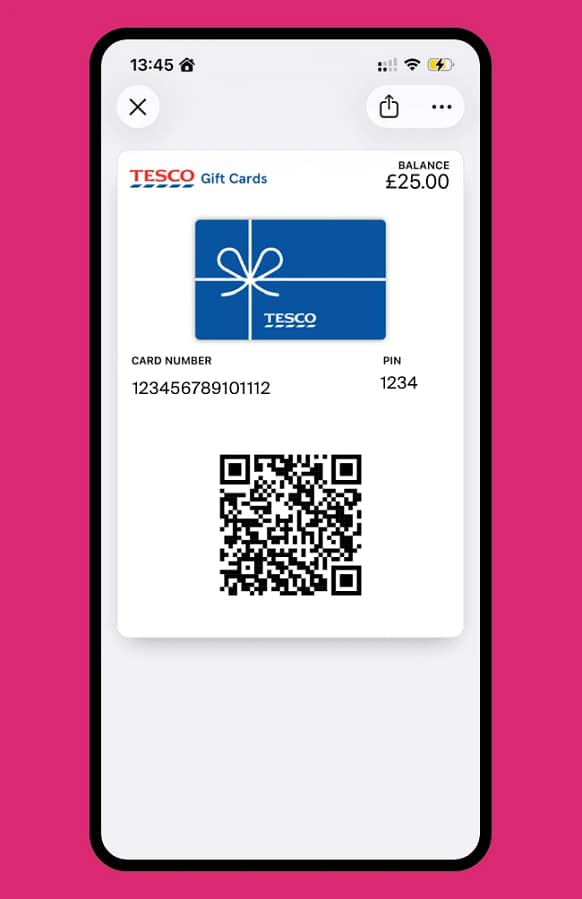
In my experience, this is the quiet upgrade that changes the habit. I no longer open the app to shop at all. The card simply lives in my wallet, ready to go.
Top upTopping up and reusing the same card
Topping up is straightforward. You open the card in Sprive. Then you choose how much to load. Finally, you pay from your linked bank using Open Banking. By default, this is manual, and the app calls it "top up once". So you stay fully in charge of when money goes on the card. The balance then sits there, ready for your next shop. Crucially, it is the same card each time, rather than a stack of one-off codes.
One small note for fairness. If you pay in-app with Apple Pay or Google Pay, Sprive says the reward is slightly lower. That is down to transaction fees. For most people, it is a minor trade-off.
The headline upgradeSmart top-up: the set-and-forget option
This is the part that turns the card from handy into properly smart. On my Sainsbury's card, Sprive offers a tab called "Smart top-up". It runs on a simple rule you control. First, you pick a day of the week. Then, you set an amount. Finally, you set an "if balance below" threshold. On your chosen day, Sprive checks the card. If the balance has dropped below your threshold, it tops up. If not, it leaves the card alone. Therefore, money only moves when you actually need it.
Here is exactly how I set mine up. I loaded £50 to start, which is roughly my weekly spend. Then I opened the Smart top-up tab. I chose Friday as the check day, a £100 top-up and a £20 threshold. Because the card also sits in Apple Wallet, I see the balance and pay at the till. I never open Sprive to shop.
"I only open the app once a week now, and that is just to pay the reward off my mortgage."
Reassuringly, none of this is locked in. You can pause or cancel a top-up at any time. So you stay in control.
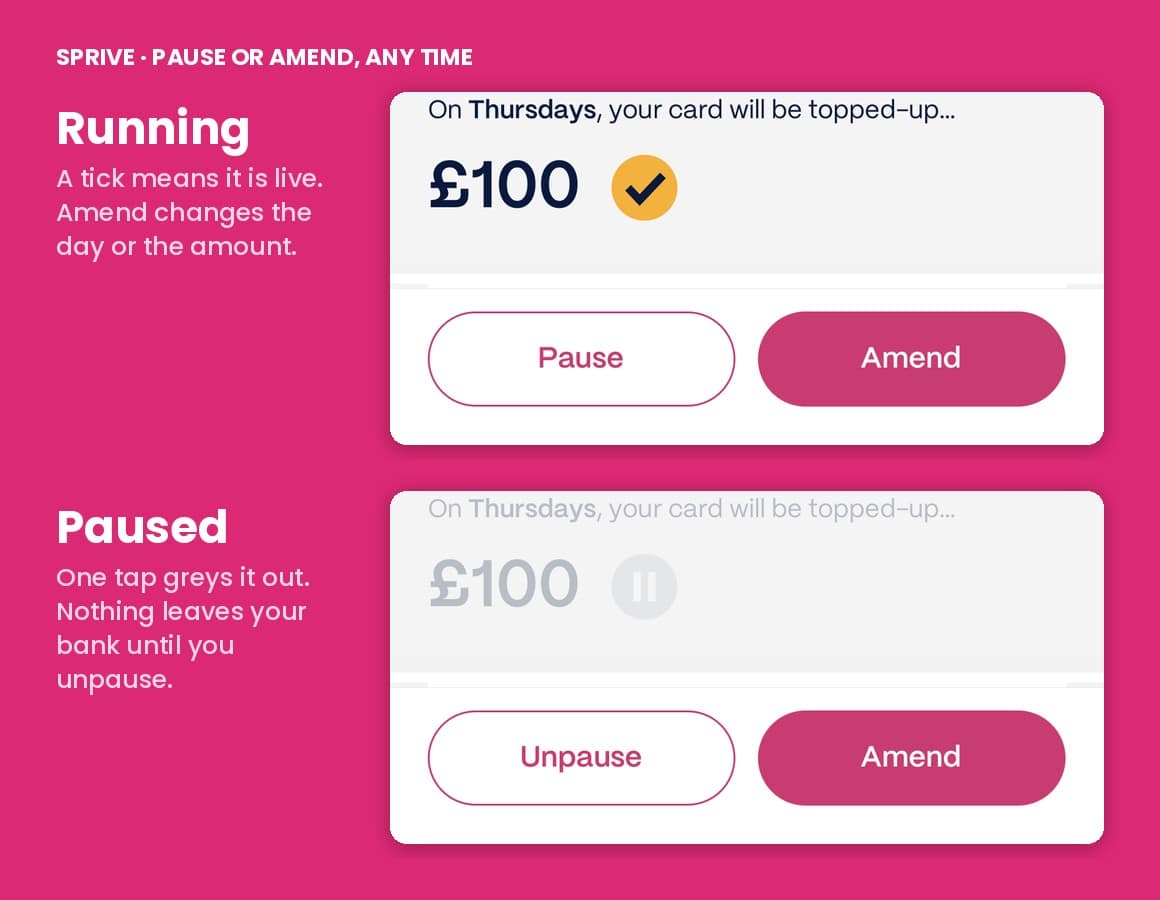
You can also choose which bank funds it. It does not have to be the bank your mortgage is with. Sprive confirms this in its own FAQ. You can link a current account from any supported bank.
In my case, I fund the top-ups from Monzo, my day-to-day current account, even though my mortgage is with Nationwide. If you want the wider comparison, see our guide to the best banking app in the UK. And if you are weighing up Monzo, the current refer-a-friend offer (rewards from £5, up to £50, sometimes up to £100) sits on our Monzo referral page.
Your home may be repossessed if you do not keep up repayments on your mortgage.
Smart vs autoAuto top-up vs smart top-up: know the difference
Now for an important wrinkle. Sprive has three ways to load a reloadable card, and two of them run on their own. Which automatic option you get seems to depend on the retailer. My Sainsbury's card offered Smart top-up. My Tesco card, by contrast, only showed a plain "Auto top-up" tab.
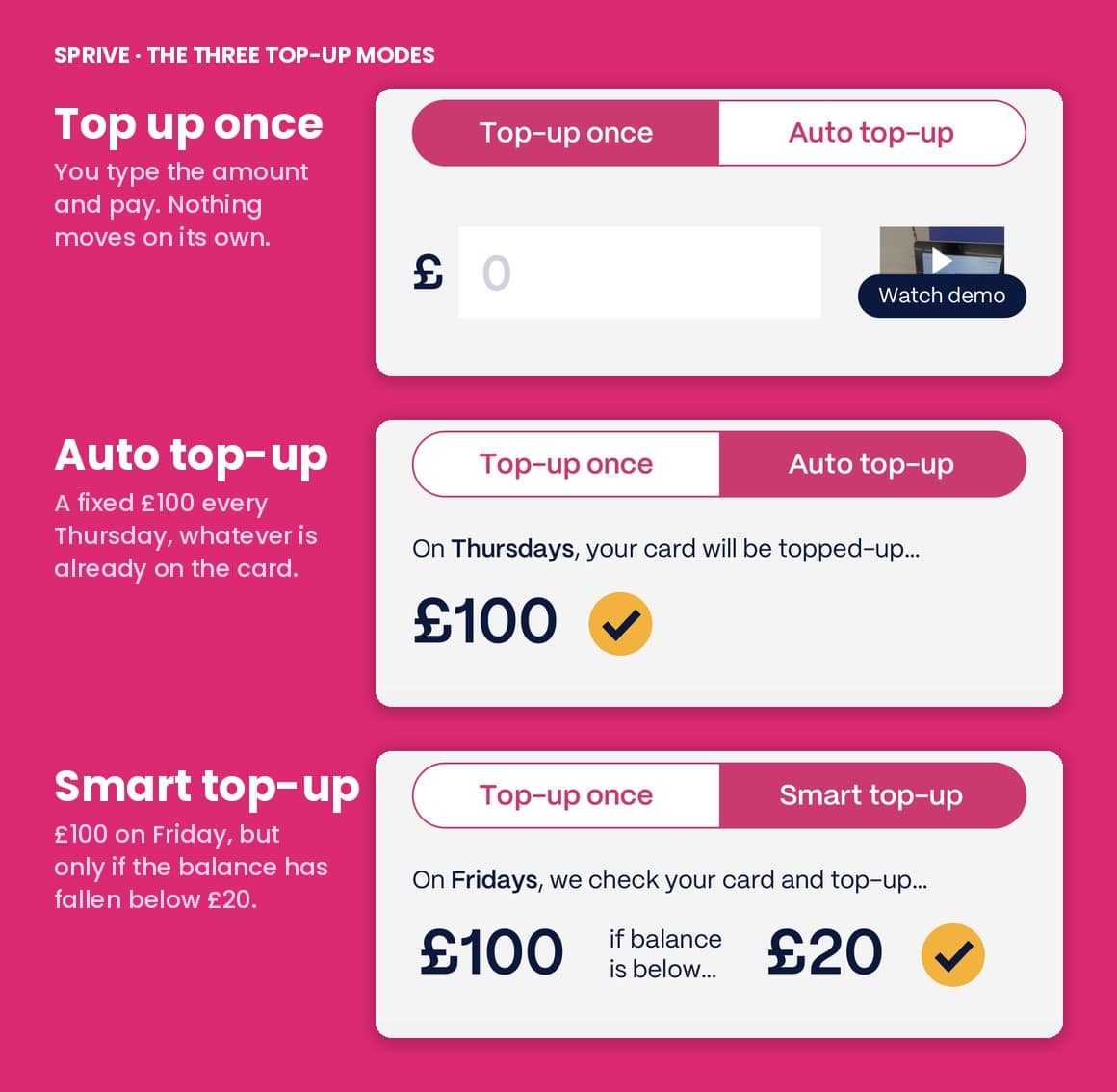
The difference really matters. Smart top-up checks your balance first, then tops up only if you are below your threshold. Auto top-up does not check at all. Instead, it reloads the same fixed amount on your chosen day, no matter what is already on the card. So if you rarely shop at that brand, an auto top-up can quietly stack up hundreds of pounds you are not using. In my experience, smart top-up is the one to choose wherever it is offered. Hopefully Sprive brings the smarter version to every shop in time.
Minimums vary by retailer, so read the screen before you confirm. Both of my cards currently sit at £100, although my Tesco card ran at £25 earlier in the year.
The payoffHow the cashback still pays down your mortgage
The reward works exactly as before, which is the whole point. Each time you buy or top up a card, Sprive credits the reward to your balance. Then, with one tap, you send it to your lender as an overpayment. Nothing about the mortgage side changed. Only the shopping got easier.
For me, the result is a once-a-week ritual. I open Sprive on a Sunday. I tap to pay the reward off my Nationwide mortgage. Then I close it again. Curious what small, regular overpayments do over time? Our mortgage overpayment calculator is a quick way to model it. For the separate auto-saving feature, see my guide to how Sprive AutoSave works.
The honest bitThe honest catches worth knowing
No feature is perfect, so here is the balanced view. First, this really suits supermarkets you use every week. For a shop you rarely visit, like the odd trip to Currys, a reloadable card makes far less sense.
Secondly, mind the plain auto top-up. As above, it does not check your balance, so a weekly reload can build up fast on a brand you barely use. Smart top-up avoids that, yet it is not offered everywhere yet. Either way, £100 is a chunky single reload where that is the minimum, especially if your weekly shop is smaller.
Thirdly, there is retailer anti-fraud. Some retailers, Tesco among them, throw up CAPTCHA checks now and then. A few even lock out customers who buy the same gift card repeatedly. It is usually short-lived, but still worth knowing.
Finally, a couple of practical points. As the screens above show, not every brand supports the reloadable format, so check first. Gift card balances are not protected by the FSCS either. Money in your Sprive wallet is safeguarded e-money via PrePay Technologies, rather than FSCS-protected. In practice, use a balance rather than leave large sums parked on a card. My fuller take on safety sits in my Sprive app review.
Who it is forWho Sprive gift cards suit
So, who does this actually fit? Do you shop at the same supermarket every week? If so, the reloadable card plus smart top-up suits you well. The routine basically runs itself. For weekly shoppers, Sprive gift cards now feel almost automatic. Equally, if you already overpay your mortgage, this is a neat, low-effort way to feed it. On the other hand, your weekly spend might be small or irregular. In that case, a £100 minimum top-up may feel like too much for one card. As ever, it depends on how you shop.
Sprive gift cards: frequently asked questions
Can you add Sprive gift cards to Apple Wallet?
Yes. You can add a reloadable Sprive card to Apple Wallet or Google Wallet. On iPhone, you can also see the card balance inside Apple Wallet. After that, you pay at the till from your phone. You do not need to open the Sprive app.
Can you reuse a Sprive gift card?
Yes, and that is the main upgrade. You no longer buy a fresh single-use card per shop. Instead, you create one reloadable card per retailer, top it up, and reuse it. The same card stays in your wallet.
Does every Sprive brand have a reloadable card?
No. In my own app, Tesco, Sainsbury's and Asda open on a "Top-up card" screen with a reloadable card. M&S, Waitrose, Iceland and Farmfoods open on "Buy shopping card" instead, so each shop needs a fresh one. Ocado has no card at all, because you shop on its own site through Sprive and the reward tracks afterwards. Check the header at the top of the screen to tell which you are looking at.
How do you set up a Sprive reloadable card?
Tap the "Shop" tab in the app, then choose your retailer, such as Sainsbury's. Where a reloadable card is offered, the app creates it for you instead of a single-use one. After that, you can add it to Apple or Google Wallet.
How does Sprive smart top-up work?
You pick a day, an amount and an "if balance below" threshold. On that day, Sprive checks the card. If the balance is below your threshold, it tops up from your linked bank. If not, it leaves the card alone. You can pause or cancel it at any time.
What is the difference between smart top-up and auto top-up?
Smart top-up checks your balance first, then tops up only if you are below your threshold. Auto top-up does not check. Instead, it reloads a fixed amount on your chosen day, regardless of the balance. So smart top-up is the safer, more flexible option where it is offered.
What is the minimum Sprive auto top-up?
Minimums vary by retailer rather than sitting at one figure. Both of my cards currently show £100, although my Tesco card ran at £25 earlier in the year. So check the screen in your own app before you confirm anything.
How do you top up a Sprive card manually?
Open the card in Sprive and choose how much to load. The app calls this "top up once". Then pay from your linked bank account using Open Banking. You can top it up again whenever it runs low.
Is Sprive safe and FCA registered?
Sprive Limited is an appointed representative of Connect IFA Ltd (FRN 441505) and New Leaf Distribution Limited (FRN 460421) for mortgage services, both authorised and regulated by the FCA. Its Financial Services Register number is 919863. Money in your Sprive wallet is issued as e-money by PrePay Technologies Limited (FRN 900010). That money is safeguarded, rather than FSCS-protected, as Sprive explains on its own pages.
Does Sprive cost anything?
No. Sprive is free to use and charges no fees. It earns from shopping rewards, and from commission if you remortgage through the app. It does not earn from you.
The bottom line. Rates, offers and app features can change. So always check the current terms in the app and on sprive.com first. This article is for information only and is not financial advice. For a decision about your mortgage, consider speaking to a qualified adviser. Your home may be repossessed if you do not keep up repayments on your mortgage. This post also contains affiliate or referral links, and CoolCuration is not authorised by the Financial Conduct Authority.
More from CoolCuration
- How to pay off your mortgage faster · practical tactics beyond cashback, plus the tools that help you overpay.
- Airtime Rewards cashback · stack more everyday cashback on top of your Sprive habit.
- Gifts for a new home · ideas for anyone who has just picked up the keys.
- Google Nest Learning Thermostat · a smart-home buy that can trim your energy bills while you trim the mortgage.
What's trending






Recent posts
- Best Audiobooks October 2026: 10 UK Listens Ranked
 Ten new audiobooks for October 2026, from a full-cast Dracula with Jonathan Bailey to Russell T Davies reading his own television memoir.
 - Louis Fratino at David Zwirner ReviewLast updated: 4 October 2026 By Tristan · Arts, exhibitions and creative culture This is an opinion piece. Views expressed are the author's own and do not constitute professional advice. Exhibition reviewMayfair Saunas, subway cars and a lot of skin in Mayfair Louis Fratino at Zwirner is the American painter's first solo show in London,… Read more: Louis Fratino at David Zwirner Review
- What Is a Sprive Boost? Seven Days, and What It Actually PaysA Sprive boost lifts your cashback rate for seven days, and it arrives on its own. What mine paid, and why Supercharge is a display toggle rather than extra cashback.


No Comments.