
Last updated: 6 April 2026
By Tristan · Arts, exhibitions and creative culture
This is an opinion piece. Views expressed are the author's own and do not constitute professional advice.
This article contains affiliate or referral links. If you click through and sign up I may earn a commission or referral bonus at no extra cost to you. It does not affect my editorial view.
Cool Factor: 5/5
The Hurvin Anderson Tate Britain exhibition is one of the most rewarding shows to open in London in years. Bringing together more than 80 paintings that span three decades of work, this major retrospective is a proper feast for the eyes. From lush Caribbean landscapes to intimate barbershop interiors, Anderson's colour-drenched canvases pull you in and refuse to let go. It runs until 23 August 2026, and if you only see one exhibition this year, make it this one.
What is the Hurvin Anderson exhibition at Tate Britain?
This is the first major survey exhibition dedicated to Hurvin Anderson, one of Britain's most important contemporary painters. It opened on 26 March 2026 and runs until 23 August at Tate Britain in Pimlico, London. The show was curated by Dominique Heyse-Moore and Jasmine Kaur Chohan, and it brings together around 80 works from student-era paintings through to brand-new canvases that have never been shown before.
Anderson was born in Birmingham in 1965, the youngest of eight children. His parents had emigrated from Jamaica in the 1960s as part of the Windrush generation. That dual heritage, growing up British while rooted in Caribbean culture, runs through every room of this exhibition. As Anderson himself has described, his work captures the feeling of "being in one place but thinking about another."
First impressions
You enter the show and immediately hit Ball Watching, one of Anderson's earliest works. It depicts a group of friends watching a football in the water at Handsworth Park in Birmingham. Compared with the sun-soaked tropical scenes in later rooms, the palette here is darker and more subdued. However, it sets the tone beautifully. This is an artist who has spent 30 years painting his own experience, and the journey from that park to a monumental airport mural is remarkable.
The opening rooms also feature family portraits and early studies. Bev (1995) shows his sister as both a girl and a woman in the same frame. Hollywood Boulevard (1997) places a young Anderson beside his father. These personal works establish the emotional core of the whole exhibition, and they feel tender without ever tipping into sentimentality.
The Barbershop series steals the show
For many visitors, the Barbershop paintings will be the highlight, and rightly so. Anderson worked on this series from 2006 to 2023, returning to the subject obsessively across nearly two decades. The barbershop motif references a period in the 1950s and 1960s when Caribbean immigrants set up makeshift barbershops in their homes. These spaces became community hubs for conversation, enterprise and belonging.
What makes the Barbershop works so captivating is how they sit between abstraction and figuration. Mirrors, chairs and clippers dissolve into fields of colour and pattern. You can almost hear the buzz of conversation. The textures are incredible up close, with layers of paint building atmosphere that photographs simply cannot capture.
Alongside the Barbershop canvases sits Peter's Sitters II (2009), one of the standout works of the entire show. It depicts an anonymous figure seated on an office chair, seen from behind, draped in a striking red patterned fabric against a vivid blue rectangle. The painting manages to be both intimate and deeply powerful. It holds you at a distance while drawing you into a quiet, charged conversation about identity and visibility.
Caribbean landscapes and the in-between
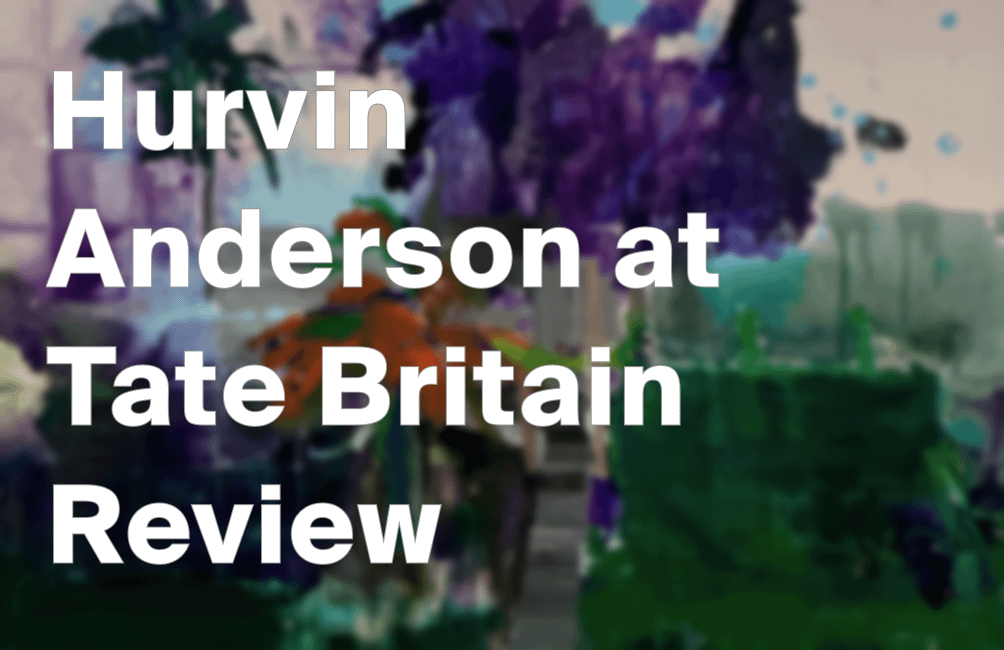
The middle rooms are where the colour really explodes. Anderson's Caribbean landscapes are astonishing, rich with purples, greens and tropical light that seem to glow from within the canvas. Several large-scale works feature palm trees, tropical foliage and reflective water, all rendered with a loose, almost dreamlike quality that blurs the line between memory and observation.
A visit to Trinidad in 2002 was a turning point for Anderson. The country club paintings and beach scenes that followed introduced new architectural elements, with security grilles, fences and screens repeatedly framing the compositions. These barriers do more than structure the image. They complicate access to the scene, reflecting themes of inclusion, exclusion and who gets to belong where.
One enormous green canvas shows two figures in blue garments standing in a lush waterscape, their reflections shimmering beneath them. It is mesmerising. You could stand in front of it for twenty minutes and still find new details emerging from the layers of paint.
Passenger Opportunity and the big moments
A major highlight is the UK debut of Passenger Opportunity (2024-25), a monumental multi-panel work inspired by murals painted by Carl Abrahams at Jamaica's Norman Manley International Airport in 1985. Anderson has reconfigured the imagery to reflect on migration between the Caribbean and Britain from the 1940s to the 1970s. It functions as a loose historical record, but also as something more personal and speculative. The scale is breathtaking.
Then there is Is It OK To Be Black? (2015-16), one of the few works where recognisable figures appear. Semi-abstracted images of Martin Luther King Jr. and Malcolm X occupy the canvas, and Anderson flips the gaze entirely. You become the subject, drawn directly into the conversation. It is a rare, confrontational moment in an otherwise contemplative show.
Value for money
Standard adult tickets cost £18, which is fair for a show of this scale and quality. Tate Members get in free, and 16-to-25-year-olds can access £5 tickets through Tate Collective. Children aged 12 to 18 also go free. Given that there are over 80 paintings across multiple rooms, plus the screening of Handsworth Songs (1986) outside the exhibition for additional context, you are getting serious value here.
If you want to extend the experience, the National Art Pass is worth considering for regular gallery-goers. There is also an exhibition catalogue (£35) and a children's activity book (£7.99) available from the Tate Shop.
The verdict
This Hurvin Anderson Tate Britain retrospective is unmissable. It is rare to see an artist's entire career laid out with such care, and even rarer for every room to feel this alive. Anderson's paintings hold you between places and between times, and by the final room you feel as though you have travelled somewhere far away. Stepping back out onto Millbank, it takes a moment to place yourself again.
Cool Factor
★★★★★
5 out of 5
Overall, a resounding 5/5 Ice cold. The Hurvin Anderson show at Tate Britain blew us away with its sheer range, its extraordinary use of colour and the emotional depth of the Barbershop and Peter's Sitters series. Very few exhibitions manage to sustain this level of quality across 80 works, yet every room here delivers something fresh and moving. There is nothing holding this back from top marks. If you care about contemporary painting, this is essential viewing.
Frequently asked questions
Is the Hurvin Anderson exhibition at Tate Britain worth visiting?
Without question. With more than 80 paintings spanning 30 years, this is a once-in-a-generation retrospective. Whether you are a contemporary art fan or simply enjoy beautiful, thought-provoking painting, there is something here for you. We gave it a full 5/5 Cool Factor rating.
How much are tickets for Hurvin Anderson at Tate Britain?
Standard adult tickets are £18. Tate Members get free entry, and 16-to-25-year-olds pay just £5 through Tate Collective. Children aged 12 to 18 go free. Walk-up tickets are usually available, but pre-booking through the Tate website is recommended.
When does the Hurvin Anderson Tate Britain exhibition close?
The exhibition runs until 23 August 2026. The gallery is open daily from 10:00 to 18:00. There is also a Late at Tate Britain event on 15 May 2026, with workshops, talks and performances inspired by Anderson's work.
Who is Hurvin Anderson?
Hurvin Anderson is a British painter born in Birmingham in 1965 to Jamaican parents. He studied at Wimbledon School of Art and the Royal College of Art. He was shortlisted for the Turner Prize in 2017, and his work is held in major collections worldwide. He is best known for his Barbershop series and Caribbean landscape paintings.
What are the best paintings to look out for?
Key works include the Barbershop series, Peter's Sitters II (2009), the monumental Passenger Opportunity (2024-25), and Is It OK To Be Black? (2015-16). Also keep an eye out for the Ball Watching series and the never-before-seen paintings in the final room.
More from CoolCuration
- Rose Wylie at the Royal Academy - Another unmissable exhibition from a bold and brilliant British painter.
- National Art Pass - Save on exhibitions across the UK with this essential gallery-goer's pass.
- Gift guide for artists and creatives - Curated picks for anyone who loves making or appreciating art.
- The Creative Act by Rick Rubin - A brilliant book on creativity that any art lover will devour.
- Penpot - A free, open source design app that runs in your browser.
What's trending




Recent posts
- Premium Bonds Alternatives UK 2026: Prize Savings Accounts Compared
 Four Premium Bonds alternatives open to new savers, with each provider's published odds, prize tables, access rules and protection.
 - Best Audiobooks October 2026: 10 UK Listens RankedTen new audiobooks for October 2026, from a full-cast Dracula with Jonathan Bailey to Russell T Davies reading his own television memoir.
- Louis Fratino at David Zwirner ReviewLast updated: 4 October 2026 By Tristan · Arts, exhibitions and creative culture This is an opinion piece. Views expressed are the author's own and do not constitute professional advice. Exhibition reviewMayfair Saunas, subway cars and a lot of skin in Mayfair Louis Fratino at Zwirner is the American painter's first solo show in London,… Read more: Louis Fratino at David Zwirner Review


No Comments.