
Last updated: 31 May 2026
By Tristan · Arts, exhibitions and creative culture
This is an opinion piece. Views expressed are the author's own and do not constitute professional advice.
This article contains affiliate or referral links. If you click through and sign up I may earn a commission or referral bonus at no extra cost to you. It does not affect my editorial view.
Cool Factor: 5/5
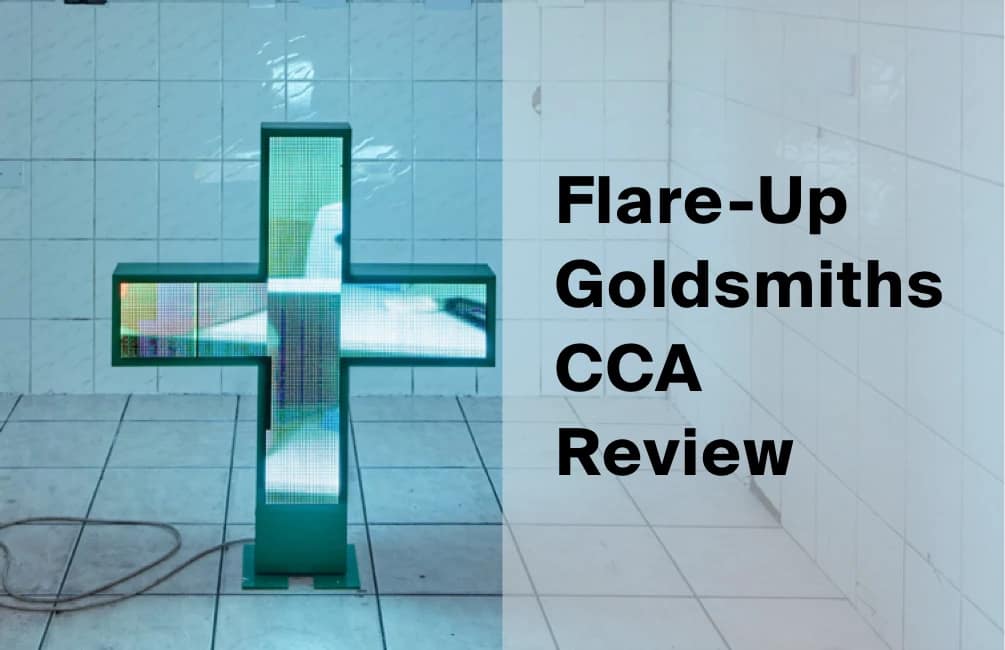
I went to Flare-Up at Goldsmiths CCA on a hot day in late May, and I left certain it is one of the shows everyone should see this year. This Flare-Up Goldsmiths CCA review is my first-hand account of the most ambitious group show on illness, disability, neurodivergence and Deafness that a London institution has yet staged. Nineteen artists. One former Victorian bathhouse, its galleries carved out of the old water tanks and plant rooms. A premise built on the flare itself: the symptom that intensifies, the burst of light, the surge of sound.
Curated by Natasha Hoare and Mariana Lemos, Flare-Up runs from 21 May to 16 August 2026 at Goldsmiths CCA in New Cross, and entry is free throughout. What follows is what I actually saw and felt walking the galleries, a short explainer on crip art for anyone new to the term, the works that floored me, an honest account of what did not quite land, and why it still earns a full Ice cold score from me.
What is Flare-Up at Goldsmiths CCA?
Flare-Up is presented as the first institutional exhibition in London to gather UK-based and international artists whose work engages with the poetics and aesthetics of illness, disability, neurodivergence and Deafness. The roll-call runs deep. Angela de la Cruz, Abi Palmer, Avril Corroon, Bella Milroy, Benoit Pieron, Carolyn Lazard, Christine Sun Kim, Constantina Zavitsanos, Derek Jarman, Felix Gonzalez-Torres, Freestylers, Jamila Prowse, Jesse Darling, Jjjjjerome Ellis, Leah Clements, Lizzy Rose, Park McArthur, RA Walden and Racheal Crowther all feature. That is nineteen artists working across sculpture, installation, painting, film, poetry, music and performance.
The curatorial conceit carries real weight. As co-curator Mariana Lemos puts it, "I'm having a flare-up is a really common phrase that you hear in the crip community". A flare-up, in medical terms, describes the intensification of symptoms in a chronic condition. In music, a flare is a surge in volume. As a signal, it is a burst of light. Crucially, this Flare-Up Goldsmiths CCA review subject holds all those meanings at once. Co-curator Natasha Hoare frames the title as something that "brings light to things that have been kept in the dark, ignored or invisible-ised", adding that "there's a sense of celebration to it, perhaps". Having walked the show, I think that doubled register, pathological and celebratory together, is exactly what makes it sing.
What moved me most, before any single work, was simply the fact of the representation. To see this many disabled, ill, neurodivergent and Deaf artists held together with such seriousness in a major London gallery felt overdue and quietly radical. That feeling stayed with me the whole way round.
So what is crip art?
Since Flare-Up sits squarely in this territory, it is worth pausing on the word "crip", because it does a lot of work here. "Crip" is a reclaimed term, short for "cripple", that disabled communities have taken back from its insulting origins and turned into something defiant and proud. Much like the word "queer", it has shifted from slur to banner. As Flare-Up artist Jamila Prowse has written, it is a word "now defiantly and joyfully reclaimed by some".
Crip art, then, is not simply art made by disabled people, nor is it art about illness as a tidy subject. Rather, it is a way of making and seeing that puts disabled, ill, neurodivergent and Deaf experience at the centre and treats it as a source of insight rather than a problem to be fixed. The performance scholar Carrie Sandahl describes the related verb, "cripping", as something that "spins mainstream representations or practices to reveal able-bodied assumptions and exclusionary effects". In other words, crip art holds a mirror up to a world built for non-disabled bodies and asks why it was built that way.
Practically, this shows up everywhere in Flare-Up. Concepts like "crip time", the way illness and fatigue stretch and fold ordinary clocks, run right through the work. Access is treated as part of the art rather than an afterthought, from audio description to creative captioning. Influenced by queer and feminist thought, crip becomes a flexible framework for thinking and making, not a fixed label. Once you have the word, the whole show clicks into focus.
The setting: a former plant works and water tanks for a public bathhouse
Goldsmiths CCA occupies the former Laurie Grove Baths, a Victorian public bathhouse. Crucially, though, the galleries are not the old bathing halls. Instead, the exhibition spaces are built into the building's former water tanks and plant rooms, the industrial guts that once kept the baths running. The architects Assemble, who won the Turner Prize in 2015, preserved this raw fabric when the building reopened as a gallery in 2018.
As a result, the rooms feel raw and industrial, mostly bare concrete and converted tank spaces rather than a polished white cube. The show runs across six named galleries over two floors, from the Basement Gallery and the Weston Gallery downstairs to the Bridget Riley Gallery and the Daskalopoulos Tank Gallery upstairs. The Tank Gallery name is no accident, since you really are standing inside a converted water tank. Given that water runs as a recurring thread through several of the works, from Clements to Corroon to Lizzy Rose, those origins lend the spaces a charged, slightly subterranean atmosphere that some of the art plays off directly.
Avril Corroon's new commission, Sublet Glory (2026), makes the show's politics visceral. Sited in the Weston Gallery and extending her 2023 project GOT DAMP, it gathers water from dehumidifiers in damp, mould-blighted homes in Dublin and south-east London, then drips it onto a plush carpet. The work ties poverty directly to health, and the slow tap of contaminated water into the space stayed with me. Nearby, Jesse Darling's three-panel altarpiece, The Cleansing of the Temple (Luke 19:46) from 2024, is built from generic white bathroom tiles smeared with dirt, drawing on religious narratives of purification and fears of contagion.
Derek Jarman's Act Up, and the works that floored me
If you see one thing here, see Derek Jarman's Act Up (1992) in the Weston Gallery. As a painting it is outstanding, and standing in front of it is genuinely visceral. Jarman scored the name of the AIDS activist coalition into thick, furious paint, and knowing how unwell he was when he made these late canvases gives the work an almost unbearable charge. It is rage and tenderness in the same gesture. Pieron homages him nearby with seed samples drawn from Jarman's Dungeness garden, which I found a lovely, quiet counterpoint to all that fire.
Upstairs in the Daskalopoulos Tank Gallery, the 40-minute video by Freestylers, the disability-led performance collective, made me emotional in a way I did not see coming. Titled Honey, You Are Art, it threads dance, satirical skits and revelatory monologues into something that turns the challenges its artists have faced into the very engine of their creativity. I sat with it far longer than I planned. If you can time your visit for a live performance, the group will perform in the space on 30 June and 15 August.
I was also thrilled to see Angela de la Cruz represented, with Transfer (Ivory) (2011) in the Bridget Riley Gallery. The physical nature of her work, the way she pushes painting off the wall and into the room as a bruised, bodily object, is always striking. Her use of space and body never fails to land for me. I even spotted de la Cruz herself among the visitors on the day, which felt like a lovely bit of serendipity.
Leah Clements and Pure Joy in the Oak Foundation Gallery
Leah Clements's new commission Pure Joy (2026) has the Oak Foundation Gallery to itself, and it is the show's immersive set-piece. A woman's voice recounts a near-death experience that resists scientific explanation, relayed beneath a large illuminated tarpaulin suspended overhead and weighed down with water, through which light refracts and scatters across the room.
It is moving and emotional, and I appreciated the purity of what Clements is sharing. Honestly, though, I found it hard to fully feel it. The intensity of the darkened room, the projector and the text was a lot for something so intimate, and sitting with strangers in that space made it difficult to surrender to it the way I sensed the work wanted me to. That is not a flaw exactly. Rather, it is the strange tension of being asked to share a profoundly private threshold in a public room. I am still turning it over, which is probably the point.
The HIV and AIDS lineage and the reclamation of crip identity
One of Flare-Up's quieter strengths is how it situates contemporary British practices in dialogue with earlier movements. The influence of HIV and AIDS art and activism runs throughout. Jarman's Act Up is the clearest example, and the show pairs it with work by Felix Gonzalez-Torres in the Weston Gallery, including his 1991 chemo-coloured curtain of metallic beads. As the Guardian noted in its review, activist art of this kind struggled for exposure in Jarman's lifetime, which makes the institutional recognition of the show's younger cohort feel like a genuine shift.
The show also extends the reclamation of crip identity I described earlier into a longer history. Crip pride did not appear from nowhere, and Flare-Up traces it back through queer and feminist activism and the AIDS crisis. Crucially, the show does not impose a single definition. Instead, it holds multiplicity, contradiction and interdependency, which keeps it from collapsing into one tidy thesis.
Language, sound, and access as artistic form
Across the works of Christine Sun Kim, Jjjjjerome Ellis and Bella Milroy, language operates simultaneously as an instrument of state control and as a site of invention. Disfluency, the stammer, silence, mistranslation and creative captioning all become generative strategies. In Sun Kim's Close Readings (2015), in the Clerestory Gallery, sound is rendered visual through captioning that deliberately overwhelms, and I loved how it made me notice my own assumptions about hearing and communication.
What makes the framing here genuinely interesting is how access is treated. Specifically, access is not a tick-box device bolted on at the end. Instead, it becomes a method intrinsic to the work. The gallery backs this up practically too, with audio descriptions of every work available by QR code, BSL tours, relaxed openings and step-free lift access throughout. On the day I went, the access provision felt thoughtful and genuinely woven in, not an afterthought.
Honest critical observations
No show this ambitious is flawless, and a five-star verdict should still say so plainly. My biggest reservation is the building itself. Goldsmiths CCA is hard to navigate, and Flare-Up ends up feeling a little disjointed as a result. You walk down corridors and up staircases with nothing on them, and there is not much to connect one space to the next. For me, that lack of connective tissue is the weakest thing about the show. To be fair, the sound and light from the projected works do echo and bleed around the building, and that accidental drift became its own loose form of flow and grounding. Still, I wanted the spaces to talk to each other more deliberately.
My second reservation is the audio. Having every video play its sound aloud may well be intentional, a deliberate refusal of tidy separation, but in practice the audio bled between works and I found it hard at times to give any single piece my full attention. I also could not quite work out what Park McArthur's red Nike Air Force Ones in the Tank Gallery, part of Extended Fantasy (2023), added on their own. Visitors are invited to try them on, which I did not do, and I assume they feature in an accompanying work, but on the floor they felt surplus to me.
One practical note, too. I visited on a hot day, and some of the rooms were genuinely hard to sit in for long, which matters more than usual in a show that so often asks you to slow down, sit and stay. None of this undoes the achievement. These are the costs of real ambition, not failures of nerve.
A triumph for Mariana Lemos and a very strong show
It is worth saying plainly: Flare-Up is a real triumph for co-curator Mariana Lemos. This is her highest-profile institutional project to date, and it lands with conviction. Lemos has been building toward exactly this for years, with a curatorial practice rooted in disability access and feminist methodologies rather than bolted-on good intentions. She holds an MFA in Curating from Goldsmiths, teaches on the MA Curating and Collections at Chelsea College of Art, and previously curated Leah Clements's solo show INSOMNIA, so seeing Clements anchor a whole gallery here feels like a through-line paying off.
Alongside Goldsmiths CCA Senior Curator Natasha Hoare, who has shaped the gallery's programme since it opened in 2018, Lemos has delivered a show that is both intellectually rigorous and genuinely moving. Writing in Frieze last year, Lemos argued that disabled people were being framed "as unproductive burdens" and insisted they "can, and must, resist". Flare-Up is that argument turned into a building full of art, and it is one of the strongest shows I have seen in London this year.
Why Flare-Up matters now
Flare-Up arrives at a moment when austerity politics and the squeezing of disability support in the UK have made the labour of access ever more visible. As Natasha Hoare observes, the pandemic sharpened this: "We've all realised our vulnerability, and it's really highlighted that pressure in capitalist society to have a productive body and be constantly working." Bella Milroy's drawings on brown DWP envelopes, shown in the Clerestory Gallery, make the connection literal, because those envelopes carry life-altering decisions about who can and cannot work.
Notably, the show sets this urgency within a longer arc. The HIV and AIDS lineage is one strand. The development of artist-led access riders is another, with the late Lizzy Rose's collaboration with Leah Clements and Alice Hattrick on accessdocsforartists.com representing a foundational contribution to rights awareness in UK arts. Rose's own video Sick, blue sea (2018), told from the perspective of a whale that died off the Margate coast after swallowing plastic, is in the Weston Gallery, and it is as oddly funny as it is heartbreaking. Crucially, this is not an exhibition about disability as subject matter. Instead, it argues for disability and illness as generative artistic positions, and that shift is exactly what makes it feel new.
Practical info, access and value for money
Flare-Up runs from 21 May to 16 August 2026 at Goldsmiths CCA, St James', New Cross, London SE14 6AD. Entry is free throughout. Galleries open Wednesday to Sunday, 12 to 6pm, and the nearest station is New Cross Gate, a short step-free walk away on the London Overground.
It was pleasingly quiet when I went, with proper lift access between the basement and first-floor galleries and audio descriptions available throughout. Programmed events during the run include a British Sign Language tour, monthly relaxed viewings on the first Wednesday of each month, Freestylers performances on 30 June and 15 August, and an ACT UP London tour reading the show through HIV and AIDS activism. Full accessibility information sits on the gallery's visitor accessibility page, which I would check before you go.
On value, a free show of this scale and seriousness is rare in London. If you are planning a wider exhibition trip, it pairs naturally with other contemporary shows I have covered, including my Chiharu Shiota and Yin Xiuzhen review at the Hayward, which similarly works across installation, material and international scope.
The verdict and Cool Factor
Flare-Up is rupture and gathering in the same breath, exactly as its title promises. It is rigorous without being airless, political without lapsing into worthiness, and generous in how it treats both its artists and its visitors. The building works against it, the audio bleeds, and a couple of works left me cold. Even so, I walked out genuinely moved, and the sheer fact of seeing this much disabled and ill and Deaf and neurodivergent talent given a serious London stage is something I will not forget.
Cool Factor
★★★★★
5 out of 5
Overall, a clear 5/5 Ice cold. Flare-Up earns it for me by doing something no London institution has quite managed before: building a serious, multi-voiced survey of crip aesthetics that treats access as art rather than admin, and putting representation of this kind centre stage. It is also a real triumph for Mariana Lemos. The disjointed building and the bleeding audio are real, and they are the only things that gave me pause, yet the show does not need to be tidier to be brilliant. It needs to be exactly this brave, and it is. This is a show everyone should see. Go before 16 August.
FAQs about Flare-Up at Goldsmiths CCA
What is crip art?
Crip art centres disabled, ill, neurodivergent and Deaf experience as a source of creative insight rather than a problem to be fixed. "Crip", reclaimed from an old slur much as "queer" has been, signals pride and defiance. The scholar Carrie Sandahl describes "cripping" as spinning mainstream practices to reveal the able-bodied assumptions built into them.
Is Flare-Up at Goldsmiths CCA worth visiting?
Yes, emphatically. I rate it 5/5 Ice cold on our Cool Factor scale. It is London's first institutional survey of illness, disability, neurodivergence and Deafness in contemporary art, and entry is free, so there is little reason not to go.
How much does it cost to visit Flare-Up?
Entry to Flare-Up at Goldsmiths CCA is free. Likewise, the programmed events during the run, including BSL tours and relaxed viewings, are free to attend.
When does Flare-Up at Goldsmiths CCA open and close?
Flare-Up runs from 21 May to 16 August 2026. Galleries open Wednesday to Sunday, 12 to 6pm.
Where is Goldsmiths CCA and how do I get there?
Goldsmiths CCA is at St James', New Cross, London SE14 6AD. The nearest station is New Cross Gate on the London Overground, a short step-free walk away, and there is lift access between floors inside.
Who curated Flare-Up at Goldsmiths CCA?
Flare-Up is co-curated by Natasha Hoare, the gallery's Senior Curator, and independent curator Mariana Lemos. For Lemos in particular, who works around disability access and feminist methodologies, the show is a real career highlight.
Which artists are in Flare-Up at Goldsmiths CCA?
Nineteen artists feature: Angela de la Cruz, Abi Palmer, Avril Corroon, Bella Milroy, Benoit Pieron, Carolyn Lazard, Christine Sun Kim, Constantina Zavitsanos, Derek Jarman, Felix Gonzalez-Torres, Freestylers, Jamila Prowse, Jesse Darling, Jjjjjerome Ellis, Leah Clements, Lizzy Rose, Park McArthur, RA Walden and Racheal Crowther.
More on London exhibitions and the art world
- Flavin Judd at David Zwirner review: my take on the Donald Judd estate show at Zwirner London.
- Hurvin Anderson at Tate Britain review: a major UK painting survey reviewed from the galleries, and one of my 5/5 benchmarks.
- Howard Hodgkin Indian Leaves print: a collectable print edition for fans of late twentieth-century British art.
- Gifts for artists and creatives: curated picks for the makers in your life.
- National Art Pass: how the Art Fund pass works for UK gallery and museum access.
What's trending






Recent posts
- Best Audiobooks October 2026: 10 UK Listens Ranked
 Ten new audiobooks for October 2026, from a full-cast Dracula with Jonathan Bailey to Russell T Davies reading his own television memoir.
 - Louis Fratino at David Zwirner ReviewLast updated: 4 October 2026 By Tristan · Arts, exhibitions and creative culture This is an opinion piece. Views expressed are the author's own and do not constitute professional advice. Exhibition reviewMayfair Saunas, subway cars and a lot of skin in Mayfair Louis Fratino at Zwirner is the American painter's first solo show in London,… Read more: Louis Fratino at David Zwirner Review
- What Is a Sprive Boost? Seven Days, and What It Actually PaysA Sprive boost lifts your cashback rate for seven days, and it arrives on its own. What mine paid, and why Supercharge is a display toggle rather than extra cashback.


No Comments.