
Last updated: 27 August 2026
By Stiv · Design, technology and personal finance
Update, 27 August 2026: this page covers the July to September 2026 cap, which has now been superseded. Ofgem confirmed the next level on 26 August 2026 and it takes effect on 1 October. For the current figures, read our energy price cap October 2026 guide.
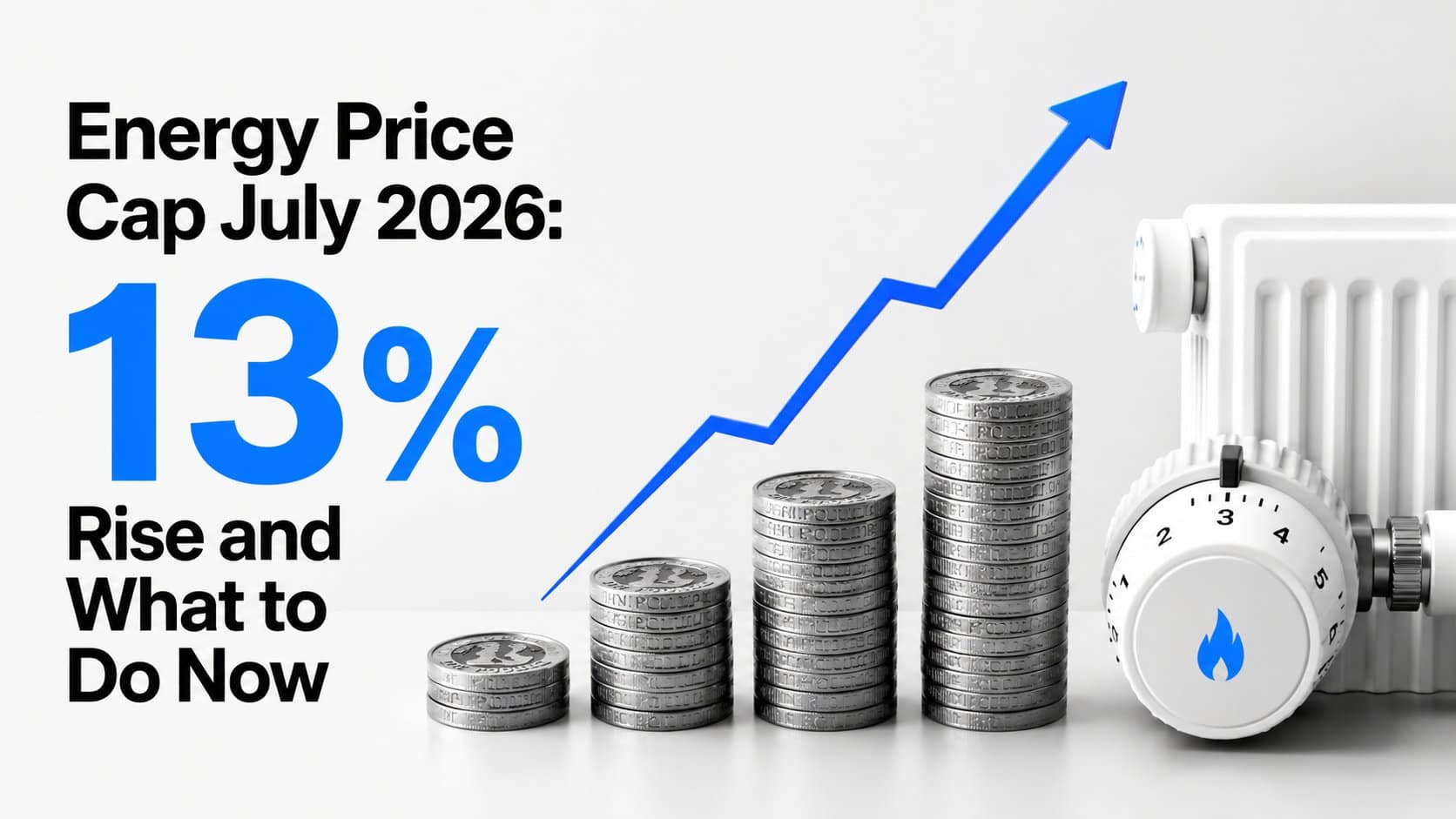
The energy price cap July 2026 is going up by 13% from 1 July, and for a typical dual-fuel household paying by direct debit that means an annual bill of £1,862, which is £221 more than today. In other words, you have roughly five weeks to do something about it before the new rates land. Here is the good bit, though: for most people this rise is voluntary, because a fixed deal below the cap can sidestep it entirely.
This article contains affiliate or referral links. If you click through and sign up I may earn a commission or referral bonus at no extra cost to you. It does not affect my editorial view.
Energy Price Cap Update: 13% increase from 1 July
A typical dual-fuel bill rises from £1,641 to £1,862 a year, about £18 a month more.
You have until 30 June to fix.
cap increase
new annual cap
extra per year
Energy prices, tariffs, and the Ofgem price cap change quarterly. This post reflects the Q3 2026 cap announced 27 May 2026. Always verify current rates with your supplier or at ofgem.gov.uk.
What Ofgem announced
On 27 May 2026, Ofgem confirmed that the price cap for 1 July to 30 September 2026 will rise by 13%. As a result, a typical household using gas and electricity and paying by direct debit will face an annual bill of £1,862, up from £1,641. That is an extra £221 a year, or roughly £18 a month if the level were sustained for twelve months.
Crucially, the cap is not a cap on your total bill. Instead, it limits the unit rates and standing charges suppliers can charge on default and standard variable tariffs. The more energy you use, the more you pay. Furthermore, it only applies to people on default tariffs, so the 40% of accounts (22 million) already on a fixed deal are unaffected by this rise.
The split between fuels matters here. According to Ofgem, gas bills are rising by about 24% while electricity bills are going up by only around 5%. On a per-unit basis the gas jump is even sharper: the gas unit rate climbs from 5.74p to 7.33p per kWh, an increase of roughly 28%. This is the opposite of what we saw during the 2022 crisis, and it reflects the growing share of renewables and nuclear in our electricity supply.
Before and after: Q2 (April to June) vs Q3 (July to September)
Electricity
Unit rate: 24.67p → 26.11p per kWh
Standing charge: 57.21p → 57.19p per day
Gas
Unit rate: 5.74p → 7.33p per kWh
Standing charge: 29.09p → 29.04p per day
Average rates across England, Scotland and Wales, direct debit, including 5% VAT. Source: Ofgem.
What this means in real money
The headline £1,862 is based on Ofgem's idea of a typical home. Your bill will differ, so here is a rough sense of the spread.
A typical household pays about £221 a year more, which works out at roughly £18 a month. However, a high-usage household in a larger home with gas central heating could see something closer to £300 or more added over a year, because the increase is loaded onto the gas unit rate. Meanwhile, a low-usage flat that barely touches the gas might only feel an extra £100 or so. The pattern is simple: the more gas you burn, the harder this lands.
There is also a quirk worth knowing about. From 1 July, Ofgem is lowering its assumption of how much energy a typical home uses (the Typical Domestic Consumption Values), because households are using less. Under those new lower values the headline cap figure is actually £1,663. The £1,862 figure is the like-for-like comparison against the old values, which is why every news outlet is quoting it. Either way, the unit rates you actually pay are the same.
Gas is driving this increase. If your home runs on gas heating, you'll feel this more than most.
Who's affected and who isn't
You are affected if you are on a standard variable or default tariff, which is where you sit if you have never switched or if a previous fixed deal has ended. According to Ofgem, around 33 million accounts are on these tariffs, of which roughly 19 million pay by direct debit.
By contrast, you are not affected if you are on a fixed deal agreed before the announcement, because your unit rates are locked for the term. Prepayment customers have a separate, slightly lower cap, which rises from £1,597 to £1,812. People who pay on receipt of a bill (standard credit) pay more, with their cap going from £1,772 to £2,005.
Not sure which camp you are in? Your latest statement will tell you. If you need a hand decoding it, our guide on how to read your energy bill walks through every line.
What to do before 1 July
This is the part that actually saves money. Four steps, and none of them take long.
Step 1: Check your current tariff. Log in to your supplier account or grab your latest bill. If it says standard variable, default or flexible, you are exposed to the rise.
Step 2: Compare fixed deals. Several fixed tariffs are now priced below the incoming July cap. For example, Uswitch reported the cheapest tariff on its site at £1,651 a year on 29 May 2026, a saving of £211 against the £1,862 cap. Look at the annual cost for your usage, not just the headline rate, and always check exit fees before you commit.
Step 3: Switch. Thanks to Ofgem's faster switching rules, most switches complete within five working days, and your supply never gets interrupted.
Step 4: Consider Octopus. We switched to Octopus over a year ago, and our tariff is fixed below the current cap. Octopus's own Octopus Fixed tariff was priced at £1,780 a year as of late May 2026, which the company says is about £82 below the July cap. It is also a Which? Recommended Provider (for the ninth year running in the 2026 survey) and ranks among the better-rated large suppliers on Citizens Advice, which is the basis for that claim. On top of that, you can grab £50 credit via a referral link when you join.
One caveat worth weighing: fixing locks in your unit rates for the term, so if the cap falls later in the year you could end up paying more than someone who stayed on a variable tariff. Exit fees may also apply if you want to leave early. Fixing buys certainty, not a guaranteed saving, so check the deal suits your usage before you commit.
Switch to Octopus (£50 credit)
If you want to weigh Octopus against another big name first, our Octopus vs OVO comparison lays it out. You can also read about the Octopus Tracker tariff if you fancy following wholesale prices, and check whether you can leave Octopus anytime and whether Octopus is regulated by Ofgem.
Why gas is the problem
The root cause is wholesale gas. Ofgem blames higher wholesale gas prices driven by the ongoing conflict in the Middle East, and the UK still relies heavily on imported gas for heating. So when global gas spikes, our bills follow.
Electricity, by contrast, is barely moving, up only around 5%. That is because more of our power now comes from renewables and nuclear, which loosens the link between the gas price and the electricity price. It is a small but real sign of the energy transition working.
In the long run, the fixes are structural: heat pumps, better insulation and weaning homes off gas. Those are big investments, though. In the short run, the practical move is to lock in a fixed tariff and protect yourself for the next twelve months. For more on the bigger picture, see our piece on the energy profits cap, and for quick wins there is our guide to saving money on winter energy.
What happens next
Ofgem will announce the Q4 2026 cap (covering 1 October to 31 December) by 26 August 2026. Cornwall Insight, an energy consultancy well-regarded for the accuracy of its price cap predictions, expects the October cap to rise by 2% to £1,899 a year, an increase of £27 on the July level. Nothing is certain, though, because wholesale markets can move quickly. Even so, if the conflict eases and prices stabilise, the increase could be modest, but a fall back to spring levels looks unlikely.
Our honest take: fix now, review in twelve months. That way you skip both the July rise and any October increase, and you can reassess when your fix ends. We track every cap announcement on our main price cap page, so bookmark our Ofgem price cap hub to stay current.
Business energy
One important note for business owners: the price cap does not apply to business energy at all. There is no ceiling on commercial rates, which are set entirely by the market and your contract. As a result, being on an out-of-contract or deemed rate can cost far more than a negotiated fixed deal, so the case for switching is arguably even stronger than it is for households. You can grab £75 credit when you move a business account to Octopus.
Switch your business (£75 credit)
For the full walk-through, see our guide on how to switch business energy in the UK.
Can overpaying your mortgage help offset rising bills?
If your bills are creeping up, it is worth looking at the biggest line in most household budgets too: the mortgage. Chipping away at the balance with small, regular overpayments can save thousands in interest over the life of the loan, which in our experience more than offsets a £221 energy rise. Our guide to mortgage overpayment savings runs the numbers, and the Sprive referral page shows how an app can round up and overpay for you automatically.
Your home may be repossessed if you do not keep up repayments on your mortgage. Overpaying reduces your balance but ties up cash you cannot easily get back, so keep an emergency fund first. Sprive Limited (Financial Services Register number 919863) is an appointed representative of Connect IFA Ltd (FRN 441505) for mortgage services. CoolCuration is not FCA authorised and does not provide financial advice.
Energy prices and tariffs change quarterly. The Q3 2026 cap applies from 1 July to 30 September 2026. Ofgem will announce the Q4 2026 cap by 26 August 2026. Always verify current rates with your supplier or at ofgem.gov.uk.
Frequently asked questions
What is the energy price cap from July 2026?
From 1 July to 30 September 2026, the cap for a typical dual-fuel household paying by direct debit is £1,862 a year, a 13% rise on the previous £1,641. Remember, it limits unit rates and standing charges, not your total bill.
How much will energy bills go up in July 2026?
A typical household will pay about £221 more a year, or roughly £18 a month. However, high users with gas heating may pay £300 or more extra, while a low-usage flat might see closer to £100.
Why are energy bills going up again?
Ofgem points to higher wholesale gas prices caused by the ongoing conflict in the Middle East. As a result, gas bills are rising about 24% while electricity is up only around 5%.
Should I fix my energy tariff before July?
For most people on a default tariff, fixing below the cap locks in savings and protects you for twelve months. Just check exit fees first, and bear in mind that if the cap later falls you could pay more than a variable tariff. This is our experience, not financial advice.
Am I affected by the energy price cap increase?
You are affected if you are on a standard variable or default tariff. By contrast, you are not affected if you are on a fixed deal agreed before the announcement. Prepayment customers have a separate, lower cap.
Is Octopus Energy cheaper than the price cap?
Yes. Octopus's variable Flexible tariff has stayed below the cap, and its Octopus Fixed tariff was priced at £1,780 a year in late May 2026, around £82 below the incoming July cap. It is also a Which? Recommended Provider and ranks among the better-rated large suppliers.
What is the energy price cap for prepayment meters?
The prepayment cap rises from £1,597 to £1,812 a year for typical use from 1 July 2026, an increase broadly in line with the direct debit cap.
When is the next energy price cap announcement?
Ofgem will announce the Q4 2026 cap, covering 1 October to 31 December, by 26 August 2026.
More from CoolCuration
- Save money on winter energy — simple ways to cut what you use before the cold sets in.
- Hive smart thermostat — control your heating from your phone and stop heating an empty house.
- Gifts for homebodies — cosy picks for people who would rather stay warm indoors.
- Airtime Rewards — earn cashback on everyday spending to soften rising bills.
- Quidco — stack cashback when you switch services and shop online.
Rates, tariffs and offer terms can change at any time, so always confirm the current position with the provider before acting. This article is for general information and personal experience only and is not financial advice; for advice tailored to your circumstances, consider speaking to a qualified adviser. This article contains affiliate or referral links: if you click through and sign up I may earn a commission or referral bonus at no extra cost to you, and it does not affect my editorial view.
What's trending





Recent posts
- Soho Home Art: The Rise Art Collection and the Artists Worth Knowing
 Soho Home art is chosen by Rise Art and runs from £295 to £10,000. Six artists worth knowing, editions versus originals, and when the member discount pays.
 - Girls Just Wanna Have Funds Review: Our Book of the MonthOur Book of the Month: Girls Just Wanna Have Funds by Female Invest. The friendliest first investing book I have read, and the one place it leaves a UK reader short. Prices, formats and an honest verdict. #BookOfTheMonth #GirlsJustWannaHaveFunds #FemaleInvest #MoneyBooks #UKFinance
- Philips OneBlade Review UK: 4/5 After Five YearsFive years with the same Philips OneBlade. One handle, a new blade every four months, and blades that work out at £1.65 a month. Here is what wore out, which blade I stopped buying, and the one design flaw that will eventually kill it. #philipsoneblade #grooming #shaving #ukreviews #coolcuration



No Comments.