
Last updated: 5 May 2026
By Tristan · Arts, exhibitions and creative culture
This is an opinion piece. Views expressed are the author's own and do not constitute professional advice.
Cool Factor: 4/5
Are We Really Here is a group show that arrives at exactly the right moment. Staged by itinerant London gallery HBH at 67 Great Titchfield Street in Fitzrovia, the show runs from 30 April to 8 May 2026. It gathers 14 artists around a single urgent question: in a world of para-social noise and algorithmically flattened experience, what does it mean to actually be present? For our money, Are We Really Here is one of the sharpest group exhibitions London has seen this spring.
The standout, above all, is Stockholm-born London-based painter Sally Kindberg. She contributes three works: Umbrella Man Special (2026, oil on linen, 91 x 81cm), Muted Corner (2026, oil on linen, 70 x 55cm), and 40 Denier (2025, oil on linen). Together, they are among the most compelling things on show in London right now.
What's On: Are We Really Here at HBH Gallery
Are We Really Here brings together 14 artists: Anna Blom, Anna Sampson, Charlie Soffe, Francisco Valdes, Jazz Grant, Linda Zhengova, Mattia Guarnera, Oleksii Shcherbak, Ruth Gilmour, Sally Kindberg, Thomas Hjelm, Tom White, Victoria Cantons, and Xu Yang. Together, they interrogate the gap between what we see and what we actually receive. The show's framing is intellectually serious but never airless. HBH describes the territory as the "sub-real": a condition that moves beyond the well-documented enshittification of online platforms into something more unsettling. Specifically, it describes a creeping replacement of familiar things with versions that bear only superficial equivalence.
The term enshittification was coined by author and technologist Cory Doctorow to describe the degradation of digital platforms as they prioritise extraction over experience. Are We Really Here extends this idea well beyond tech. Admission is free. The show is open daily at HBH Gallery, 67 Great Titchfield Street, London W1W 7PT, until 8 May 2026.
HBH Gallery and the Venue
HBH Gallery operates as a nomadic, itinerant project with no fixed physical home. It occupies temporary spaces that suit each exhibition, and this approach is, in itself, a curatorial statement. There is something fitting, therefore, about Are We Really Here being staged in a borrowed space. The absence of a permanent address mirrors the show's central anxiety about rootedness, belonging, and the reliability of the things we think we know.
Great Titchfield Street sits in Fitzrovia, close to the creative cluster around Goodge Street and Charlotte Street. It is accessible from Oxford Circus and Warren Street. For a short-run show with no permanent gallery to signal its presence, the location works well: it sits between the commercial and the independent, which suits the exhibition's tone precisely.
First Impressions
Walking into Are We Really Here, you are immediately aware of a deliberate pacing. HBH has designed the space to slow visitors down. There is no single obvious focal point on entry. Instead, the works are distributed to encourage drift and return. This is a clear curatorial choice and it works well.
The scale of work varies considerably across the 14 artists. Some pieces are intimate; others demand time and space. Notably, the hang does not feel crowded, which is a real achievement given the number of contributors. Overall, Are We Really Here has the atmosphere of a show that knows what it wants to say and has found a way to say it spatially.
Sally Kindberg: Umbrella Man Special
Sally Kindberg is, without question, the artist to watch in Are We Really Here. Born in Stockholm in 1970, she has lived and worked in London since completing her MFA at Goldsmiths College. Her career is genuinely impressive: solo exhibitions at Thierry Goldberg Gallery in New York, Duve in Berlin, Everyday Mooonday in Seoul, and Peter von Kant in London. She was shortlisted for the John Moores Painting Prize in 2020 and received the Jerwood Contemporary Painters Prize in 2008. Furthermore, she has shown in group exhibitions at Phillips in London and Rodolphe Janssen in Brussels.
The largest of her three contributions is Umbrella Man Special (2026, oil on linen, 91 x 81cm). The painting shows a figure cropped from chest to upper thigh: a beige jacket, blue trousers, and a wooden-handled umbrella gripped at the centre. There is no head, no face, no ground. A flash of acid yellow catches the left edge. The cropping is characteristic Kindberg: she gives you a body without giving you a person. The result is a painting that is simultaneously familiar and withheld, grounded and slightly adrift.
The technical execution is remarkable. The umbrella handle is rendered in warm, layered wood tones with almost sculptural precision. The soft nap of the jacket fabric sits against the crisp geometry of the handle in a way that is genuinely pleasurable to look at. Yet the composition refuses comfort. The figure has no context, no clear destination. It is here, certainly, but the painting keeps asking whether it is really here. That tension is the show's entire thesis delivered in a single image.
Sally Kindberg: Muted Corner and 40 Denier
The second work, Muted Corner (2026, oil on linen, 70 x 55cm), shifts registers entirely. A squat, dusty-pink rotary telephone sits tilted on a flat acid-green surface. The phone is slightly off-balance, as though it has just been placed down in a hurry or has gently given up. There is no caller, no context, no sound. The object is rendered with the uncanny solidity of a still life but carries the mood of something abandoned.
In her catalogue interview for Are We Really Here, Kindberg describes her approach to reality as a kind of "plat du jour": her version of it changes daily, and she is serving it to you fresh. Muted Corner embodies this perfectly. The telephone is a technology that once mediated the most urgent human contact. Here it sits, muted and inert on its lurid green plinth, simultaneously comic and melancholy.
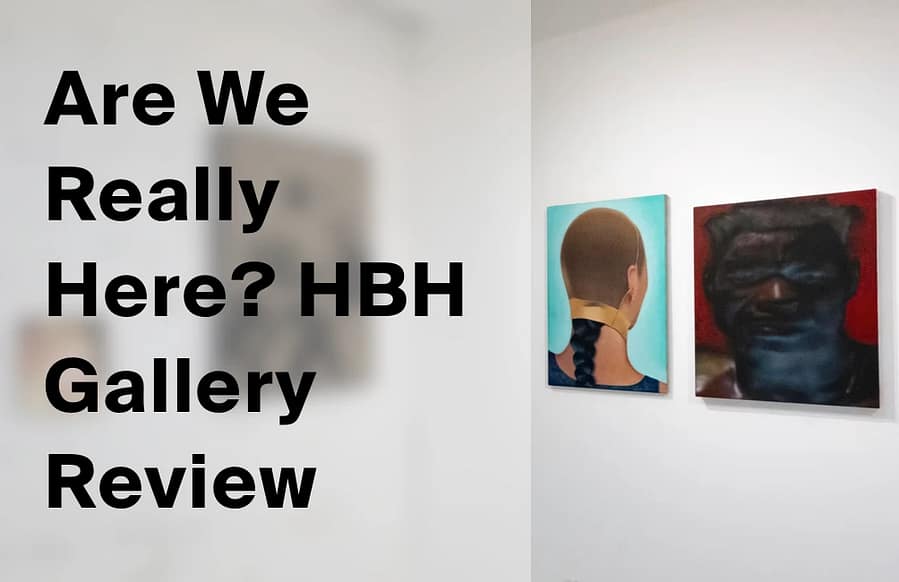
The third work, 40 Denier (2025, oil on linen), is arguably the most arresting of the three. It shows the back of a figure's head against a flat, saturated teal ground: a neat braid running down the neck, a gold neckband cutting across the nape. The title refers to tights fabric. The figure, again, faces away. As Kindberg has noted in the same catalogue interview, we are blind to ourselves from behind: there is always more to a scene than meets the eye. Here that blindness becomes the subject of the painting itself. The work connects directly to Kindberg's longstanding interest in what we cannot see of ourselves and, consequently, what others see that we cannot.
The Show's Thesis: Sub-Real and the Para-Social Dystopia
Are We Really Here borrows the language of enshittification and extends it into something philosophically broader. The show argues that we are now living in a condition where the familiar has been hollowed out and replaced with a superficially equivalent version. The brand is the product. Content is king. Para-social relationships substitute for genuine ones.
This is a convincing premise. Moreover, painting is unusually well-placed to address it. Paint is slow. It is physical. It accumulates through time and decision. It is, by nature, resistant to the logic of the feed. Therefore, a show of paintings that asks whether we are really here makes a formal argument as well as a thematic one.
Kindberg's three works carry this argument with particular force. In the HBH catalogue she describes herself as giving viewers "visual muzak as the world carries on": the idea that her paintings function like the background music piped into lifts and car parks, designed to make you feel comfortable in public. Except, of course, Kindberg's work does not make you comfortable at all. It makes you look twice. That doubling, that refusal to stay put in a single register, is precisely what the show needs from its strongest contributor.
The Other Artists
With 14 artists in Are We Really Here, the show necessarily has moments of unevenness. Nevertheless, there are strong contributions throughout.
Oleksii Shcherbak's work brings a muscular painterly energy to the exhibition. His large-format compositions feel physically present in a way that reinforces the argument about the weight of material experience. Similarly, the contributions of Anna Blom and Victoria Cantons add texture and variation to what could otherwise have been a monothematic hang.
The international range of the group, connecting artists working across London, Berlin, Brussels, and beyond, gives Are We Really Here a breadth that prevents it feeling parochial. For a show staged in a temporary Fitzrovia space over nine days, this is genuinely impressive programming from HBH.
Honest Critical Observations
Are We Really Here is not without its limitations. At 14 artists in a single temporary space, the show asks a great deal of its hang. Inevitably, not every work has room to breathe. Some of the smaller-format pieces risk being read too quickly by visitors still adjusting to the careful pacing the curators intend.
The nine-day run is also a significant constraint. Many people will hear about Are We Really Here only once it has closed. The show deserves a longer window. A strong roster and an ambitious thesis would benefit from more time in front of an audience.
There is, additionally, a risk common to shows with strong curatorial statements: the concept can outpace some of the individual works. Not every contribution responds to the sub-real thesis with equal clarity or conviction. A tighter selection of ten or eleven artists might have made a sharper argument. That said, the overall quality level is genuinely high, and Kindberg's three works alone justify a visit.
Why This Show Matters Now
Shows like Are We Really Here matter because painting is currently having a serious conversation with itself about what it is for and who it is speaking to. Across London this spring, major institutions have staged significant painting exhibitions: Cecily Brown at the Serpentine and Hurvin Anderson at Tate Britain are two standout examples from our recent coverage. Are We Really Here operates on a smaller scale, but its ambitions are comparable. It asks genuine questions rather than simply presenting beautiful objects.
Sally Kindberg, in particular, is an artist whose UK profile deserves to be higher. Her international career, built across New York, Berlin, Seoul, and Brussels, rests on a rigorous and distinctive practice. Her work's tragicomic intelligence, its capacity to hold sophistication and absurdity simultaneously, is directly relevant to the cultural conditions Are We Really Here describes. Furthermore, her three contributions here suggest an artist in a productive and evolving period: the formal precision of Umbrella Man Special and the melancholy restraint of Muted Corner feel like the work of someone pushing deliberately into new painterly territory.
Practical Info: Getting There
Are We Really Here is free to attend. The venue at 67 Great Titchfield Street, London W1W 7PT is accessible from Oxford Circus (Central and Victoria lines), Warren Street (Northern and Victoria lines), and Goodge Street (Northern line). The show runs until 8 May 2026, so there are very few days remaining.
If you visit London galleries regularly, a National Art Pass is well worth having. It provides access to hundreds of exhibitions and permanent collections across the UK. Find out more about the National Art Pass on CoolCuration. Follow HBH Gallery at @hbh_gallery on Instagram for updates on this and future projects.
The Verdict
Cool Factor
★★★★☆
4 out of 5
Are We Really Here is a well-conceived and genuinely absorbing group show. Sally Kindberg's three contributions, particularly Umbrella Man Special and 40 Denier, are the standout works. They encapsulate the exhibition's central tension with characteristic precision, wit, and formal intelligence. The other artists add real range and quality. For a free, nine-day show in Fitzrovia, Are We Really Here punches well above its weight.
Overall, a solid 4 out of 5 Stone cold. Are We Really Here earns its score through an ambitious thesis, strong curation from HBH, and the quality of work from artists like Sally Kindberg, whose practice this show presents at a particularly interesting moment. It misses Ice cold because the short run and the slightly overpopulated hang prevent every contribution from landing with maximum force. Nevertheless, Are We Really Here is among the more interesting group shows in London this spring. Go, and go soon.
Frequently Asked Questions
Where is Are We Really Here taking place?
Are We Really Here is at 67 Great Titchfield Street, London W1W 7PT, presented by HBH Gallery. The nearest tube stations are Oxford Circus, Warren Street, and Goodge Street.
When does Are We Really Here close?
The show runs from 30 April to 8 May 2026. Given the short run, we recommend visiting as soon as possible.
Is Are We Really Here free to attend?
Yes. Admission is free. There is no booking required based on current information from HBH Gallery.
Who is Sally Kindberg?
Sally Kindberg is a London-based painter, born in Stockholm in 1970. She holds an MFA from Goldsmiths College and has exhibited internationally at galleries including Thierry Goldberg in New York, Duve in Berlin, and Peter von Kant in London. She was shortlisted for the John Moores Painting Prize in 2020. Her three works in Are We Really Here are Umbrella Man Special (2026), Muted Corner (2026), and 40 Denier (2025), all oil on linen.
Is Are We Really Here worth visiting?
In our view, yes. It is a genuinely thought-provoking group show with strong work, particularly from Sally Kindberg. The fact that it is free makes it an easy recommendation for anyone in central London before 8 May.
What is HBH Gallery?
HBH Gallery is an itinerant contemporary art gallery based in London. It presents nomadic projects in temporary spaces rather than operating from a fixed address. You can follow its work at @hbh_gallery on Instagram or via hbhgallery.com.
More from CoolCuration
- Hurvin Anderson at Tate Britain: our review of the 5/5 benchmark show
- Cecily Brown at the Serpentine: our full exhibition review
- Amalia Pica: Daisy Chain reviewed
- National Art Pass: the best way to make the most of London's galleries
- Howard Hodgkin Indian Leaves Print: a beautiful edition for art lovers
- Audible: the best way to consume culture on the go
What's trending






Recent posts
- Structured App Review UK 2026: The Day Planner That Sticks
 Our first App of the Month. Structured turns your day into one visual timeline, it is free to start, and Apple made it a 2026 Design Award finalist for Inclusivity. Here is what it does brilliantly and where the paywall lands wrong. #StructuredApp #DailyPlanner #ProductivityApps #AppleDesignAwards #AppOfTheMonth
 - Monzo Perks and Max Price Increase 2026: Every New PriceMonzo Perks goes from £7 to £9 a month and Max from £17 to £19. Here are all the new plan prices, the dates that matter, and the honest maths.
- Which Supermarkets Does Sprive Support?Seven supermarkets. Seven rates. One catch: the cashback never reaches your bank account, it goes straight at your mortgage. Here's exactly what Sprive pays at Tesco, ASDA, M&S and the rest, taken from my own app rather than a press release.



No Comments.