
Last updated: 8 May 2026
By Stiv · Design, technology and personal finance
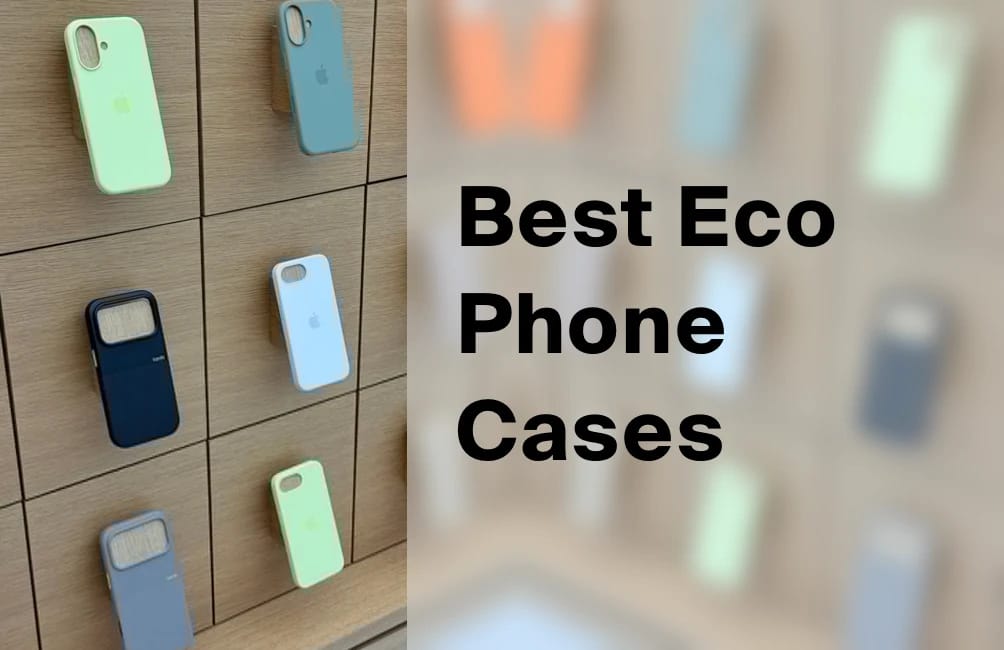
Your phone case is the thing you touch more than almost any other object you own. It's also one of the most frequently replaced accessories on the planet, and most end up in landfill within 18 months. The best ethical phone cases don't have to follow that script. We've tried cheap Amazon eco cases that fell apart in weeks, and we've tried premium ones that lasted years. The price difference is usually about a tenner. That tenner buys you a case that actually protects your phone and doesn't end up as microplastic in the ocean.
So we set ourselves a simple test. Does it look good? Does it protect the phone? And can we actually verify the sustainability claims? If a case ticks all three, it earns a spot on the list.
Some links in this guide are affiliate links. This costs you nothing extra, and it helps support the site.
How we picked the best ethical phone cases
There are roughly 1.4 billion phone cases sold globally every year. Most are virgin plastic, used for a year, then binned when you upgrade. However, a growing number of brands are doing it differently. They're using recycled ocean-bound plastic, compostable bioplastics, FSC-certified wood, and materials engineered to outlast the phone itself. We've split the best ethical phone cases below by material and approach, not by brand, so you can find what suits your priorities. Whether that's compostability, recycled content, durability, or simply a case that looks great on your iPhone 17 or Galaxy S25.
Quick-pick table
| Category | Our pick | From | Material |
|---|---|---|---|
| Best compostable | Pela Classic | £27 | Flaxstic (flax + bioplastic) |
| Best UK-made | Gomi Forever Case | £55 | 100% recycled LDPE |
| Best value | Wave Case | £18 | Wheat-straw bioplastic |
| Best protection | Otterbox Symmetry Core | £35 | Min. 40% recycled plastic |
| Best design | Woodcessories Bumper | £40 | FSC-certified wood + recycled TPU |
| Best premium | Native Union (Re)Classic | £60 | Recycled vegan leather + 100% recycled frame |
Compostable cases
Compostable cases are the closest thing to a guilt-free phone case. They break down at end of life, instead of hanging around for the next several centuries. However, there's a catch. Most compostable cases need industrial composting facilities rather than your garden compost bin. Always check the fine print before you toss one into the brown bin.
Pela Case (£27 to £45)
Pela basically invented this category. Their Flaxstic material blends flax shive (a waste byproduct of flax harvesting) with a plant-based bioplastic elastomer. The result is a flexible, slightly grippy case that genuinely protects your phone. Pela meet both US (ASTM D6400) and EU (EN 13432) industrial composting standards, they're a certified B Corporation, and they're a 1% for the Planet member. Range covers iPhone 17, iPhone 17 Pro, iPhone 17 Pro Max, iPhone Air, the older iPhone 16 series, plus Samsung Galaxy and Pixel. Honest limitation: Pela cases ship from Canada, so the carbon footprint of delivery isn't zero. They also fade slightly with heavy daily use.
agood company (£25 to £35)
Sweden-based agood company built what they call the world's first fully circular mobile case. Made from a blend of hemp, flax, cellulose, PLA and biodegradable PBAT, manufactured locally in Sweden, and engineered to be returned and remade rather than composted. Their agood loop programme gives you 25% off your next case if you send the old one back. We've featured them as a detail page on the site too, so head to our A Good Company mobile phone case page for the full breakdown. Honest limitation: the design is fairly minimalist, so anyone after bold prints might be underwhelmed.
Wave Case (from £18)
The cheapest properly-credentialed case on the list. Made by a North-East England outfit using wheat-straw-derived bioplastic, Wave Case is fully biodegradable, MIL-STD 810 drop-tested, ships in plastic-free recycled mailers, and donates to Surfers Against Sewage via their 250 Club membership. The wheat-straw flecks give every case a slightly different finish. Honest limitation: lighter colours pick up dirt fast, especially from denim. Range mostly covers iPhone, with limited Samsung options.
Casetify Compostable (£55 to £80)
Casetify's compostable line uses Ecotify, a blend of bamboo, starch and biopolymers that meets ASTM-D6400 standards. The Re/CASETiFY recycling programme has reportedly diverted over 2.1 million cases from landfill since 2021. Designs are the strongest of any brand here, with collaborations spanning everyone from Vetements to Gundam. Honest limitation: it's premium-priced, the recycling drop-off points are mostly outside the UK, and a 2021 Pela compost test suggested the case didn't fully break down in their test environment. Worth flagging too, the compostable line has been patchy in 2026. Casetify's own site sometimes shows only AirTag holders rather than phone cases for the model you want, so check stock carefully before getting your heart set on a specific design.
Shop Casetify Compostable on Amazon UK
Recycled material cases
Recycled cases keep existing plastic in circulation rather than pulling new petroleum out of the ground. The number that matters is the recycled percentage. "Made with recycled materials" sounds reassuring, until you realise it might mean only 10%. Always check the spec sheet.
Gomi Forever Case (£55)
This is properly exciting. Brighton-based Gomi launched the Forever Case in late 2025, made from 100% recycled LDPE plastic. Things like plastic bags, bubble wrap and pallet wrap that most UK councils won't take. Each one is hand-pressed in Brighton, so the marbled finish is genuinely unique. The promise is the bit that makes it stand out. Send the case back when you upgrade and Gomi will remelt it into a new case for £20, forever. Currently available for iPhone 16 and iPhone 17 across seven models, MagSafe optional, drop-tested to military grade. We're already fans of their power bank, which has its own Gomi power bank detail page. Honest limitation: it's a small studio, so stock is limited and not every iPhone or Android model is supported yet.
Otterbox Symmetry Series Core / with Magnets (£25 to £45)
Mainstream brand, properly meaningful recycled content. The Symmetry Series Core silicone cases are flecked with reground silicone scraps, and the Symmetry Series with Magnets contains a minimum of 40% recycled content (consisting of 100% recycled plastics). MIL-STD-810 drop-tested to triple military standard, MagSafe and Qi2 compatible, and available across the iPhone 17 family, the Galaxy S25, S25+ and S25 Ultra. Honest limitation: the rest of Otterbox's huge catalogue still uses virgin plastic, so this is a sliver of their range rather than a brand-wide commitment.
Shop Otterbox recycled on Amazon UK
Fairphone (Gen. 6) Protective Case (£25)
If you've gone the whole hog and bought a Fairphone, their own protective case uses 100% post-consumer recycled (PCR) plastics on the back and sides, with FSC-certified paper packaging printed in soy-based ink. It comes in three colours and integrates with Fairphone's modular accessory system. Cardholder, finger loop, lanyard. For Fairphone owners after a fully biodegradable option, German brand Biowaves does a wheat-straw alternative on Amazon UK. Honest limitation: only relevant if you actually own a Fairphone. We covered them in our best phone for every budget guide if you're tempted.
Native Union (Re)Classic Case 3.0 (£60 to £70)
Premium, design-led, and genuinely improved over previous generations. The (Re)Classic 3.0 wraps a 100% recycled polycarbonate frame in a recycled animal-free leather alternative, with a recycled microfibre lining inside. Drop protection up to 6ft / 1.8m, MagSafe compatible, and a precise cutout for Apple's Camera Control button on iPhone 17. There's also a (Re)Clear option made from 100% recycled PCTG and TPU with anti-yellowing coating. Honest limitation: the recycled content is brilliant, but the leather alternative is still a polyurethane-based material, so it isn't biodegradable.
Shop Native Union (Re)Classic on Amazon UK
Natural material cases
Woodcessories (£35 to £55)
German brand Woodcessories has been making real-wood phone cases since 2013, and the range now spans walnut, cherry, FSC-certified hardwoods, plant-based aloe vera leather, and even stone-finish cases. Their Bumper Cases pair the wood face with a recycled TPU frame for proper drop protection (certified to 1.8m), with full MagSafe compatibility. Range covers everything from iPhone X up to the iPhone 17 Pro Max, with Galaxy S26 and OnePlus 15 also supported. Honest limitation: real wood adds weight, lighter colours can pick up oil from your hands over time, and the cheaper Slim Case offers less drop protection than the Bumper.
Shop Woodcessories on Amazon UK
Buy it once, keep it forever
The most sustainable case is the one you never throw away. That principle works two ways. First, premium cases like Native Union, Woodcessories and Gomi are engineered to outlast a phone or two, so you're not replacing a £10 silicone case every six months. Second, the second-hand market is criminally underused for accessories.
eBay and Vinted both have huge stocks of barely-used phone cases, often from people who upgraded their phone after a few months and ditched a perfectly good case with it. Filter by your phone model, sort by lowest price, and you'll typically find premium cases (Casetify, Otterbox, Native Union) for a fraction of retail, with no new manufacturing footprint at all. We routinely buy second-hand tech accessories this way. Combined with a refurbished phone, it's about as low-impact as smartphone ownership gets. Speaking of which, if you've already saved by buying refurbished from somewhere like Back Market (we've written about how to use Back Market with a referral code if that's news to you), it's worth putting some of that saving into a case that lasts.
How to spot greenwashing
Not every "eco" case deserves the label. Watch for these red flags. Vague claims like "eco-friendly case" with no specifics about materials. Statements like "made with recycled materials" that don't state the percentage. No certifications, no third-party verification, and no end-of-life pathway. If a brand can't tell you exactly what the case is made from, where those materials come from, and what happens to it when you're finished, scroll past. Certifications worth looking for include EN 13432 or ASTM D6400 (for compostable claims), B Corp status, 1% for the Planet membership, and FSC certification on any wood content.
Do sustainable phone cases actually protect your phone?
Mostly, yes. Compostable cases tend to be slightly thinner and more flexible, so they're brilliant for everyday bumps but not designed for extreme drops. Recycled-plastic cases often perform identically to virgin-plastic equivalents. Otterbox's Symmetry Series Core, for example, still passes the same triple-military-standard drop test as the rest of the line. If you genuinely need indestructible drop protection (think builders, climbers, parents of small humans), a compostable case probably isn't your best shout. For most people, though, every option on this list will protect against the everyday drops, knocks and scratches your phone is most likely to face.
What about your old case?
If your old case is still functional, list it on Vinted, donate it to a charity shop, or pass it to a friend. If it's at end of life, TerraCycle UK runs a Zero Waste Box programme for mobile phone accessories. It accepts cases of any brand, although you'll need to buy the box. Pela Case will recycle any old case for free if you buy a new one through them. Casetify offers Re/CASETiFY drop-offs (mostly in Hong Kong, the US and a few other markets, so UK users currently need to mail in). What you should not do is throw it in the household recycling. Most cases are mixed plastics or silicone, neither of which UK kerbside schemes accept.
FAQs
What is the most sustainable phone case?
It depends on how you define "most sustainable". For end-of-life impact, fully compostable cases like Pela or agood company score highest. For circularity, Gomi's Forever Case is unbeatable since the same plastic gets remade into your next case indefinitely. For lowest manufacturing footprint, buying any case second-hand from Vinted or eBay beats buying new.
Are compostable phone cases any good?
Yes, generally. Brands like Pela have iterated their materials over a decade, and the cases now offer drop protection comparable to mid-range plastic cases. They're particularly good for everyday use. However, they aren't designed for extreme drop scenarios, so if you regularly destroy phones, a recycled-plastic Otterbox might be a smarter shout.
Do recycled phone cases protect as well as normal ones?
In most cases, yes. Recycled plastic and recycled silicone behave nearly identically to virgin equivalents once moulded. Otterbox's recycled Symmetry Series cases pass the same triple-military-standard drop test as their non-recycled lines, and Native Union's recycled-frame cases are rated to 1.8m drops. The recycled label doesn't mean weaker.
Where can I buy ethical phone cases in the UK?
Direct from the brands above is usually the best route. Pela, agood company, Wave Case, Gomi, Casetify, Woodcessories, Native Union and Fairphone all ship to UK customers. Otterbox is widely stocked on Amazon UK. For second-hand options, Vinted, eBay and Facebook Marketplace are excellent for premium cases at a fraction of retail.
Can you recycle old phone cases?
Not via household kerbside recycling, no. They're typically mixed plastics or silicone, which contaminate the recycling stream. However, TerraCycle UK runs a Zero Waste Box programme that accepts mobile phone accessories, and several brands (Pela, Casetify, Wave Case) offer take-back schemes when you buy a replacement.
What are Pela cases made from?
Pela cases use Flaxstic, a proprietary blend of flax shive (waste from flax farming) and a plant-based compostable bioplastic elastomer. The material is BPA-free, phthalate-free, and certified to both US (ASTM D6400) and EU (EN 13432) composting standards.
Is Casetify sustainable?
Partially. Their compostable line uses bamboo, starch and biopolymers and meets ASTM-D6400 standards. The Re/CASETiFY recycling programme has reportedly diverted over 2.1 million cases since 2021. However, the bulk of Casetify's range is still standard polycarbonate, and independent compost tests on their compostable line have produced mixed results. Worth knowing if compostability is your main reason for buying.
Related reads on CoolCuration
- Best phone for every budget UK: pick the right phone first, then protect it.
- Best refurbished phones UK: bought refurbished? Protect the saving with a case that lasts.
- Best sustainable gifts UK: more sustainable gift ideas for the design-conscious.
- UK-made clothing, why it matters: same principle, applied to your wardrobe.
- Back Market discount code: save on a refurbished phone before you spend on a case.
- Gifts for the carbon-conscious: more thoughtful low-impact gift ideas.
What's trending






Recent posts
- Best Audiobooks October 2026: 10 UK Listens Ranked
 Ten new audiobooks for October 2026, from a full-cast Dracula with Jonathan Bailey to Russell T Davies reading his own television memoir.
 - Louis Fratino at David Zwirner ReviewLast updated: 4 October 2026 By Tristan · Arts, exhibitions and creative culture This is an opinion piece. Views expressed are the author's own and do not constitute professional advice. Exhibition reviewMayfair Saunas, subway cars and a lot of skin in Mayfair Louis Fratino at Zwirner is the American painter's first solo show in London,… Read more: Louis Fratino at David Zwirner Review
- What Is a Sprive Boost? Seven Days, and What It Actually PaysA Sprive boost lifts your cashback rate for seven days, and it arrives on its own. What mine paid, and why Supercharge is a display toggle rather than extra cashback.


No Comments.