
Last updated: 23 May 2026
By Tristan · Arts, exhibitions and creative culture
This is an opinion piece. Views expressed are the author's own and do not constitute professional advice.
This article contains affiliate or referral links. If you click through and sign up I may earn a commission or referral bonus at no extra cost to you. It does not affect my editorial view.
This Stubbs Portrait of a Horse review follows a slow afternoon spent in Room 1 of the National Gallery, where one of British painting's rarest masterpieces is on free display until 31 May 2026. Indeed, this is a small show with a huge centrepiece. Above all, it offers a once-in-a-generation chance to see Scrub, a bay horse belonging to the Marquess of Rockingham, a 1762 portrait that has only ever appeared in public once before. So if British painting, animal art, or sheer ambition on canvas interests you in any way, do not skip this one.
Cool Factor: 4/5
Stubbs Portrait of a Horse review: what's on
Stubbs: Portrait of a Horse runs from 12 March to 31 May 2026 in Room 1, also known as the H J Hyams Room. Admission is free. The show is curated by Dr Mary McMahon, Associate Curator (NG200 Collections), and focuses on a single monumental painting: George Stubbs's Scrub, a bay horse belonging to the Marquess of Rockingham (about 1762). Around this centrepiece, have been placed six finished and working anatomical drawings on loan from the Royal Academy of Arts, plus two later Turf Review pictures featuring the racehorses Dungannon and Mambrino.
Room 1: a small stage for a giant painting
Room 1 sits just off the main entrance hall, well, the former main entrance hall as the only public ways in and out of the gallery are via the Sainsbury wing or smaller east entrance. It is, frankly, not the National Gallery's grandest space. Nevertheless, the modest scale works in the show's favour. Scrub measures around 270 cm (height) x 250 cm wide on canvas. Therefore he fills the wall without having to compete with neighbouring pictures. The room feels, in short, like a chapel built for a single hero. For a free display in a building that usually trades on ticketed scale, this is a quietly confident piece of curation.
First impressions: meeting Scrub
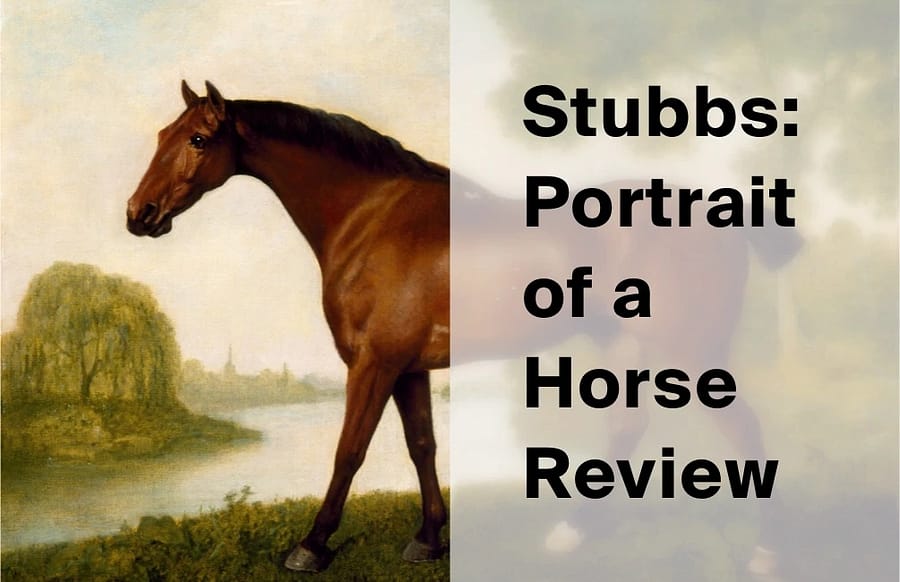
Walking in Scrub rears in a misty English landscape, a river curling behind him, his front hooves carving the air. He is not running. Nor is he being ridden. That still feels radical, even in 2026. Equally radical was the original 1762 decision to paint a horse without a human master in frame. Apollo magazine rightly notes that Stubbs painted horses with "anatomically accurate detail and psychological depth". Standing in front of Scrub, both qualities land instantly.
Scrub up close: anatomy made visible
The closer you get, the more the painting opens up. Stubbs has rendered every vein, every fold of muscle, every glint of damp coat. Look at the front legs in particular. Furthermore, look at the rib cage, where you can almost see the skeleton pushing against the skin. This is not photographic realism. It is something stranger. Stubbs knows where every bone lives because he has handled them himself. As a result, the picture holds a tension between living animal and anatomical diagram. Notably, Waldemar Januszczak in The Sunday Times has even suggested that Scrub is more accurately painted than his famous stablemate (Whistlejacket who hangs on permanent display elsewhere in the NG). On the strength of this visit, we are inclined to agree.
The Horkstow anatomy drawings
To the left of Scrub, on the walls and in a low display case, you find the supporting evidence. Between 1756 and 1758, Stubbs holed up in a remote barn in Horkstow, Lincolnshire. There, over 18 months, he dissected horse after horse. Layer by layer, he peeled back skin, muscle, fascia and ligament, drawing each stage as he went. The resulting treatise, The Anatomy of the Horse, published in 1766, sits open in one of the cases. Crucially, the six original working drawings on loan from the Royal Academy of Arts give the room its scientific spine. They are precise, restrained and oddly beautiful. Moreover, they are evidence of an artist treating dissection as devotion.
The Whistlejacket walk to Room 34
Here is where Stubbs Portrait of a Horse tips into something genuinely special. After spending time with Scrub, visitors are encouraged to walk roughly one hundred yards across the gallery (via the throngs of visitors and the ghastly new wooden seating benches) to Room 34. There hangs Whistlejacket, almost certainly the most famous horse painting in Britain. The two pictures were made in the same year, for the same patron: the 2nd Marquess of Rockingham. Yet they could hardly feel more different. Whistlejacket faces left, riderless, against a flat gold-brown void. In contrast, Scrub faces right, set in a soft landscape with a misty river behind. Seen together, the contrast is electric. Importantly, both horses were originally meant to carry George III on their backs, before Rockingham fell out with the king.
The Turf paintings: Dungannon and Mambrino
Two later pictures round out the room. Dungannon, with a Lamb (1793) shows a champion racehorse standing with a sheep that had wandered into his paddock. It is gentle, slightly comic, and clearly affectionate. Meanwhile, Mambrino (1779 or 1793) is a more conventional racehorse portrait, painted as part of Stubbs's late Turf Review project. That project, commissioned anonymously around 1790, was meant to chronicle fifty years of British racing history. Funding collapsed and only sixteen of the planned portraits were completed. Still, these two surviving examples reveal how Stubbs's reputation evolved into a kind of equine documentary practice. Notably, they also reveal his ongoing interest in comparative anatomy, hence the inclusion of the sheep.
Stubbs Portrait of a Horse review: honest critical observations
No Stubbs Portrait of a Horse review would be complete without saying clearly what the show is not. It is small. One room, one major painting, six drawings, two further works and a book. That is the lot. Furthermore, the wall text feels lean. There is no deep dive into the picture's afterlife at sea, the forger William Wynne Ryland, or the failed attempt to sell Scrub in India. Anyone hoping for a proper survey of Stubbs's full menagerie, including his zebra, kangaroo and rhinoceros, will leave wanting more. The Guardian's Jonathan Jones argued the show deserves "a longer canter", and on that narrow point we cannot really disagree. Stubbs is one of Britain's greatest painters of animal life. Therefore he could easily fill three rooms, not one.
What the wall text leaves out
One genuine gap in this Stubbs Portrait of a Horse review needs naming. The show has nothing to say about the colonial economy these horses lived inside. Rockingham was not a plantation owner. His annual income of around £20,000 came mostly from Yorkshire agricultural rents and coal royalties. Wentworth Woodhouse, his seat, sat atop active collieries. Beyond Yorkshire, he held land in Northamptonshire and a large estate in County Wicklow, Ireland. Politically, he led the Rockingham Whigs and opposed Lord North's American war. Indeed, his successors in the Fitzwilliam line became publicly pro-abolition by the 1807 Yorkshire election. So far, so documented.
However, the picture is not entirely clean. In December 1776, the Marchioness of Rockingham received "a present" of two enslaved teenage boys, Romulus and Remus, from John Wentworth, the ousted Governor of New Hampshire. They played the French horn, and joined the household at Wentworth Woodhouse, where Whistlejacket then hung. The Wentworth Woodhouse Preservation Trust has researched and published this story in full. By 1782, records list both men as paid Footmen with their own chosen surnames. Notably, Remus chose Stanfield, almost certainly after the abolitionist James Field Stanfield. This story post-dates the 1762 commissions of Scrub and Whistlejacket, so it does not fund the paintings. Nonetheless, it sits in the same household.
Equally, Stubbs himself grew up in Liverpool at the height of the slave trade. He also accepted commissions from plantation owners elsewhere in his career. His Horse and Dog Trim, painted for the Jamaican planter G. W. Ricketts, is catalogued openly by the Understanding Slavery Initiative. Furthermore, the Royal Academy has lent six anatomy drawings to this show, and runs a decolonial research project on its own Stubbs collection. Therefore the silence in Room 1 is striking. None of this changes the brilliance of Scrub. However, a serious 2026 exhibition could, and arguably should, find space to say it out loud.
Why Stubbs still matters in 2026
What this Stubbs Portrait of a Horse review keeps coming back to is how modern Stubbs feels once you strip away the wig-and-buckle setting. He treats animals as individuals with character. Moreover, he combines forensic science with empathy, in a way that anticipates today's conversations about animal welfare and our place in the natural world. Curator Mary McMahon argues that Stubbs "fundamentally changed the approach to depicting the horse" in late 18th-century British art. We would go further. In our view, Stubbs invented a way of looking at animals that artists, photographers and filmmakers still reach for today. Notably, his pairing with the ticketed Joseph Wright of Derby exhibition in the NG makes that point even more strongly. Together, the two shows sketch a Britain in which science and art were not separate kingdoms.
Value for money and visiting tips
Free is free. Therefore this is, on a pure cost-per-masterpiece basis, one of the best art tickets in London right now. If you plan to combine it with the ticketed Wright of Derby show in the Sunley Rooms (running until 10 May 2026), you can stretch the visit into a full afternoon. For frequent gallery-goers, a National Art Pass is worth considering if you visit several London and regional exhibitions each year. Furthermore, weekday mornings tend to be quietest. We recommend arriving when doors open at 10am, walking straight to Room 1, then taking your time at Whistlejacket before grabbing a coffee in the Espresso Bar. In short, this is high-impact culture on a small budget.
Stubbs Portrait of a Horse review: practical info
The National Gallery sits on Trafalgar Square, with Charing Cross and Leicester Square Tube stations a short walk away. Opening hours run from 10am to 6pm daily, with extended hours on Fridays. Step-free access is available via the Sainsbury Wing and Getty Entrance, and accessible toilets are on site. Members get advance access on preview days; non-members simply walk in. Crucially, the exhibition closes on 31 May 2026, so do not leave it too late. Always check the official National Gallery exhibition page for the latest opening hours and accessibility info before you travel.
The verdict
Our Stubbs Portrait of a Horse review lands at a confident 4/5 Stone cold. It is rare, beautiful, free and unrepeatable. Yet the limited scope, and the missing colonial context, hold it back from a perfect score. This Stubbs Portrait of a Horse review sums up the Cool Factor at a glance below.
Cool Factor
★★★★☆
4 out of 5 — Stone cold
Overall, this Stubbs Portrait of a Horse review earns a solid 4/5 Stone cold. The exhibition blew us away with the sheer presence of Scrub, the brilliance of the anatomy drawings, and the rare gift of seeing two Rockingham horses in dialogue across the building. However, it did not quite reach Ice cold because one room simply is not enough room for Stubbs's full genius, and because the wall text sidesteps the colonial story sitting next door to it. If you only have an hour in central London this spring, spend it here. After all, you will not see Scrub in public again any time soon.
FAQs
Is the Stubbs Portrait of a Horse exhibition free?
Yes, entry to Stubbs: Portrait of a Horse in Room 1 of the National Gallery is free for all visitors. No booking is required, although the gallery does recommend timed booking for accessibility on busier days.
When does Stubbs: Portrait of a Horse close?
The exhibition runs until Sunday 31 May 2026. After that date, Scrub returns to its private owner and is unlikely to be seen in public again for many years.
Where can I see Whistlejacket during the show?
Whistlejacket continues to hang in Room 34, roughly one hundred yards from Room 1. The National Gallery recommends visiting both paintings on the same trip to feel the full impact of the original Rockingham commission.
How does this Stubbs Portrait of a Horse review compare to other recent National Gallery shows?
This is a tighter, more focused display than something like a Constable retrospective. Nevertheless, it sits comfortably alongside the ticketed Joseph Wright of Derby exhibition upstairs, and together they offer one of the strongest pairings in London this spring.
Did the wealth behind Whistlejacket and Scrub come from slavery?
Not directly. The 2nd Marquess of Rockingham, who commissioned both paintings in 1762, was a Yorkshire landowner whose income came chiefly from agricultural rents and coal royalties, not plantation ownership. However, his household at Wentworth Woodhouse later included two enslaved teenagers, Romulus and Remus, sent as a "gift" in 1776. The Wentworth Woodhouse Preservation Trust has documented this story in full. Stubbs himself grew up in Liverpool during the slave trade era and accepted other commissions from plantation owners over his career.
Is the exhibition suitable for children?
Yes. The room is small, calm and uncrowded, which makes it ideal for younger visitors with limited attention spans. The anatomy drawings are also a brilliant way to start a conversation about how artists learn to see.
How much time should I budget for the visit?
Plan for around 30 to 45 minutes in Room 1, followed by 15 minutes with Whistlejacket in Room 34. If you add the Joseph Wright of Derby exhibition, you can comfortably spend a full half-day.
Discover more on CoolCuration
- Hurvin Anderson at Tate Britain review — our 5/5 Ice cold benchmark, and a useful reference for what an Ice cold show actually feels like.
- V&A East Museum review — a first look at London's newest major museum and how it stacks up against the original V&A.
- Tracey Emin at Tate Modern review — our take on her "A Second Life" show, for fans of personal, raw, contemporary work.
- Gifts for artists and creatives — handpicked presents for friends who love a sketchbook as much as a finished frame.
- Great Women Artists book — Phaidon's brilliant survey of women painters often missed by the standard canon.
What's trending






Recent posts
- Mobbin New August 2026: What’s New on Mobbin This Month
 Last updated: 5 August 2026 By Stiv · Design, technology and personal finance This post contains affiliate or referral links. If you click through and sign up I may earn a commission or referral bonus at no extra cost to you. It does not affect my editorial view. Mobbin / Design LibraryAugust 2026 Edit What's… Read more: Mobbin New August 2026: What’s New on Mobbin This Month
 - Whistler Tate Britain Review: The Fullest Survey in 30 YearsOur Whistler Tate Britain review: nine rooms, the Nocturnes reunited and the etching room that invented the white cube. Budget for two visits, not one.
- Best Free Budgeting Apps UK 2026The best free budgeting apps in the UK for 2026, compared: what each free tier really includes, what is paywalled, and who each app suits.


No Comments.