
V&A East Museum Review: Opening Day First Look
Last updated: 20 April 2026
By Tristan · Arts, exhibitions and creative culture
This is an opinion piece. Views expressed are the author's own and do not constitute professional advice.
This article contains affiliate or referral links. If you click through and sign up I may earn a commission or referral bonus at no extra cost to you. It does not affect my editorial view.
Cool Factor
★★★★★
5 out of 5 · Ice cold
Our V&A East Museum review comes straight from opening day, Saturday 18 April 2026. And we came away grinning. London does not get a brand new major museum very often. So when this one arrived in Stratford, we cleared the diary and went.
A decade in the making, this is the V&A's newest outpost. Crucially, it is the final piece of the East Bank cultural district. And it lands with genuine ambition. Here are our honest first impressions of the building, the free galleries, the ticketed opening show and the cafe.
What's on at V&A East Museum
V&A East Museum sits on Waterworks River in Queen Elizabeth Olympic Park. Its address on Carpenters Road now hosts the BBC, Sadler's Wells East and London College of Fashion too. Inside the five-storey, 7,000 square metre building, the Why We Make galleries fill two free permanent floors. Then, on the top floor, a rotating temporary exhibition space completes the picture.
The inaugural paid show is The Music is Black: A British Story, which runs until 3 January 2027. Tickets start from £20 on weekdays and rise to £24.50 at weekends. Also, under-26s pay from £10, under-18s go free, and V&A members get in for free.
Downstairs sits Cafe Jikoni, a new outpost of Ravinder Bhogal and Nadeem Lalani Nanjuwany's much-loved Marylebone restaurant. Outside, Thomas J Price's five-metre bronze sculpture A Place Beyond greets you on the waterfront. The figure shows a young woman with a mobile phone, gazing out towards the horizon.
Crucially, entry to the museum and the permanent galleries costs nothing. That detail is worth repeating, because it changes how you plan the visit and who feels welcome.
First impressions
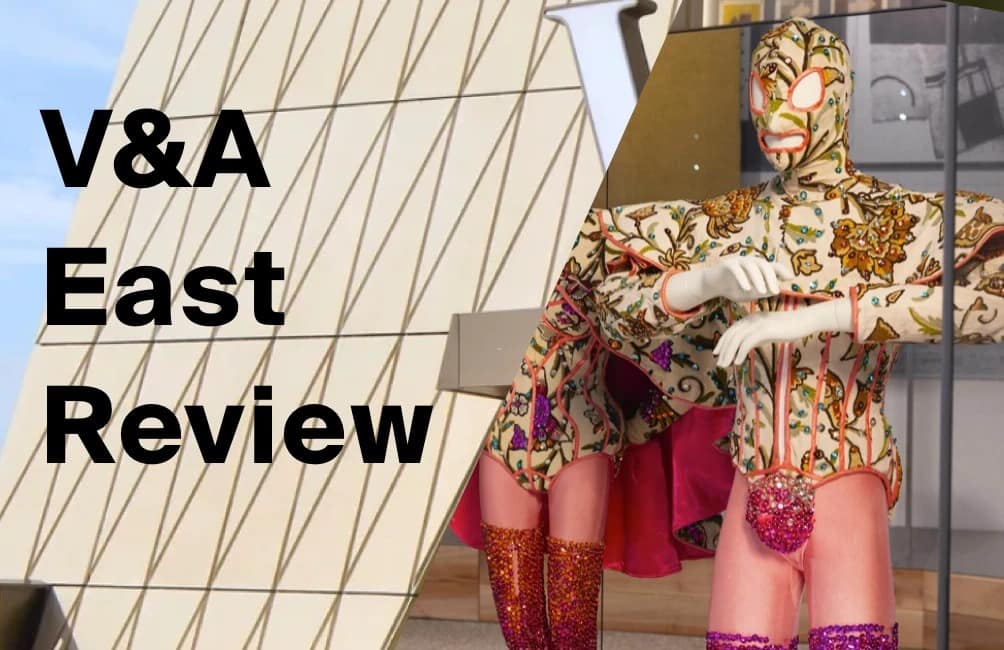
Opening day felt genuinely emotional. The queue moved quickly, staff looked delighted, and the building does its job immediately. From the outside, the sandy concrete facade folds and pleats like origami, or a piece of couture tailoring. That is not an accident.
Architect John Tuomey has spoken about his starting point. It was the sleeve of a Vermeer painting. He was thinking about "the fabric that clothes you, the body that's sheltered, the space in between". Also, the building references X-rays of Balenciaga dresses from the V&A's 2017 show. Once you know that, you cannot unsee it.
Outside, up close
Up close, 479 pigmented concrete panels stitch the facade together. Each one carries linear patterns that echo the V&A's famous logo. Also, a few panels double up as outdoor seating on the waterfront, which is a small, generous touch. Meanwhile, the V&A lettering at the top catches the sunlight. It reads almost like signage for the whole park. In fact, the whole thing feels civic rather than corporate.
Inside the atrium
Inside, the vibe is modern, airy and unfussy. White walls and robust terrazzo floors let the objects do the talking. Meanwhile, the main staircase cranks through the atrium like a set from a German expressionist film. It gives you somewhere to sit, perch, people-watch and mentally map the journey up.
On the top floor, the public terrace offers one of the best new views in east London. From there, you can see the Olympic Park, Westfield, and on to the old city skyline. In short, it feels like a V&A, but a younger, scruffier cousin. The kind who grew up closer to the action.
The permanent galleries: Why We Make
The Why We Make galleries are the real gift. They span two floors and hold roughly 500 objects from the V&A collection, plus new acquisitions. Also, they follow themes like identity, wellbeing, social justice and environmental action. Crucially, they are free to browse.
Senior curator Zofia Trafas White describes them as "a new way in to experiencing the V&A's collection". In practice, that rings true. The curation is thematic rather than chronological, which works brilliantly.
Ground floor highlights
For example, take the hot-pink Molly Goddard Daria dress that Beyoncé wore. It stands guard at the entrance. Next to it, a 16th-century Sofonisba Anguissola self-portrait copy hangs. Then a 1988 Maud Sulter photograph of Lubaina Himid joins them. Meanwhile, a William Morris print pairs with a Walthamstow FC shirt in the same "Yare" design. Also on show: delicate Alexander McQueen dresses, punky Vivienne Westwood ensembles, and 18th-century silk gowns from Spitalfields. Finally, a zinging constructivist rug by Eileen Gray rhymes with Derek Jarman's punk set designs across the room.
Then there is Leigh Bowery and Mr Pearl's outrageous pink-sequinned codpiece. Mr Pearl made it for the 1987 Michael Clark ballet Because We Must. It hangs alongside an impromptu video of the performance. So yes, it is serious, silly and sharp all at once. Frankly, it steals the room.
Display cases and signage
Jayden Ali of JA Projects designed the display cases. He worked with artist Larry Achiampong and graphic studio A Practice for Everyday Life. And London market stalls and shopfronts inspired the whole approach. Illuminated fascias echo high-street signage. Meanwhile, some cabinets come from salvaged London plane trees.
The V&A East Youth Collective also shaped the wayfinding. The group gathered 16 to 24-year-olds from Hackney, Newham, Tower Hamlets and Waltham Forest. Together, they developed the bespoke typography and illuminated signs. Crucially, you can feel that local fingerprint throughout.
Upstairs, things turn political
Climate activism banners from Extinction Rebellion and Greenpeace fill one wall. Next to them hangs an Egyptian textile that Hany 'Abd al-Kader made in secret. It documents the 2011 uprising. Also on show: posters from the Tower Hamlets Federation of Tenants and the See Red Women's Workshop. And nearby, Arakawa and Gins' model for a "life-extending villa" sits with an Alvar Aalto sanatorium chair.
Newer voices get room too. For example, VIN + OMI show stinging-nettle eco-textiles, and Richard Malone has an ensemble on display. Lazy Oaf's collaboration with illustrator King Owusu also features. Finally, Jamie Hawkesworth's photographs of Preston Bus Station get the wall space they deserve.
The pace is deliberately slow. A sign near the entrance reads "don't feel you have to see everything today". In short, a good museum gives you permission to skip things. And because entry is free, you can treat this as a place to pop back to. No need to grind through it in a single afternoon.
The Music is Black: A British Story
The Music is Black: A British Story charts 125 years of Black British music-making. Jacqueline Springer curated it. The show runs from composer Samuel Coleridge-Taylor in 1900 through to Little Simz, Skepta, Sampha and Shy FX now. Crucially, four thematic acts structure the experience. First, you move through origins and 20th-century Britain. Then the show lands in lovers rock, Brit funk and 2 Tone. Finally, it takes you to jungle, drum and bass, UK garage, grime, drill and afrobeats.
How the exhibition works
Staff hand you wireless headphones with sensors on top. These detect which object you stand next to, and play the relevant music. Sennheiser designed the sound environment. And when it works, it is magic. For example, stand in front of Skin's "Clit Rock" suit while Skunk Anansie roars in your ears. It is unforgettable.
Janet Kay's "Silly Games" lifts the lovers rock section too. Meanwhile, Sade, Steel Pulse and a Shirley Bassey gown all get their moment. And so do signs from legendary venues like 4 Aces and Blue Note.
Objects worth queueing for
The object selection is extraordinary. First up, Winifred Atwell's piano sits beside Joan Armatrading's childhood acoustic guitar. Atwell was the first Black artist to reach a UK number one. Meanwhile, Jme's original Super Nintendo sits nearby. He first experimented with beats on it, long before Boy Better Know.
Also on display, the museum shows new photographs of Kemistry and Storm, Mis-Teeq and Skepta. Photographers Jennie Baptiste, Beezer, Dennis Morris, Eddie Otchere and Sam White shot them. Plus DJ Paulette's customised stagewear, LR Vandy's sculptural rock-and-roll tribute, and a Stormzy Union Jack stab vest that Banksy painted. Every one of them lands hard.
That Stormzy vest deserves its own paragraph. Banksy made five of these from real police body armour. Remarkably, one sold for seven figures at Sotheby's in 2024. This one sits in its glass case near the exit, almost apologetically. And it is extraordinary. Up close, it is genuinely disorienting. In fact, it works as a bulletproof collage about Black life in Britain. Music, violence, protest, patriotism, all in one object.
If the exhibition leaves you wanting more, try our companion guide. It rounds up the best Black British music audiobooks on Audible to pair with the visit. For example, Dan Hancox covers grime, and David Olusoga gives you the longer historical arc.
Honest niggles
Honesty time, though. The headphone system occasionally crosses wires when rooms are busy. Audio can bleed between sections too. Also, a few critics have argued the show sometimes smooths down the harder edges of Black British experience. In their view, it prefers joy over confrontation. Some also say the Notting Hill carnival section feels light, given the festival's scale and significance. Both points are fair. Yet neither knocks the show off must-see status. For a second opinion, you can read Time Out's review. Meanwhile, a summer 2026 Music is Black Festival runs across the park in partnership with BBC Music.
Cafe Jikoni
We only had a coffee, so this is a snapshot rather than a full food review. Still, the room alone is a reason to drop in. Cafe Jikoni sits on the ground floor, tucked under one of the concrete pleats of the building. Inside, you get an open kitchen, floor-to-ceiling windows over the Waterworks River and a dark-wood counter. Crucially, the terrazzo floor is crisp. Meanwhile, comfy cow-horn dining chairs fill the 120-cover space. Workshop supply the coffee, and our flat white arrived excellent even during opening-day chaos.
The menu is "no borders kitchen" in the Jikoni tradition. For example, there are macaroni dhal and turmeric and ginger chicken pies. Also on offer: butter beans aglio e olio with zhoug. Plus Goan aubergine and cheddar toasted sandwiches, mushroom congee and lamb sausage rolls. And prawn toast scotch eggs, plus yuzu and pandan strawberry iced buns. Crucially, Bhogal and Nanjuwany have built in meal deals for local residents and under-25s. We will come back for a proper lunch and report back.
Value for money
Here is where V&A East Museum really earns its stripes. Crucially, the Why We Make galleries are genuinely free. So you can travel to Stratford and spend two hours with world-class objects. Then grab a coffee at Cafe Jikoni. Climb up to the terrace for the view. And leave without spending more than the price of a flat white.
The Music is Black adds £20 weekday or £24.50 weekend for adults. Under-26s get in from £10, and under-18s go free. For context, Schiaparelli at V&A South Kensington was around £22. Tracey Emin at Tate Britain sits at £23. Also, the recent Rose Wylie show at the Royal Academy was in similar territory. So the ticketed show sits firmly in the middle of London's exhibition market. If you care about British music, it is worth every penny.
Travel cost and time matter too, especially from west or central London. For reference, Stratford mainline station is about a 20-minute walk away. Hackney Wick Overground is closer, at eight minutes. Meanwhile, Stratford International drops you 17 minutes from the entrance. Also, the 388 bus stops at Here East, and you will find Santander Cycle docks on Parkes Street. From zone 1, allow an hour door to door. Happily, the journey has become much nicer since the Elizabeth line opened.
The wider picture
Zoom out and V&A East Museum is more than a building. Crucially, it makes a statement about where culture lives in London in 2026. For years, the press mocked the area around Stratford as "London's scrapyard". That was before the 2012 Olympics. Today, it is the East Bank, a cultural quarter deliberately echoing the Victorian Albertopolis in South Kensington. The BBC, London College of Fashion, Sadler's Wells East and the V&A East Storehouse all sit within a few minutes' walk. So the stretch has genuine critical mass.
Director Gus Casely-Hayford has described Thomas J Price's entrance sculpture, A Place Beyond, as "full of dreams and hopes". In fact, that framing runs right through the museum. Meanwhile, the New Work commissions programme rotates every six months. It will platform artists like Tania Bruguera, René Matić, Carrie Mae Weems, Laura Wilson and Justinien Tribillon. Crucially, the programme keeps the building restless. And that is the right instinct for a civic space of this scale. Also, other major London shows can feel closed off. This one feels more like a public room you share with the city.
The verdict
Cool Factor
★★★★★
5 out of 5 · Ice cold
Five out of five. Ice cold. V&A East Museum is the most exciting London museum opening in years. And on opening day it felt every bit that. Director Gus Casely-Hayford and his team have delivered something that feels genuinely new, without losing what people love about the V&A brand.
Closing summary
Overall, this is a 5/5 Ice cold V&A East Museum review. The score reflects three things. First, the free permanent galleries are strong enough to justify the trip on their own. Second, the ticketed opening show adds serious weight on top. Third, the building, cafe and terrace make it a destination rather than a tick-box visit.
Of course, small niggles exist too. For one thing, the headphone audio in The Music is Black occasionally crosses wires. Also, the Notting Hill carnival section could be fuller. Plus, a few corners of the storytelling feel smoother than they probably need to be. Still, none of that dents the ambition, warmth and craft on show.
For art lovers, music fans, families and architecture nerds, this belongs at the top of your list. The same goes for anyone curious about east London's cultural shift. Practical tip: pair it with a walk along the waterfront and a visit to V&A East Storehouse, five minutes away. And if you want to dig deeper, our Black British music audiobooks guide picks six standout listens.
FAQs
Is V&A East Museum free?
Yes. The permanent Why We Make galleries and the museum building are free to enter. Ticketed temporary exhibitions have separate prices. Also, V&A members get free entry to all exhibitions as part of membership.
How do I get to V&A East Museum?
The museum is at 107 Carpenters Road, Queen Elizabeth Olympic Park, E20 2AR. Newham is the borough. Hackney Wick Overground is an eight-minute walk away. Stratford International is 17 minutes out. Meanwhile, Stratford station on the Central, Jubilee and Elizabeth lines is around 20 minutes on foot. Also, the 388 bus stops at Here East nearby, and you will find Santander Cycle docks on Parkes Street.
Is The Music is Black exhibition worth it?
Yes, especially if you care about British music or cultural history. Tickets start from £20 on weekdays and £24.50 at weekends. Under-26s get in from £10, and under-18s go free. Also, allow at least 90 minutes. Finally, the show runs until 3 January 2027, and a summer festival follows across the park.
How long do you need at V&A East Museum?
Plan at least two hours for the free Why We Make galleries alone. Then add another 90 minutes for the ticketed exhibition. For a full day with Cafe Jikoni, the terrace and a waterfront walk, budget four hours.
What is the difference between V&A East Museum and V&A East Storehouse?
The Storehouse opened in May 2025. It works as an open-access archive, showing more than 250,000 objects and 350,000 books across a vast hangar-like space. Also, it now houses the David Bowie Centre. Meanwhile, the new Museum is a curated public space with themed galleries and ticketed exhibitions. They sit about five minutes apart on foot. So they work brilliantly as a pair, either on the same day or split across two visits.
Is V&A East Museum good for kids?
Yes, and better than many V&A spaces. The Why We Make galleries include interactive tiles, tactile tile recreations and video moments. Also, the bold, colourful objects hold attention easily. Meanwhile, Cafe Jikoni has nibbles and kids' portions. And under-18s go free to The Music is Black.
Who designed V&A East Museum?
Dublin practice O'Donnell + Tuomey designed the building. The same practice also designed Sadler's Wells East nearby. Meanwhile, Jayden Ali of JA Projects designed the display cases inside the Why We Make galleries. He collaborated with artist Larry Achiampong and graphic designers A Practice for Everyday Life.
You might also like
- Best Black British music audiobooks on Audible · the perfect companion listen for The Music is Black exhibition.
- Gift guide for audiophiles · music-lover gift ideas to pair with the exhibition.
- How Music Works by David Byrne · a perfect companion read to The Music is Black.
- Queen of Bebop · a deep-dive biography of Sarah Vaughan, made for Music is Black visitors.
- Best audiobooks right now · our monthly pick of the audiobook highlights.
- CA7RIEL and Paco Amoroso at Brixton · our 5/5 review of the FREE SPIRITS tour, for when the listening needs to become a night out.
What's trending





Recent posts
- Best Audiobooks October 2026: 10 UK Listens Ranked
 Ten new audiobooks for October 2026, from a full-cast Dracula with Jonathan Bailey to Russell T Davies reading his own television memoir.
 - Louis Fratino at David Zwirner ReviewLast updated: 4 October 2026 By Tristan · Arts, exhibitions and creative culture This is an opinion piece. Views expressed are the author's own and do not constitute professional advice. Exhibition reviewMayfair Saunas, subway cars and a lot of skin in Mayfair Louis Fratino at Zwirner is the American painter's first solo show in London,… Read more: Louis Fratino at David Zwirner Review
- What Is a Sprive Boost? Seven Days, and What It Actually PaysA Sprive boost lifts your cashback rate for seven days, and it arrives on its own. What mine paid, and why Supercharge is a display toggle rather than extra cashback.

No Comments.