
Last updated: 12 July 2026
By Tristan · Arts, exhibitions and creative culture
This is an opinion piece. Views expressed are the author's own and do not constitute professional advice.
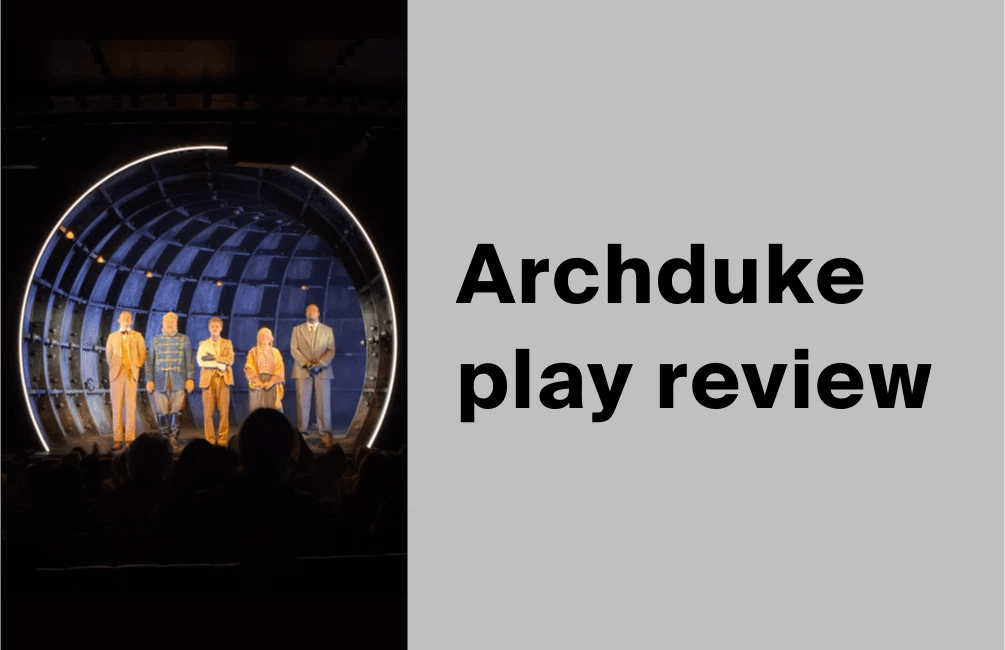
Archduke, Royal Court: superb set, brilliant cook, blunt comedy.
This Archduke Royal Court review comes from a normal Saturday night in the stalls rather than from press night, and it arrives with a slightly frustrated shrug. Rajiv Joseph's play has a gorgeous railway tunnel, a genuinely thrilling train, and one of the funniest supporting turns in London. However, it also has a first half dominated by a bully who simply is not funny enough to hold it.
Cool Factor: 3/5
Section 01 / The Show
What is Archduke?
Belgrade and Zemun, 1914. Three starving teenagers are handed a sandwich and a century.
Archduke is a black comedy by Rajiv Joseph, and his credentials are not in question. Bengal Tiger at the Baghdad Zoo made him a Pulitzer finalist in 2010 and reached Broadway with Robin Williams in the title role. Guards at the Taj won the Obie for Best New American Play. Lyndsey Turner directs here, Es Devlin designs, and the Royal Court is staging the European premiere in the Jerwood Theatre Downstairs until 25 July 2026.
One detail is worth holding onto, because it shapes everything below. Archduke is not a first draft in front of an audience. It premiered at the Mark Taper Forum in Los Angeles back in 2017, then ran off Broadway with Roundabout Theatre Company in late 2025. This play has had nine years and three productions to find its jokes.
The setup is simple and rather brilliant. Gavrilo (Stanley Morgan) and Nedeljko (Chris Walley) meet in a tunnel, both diagnosed as consumptive "lungers" and both broke. Trifko (Abraham Popoola) turns up with a proposition. Soon all three are eating at the table of Captain Dragutin "Apis" Dimitrijevic (Marc Wootton), a Serbian nationalist who feeds hungry boys and then points them at an Archduke. Franz Ferdinand himself never appears. Neither does Sophie. The play belongs entirely to the people who pulled the trigger, and to the cook who fed them first.
Section 02 / The Venue
The Royal Court, seventy years on
A writers' theatre in its anniversary year, taking a swing at a comedy.
The Royal Court has spent seventy years insisting that the play is the point. Consequently, a big design-led import from an American writer feels like a mild change of gear, and the building seems to know it. The Jerwood Downstairs is a lovely room to sit in. Seats are wide, the leather is soft, and the legroom shames most of the West End. Rows are offset too, so you are looking over shoulders rather than through heads.
One warning, though. The rake on the stalls floor is gentle, so a tall person in front of you becomes a genuine problem. Meanwhile the bank of LED lights ringing the stage stays on throughout, blazing straight into the audience. Initially it reads as a halo, which suits a boy named after the Angel Gabriel. After ninety minutes it simply reads as a headache.
Section 03 / The Room
First impressions from an ordinary Saturday
The set got a murmur. The jokes got a yawn, at least behind me.
Devlin's tunnel lands before a word is spoken. It looks like the pedestrian underpass at London Bridge crossed with a Victorian railway vault, and it carries an immediate weight of dread. The smoke and Tingying Dong's sound design do a lot of quiet work too. So far, so promising.
Then the play starts, and the room never quite catches. The person behind me yawned loudly and repeatedly through the first act, which felt less like one bored punter and more like an important sign of a sentiment others in the room may well have shared. Roughly ten people did not come back after the interval. On the upside, my sightline improved considerably. Others around me laughed more than I did, and at completely different moments, which tells you something about how unevenly the comedy lands.
Section 04 / The Problem
The Captain eats the first half
Marc Wootton is committed. The writing simply does not back him up.
Here is where my Archduke Royal Court review parts company with the four-star crowd. Wootton's Apis dominates act one, and it feels as though he speaks for more than half of it. He is a caricature, which is fine, since caricature can be devastating. Unfortunately he is a caricature who is not actually funny.
The performance reaches for something like a mansplaining Matt Berry, all fruity bombast and self-regard. Yet the delivery keeps sliding between sincerity and slapstick without ever committing to either. Is the scene frightening? Is it a joke? Is it a lecture about grievance politics? The production never decides, so the audience never relaxes. Wootton is working extremely hard. Nevertheless, the material gives him a monologue where it needed a punchline.
Compare it to the great comic monsters. Jim Carrey's Count Olaf in A Series of Unfortunate Events is horrible and hilarious at once, because the writing knows exactly which gear it is in. Apis is horrible and only occasionally amusing, and that gap is where the first half quietly dies.
Section 05 / The Highlight
Sladjana steals the whole thing
Janice Connolly gets the least fashionable part and turns it into the best one.
Sladjana, the Captain's cook, is on paper the most stereotyped figure in the play. She is the folksy Slavic granny, all herb bundles and superstition, and she is the only woman on stage. Several critics have flagged that as a problem, and they are right to. Even so, Janice Connolly is the funniest and most complete thing in the building.
Her dry delivery is a joy. She keeps circling back to pudding while the men grandstand about nationhood, and the deflation is perfect every time. Better still, she is the only character with a working moral compass. She actively resists the Captain, and she goes as far as suggesting the boys simply do not do it. She also has firm and alarming views about cats.
That contradiction is the play Joseph could have written all the way through. A woman who will happily dispatch a cat, feed you like her own son, and quietly try to talk you out of a murder is a genuinely rich comic invention. A stereotype, yes, and yet by some distance the most nuanced person here.
She calls for pudding while the men call for war. Guess which one lands.
Section 06 / The Turn
The second half is the better play
More pace, more nuance, more actual jokes, and then that train.
After the interval Archduke finds the register it was fumbling for. The pace tightens, the boys get room to breathe, and the humour becomes properly funny rather than theoretically funny. Morgan's Gavrilo sharpens into something scrappy and quick, Walley's Nedeljko gets the best gag in the script about sex feeling like "taking a bath with a bunch of rabbits", and Popoola's Trifko finally registers as a person rather than a plot device. The chemistry between the three of them is excellent throughout, which makes the thin material in act one all the more annoying.
Then Devlin's tunnel finally gets a train through it. A luxurious carriage bound for Sarajevo advances towards the audience in puffs of smoke, with the sound of the engine building around you, and the room lets out an audible murmur. There was a lovely accident on my night, too. You can hear the real Underground trains rumbling somewhere beneath Sloane Square, and that made the whole thing feel oddly, physically true.
It is a magnificent piece of theatre. The set dressing is as rich as anything in Stranger Things: The First Shadow, yet Devlin uses it far more effectively. Where that show throws spectacle at you until it stops meaning anything, this has restraint and curation. The design waits, holds back, and then spends everything in one moment.
Above all, it is dramatically right. These boys have never had anything nice, and now they are being given luxury as a down payment on their deaths.
Section 07 / The Craft
Stagecraft, sleight of hand and disappearing sandwiches
Skylar Fox's illusion design is doing a lot of the heavy lifting.
The Royal Court has hired an illusion designer, and it shows. Actors materialise in the chapel. Sandwiches appear from nowhere. The dagger leaves its box and arrives in Gavrilo's hand by a route your eye simply refuses to follow. Each trick is small, and each one is beautifully crafted.
Crucially, these effects are not decoration. They make history feel like conjuring, as though the twentieth century were being palmed and forced on us by an unseen hand. Turner's staging is confident and clean throughout, and Neil Austin's lighting builds real shadow and menace. On the technical side, this Archduke Royal Court production is close to faultless.
Section 08 / The Criticism
Honest critical observations
It wants to be Four Lions and it will not commit to the bit.
My core objection is tonal. Archduke plainly wants the territory Chris Morris occupied in Four Lions, where the men we call masterminds turn out to be desperate, frightened and daft. That is a fine target. Yet the punchline never really lands here, because the play keeps flinching. The humour is too polite, the boys are too gently drawn, and the abruptness that makes that kind of comedy sing is missing.
Instead the undertones turn quietly sad. Three teenagers are dying of tuberculosis, and a nasty man buys their deaths with dinner. That is genuinely bleak, and it deserves either full farce or full tragedy. Archduke hovers between the two and gives us half of each.
Sladjana is the only person here who is truly funny, and she is funny because she cuts against everything around her. The boys never reach that. Their best comic material is the physical stuff in the early scenes, which the play then largely abandons, and beyond that they never develop enough contrast between them. I wanted sharper edges, faster cuts, and a great deal more nerve.
As the woman behind me put it on the way out, "I don't tolerate stupidity as a humour device." I understand her, and yet I would argue the opposite. The problem is not that Archduke is too stupid. The problem is that it is not stupid enough.
Let me temper all of that, though, because criticism is cheap and playwriting is not. I have never written a play, and Joseph has written several very good ones. Building a comedy out of a double murder that killed sixteen million people afterwards is a brutally hard brief, and choosing tenderness over cruelty is a defensible artistic choice rather than a failure of nerve. Plenty of critics loved it. My complaint is that the bolder version of this play was clearly available, and I wanted to see it.
Section 09 / The Missed Joke
The sandwich, and the gag it never made
A sincere, lovely ending, where a properly funny one was sitting right there.
Food runs through Archduke like a spine. Apis recruits with a banquet, Sladjana loves through cooking, and the boys chase a sandwich into infamy. Finally the play closes on sandwiches and on a wistful what-if. What if Gavrilo had never got off the train? It is a sincere ending, and it is a genuinely lovely idea. Most of us wrote about this assassination at school, so the invitation to rerun the tape has real pull.
Even so, I wanted the ending to be funnier rather than sweeter. The whole play has been circling a joke about hungry idiots stumbling into catastrophe, and here was the moment to detonate it. Give me a "sod it, let's do it" shrug. Give me a sawn-off shotgun pulled out of a baguette. Something with teeth, something absurd, something that makes the audience laugh and then feel slightly sick about laughing.
Incidentally, the sandwich is a nice piece of mythology in its own right. The famous story that Princip was eating outside Schiller's delicatessen when the car reversed in front of him was, according to Smithsonian Magazine, invented in a 2001 novel and spread by a television documentary. Myths are myths, and there is nothing wrong with a play feeding off one. I simply wish it had chewed harder.
Section 10 / The Context
Why Archduke matters now
Joseph knows exactly what he is writing about. That makes the timidity stranger.
Joseph has been clear about his subject. Speaking about the play's origins, he described the real chain of events as "absurd" and "farcical", noting that the steps to the assassination "are almost comical in the way that so many things went wrong, and yet they were still able to succeed". Patrick Page, who played Apis in the New York production, put the modern parallel bluntly: "Rajiv is not writing about how World War I began. He's writing about us today. It's about how young men become radicalized toward violence." Page also observed that today Apis "would be on a website, he'd be in a chat room, or he might even have a podcast".
That is a properly good idea, and the Royal Court is exactly the right home for it. Turner directed Ava Pickett's 1536 to considerable acclaim, and she is clearly interested in how old stories rhyme with new ones. The Guardian, awarding four stars, decided that "theatrically Joseph's thesis graduates with high honours".
Respectfully, I would mark it lower. Recruitment plus hunger plus grievance is a real and frightening equation. Even so, the play states it early and then keeps restating it for two hours. Once the thesis is on the table, Archduke has surprisingly little left to argue.
Section 11 / The Money
Value for money
Worth around £40 of anyone's money. At £74.50 it is a much harder sell.
Tickets run from £15 to £74.50, and there is a £1.50 restoration levy baked into every seat. The Royal Court's £15 Monday tradition still stands, with all seats at that price and booking opening at 9am on the day, online only. Concessions cover over-65s, students, unwaged, union members and anyone aged 25 or under on Thursdays and Saturdays.
My honest read is that this is comfortably a £40 night out. For that you get Es Devlin at full power, a genuinely strong ensemble, and one of the best set reveals of the year, which is decent value even with a wobbly first half. At the very top of the range you are paying full West End money for a play that only really ignites after the interval, and that is where the maths stops working. The £15 Monday, meanwhile, is close to daylight robbery in your favour. If you are travelling in for it, our TrainPal guide is a sensible place to trim the cost of getting to London in the first place.
Section 12 / The Practicals
Practical info
Sloane Square, two hours, and a few things worth knowing before you book.
The Royal Court sits on Sloane Square, London SW1W 8AS, directly above the Tube station, so getting there is about as easy as London gets. The running time is roughly two hours including a fifteen-minute interval. Age guidance is 14 and over.
Content guidance matters here. The production carries sudden loud noises including a gunshot, plus haze, depictions of violence, and descriptions of death and suicide. Access performances are scheduled too: a chilled performance on Saturday 18 July at 1.30pm, a captioned performance on Wednesday 22 July at 7.30pm, and an audio-described performance on Saturday 25 July at 1.30pm.
Two notes from the night. Firstly, the stalls rake is shallow, so a tall person directly in front will take a chunk of the stage with them. Seats are reserved, so you cannot simply shuffle along. Perhaps the Royal Court should start selling tickets by height. Secondly, the relaunched bar downstairs is big, calm and pleasant, and the front-of-house staff were genuinely lovely, which counts for more than people admit.
Section 13 / The Verdict
The verdict
Go for the design, stay for the cook, forgive the first half.
Cool Factor
★★★☆☆
3 out of 5
Archduke at the Royal Court is a handsome, well-acted, technically dazzling production of a play that keeps pulling its punches. The staging writes cheques the writing cannot cash. Devlin, Turner, Austin and Fox have built something remarkable, and Connolly is worth the ticket on her own. The script, however, wants to be a savage farce about idiots making history and settles for being a sad, mild one.
Overall, a 3/5 Cool. The second half, the carriage and the cook earned it, and the sleight of hand and the ensemble chemistry are properly impressive. It fell short of Stone cold because the Captain swallows the first hour without ever being funny, and because the tone keeps wobbling between sincerity and slapstick. Nine years and three productions on from its Los Angeles premiere, I expected those jokes to have been sharpened rather than smoothed. Joseph called the real events farcical, and he is right. I only wish he had trusted that instinct all the way to the sandwich.
Over To You
Did Archduke work for you?
That is my view, and the room I sat in clearly did not agree with itself, let alone with me. Some people laughed hard at the Captain. Some people left at the interval. Meanwhile the critics have scattered from four stars down to a very rude 40%, which tells you this is a play people genuinely argue about. So here is the open question, and I would love to hear the counter-argument.
If the history really is farcical, should the play commit to the farce and give us the shotgun in the baguette? Or does the fact that three dying teenagers were used and discarded earn the restraint Joseph chose? And be honest: did the Captain make you laugh, or make you check your watch?
Tell me in the comments. I am fully prepared to be told I am wrong about this one.
Archduke at the Royal Court: FAQs
Is Archduke at the Royal Court worth seeing?
Yes, with caveats. The design, the illusion work and Janice Connolly's performance are all excellent, and the second half is considerably stronger than the first. Around the £40 mark it is easy to justify, and at the £15 Monday price it is a steal. At the top of the range the case gets much weaker.
How much are tickets for Archduke?
Tickets range from £15 to £74.50, including a £1.50 restoration levy. Every Monday all seats cost £15, with booking opening at 9am on the day of the performance, online only. Concessions apply to over-65s, students, unwaged people, union members and under-25s on Thursdays and Saturdays.
How long is Archduke and when does it close?
The running time is approximately two hours including a fifteen-minute interval. The production runs in the Jerwood Theatre Downstairs until 25 July 2026, so there is very little time left to catch it.
Is Archduke a comedy or a tragedy?
Officially it is a black comedy, and Rajiv Joseph has described the real history as absurd and farcical. In practice it sits somewhere between the two registers, which is precisely my criticism of it. Expect gallows humour rather than belly laughs.
Do I need to know about the First World War to enjoy it?
Not at all. The play assumes you have heard of Franz Ferdinand and nothing more. Notably, the Archduke himself never appears on stage, and the story stays firmly with the young men who were recruited to kill him.
Is Archduke suitable for children?
The age guidance is 14 and over. The production includes a gunshot and other sudden loud noises, haze, depictions of violence, and descriptions of death and suicide. Cat lovers should also brace themselves.
Read next
- Dracula, West End review - another London staging that leans hard on design, and our take on whether the spectacle earns its keep.
- Sherlock Holmes at the Open Air Theatre review - if you want your period drama with rather more mischief and a lot more fresh air.
- National Art Pass - how the pass works and whether it actually pays for itself if you go to a lot of shows.
- Railcard discount code - a straightforward way to cut the cost of getting into London for a theatre night.
- Gail's promo code - since this is a play about sandwiches, you may as well eat a decent one first.
- Loop earplugs - useful if sudden loud noises and gunshots are not your idea of an evening out.
Sources
- Royal Court Theatre: Archduke
- New York Theatre Guide: 5 fun facts about Archduke off Broadway
- Smithsonian Magazine: the origin of the Gavrilo Princip sandwich story
- London Theatre: Archduke review
What's trending




Recent posts
- Figma Creator Micro Review: Beautiful, But Do You Need It?
 My Figma Creator Micro review: beautiful design and admirable build, but a price I found hard to justify. Cool Factor 3/5.
 - New on Mobbin October 2026: Jomo, Delphi, Lloyds and MoreNew on Mobbin October 2026: Jomo, Delphi, Lloyds and five more apps, with the consent, search and unlock screens worth studying.
- British Art Fair 2026 ReviewArt fairsSaatchi Gallery A Sickert study best in show, a Hockney for £800, and naff AI art Last updated: 28 September 2026. I checked every price and date in this British Art Fair review against the dealers' labels and the fair's own pages. By Tristan · Arts, exhibitions and creative culture This is an opinion… Read more: British Art Fair 2026 Review


No Comments.