
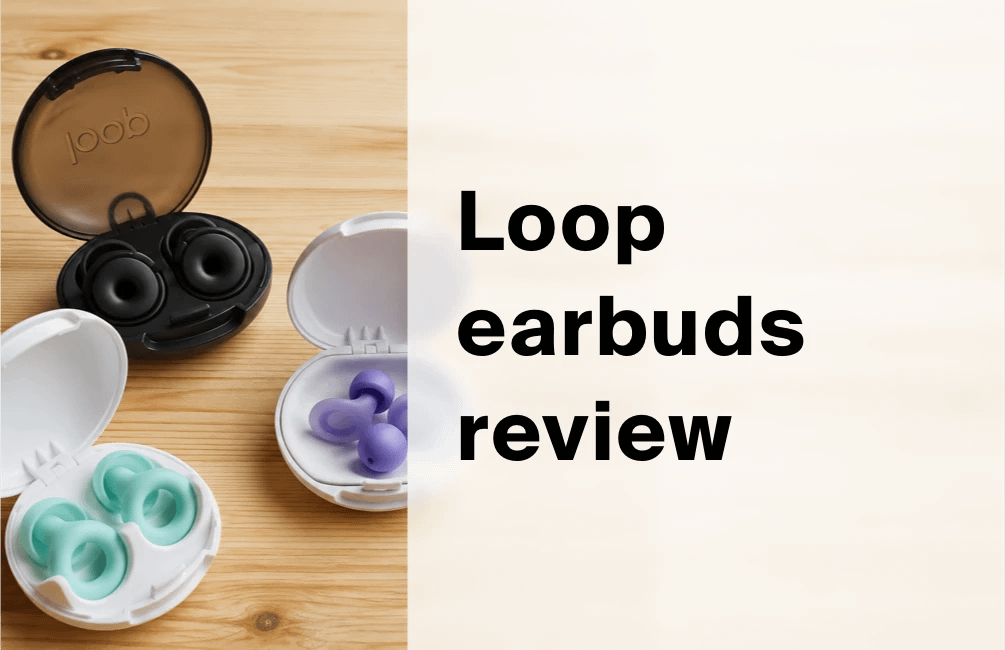
Last updated: 28 August 2026
By Stiv · Design, technology and personal finance
Based on my own experience using Loop earplugs since 2024, across three models: the Quiet 2, the Switch 2 and the Dream. More than two years of gigs, night buses and broken sleep went into this.
This article contains affiliate or referral links. If you click through and sign up I may earn a commission or referral bonus at no extra cost to you. It does not affect my editorial view.
This is an opinion piece. Views expressed are the author's own and do not constitute professional advice.
Two years, three pairs, one broken case.
This Loop earplugs review is not a first-week impression. I have carried a pair of Loops on my keys through London for more than two years. They have been to gigs, ridden the Northern line and spent most nights in my ears. As a result they have changed how loud the world feels. They have also annoyed me, repeatedly, in ways the marketing never mentions.
Cool Factor: 4/5
The short answer, before you scroll: yes, they work, and yes, I would buy them again. The plugs themselves are properly engineered. The carry case, however, is the weakest thing Loop makes. That case alone is why this Loop earplugs review stops one point short of top marks.
Want the pair I actually carry?
These are the three models in this review, at the UK prices I paid. The Switch 2 is the one on my keys.
Loop Switch 2, £54.95 Loop Dream, £44.95 Loop Quiet 2, £19.95
Prices and ratings checked in July 2026 against Loop and UK retailers. They change, so treat them as a snapshot rather than gospel.
Section 01 / The basics
What are Loop earplugs?
Reusable, filtered earplugs that turn the volume down instead of switching the world off.
Loop earplugs are passive, reusable plugs with a small circular loop that sits in the outer ear. Consequently there is no battery, no app and no Bluetooth. A mechanical filter or a solid silicone body does all the work. What you get, therefore, is attenuation rather than active noise cancellation. That distinction matters more than any spec sheet in this Loop earplugs review. People buy them expecting AirPods-style silence, then feel let down.
The current range splits by job. The Quiet 2 blocks the most for the least money, at 24 dB SNR. Experience 2 uses an acoustic channel to shave roughly 17 dB off a gig while keeping music recognisable. Engage 2 takes off about 16 dB and is aimed at conversation. Meanwhile the Switch 2 crams three filters into one plug. Finally there is the Dream, a sleep-specific design rated at 27 dB SNR. That is the strongest reduction Loop currently sells.
I own three of them. The Quiet 2 came first. Then came the Switch 2, which lives on my keys, and the Dream, which lives on my bedside table. Naturally that spread is the point of this Loop earplugs review. Loop's range only makes sense once you have used more than one.
Section 02 / Context
The brand behind the hype
A Belgian engineering story that accidentally became a lifestyle brand.
Loop was founded at the end of 2016 in Antwerp by Maarten Bodewes and Dimitri O, two childhood friends who both trained as engineers. Crucially, they were not building a product for other people. Loop's own press material describes them as "nightlife lovers suffering from tinnitus" who "sampled every earplug on the market" and came away unimpressed.
Then the numbers got silly. Loop reported revenue of €126.5 million in 2023 and says it has sold more than eight million sets. In 2024, Fast Company placed it 18th on its World's Most Innovative Companies list. It also took first place in the Design category, for "designing ear protection people want to wear". Since then Loop has become the official earplug partner of Coachella, alongside collaborations with McLaren Racing and Tomorrowland.
That is worth stating plainly in a Loop earplugs review, because the design-led branding cuts both ways. On one hand, it got a generation of people to actually wear hearing protection. On the other, it prices a piece of moulded silicone like a fashion accessory. Both things are true at once.
Section 03 / Out of the box
First impressions and unboxing
Slick packaging, a QR code, and four sizes of tip you will absolutely need.
Every Loop set arrives in the same neat, slim box. Inside you get the plugs, a small carry case and a tray of extra ear tips. There is also a manual with a QR code that opens fitting videos. Admittedly I skipped those videos the first time, which was a mistake I will come back to.
The plugs themselves look like jewellery, and that is deliberate. My Switch 2 came in emerald, and it genuinely does not read as hearing protection from a metre away. The Dream is squishier and rounder, in lilac, with an oval memory-foam tip unlike anything else in the range. Sizing runs XS to L across the models, so most ears are covered on paper.

Every Loop set ships with spare ear tips, a user guide and a QR code to the fitting videos.
First impressions, then, were strong. Yet the unboxing is the easiest part of any Loop earplugs review to be positive about. The interesting bit starts when you try to get them to stay in.
Section 04 / The core experience
Fit and comfort: the make-or-break bit
Loops live or die on the seal, and the seal took me weeks to get right.
Here is my biggest honest gripe, and it applies across every model I own. Finding the right fit was a faff. I cycled through tip sizes for weeks, and even now I am not fully convinced I have landed on the correct one. Nothing about the process is difficult, but it is fiddly, repetitive and oddly demoralising when a £45 product keeps whistling out of one ear.
Loop's own instructions want you to insert the plug and then rotate it back towards the earlobe. Once it seals, your own voice suddenly sounds boomy and internal. That occlusion effect is the tell. Without it, you are wearing decoration rather than protection.
Get the seal wrong and a 27 dB plug performs like a 5 dB one.
Dr Steve Taddei is an audiologist and lab director at HearAdvisor. He tested the current Loop line for Hearing Tracker, and he reached the same conclusion I did the hard way. As he puts it, "a proper fit makes or breaks any earplug". He also notes that even excellent plugs are "mostly useless if they keep falling out of your ears". So if you take one thing from this Loop earplugs review, take that. Spend an evening trying every tip in the box.
Section 05 / On the road
Loop Switch 2 at gigs and on the Tube
Three filters, one plug, and the model I actually reach for.
The Switch 2 is the one that earns its keep. A tiny mechanical dial on the loop rotates between three modes: Engage at 20 dB, Experience at 23 dB and Quiet at 26 dB. There is no power, no pairing and no fuss, and you can change mode without taking the plug out of your ear.
In practice that flexibility is the whole product. At a gig I sit in Experience mode, where the low end stays fat and vocals stay legible. Between sets I flick to Engage so I can hear my mate at the bar without shouting. Then on the way home, on a screeching Northern line platform, I go to Quiet and the world softens into a manageable hum.
Does it perfectly replicate the dedicated Experience 2? No. Music through the Switch 2 is a little more veiled, a little less airy. Nevertheless, my evening usually involves a loud room, a conversation and a train. One plug that handles all three beats three plugs I would inevitably lose.
 The pick of the range
Loop Switch 2
One plug, three volumes, and the only pair I have never regretted carrying.
£54.95
Rotate between Engage, Experience and Quiet without removing the plug. It is Loop's priciest everyday earplug, and after two years of gigs and commutes it is still the one clipped to my keys.
Section 06 / After dark
Loop Dream for sleep, and my small-ear problem
The plug built for side sleepers still hurt me by morning.
The Dream is Loop's sleep specialist, and on paper it is exactly what I needed. It has a closed-loop body in ultra-soft silicone, an oval memory-foam tip that follows the ear's natural shape, and 27 dB SNR of reduction. Loop designed it explicitly for side sleepers, so pressure should not be an issue.

The Dream's oval memory foam tip is the bit meant to survive a night on your side.
For the first few hours it is excellent. Traffic drops to a rumour. My partner's breathing disappears entirely. Loop is honest that soft sounds vanish while sirens and fireworks still get through, and that matches what I hear.
However, after a full night on my side, my ears ache. I have small ear canals. A snug tip plus seven hours of pillow pressure leaves a dull, bruised soreness by morning. It is not agony. It is enough that I sometimes pull them out at 4am and take the noise instead. If you want audio rather than silence, incidentally, our take on the best headphones for side sleepers covers the alternative approach.
Section 07 / Build
Build quality, and the case that broke
The plugs are built to last. The thing you carry them in is not.
Two years in, the plugs themselves are fine. The silicone has not perished, the Switch 2 dial still clicks positively and nothing has cracked or discoloured. Frankly, the engineering on the plug is exactly what you would hope for from a company founded by two engineers.
The case is a different story, and it is the loudest complaint in this Loop earplugs review. The hinge on my carry case snapped clean off within a few months. That mattered far more than it should have. Clipping the case to my keys was the entire reason I ever had earplugs on me when I needed them. Hearing protection you left at home protects nothing.

The hinge, snapped. This is the weakest part of the whole product.
Since then I have hunted for a decent third-party replacement, without finding one I trust. It is a strange failure of priorities. Loop will happily sell you a £45 sleep plug engineered around the geometry of the human ear. Then it packages that plug in a case whose hinge does not survive a year in a coat pocket.
Section 08 / The cons
Honest critical observations
Four things I would fix, in order of how much they bother me.
The carry case is not good enough. The hinge on mine snapped inside a few months. For a product whose usefulness depends on you having it with you, that is a design failure, not a niggle.
Fit is genuinely fiddly. Expect trial and error, expect to re-watch the fitting video, and expect one ear to behave differently from the other. Small ears in particular are underserved.
Long wears hurt. A full night in the Dream leaves my ears sore. Loop markets side-sleeping comfort, and for most people it clearly delivers. Even so, "designed for side sleepers" is not the same as "comfortable for every side sleeper".
They muffle, they do not preserve. Even the Experience filter dulls the top end. Custom musicians' moulds sound better. So do flatter plugs such as the Etymotic ER20XS. Loop trades a little fidelity for a lot of comfort and retention. That is a reasonable trade. It is still a trade.
One more, for fairness. Buying into the range properly means buying more than one pair, and Loop's pricing quietly assumes you will. A Quiet 2 plus a Dream plus a Switch 2 lands well north of £100. No Loop earplugs review should pretend otherwise.
Section 09 / Context
Why Loop earplugs matter now
Hearing damage is permanent, and the numbers are worse than most people assume.
According to the RNID, "repeated or long exposure to sounds at 85dB or above can cause hearing loss". A nightclub averages around 100 dB. At that level, the charity says you are at risk of damage after roughly 15 minutes without protection. A live gig can hit 110 dB.
Those figures reframe the price question entirely. Furthermore, hearing loss and tinnitus do not heal. You cannot buy your hearing back at any price. That, precisely, is the realisation that drove Loop's founders to build the thing.
Beyond gigs, the category has broadened. Loop plugs are now widely used by neurodivergent people and by anyone managing sensory overload. The founders did not originally design for that. Yet the shift, from safety gear to everyday self-regulation tool, is the real story behind the brand's growth.
Section 10 / The money
Value for money: are they worth it?
Expensive next to foam. Cheap next to a hearing aid.
Let us be blunt about pricing, because value is where most of the scepticism lives. Foam plugs cost pennies. Loop Quiet 2 is £19.95, Loop Dream is £44.95 and Loop Switch 2 is £54.95. Alpine's PartyPlug Pro is a well-regarded rival rated at 23 dB, and it starts around £20 at UK retailers. Etymotic's ER20XS sits at a similar level, and it sounds flatter.
So Loop is not the cheapest, nor the most acoustically transparent. Instead it wins on the boring stuff that decides whether a plug gets used. That means retention, comfort, and not feeling daft wearing it. Two years of evidence says I wear my Loops. I never wore foam twice.
For the factual rundown of models, colours and current pricing, our Loop earplugs product page keeps the details in one place. This piece is the opinion; that page is the reference.
Loop Dream on Amazon UK Loop Quiet 2 on Amazon UK
Section 11 / The admin
Practical info: sizing, cleaning and returns
The bits that decide whether you keep them past week two.
Sizing. Most models ship with XS, S, M and L tips, with medium pre-fitted. Try all four. Then try mixing sizes between ears, because ears are rarely symmetrical.
Cleaning. Silicone tips wash with warm water and mild soap, and they need it more often than you would think. The Dream's foam tips are different: Loop recommends replacing them roughly every 100 days, and a four-pair pack costs £14.95. Budget for that.
Returns and warranty. Loop runs a 100-day trial period on direct orders, so a bad fit is recoverable if you buy from Loop rather than a marketplace. Check the current terms on Loop's own site before ordering, since policies do change.
Section 12 / The fix
What to do when your Loop case breaks
Claim first, buy second. This is the order I would work through.
Start with the warranty, because it costs nothing. Loop covers every branded product and accessory, carry cases included, for two years from the delivery date. So if yours failed early, claim before you spend anything. Orders placed on Loop’s own site go through the returns portal. Marketplace and shop purchases use the warranty claim form instead. One caveat, though: the policy excludes broken plastic unless a defect caused it. A snapped hinge is therefore a judgement call.
Then buy the case that matches your plugs. Loop sells replacements at £14.95 each, checked on 28 August 2026. Crucially, they are model specific. The Switch 2 carry case is the one I would buy, because the Switch 2 lives on my keys. Meanwhile the standard Extra Carry Case suits Quiet, Experience and Engage. However, it does not fit the Switch or the Dream. Our Loop earplugs page keeps the models and prices in one place.

The current Switch 2 case: sturdier shell, moulded silicone insert, and still a hinge at the back.
The Amazon route has one catch. Loop’s own cases are not listed on Amazon UK at the moment. However, SURITCH sells a rotating, locking case with a lanyard for £11.99. It rates 4.4 out of 5, checked on 28 August 2026. Read the listing first, though, because it does not fit the Switch.
SURITCH Loop case on Amazon UK
Skip the unbranded pods. Amazon and eBay list generic earbud and pill cases from roughly £3 to £10. These are not official Loop products. Most sellers state no internal dimensions either. Consequently you are guessing at the fit.
Does the new case fix the hinge? Loop describes the current cases as redesigned, with a sturdier outer shell and a moulded silicone insert. Nevertheless it says nothing about the hinge itself. The product shots still show a hinged clamshell, so I cannot confirm that the weak point has gone.
Section 13 / The call
The verdict
Cool Factor
★★★★☆
4 out of 5
Loop makes the best-designed passive earplugs I have used. After two years I still reach for them without thinking. The Switch 2 in particular has quietly changed how I do a night out. Meanwhile the Dream has salvaged more sleep than it has cost me, even on the nights it leaves my ears sore.
Overall, this Loop earplugs review lands on a solid 4/5, Stone cold. The plugs themselves earn it. The engineering is real, the range makes sense once you understand it, and wearing hearing protection no longer feels like an admission of age. What holds Loop back from Ice cold is not the acoustics. It is the accessories and the ergonomics. A case whose hinge snapped within months, a fit that took weeks to half-solve, and a sleep plug that still aches by morning are not trivial. This product only works if you have it, wear it and keep it in. So fix the case, Loop, and I would happily hand over the fifth star.
Loop earplugs review: FAQs
Are Loop earplugs worth it?
In my experience, yes, provided you accept what they are. They reduce noise rather than cancel it, and they only work when they seal properly. If you go to gigs, commute in a loud city or struggle with sensory overload, they are worth the money. If you want silence, they will disappoint you.
How much do Loop earplugs cost in the UK?
At the time of writing, Loop Quiet 2 is £19.95, Loop Dream is £44.95 and Loop Switch 2 is £54.95. Those are the three I own and paid for. Replacement Dream ear tips cost £14.95 for four pairs. Prices shift, so check before you buy.
Which Loop model should I get?
For sleep, the Dream. For maximum quiet on a budget, the Quiet 2. For gigs specifically, the Experience 2. For one plug that handles a whole evening, the Switch 2, which is what I carry.
Do Loop earplugs actually block noise?
They reduce it. Ratings run from about 16 dB SNR on the Engage 2 to 27 dB SNR on the Dream. Soft sounds usually vanish, medium sounds drop to a murmur, and loud sounds such as sirens still come through, quieter.
Loop versus Alpine: which is better?
Alpine's PartyPlug Pro is cheaper and perfectly competent hearing protection. Loop wins on fit, retention and design, which is why I keep wearing mine. Alpine wins on price. Neither is wrong, and both beat no earplugs at all.
Can you sleep on your side with Loop earplugs?
The Dream is built for exactly that, with a low-profile closed-loop body. Most side sleepers report no pressure. I have small ears, though, and a full night still leaves them tender, so results genuinely vary by ear.
More from CoolCuration
- Best noise-cancelling headphones UK: when you want the noise gone electronically rather than plugged.
- Soundcore Sleep A20 sleepbuds: the audio-in-your-ears route to a quiet night, if plugs are not for you.
- Back Market discount code: cheaper refurbished audio kit, with a warranty attached.
- 1Blocker: for cutting a different kind of noise, the kind that follows you around the internet.
- Best wireless earbuds UK: what to wear when you actually want to hear something.
Sources
- Loop Earplugs: official range, specifications and pricing.
- Loop press corner: meet the co-founders: founding story, revenue and awards.
- RNID: How loud is too loud?: safe listening levels and exposure times.
- Hearing Tracker: Loop earplugs lab and real-life testing: independent HearAdvisor measurements.
- T3: Loop Dream review: UK pricing and ear-tip replacement costs.
Disclosure: this review contains affiliate links. If you buy through them I may earn a small commission at no extra cost to you. Loop did not supply these products, did not see this article before publication and has no editorial input. Prices and specifications were correct in July 2026 and can change.
What's trending






Recent posts
- Best Audiobooks October 2026: 10 UK Listens Ranked
 Ten new audiobooks for October 2026, from a full-cast Dracula with Jonathan Bailey to Russell T Davies reading his own television memoir.
 - Louis Fratino at David Zwirner ReviewLast updated: 4 October 2026 By Tristan · Arts, exhibitions and creative culture This is an opinion piece. Views expressed are the author's own and do not constitute professional advice. Exhibition reviewMayfair Saunas, subway cars and a lot of skin in Mayfair Louis Fratino at Zwirner is the American painter's first solo show in London,… Read more: Louis Fratino at David Zwirner Review
- What Is a Sprive Boost? Seven Days, and What It Actually PaysA Sprive boost lifts your cashback rate for seven days, and it arrives on its own. What mine paid, and why Supercharge is a display toggle rather than extra cashback.



No Comments.