
Last updated: 15 May 2026
By Tristan · Arts, exhibitions and creative culture
This is an opinion piece. Views expressed are the author's own and do not constitute professional advice.
Five names, one Mayfair townhouse, and a quietly precise group hang. This David Zwirner London review covers Flavin, Judd, McCracken, Ryman, Sandback, on view at 24 Grafton Street until 22 May 2026. Although the artists are familiar, the way David Zwirner has threaded them together is genuinely fresh. So if you've ever wondered what colour itself can do as a material, this is the show to see.
Cool Factor: 4/5
What's on at 24 Grafton Street
The David Zwirner London review's subject brings together five giants of post-war American art: Dan Flavin (1933 to 1996), Donald Judd (1928 to 1994), John McCracken (1934 to 2011), Robert Ryman (1930 to 2019) and Fred Sandback (1943 to 2003). It opened on 25 March 2026 and closes on 22 May 2026. Although every name on that list is canonical, the curatorial premise is unusually focused. Specifically, the show looks at how each artist used colour, and sometimes its absence, to pursue non-representational expression. Furthermore, the hang spans two floors. Crucially, the ground floor leans into colour while the first floor strips it back. So you get the same idea, twice, in two opposite registers. Welcome to our David Zwirner London review.
A Mayfair townhouse with serious heft
David Zwirner's London outpost sits at 24 Grafton Street, just off Bond Street in Mayfair. It's a five-minute walk from Green Park station and roughly ten from Bond Street. Furthermore, the building is a classic Mayfair townhouse, which gives the show a domestic scale that suits these artists. None of the five really wanted museum-style bombast. Notably, Sandback once described his sculptures as inhabiting "pedestrian space", by which he meant the everyday environment around the viewer rather than the rarefied air of the white cube. So the townhouse setting suits the work. You feel like you're walking through rooms, not past trophies.
The ground floor: when colour does the work
The hang reveals itself slowly. So you step in expecting drama and instead get clarity. There's no didactic wall text wrapping you up in scholarly arguments. Just works on white walls, small labels, and plenty of breathing room. Indeed, in his 1993 essay Donald Judd argued that "material, space, and color" are the main aspects of visual art. So the gallery is, in effect, taking him at his word.
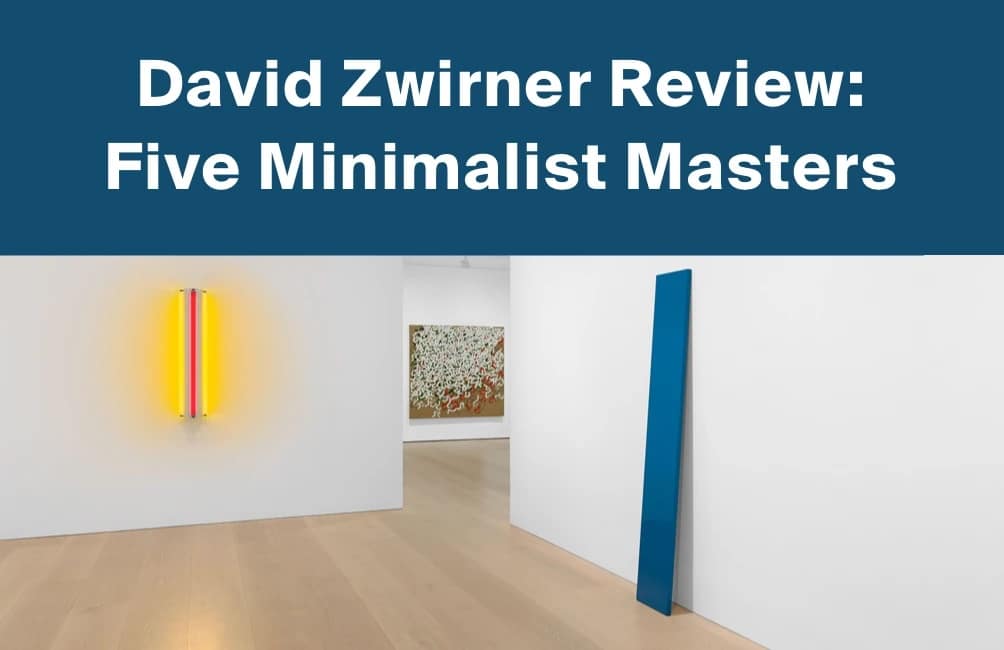
This is where the show earns its premise. Flavin's three fluorescent tubes (1963) glows in red, yellow and pink light. Notably, the piece is rare. Specifically, it was the first time Flavin used more than a single lamp, and the first instance of him combining multiple colours in a single fluorescent work. Although it predates his familiar corner pieces, you can already see the language fully formed. Across the room, two of McCracken's signature planks lean against the wall in highly glossed red and blue. McCracken once said he saw the plank "as existing between two worlds": the floor as the physical world and the wall as imagination. Then there's Judd's untitled set of twenty woodcuts, which uses a single compositional template and runs colour variations across it. Effectively, you're looking at twenty thought experiments hung as one. Together, these works make this David Zwirner London review's ground floor a quiet triumph.
Sandback's green yarn and Ryman's hinge painting
Two ground-floor works stand out for different reasons. First, there's a ten-part vertical construction by Sandback in green acrylic yarn. Green is rare in his output. Most of his yarn pieces sit in red, black, white or yellow. So the green hum here is genuinely surprising, especially when daylight catches the strands. Second, there's a major early Ryman painting from 1963 that lays curving white brushstrokes over similar strokes of green, red and taupe. The painting is glyph-like. Each stroke functions as a compositional unit, almost the painterly equivalent of Judd's repeated boxes. Furthermore, the dating is significant. 1963 is the year Ryman's mature vocabulary started to lock in. Therefore, in this David Zwirner London review the Ryman is not a peripheral work. It's a hinge.
The first floor: when colour disappears
Climbing the stairs changes the temperature. Suddenly, colour is gone, or at least pushed to the edges. White Ryman, untreated McCracken, the implied lines of Sandback's yarn, and Judd's stripped-back forms take over. So our David Zwirner London review enters its second act, and the room feels colder, slower, more meditative. It's also where the show's curatorial argument really lands. Once colour drops out, you start to notice scale, surface, weight, and the room itself. Flavin is the obvious absence here. Instead of his light, you get the negative of it: a quietness that asks you to keep looking. Importantly, that absence is the point.
Why these five artists, and why now
These names get grouped together so often that it's easy to forget they were peers. Flavin, Judd and Ryman knew each other in 1960s New York, where their work helped define what would become Minimalism and post-Minimalism. McCracken was on the West Coast, working in his own dialect, sometimes called Finish Fetish for its lacquered surfaces. The Art Institute of Chicago describes him as a pioneering figure of West Coast Minimalism in the 1960s. Sandback came slightly later. He was a graduate student at the Yale School of Art and Architecture in the late 1960s, when his first solo shows took place at Konrad Fischer in Düsseldorf and Heiner Friedrich in Munich. So showing the five together gives you a compressed history of the most influential American abstraction of the 1960s and 1970s. Furthermore, that cross-coastal framing is part of why the David Zwirner London show holds together.
Honest critical observations
No review is complete without naming what doesn't quite land. Although this David Zwirner London review is positive overall, the show is also small. Five major artists across two floors means you get roughly one or two works each. So this is more of a sampler than a survey. If you've already seen Tate Modern's Minimalism collection, the show won't transform your understanding. Furthermore, the labelling is minimal, almost to a fault. There's no long-form interpretation, and no gallery guide handed to you on the way in. Some of that restraint is intentional. However, less confident viewers may want more help unpicking why the green Sandback matters, or why Ryman's 1963 painting is a hinge work. Finally, although McCracken's planks are stunning, two planks alone can't show his range. You leave wanting more. Whether that's a flaw or a feature depends on you.
Value for money: a free Mayfair show with a long shadow
Like most commercial gallery shows, entry is free. So that's already a strong start. You get to see a rare early Flavin, a major Ryman, two glossed McCracken planks, a green Sandback and a major Judd woodcut series, all for the price of a Tube journey. Therefore, on a pure value basis this David Zwirner London review can only land in positive territory. Compared to ticketed institutional shows, it's a steal. Equally, if you're already heading to South Bank for our Chiharu Shiota and Yin Xiuzhen review at the Hayward Gallery, this Mayfair stop sits naturally in the same afternoon. It's the kind of free show that makes London's commercial gallery scene quietly world-class.
Practical info for visiting David Zwirner London
The gallery is at 24 Grafton Street, London W1S 4EZ. The closest stations are Green Park (Jubilee, Piccadilly and Victoria lines) and Bond Street (Central, Jubilee and Elizabeth lines). David Zwirner London opens Tuesday to Saturday, 10am to 6pm. It's closed on Sunday and Monday. Entry is free, with no booking required. The gallery hosted a discussion on the show on 21 April 2026 with Chris McCormack, associate editor at Art Monthly, and Wells Fray-Smith, curator at the Barbican Centre. So that talk has now passed, but it's worth checking the gallery's events page in case anything new is added before closing day. Finally, plan around 30 to 45 minutes for the show itself. Less, obviously, if you're rushing through Mayfair on a lunch break.
Final verdict on this David Zwirner London review
A serious, beautifully presented sampler from five artists who continue to shape how abstraction is read. The show works because its premise (colour and the absence of colour) is simple enough to feel inevitable but specific enough to surface unexpected pairings.
Cool Factor
★★★★☆
4 out of 5: Stone cold
Overall, a solid 4 out of 5, Stone cold. This David Zwirner London review earned that score off the back of a tight, intelligent hang and three genuine highlights: the rare 1963 Flavin, the green Sandback, and the hinge-work Ryman painting that pulls the whole argument into focus. So why not Ice cold? Because the format itself is constrained. A few key works each from five major artists is, by definition, more sketch than statement. Still, for a free Mayfair drop-in before the show closes on 22 May 2026, it's hard to do better.
Frequently asked questions
Is the David Zwirner London show worth visiting?
Yes, especially if you have any interest in Minimalist or post-Minimalist art. The hang is small, free, and concentrated. Plus, the rare 1963 Flavin and the green Sandback alone justify the trip.
How much does it cost to visit David Zwirner London?
Entry is free. Like most commercial galleries in Mayfair, David Zwirner does not charge admission. So it's one of the better cultural bargains in central London.
When does the exhibition close?
The Flavin, Judd, McCracken, Ryman, Sandback show closes on 22 May 2026. The gallery opens Tuesday to Saturday, 10am to 6pm.
How does this compare to Minimalism at Tate Modern?
Tate Modern offers a broader narrative survey across many artists and decades. By contrast, the David Zwirner London show is a tight, single-room conversation between five names. So they complement each other well rather than overlapping.
What's the must-see work in this David Zwirner London review?
For me, it's Flavin's three fluorescent tubes from 1963. Although the McCracken planks and the green Sandback are properly impressive, the Flavin is the rarest piece on view and changes how you read everything else.
You might also like
- Katharina Grosse at White Cube review: another commercial gallery show where colour does most of the heavy lifting.
- Tracey Emin: A Second Life at Tate Modern review: a major museum survey that pairs well with this Mayfair sampler.
- National Art Pass: cuts the cost of ticketed exhibitions if you visit galleries regularly.
- Howard Hodgkin Indian Leaves print: a print edition for collectors who like their colour bold.
- Gifts for artists and creatives: a handpicked guide for studio-friendly presents.
What's trending





Recent posts
- Best Audiobooks October 2026: 10 UK Listens Ranked
 Ten new audiobooks for October 2026, from a full-cast Dracula with Jonathan Bailey to Russell T Davies reading his own television memoir.
 - Louis Fratino at David Zwirner ReviewLast updated: 4 October 2026 By Tristan · Arts, exhibitions and creative culture This is an opinion piece. Views expressed are the author's own and do not constitute professional advice. Exhibition reviewMayfair Saunas, subway cars and a lot of skin in Mayfair Louis Fratino at Zwirner is the American painter's first solo show in London,… Read more: Louis Fratino at David Zwirner Review
- What Is a Sprive Boost? Seven Days, and What It Actually PaysA Sprive boost lifts your cashback rate for seven days, and it arrives on its own. What mine paid, and why Supercharge is a display toggle rather than extra cashback.


No Comments.