
Last updated: 25 August 2026
By Tristan · Arts, exhibitions and creative culture
This is an opinion piece. Views expressed are the author's own and do not constitute professional advice.
This article contains affiliate links. If you click through and buy, I may earn a small commission at no extra cost to you. It does not affect my editorial view.
This month I went back to a book I was made to read at sixteen and had been quietly avoiding ever since. My Nineteen Eighty-Four review, then, is really a re-reading. Orwell's last novel turns out to be a stranger, funnier and more irritating thing than the version I remembered, and the parts that have dated are not the parts everyone assumes.
It also happens to be having a moment. A new stage adaptation opens in Glasgow next week, there is a full-cast Audible production with a genuinely starry list of names, and the paperback now costs less than a pint. Here is what I made of it, and which edition I would actually put your money on.
One book a month. This was my August 2026 pick. Every edition so far, newest first, is on the Book of the Month hub.
Why Nineteen Eighty-Four, and why now
Every month I pick one book from our Greatest Books of All Time list and read it properly. No more nodding along at parties. This month the draw landed on Orwell, which felt almost too obvious until I checked the diary.
The Citizens Theatre in Glasgow premieres a new stage version by Chris Hannan, directed by Dominic Hill. Previews start on 29 August 2026, the world premiere is on 3 September, and a Scottish tour follows. Meanwhile Raoul Peck's documentary Orwell: 2+2=5 has toured UK cinemas since the spring. So the book is back in the room. It seemed a good moment to ask whether it deserves to be.
What it is actually about, briefly
Winston Smith works in the Records Department of the Ministry of Truth. His job is to rewrite the past so it always agrees with the present. He hates it. Then he buys a notebook and starts an affair with a colleague called Julia. Soon he is drawn towards what he takes for an underground resistance.
That is the plot. However, the plot is not really the point. The novel is an argument about what happens to a person when the facts will not stay still, and it makes that argument through language rather than action. Doublethink, thoughtcrime, memory hole, Newspeak: Orwell invented the vocabulary we still use to describe the problem.
The bit everyone remembers, and the bit everyone skips
Everyone remembers Room 101. Fewer people admit what happens halfway through. The novel stops dead for about thirty pages while Winston reads long extracts from Emmanuel Goldstein's book.
I will be honest: it is a slog. Isaac Deutscher called it "an obvious, though not very successful, paraphrase of Trotsky's The Revolution Betrayed". Unkind, but not wrong. On the other hand, it is doing real work. Orwell needed you to understand the machine before he broke Winston inside it. Skim it if you must. You will not lose the plot.
What the first reviewers said
The book landed on 8 June 1949. The first reviews were sharper than the reverent modern consensus. V.S. Pritchett, in the New Statesman, wrote: "I do not think I have ever read a novel more frightening and depressing; and yet, such are the originality, the suspense, the speed of writing and withering indignation that it is impossible to put down."
Pritchett also landed the criticism that still sticks. The torture scenes, he said, are "merely melodramatic". They are full of "rather grotesque machines which used to appear in terror stories for boys". Read the last third with that in mind and you will see it.
What does not hold up
Plenty, actually, and pretending otherwise does the book no favours.
The characters are thin. Ben Pimlott, whose introduction runs in the Penguin edition, is blunt about "a lack of subtlety in his characterisation, and a crude plot". Most of the cast, he argues, exist "only to explain a political point". O'Brien in particular is "an intellectual construct: not a flesh-and-blood human being at all".
Then there is Julia. The novelist Sandra Newman, who later wrote a whole book from Julia's point of view, put it plainly: "I was especially shocked that I hadn't noticed the misogyny the first time round." Julia is the most alive person on the page and the least plausible. She is a fantasy of uncomplicated appetite, dropped into a society that supposedly conditions such things out of people.
Finally, the prophecy itself has aged oddly. Pimlott notes that there has been "no third world war or Western revolution". Totalitarian systems are also less common now than when he wrote. The book survives anyway, because it is not a forecast. It is a description of a mood.
Why it reads differently in 2026
Here is what surprised me. At sixteen I read it as a book about being watched. Coming back to it in my thirties, it is a book about record-keeping. That is a far more uncomfortable subject.
Winston's job is not surveillance. His job is editing the archive. Consequently the horror is not that someone is watching you. It is that the record of what happened can be quietly amended by anyone with access and a deadline. In an era of retracted statements, edited posts and confidently wrong summaries, that lands rather differently.
And then there is the appendix. The essay on the principles of Newspeak sits at the very end, written in the past tense. Somebody, later, is looking back at Oceania as history. Nobody told me that at school, and it changes the ending completely.
Which edition should you buy?
Orwell died in January 1950, so the novel entered the UK public domain on 1 January 2021. As a result there are dozens of editions at wildly different prices. Three cover almost everyone. All prices below were checked on 25 August 2026.
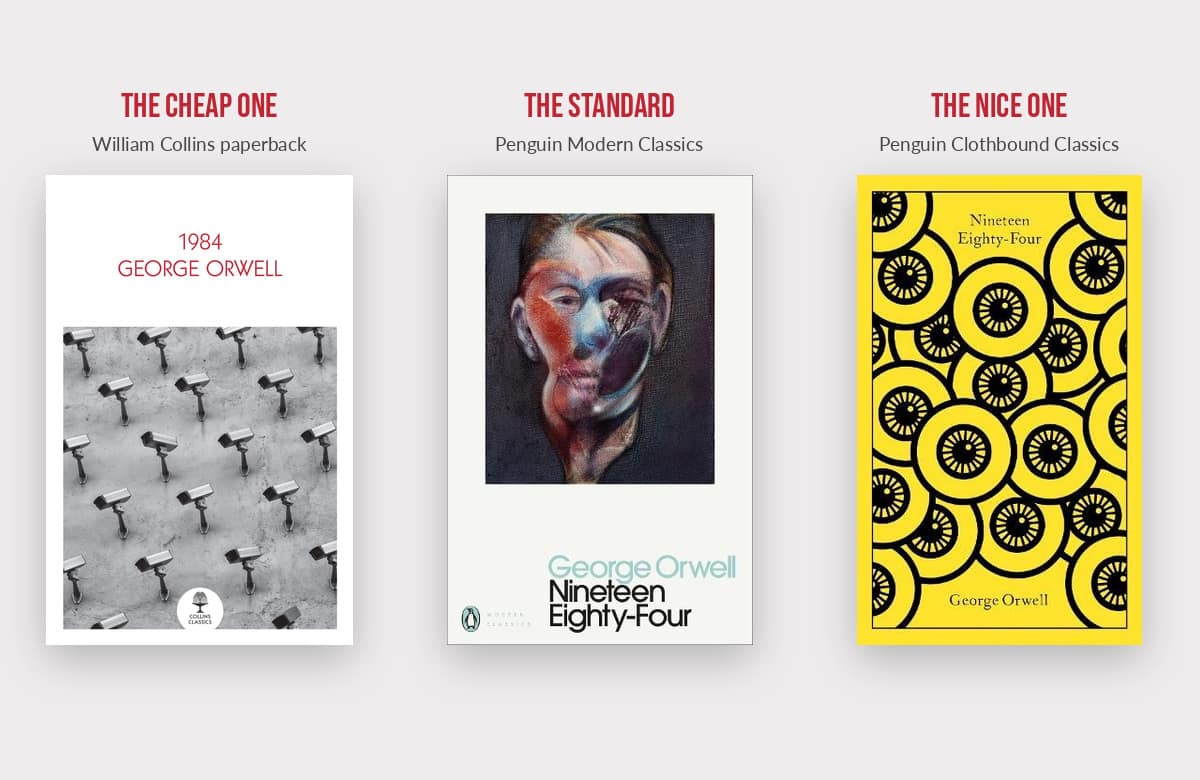
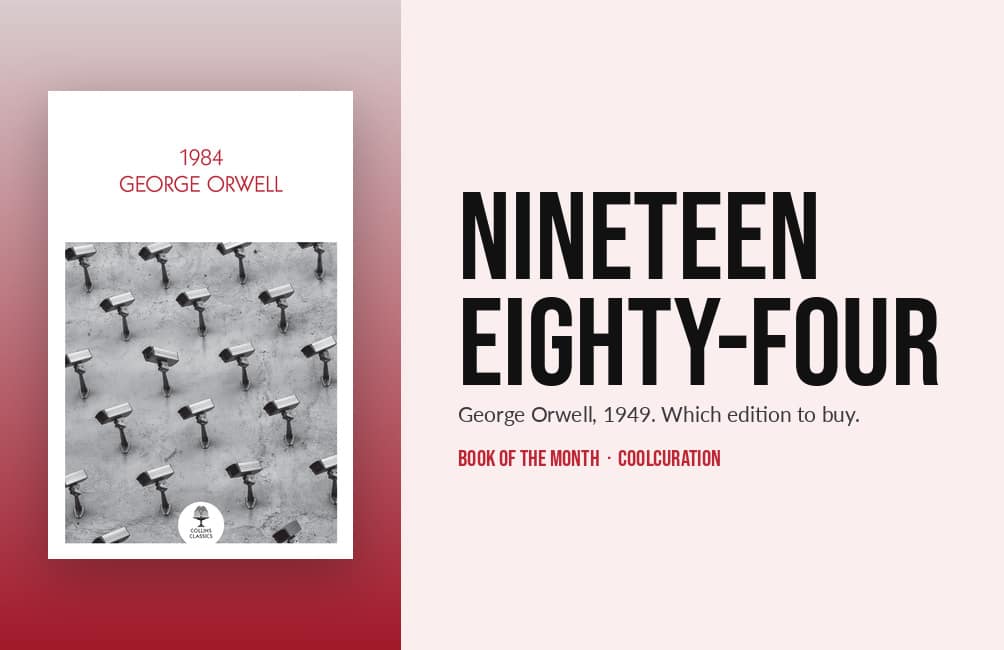
The cheap one. Collins Classics, 384 pages, £3.79 on Bookshop.org as of 25 August 2026. A small paperback with a greyscale CCTV cover. Buy this if you simply want to read the thing.
Buy it: Bookshop.org or Amazon UK
The standard one. Penguin Modern Classics, 384 pages, £8.54 on Bookshop.org as of 25 August 2026. It carries an introduction by Thomas Pynchon and a Francis Bacon painting on the cover. This is the one most UK readers picture.
Buy it: Bookshop.org or Amazon UK
The nice one. Penguin Clothbound Classics, hardback, £16.14 on Bookshop.org as of 25 August 2026, designed by Coralie Bickford-Smith. It appeared on 7 January 2021, days after the copyright lapsed. Yellow, patterned, and the obvious gift.
Buy it: Bookshop.org or Amazon UK
Full specifications, ISBNs and buy links for all of them live on our Nineteen Eighty-Four book page, which we keep updated as prices move.
Buy Nineteen Eighty-Four from £3.79
What to read next
Two follow-ups earned their place on my shelf. Sandra Newman's Julia came out from Granta in 2023, in paperback in 2024. It retells the novel from Julia's side with the estate's blessing, and it is much funnier than you would expect. Dorian Lynskey's The Ministry of Truth is a biography of the book itself, tracing where every idea came from.
Would you rather listen? Audible's 2024 full-cast production casts Andrew Garfield as Winston, alongside Cynthia Erivo, Andrew Scott and Tom Hardy. It is an adaptation rather than a straight reading, so treat it as a companion.
The verdict
Nineteen Eighty-Four is not a perfect novel. The middle sags, the women are badly drawn and the torture reads like a boys' adventure story. Nevertheless it gave us the words for the thing it describes. That is a kind of immortality most novels never get near.
As Orwell dictated from his sanatorium bed in June 1949, months before he died: "The moral to be drawn from this dangerous nightmare situation is a simple one... Don't let it happen. It depends on you." For more on the novel and its author, see The Orwell Foundation.
Read it again. Just do not do it in one sitting.
Nineteen Eighty-Four FAQs
How much does Nineteen Eighty-Four cost in the UK?
All figures here were checked on 25 August 2026. On Bookshop.org the Collins Classics paperback is £3.79, Penguin Modern Classics is £8.54, and the Penguin Clothbound hardback is £16.14. Granta's 75th anniversary edition is £30. Prices change, so check before you buy.
Is Nineteen Eighty-Four worth reading in 2026?
Yes, although not for the reason most people give. Read it for the argument about language and records rather than as a prediction about surveillance cameras. The appendix on Newspeak is the part that will stay with you.
Is Nineteen Eighty-Four the same book as 1984?
It is. Orwell's title is Nineteen Eighty-Four, spelled out, but many covers print it as 1984. Both refer to the same novel, so either search term will find it.
How long does Nineteen Eighty-Four take to read?
Most UK paperbacks run to 384 pages. A steady reader will therefore finish in roughly seven or eight hours. However, the Goldstein section slows almost everyone down.
Which edition of Nineteen Eighty-Four is best?
For reading, the Collins Classics paperback is unbeatable value. For a proper introduction, choose Penguin Modern Classics and Thomas Pynchon's essay. For a gift, the Penguin Clothbound Classic wins easily on looks alone.
Why is Nineteen Eighty-Four so cheap now?
Because it is out of UK copyright. Protection runs for seventy years from the end of the year the author died. Orwell died in January 1950, so the novel became public domain on 1 January 2021. Consequently any publisher can print it.
More from CoolCuration
A few other things worth your time:
- Nineteen Eighty-Four book page - every current UK edition, with ISBNs and prices.
- Greatest books of all time gift guide - the whole list, if you fancy reading along with us.
- The Great Gatsby - another entry from the same list, and a far quicker read.
- Best audiobooks August 2026 - ten UK listens worth a credit this month.
- Structured daily planner - our App of the Month, for when your reading pile needs a slot in the day.
- Service guides - every guide we have written, in one place.
What's trending




Recent posts
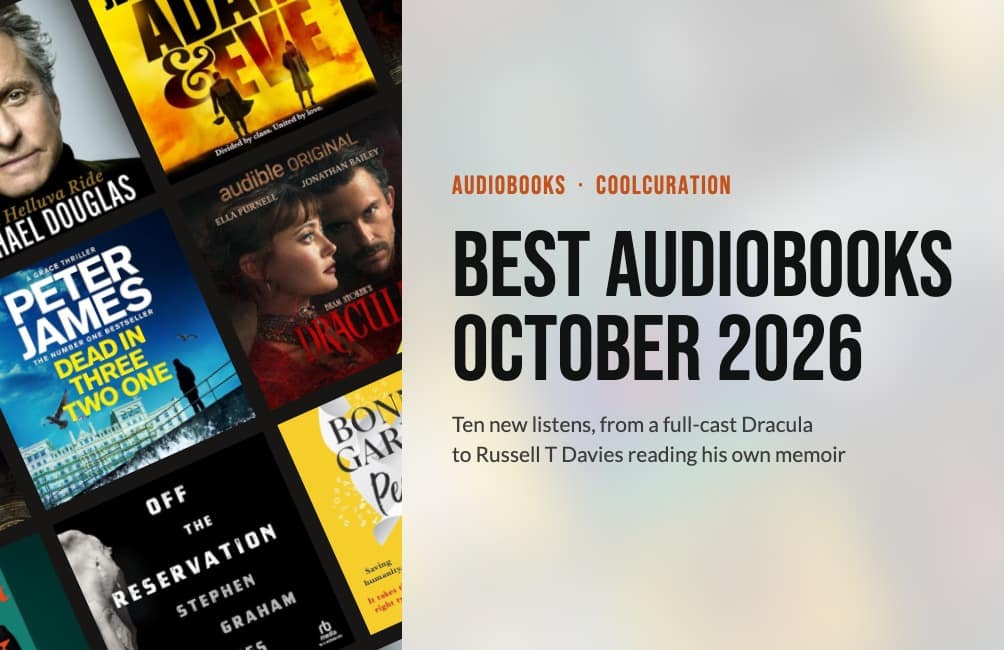
- Best Audiobooks October 2026: 10 UK Listens Ranked
 Ten new audiobooks for October 2026, from a full-cast Dracula with Jonathan Bailey to Russell T Davies reading his own television memoir.
 - Louis Fratino at David Zwirner ReviewLast updated: 4 October 2026 By Tristan · Arts, exhibitions and creative culture This is an opinion piece. Views expressed are the author's own and do not constitute professional advice. Exhibition reviewMayfair Saunas, subway cars and a lot of skin in Mayfair Louis Fratino at Zwirner is the American painter's first solo show in London,… Read more: Louis Fratino at David Zwirner Review
- What Is a Sprive Boost? Seven Days, and What It Actually PaysA Sprive boost lifts your cashback rate for seven days, and it arrives on its own. What mine paid, and why Supercharge is a display toggle rather than extra cashback.

No Comments.