
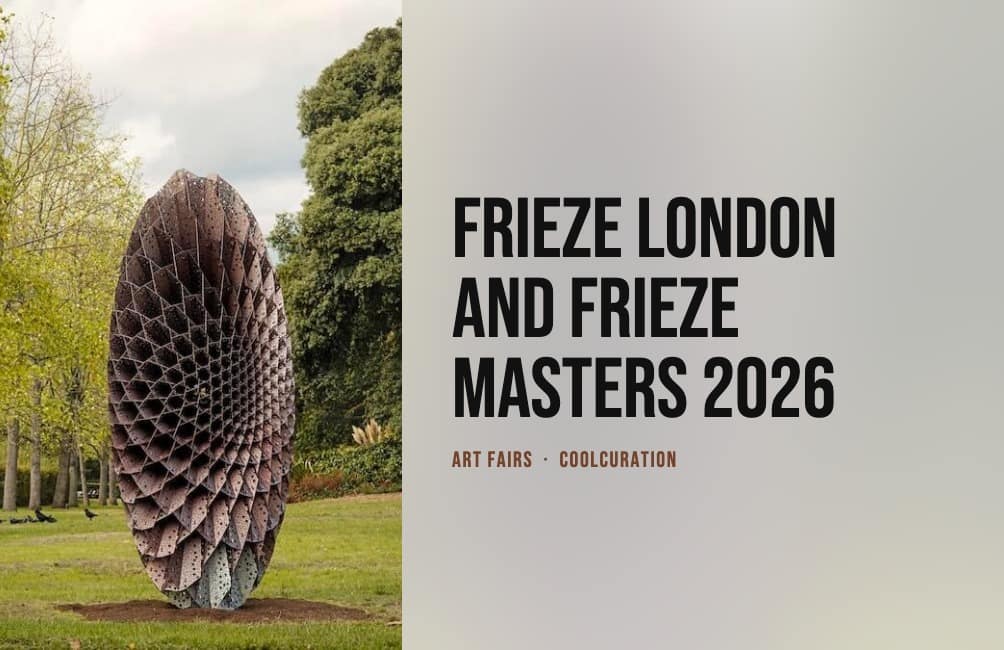
Last updated: 30 September 2026. I checked every price, opening time and date in this Frieze London 2026 guide against Frieze's own ticket and visitor pages that day.
By Tristan · Arts, exhibitions and creative culture
This article contains affiliate and referral links, which are paid links. If you click one and buy or sign up, I earn a commission or referral bonus at no extra cost to you. Brands don't choose what I feature or what I say about them.
Coming into London for Frieze?
A railcard takes a third off most UK rail fares for a year, and my railcard page has the current TrainPal new-customer discount and the steps to claim it.
Frieze London 2026 and Frieze Masters run in The Regent's Park from Wednesday 14 to Sunday 18 October 2026. Wednesday is invitation only, so the public gets four days. Frieze London shows art made mostly since 2000. Frieze Masters shows work made before 2000, from ancient Egypt to the late 20th century, and the two tents sit about 15 minutes' walk apart at either end of the park.
After the fair: we went three times. Read our Frieze London review for how the stands, the Deutsche Bank lounge and our five picks actually held up.
Tristan's top five for Frieze London
Tristan's top five for Frieze Masters
We went: read our Frieze Masters review to see how these five picks held up on the day.
Section 01 / Themes
What to look out for at Frieze 2026
Almost 300 galleries from 48 countries and regions.
Frieze London has 172 galleries from 42 countries and regions this year. Frieze Masters has more than 140 from 30.
Five things run through both fairs this year.
- Two new curated sections. The Code Universe at Frieze London, curated by Carol Yinghua Lu of Beijing's Inside-Out Art Museum, looks at how artists have responded to mass culture, from consumer goods to the media. Queering Modernism at Frieze Masters, curated by Anke Kempkes, puts LGBTQIA+ artists of the 20th century back into the story, with its stands spread across the fair rather than in one corner.
- Women artists, old and new. Frieze has grouped stands by women artists across both fairs, from Louise Bourgeois and Ana Mendieta to Dorothea Tanning and Caroline Walker. The Women's Art Collection and the Female Artists of the Mougins Museum have also set up a fund to buy a work at Frieze London by a woman artist not yet in a UK public collection, and they'll announce the purchase at the fair.
- Brazil. Frieze has given one of its two entrance stands at Frieze London to Márcia Falcão, shown by the São Paulo gallery Fortes D'Aloia & Gabriel. Dalton Paula, Marina Perez Simão and Fernanda Galvão, all Brazilian, have solo stands too.
- London's own galleries. The Approach, Arcadia Missa, Carlos/Ishikawa, Emalin and Maureen Paley are all at Frieze London, alongside the big international names such as Gagosian, Hauser & Wirth, White Cube and David Zwirner.
- Museums buying. The Contemporary Art Society has now bought work at Frieze London for regional UK museums for ten years, and several other funds and prizes buy at the fair too. So some of what you see on a stand this year could end up on a museum wall outside London.
Section 02 / Market
Frieze 2026 and the art market right now
Sales at the top of the market have recovered faster than the rest.
Frieze itself changed hands in 2025. Ari Emanuel, the former chief executive of Endeavor, agreed to buy it from the entertainment company in a deal that The Art Newspaper reported as worth $200m.
Meanwhile, the market itself has turned. According to the Art Basel and UBS Art Market Report 2026, global art sales rose 4% to $59.6bn in 2025, after falling in the previous years. The UK is still the second-biggest market in the world, with 18% of sales by value and $10.5bn in 2025, up 2%. However, the report says auction sales in the UK grew while sales by dealers, the galleries you meet at Frieze, were more subdued.
The recovery has also been lopsided. At auction, sales above $10m grew by 30% in 2025, but sales under $50,000 fell by 2% in both value and number. Then 2026 started fast at the very top. Christie's reported $4.5bn of sales in the first half and Sotheby's a record $4.4bn. In June, the Lewis collection made $406.2m at Sotheby's in London. According to The Art Newspaper, that was the highest-value sale of Impressionist, Modern and contemporary art ever held in Europe. Even so, Christie's chief executive Bonnie Brennan described buyers as "disciplined", and said bidding was thinner where estimates got pushed.
Art fairs matter more to galleries than they did, too. The same report found fairs made up 35% of dealers' sales in 2025, their highest share since 2022. For mid-sized galleries, turning over between $1m and $10m a year, the share rose from 29% to 36%.
If you're going to look rather than buy, none of this changes your day. If you're thinking about a first purchase, though, the lower end is where auction prices have been softest. At the fair, that means starting with the Editions section and the Reading Room. Art Basel Paris follows a week later, from 23 to 25 October. For the affordable end of the same week, my guide to affordable art in the UK covers prints and originals under £500.
Section 03 / Tickets
Frieze London 2026 tickets, day by day
Early bird tickets have sold out, so these are the full prices. Frieze adds a booking fee on top.
Frieze only sells tickets online, in advance, and each one is for a set day and entry time. Frieze doesn't refund or exchange them, and a general admission ticket also has no re-entry. A combined ticket gets you into both fairs on the same day, but you have to visit them in the order printed on it.
| Day | Ticket | One fair | Both fairs |
|---|---|---|---|
| Thursday 15 October | Thursday First Preview, from 1pm | £150 | £250 |
| Friday 16 October | Preview First Access, entry before 3pm | £95 | n/a |
| Friday 16 October | Preview | £78 | £130 |
| Saturday 17 or Sunday 18 | General Admission First Access, entry before 3pm | £59 | n/a |
| Saturday 17 or Sunday 18 | General Admission | £48 | £92 |
| Saturday 17 or Sunday 18 | Student, with valid ID | n/a | £32 |
| Saturday 17 or Sunday 18 | Child, aged 2 to 17, from 2pm | £10 | n/a |
Two of those rows come with conditions. Student tickets only come as combined tickets, so £32 covers both fairs. Child tickets, meanwhile, are only sold for the weekend, from 2pm, and under-twos go free. Carers and companions also go free, but you have to book your own ticket first and then ask Frieze's ticket desk for theirs.
Frieze's In Person members get into both fairs from 11am on the Thursday, two hours before Thursday ticket holders. Frieze Connect members, who join by application, can go from the Wednesday.
The Thursday catch
Here are the public hours, from Frieze's visitor information page. Last entry is 30 minutes before closing every day.
| Day | Frieze London | Frieze Masters |
|---|---|---|
| Wednesday 14 October | Invitation only | Invitation only |
| Thursday 15 October | 1pm to 5pm | 1pm to 7pm |
| Friday 16 October | 11am to 7pm | 11am to 7pm |
| Saturday 17 October | 11am to 7pm | 11am to 7pm |
| Sunday 18 October | 11am to 6pm | 11am to 6pm |
On the Thursday, that means Frieze London's last entry is 4.30pm. If you arrive after work, as I will, you get to Frieze London first or you don't get in at all. After that, a free shuttle bus leaves from outside each fair about every 15 minutes, and Frieze Masters lets people in until 6.30pm.
If you can go at the weekend instead, the same two fairs cost £92 together, and both open at 11am. That's £158 less than the Thursday combined ticket, and you also get twice as long in each tent.
Section 04 / Contemporary
Five stands at Frieze London
Four gallery stands and one curated section.
Alongside The Code Universe and Artist-to-Artist, the fair has three more sections. The Galleries section is the main floor. Focus gives 35 solo presentations to galleries founded in the last twelve years. Then there's Editions, where publishers and print studios such as Cristea Roberts Gallery and Paragon sell prints and multiples.

Helen Chadwick, Glossolalia, 1993. Courtesy: The Estate of Helen Chadwick and Richard Saltoun Gallery
Helen Chadwick and Cathy de Monchaux at Richard Saltoun Gallery
Chadwick and De Monchaux first showed together in 1994, at the 22nd São Paulo Biennial, and became close friends. Richard Saltoun is putting two of their big works side by side for the first time. Chadwick's Glossolalia (1993) is a bronze with fox fur pelts on an oak-veneered base, about 2 metres across. De Monchaux's Sovereign (1999), made six years later, goes on show next to it.
Both artists are also in The 90s: Art and Fashion at Tate Britain.
Galleries section, Frieze London

Ana Mendieta, Untitled (Facial Hair Transplants), 1972. Courtesy: The Estate of Ana Mendieta Collection, LLC, DACS 2026 and Alison Jacques
Ana Mendieta at Alison Jacques
Alison Jacques is showing Mendieta's Untitled (Facial Hair Transplants) from 1972. It's a suite of seven colour photographs in which she glues a friend's beard onto her own face, one of her early works about how gender gets written onto a body.
Galleries section, Frieze London

Dalton Paula, Zacimba Gaba, 2025. Courtesy: Dalton Paula and Lisson
Dalton Paula at Lisson
Paula paints portraits of Black Brazilians from the 16th to the 19th centuries, many of them leaders of resistance to slavery, such as Chico Rei and Zeferina. He works from overlooked biographies, oral histories and visual records. Zacimba Gaba (2025) is in oil and gold leaf, and it's about 1.8 metres tall.
Solo presentation, Frieze London

Myrlande Constant, Lasirène Diamant, 2025. Courtesy: Myrlande Constant and Fort Gansevoort
Myrlande Constant at Fort Gansevoort
Constant makes drapo, the sequinned flags of Haitian Vodou. Men traditionally made them. She learned tambour beading as a teenager, working next to her mother in a wedding dress factory in Port-au-Prince. Her flags are now dense scenes of festivals, sea and land, built from beads and sequins on fabric.
This New York gallery's stand is her first solo show in Europe. Lasirène Diamant (2025) is about 1.5 metres tall and 1.7 metres wide.
Solo presentation, Frieze London

Paul Robas, Long Story, 2026. Photo: Roberto Apa. Courtesy: Paul Robas and Alice Amati, London
Artist-to-Artist
Artist-to-Artist has seven solo stands, and an established artist picked each one. For example, Yinka Shonibare chose Unathi Mkonto, shown by Goodman Gallery. Louise Giovanelli chose Paul Robas, shown by Alice Amati in London. Firelei Báez chose Eilen Itzel do Espírito Santo, and Otobong Nkanga chose Jota Mombaça.
For names you haven't heard yet, this is the part of the fair to walk slowly. Robas's Long Story (2026) is ink, encaustic and oil on a board about the size of an A4 sheet.
Artist-to-Artist, Frieze London
One more thing at Frieze London that isn't on a stand. Gray Wielebinski's new commission, Production, puts scented urinal cakes and toilet-rim blocks in sculptural cages across the fair's toilets. Dean's Bottom commissioned it, and since it's in the toilets, you'll find it whether you look for it or not.
Near it, the Reading Room gives stands to four non-profits that sell editions and prints to fund their work: Nottingham Contemporary, Gasworks, Black Curatorial and the mental health charity Hospital Rooms. My post on the Hospital Rooms poster sale also covers what that charity does. Allied Editions is back too, selling artists' editions for seven London non-profits including the Serpentine and Whitechapel Gallery. Thursday and Friday ticket holders get 10% off there, and weekend ticket holders get 5%.
Section 05 / HistoricalFive stands at Frieze Masters
From about 1390 BCE to 1957, oldest first. Artists born before 1950 can show work made up to 2010.
Spotlight is Frieze Masters’ long-running section of solo shows by 20th-century artists, curated this year by Devika Singh and Sofia Gotti of the Courtauld Institute. Victoria Miro and David Zwirner also share an Alice Neel stand, as part of Queering Modernism.

Egyptian Head of Sekhmet, New Kingdom, 18th Dynasty, c.1390 to 1352 BCE. Courtesy: ArtAncient
A head of the goddess Sekhmet at ArtAncient
Sekhmet was the lion-headed warrior goddess of ancient Egypt. This polished granodiorite head, 29.5cm tall, was made for Pharaoh Amenhotep III's temple at Kom el-Hettan, about 3,400 years ago. It was one of around 730 statues made for his jubilee, and traces of red pigment survive in the eyes.
The same French family owned it for over a century, after buying it in Paris in 1923. It came to light again in 2025, when the gallery went through the family's archives. Now the Vatican Museums are including it in their study of the surviving Sekhmet statues.
Galleries section, Frieze Masters

Renaissance cup in the form of a shoe, South German, dated 1567. Courtesy: Kunstkammer Georg Laue, Munich and London
A drinking cup shaped like a shoe at Kunstkammer Georg Laue
Georg Laue deals in the kind of objects that filled Renaissance cabinets of curiosities. One piece to find is a South German drinking cup in the shape of a gothic shoe, dated 1567, in leather and engraved, fire-gilt copper. Very few survive, but The Metropolitan Museum of Art in New York owns one of them. People used cups like this at ceremonies, weddings among them.
Galleries section, Frieze Masters

A Pichvai depicting Krishna and Radha (detail), Kota or Nathdwara, Rajasthan, circa 1850. Courtesy: Prahlad Bubbar
A temple painting of Krishna and Radha at Prahlad Bubbar
A pichvai is a painted cloth made to hang behind a statue of Krishna in a temple. This one, from Rajasthan and painted around 1850, shows Krishna and Radha in a forest of lotus flowers and peacocks. At 2.54 metres tall, it's also higher than a standard door.
There's a second reason to stop at this stand. Prahlad Bubbar is also showing a life-size portrait of Maharana Amar Singh I of Mewar, painted in the mid-17th century. It was in a private collection for 35 years, and scholars know of only one other large portrait from that period.
Galleries section, Frieze Masters

Helene Schjerfbeck, Head of Slant-Eyed Lady (Dora), c.1928. Courtesy: Åmells Konsthandel
Nordic Women Artists at Åmells Konsthandel
The Stockholm dealer has built its stand around women painters from the turn of the 20th century. Helene Schjerfbeck, the Finnish modernist, leads it. Her Head of Slant-Eyed Lady (Dora), painted around 1928, is 26cm square, a little smaller than an LP sleeve. Around her are Fanny Brate, Anna Boberg, Mollie Faustman and Sigrid Hjertén, whose work covers domestic life, landscape and portraits as well.
Galleries section, Frieze Masters

Ibrahim El-Salahi, Untitled, 1954 to 1957. Courtesy: the artist and Vigo Gallery
Ibrahim El-Salahi at Vigo Gallery
El-Salahi is a Sudanese painter, now 95, and a pioneer of African and Arab modernism. Vigo's stand, titled Pre-Pixel, shows only work from 1954 to 1957, when he was a student at the Slade School of Fine Art in London. In these paintings, for example, landscapes break up into grids of colour and faces into flat geometric shapes.
Solo presentation, Frieze Masters
Anish Kapoor fans have a reason to visit Frieze Masters too. Galleria Continua is bringing early sculptures, including Not Eve (1989), in sandstone and pigment, and ceramics from the mid-1990s.
The Frieze Masters talks
This year's talks are called Breaking the Mould, curated by Arturo Galansino of Palazzo Strozzi in Florence. First, on Thursday 15 October, Grayson Perry talks ceramics with Iris Moon of The Met at noon. Then at 3pm, the artists Paul Pfeiffer and Danh Vō discuss broken objects and fragments. Frieze records every talk and releases it afterwards on frieze.com, Spotify and Apple Podcasts, so you can catch up on any that fall outside your ticket time.
Section 06 / Free
Three free walks during Frieze week
None of these needs a ticket, and the first one sits between the two fairs.
Regent's Park: Frieze Sculpture, open now
Frieze Sculpture opened on 16 September in the English Gardens at the south end of the Broad Walk, so you don't have to wait for the fairs to see it. When they do open, the walk between the two tents takes you past it. There are eleven works this year, curated for the fourth time by Fatoş Üstek. It's free, it needs no booking, and it stays up until 1 November.
Three to find first:
- Conrad Shawcross, Eye of the Needle (Time Pebble (E30A13)), presented by Victoria Miro. An elliptical monolith with a perforated skin, so light and shadow pass through it as the day moves on. It belongs to his Time Pebbles series, which started with a 2008 visit to the Holmdel Horn Antenna in New Jersey, the instrument that detected the cosmic microwave background. Shawcross also made Timepiece (2013), which turned the Roundhouse in Camden into a giant clock.
- Angel Otero, Dreams and Salt, presented by Hauser & Wirth. A plywood door set into the ground at an angle and left ajar over a short staircase going down. Otero grew up in Puerto Rico, studied in Chicago and now lives between Puerto Rico and New York. The door is about leaving home, and the distance that grows between a person and the place they left.
- Ramesh Mario Nithiyendran, Warrior Figure, presented by Jhaveri Contemporary and Sullivan+Strumpf. A two-metre bronze that he built by hand in wet clay at full size, then had cast by the lost-wax method in Melbourne. Walk all the way round it. One side has a painted, patinated face that draws on Hindu, Buddhist and Christian idols, while the other is polished bronze that catches the light. It stands on a spray-painted steel plinth.
The free Bloomberg Connects app has an audio tour narrated by Üstek and the artists.
Kensington Gardens: the Serpentine
Both Serpentine galleries are free. Serpentine South reopens on 8 October with Justin Caguiat: Change Ringing, his first show at a UK institution, on until 10 January. Serpentine North has the filmmaker Amar Kanwar until 31 January. Outside, this year's Serpentine Pavilion by LANZA atelier and Jesús Rafael Soto's walk-through Pénétrable BBL Jaune both close on 25 October.
My Cecily Brown review from the Serpentine, from earlier this year, also covers the gallery itself.
Marylebone and Mayfair: the galleries
On Saturday 17 October, Frieze runs West End Day, from 11am to 6pm, when the galleries of Mayfair and the West End open for fair visitors. It's one of three neighbourhood days Frieze has organised. However, the other two, in Bloomsbury and the East End, fall before the fair, on 9 and 11 October.
Closer to Frieze London, Lisson's two Marylebone spaces are free and open Tuesday to Saturday, with Ha Chong-Hyun on Bell Street and Carmen Herrera on Lisson Street until 7 November.
Section 07 / Elsewhere
The other fairs and shows that week
Three more fairs open across London, and two big Tate shows are running.
If you want the gallery shows rather than the fairs, our Frieze week exhibitions guide picks nine across town, from Cindy Sherman at Hauser & Wirth to Issy Wood at the National Portrait Gallery.
1-54 Contemporary African Art Fair
The 14th London edition of 1-54 is at Somerset House, from 15 to 18 October. Thursday, however, is a VIP preview at £100. The public opens on Friday 16, and a standard ticket is £32, or £18 for concessions. Under-12s go free. This year the fair adds a section on Modernist artists from Africa and its diaspora, with an exhibition called West Wind, curated by Dr Nancy Dantas.
PAD London
PAD mixes design, decorative arts and art, on Berkeley Square in Mayfair. It runs from 13 to 18 October, but it only opens to the public on Thursday 15, from 11am to 7pm, with a 6pm close on the Sunday.
London Invitational
Unlike Frieze, London Invitational is deliberately small, with twelve galleries on one floor of The Chancery Rosewood. That's the former US Embassy on Grosvenor Square, designed by Eero Saarinen. It's open to the public on Friday 16 and Saturday 17 October from 11am to 6pm, and on Sunday from noon to 4pm. You need a ticket.
Anish Kapoor at the Hayward Gallery
Kapoor's Hayward show closes on Sunday 18 October, so Frieze week is your last chance. Tickets are £22, and in its final weeks the gallery stays open until 9pm. My Chiharu Shiota and Yin Xiuzhen review from the spring covers the Hayward itself.
Tate Modern and Tate Britain
Tate Modern's Ana Mendieta show runs until 17 January 2027. At Tate Britain, The 90s: Art and Fashion, curated by Edward Enninful, opens on 8 October and runs until 14 February 2027. Both are ticketed, although Tate Members go free.
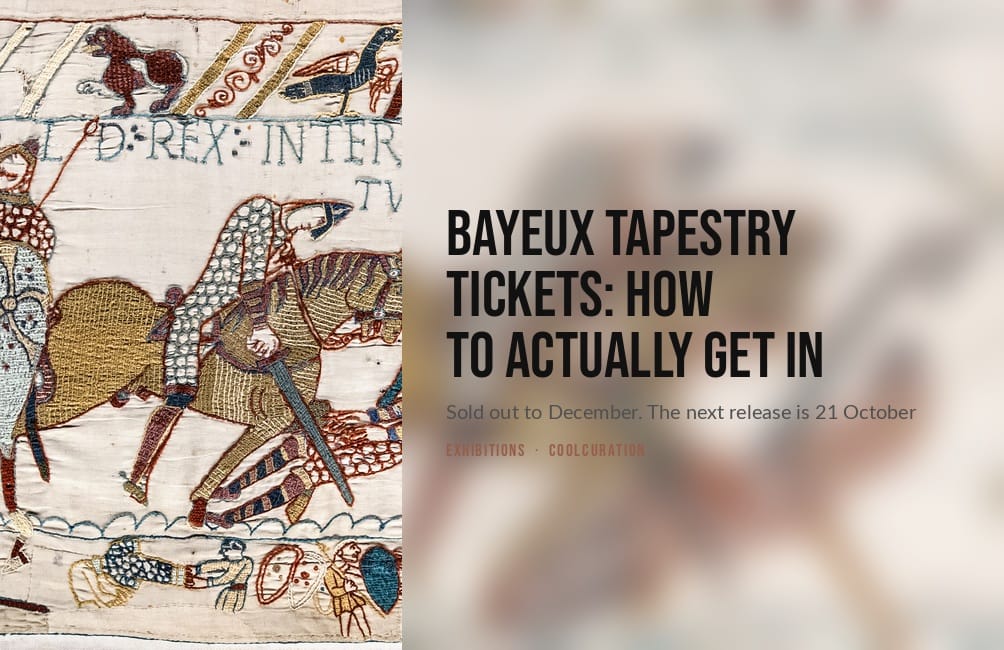
If the Bayeux Tapestry at the British Museum is on your list, don't plan it for Frieze week. It's sold out until the end of December, and the next public release is on 21 October. My Bayeux Tapestry ticket guide has the release dates.
Getting there and getting in
For Frieze London, the entrance is off Park Square West, postcode NW1 4LL, and Regent's Park station is less than five minutes' walk away. Baker Street and Great Portland Street are close too. Frieze Masters, meanwhile, is on Gloucester Green, NW1 4HA, ten minutes' walk from Camden Town or Mornington Crescent. Frieze doesn't let coaches into the park, and pay-and-display spaces are limited, so take the Tube.
Pack light. Frieze won't let in anything bigger than 40 by 20 by 40cm, about the size of an under-seat airline bag, and you have to carry a backpack in your hand rather than wear it. You can't bring your own food or drink, but both fairs have bars and places to eat. The cloakroom also has very little space and takes no umbrellas.
Frieze says both fairs are fully accessible for people with reduced mobility, and it has wheelchairs to borrow, first come, first served. Frieze also runs British Sign Language tours of both fairs and of Frieze Sculpture, at £10 including entry.
If the fair leaves you wanting prints of your own, the gift guide for artists is a good place to start.
Frieze London 2026 FAQs
When is Frieze London 2026?
Wednesday 14 to Sunday 18 October 2026. Wednesday is invitation only, so the public can go from Thursday 15 October.
How much are Frieze London 2026 tickets?
As checked on 30 September 2026, they run from £48 for one fair at the weekend to £250 for both fairs on the Thursday, plus a booking fee. Students pay £32 for both fairs at the weekend.
More from CoolCuration
- London Design Festival 2026 guide: eleven picks from last month's festival, grouped into walks.
- Tracey Emin at Tate Modern review: my verdict on A Second Life, room by room.
- Great Women Artists: the big illustrated survey of women artists, to read after the Masters stands on women painters.
- Chiharu Shiota, Connected to the Universe: a woodcut edition of 120 by the artist behind the Hayward's thread installations.
- theprintspace discount code: money off printing your own work if the Editions stands inspire you.
- Uber referral code: 50% off your first five rides, including the one home from Regent's Park.
Prices, opening times and programmes change, so check Frieze's own pages before you travel. Artwork images are courtesy of the galleries named in each caption, via Frieze.
What's trending





Recent posts
- Frieze London 2026 Review: Why It Only Gets Two Stars
 Three visits to Frieze London 2026, a Deutsche Bank lounge full of Studio Lenca, and why the fair only gets two stars.
 - Frieze Masters Review 2026: Old Masters, Queering Modernism and Alice NeelFrieze Masters review 2026: a few visits to Regent's Park, from a 1520s royal portrait to Alice Neel and the new Queering Modernism strand. 4/5 Stone cold.
- Best Easy Access Savings Accounts UK: October 2026 RatesLast updated: 21 October 2026. I checked every rate on this list of the best easy access savings accounts on the provider's own website on 20 October 2026. By Stiv · Design, technology and personal finance Affiliate disclosure: This article contains affiliate and referral links, which are paid links. If you click one and buy… Read more: Best Easy Access Savings Accounts UK: October 2026 Rates

No Comments.