
Last updated: 17 June 2026
By Tristan · Arts, exhibitions and creative culture
Less fuss, more finds: Gander opens up the RA
I went in slightly braced to this year's Summer Exhibition 2026, because the world's biggest open-submission show can be exhausting, but I came out cheerful. Ryan Gander's turn as curator this year has resulted in the least fussy Summer Exhibition I can remember, and the rummage was a joy. So why only three stars? Read on.
This is an opinion piece. Views expressed are the author's own and do not constitute professional advice.
Cool Factor: 3/5
What's on
What's on at the Summer Exhibition 2026
The Summer Exhibition 2026 is the Royal Academy's 258th annual hang, running from 16 June to 23 August 2026 at Burlington House. Ryan Gander OBE RA coordinates this year, and he has chosen "Interconnectedness" as his theme. According to the Royal Academy, the show gathers 1,851 works by 1,241 artists, whittled down from roughly 18,000 entries. Furthermore, Gander did not work alone. A committee of Academicians, including Eileen Cooper, Michael Craig-Martin, Oona Grimes, Katherine Jones, Goshka Macuga, Humphrey Ocean and architect Peter St John, each took a room, chaired by RA President Rebecca Salter.
The setting
The Royal Academy as a setting
Context matters, because the Summer Exhibition 2026 is not just an art show. It is an institution that has run, without a single gap, since 1769. Moreover, the money does real work. Sales help fund the RA Schools, which still offers a free three-year postgraduate programme, a rarity in Europe. The show is sponsored this year by Insight Investment, marking twenty years of support. So when you buy any piece here, be it a painting by a heavy-hitter name or a print of a whippet by an amateur, you are also quietly bankrolling the next generation of artists. That backstory gives the whole thing a generosity that most blockbuster shows simply lack.
First impressions
First impressions: a rainbow in the courtyard
Before you even reach the door, the tone is set. Ugo Rondinone has filled the Annenberg Courtyard with The Song is You, a ten-metre rainbow-striped LED sign from his Rainbow Poems series, lit up at night. It is cheerful, frankly Instagram-friendly, and not remotely subtle. Some critics have rolled their eyes at it. I understand why, yet on a grey London afternoon it did its job, which was to make me grin and walk in faster. Rondinone has also strung 54 of his LIGHT flags along Bond Street for Art in Mayfair, not quite as effective, but at least the colour spills well beyond the galleries.
The theme
Interconnectedness, or a word to hang 1,851 things on
Here is the central tension of the Summer Exhibition 2026. Gander's theme asks us to see "the unexpected and fortuitous connections" between disparate works. He describes himself, rather wonderfully, as "a sort of neo-conceptual no-style-style amateur philosopher", and he hopes the show reads as a kind of "sociological diagram" of what we share. It is a lovely idea. However, with nearly 1,900 works on the walls, interconnectedness becomes a word you can stretch over almost anything. Sometimes the conversations between pieces genuinely sing. Often, though, two neighbours simply happen to be neighbours, and this is where the nature of the RA Summer show and the traditional salon hang becomes a curatorial constraint. Still, there was fun to be had.
The least fussy Summer Exhibition I can remember, and the rummage was a joy.
The rooms
The rooms that actually work
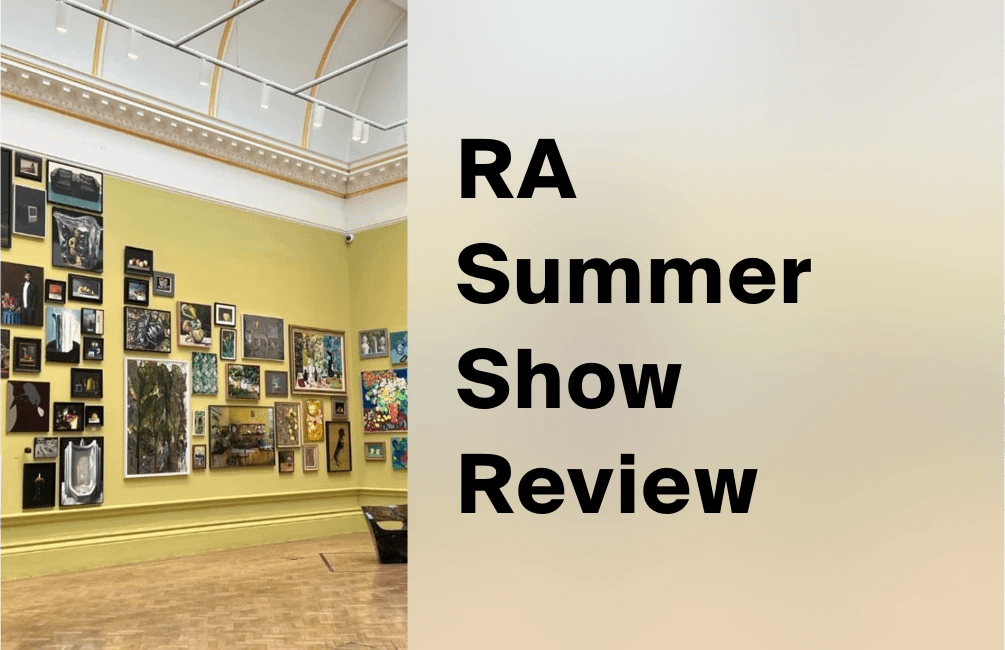
Where the Summer Exhibition 2026 shines is in the curation, which is noticeably better than recent years. The work is hung with more air around it and spread more evenly, so the eye is not constantly mugged. Katherine Jones's room leans into nature and gardens, opening with Philip Sutton's vivid flowers and building into something genuinely calming. Elsewhere, Frank Bowling offers a rich study in two glowing colour tones, and Isaac Julien's large waxed print Giants, After the Fall commands a wall. Kevin Francis Gray's monumental Hades Head, carved in Swaledale stone, is one of those pieces you circle twice.
Curatorial games
Gander's mirrors and the line of passivity
Gander could not resist a couple of curatorial games, and they are the most divisive part of the show. In the central hall he shows a series of mirrors half draped in sheets, which the catalogue rather grandly says provides a sense of drama. Additionally, he has run a pale horizontal "line of passivity" through the rooms at roughly two metres, the height that gentlemen's top hats once reached. As a witty nod to history, it raises a smile. As a hanging logic, though, it pushes some smaller pictures up where you genuinely need binoculars.
The students
The students in the room
One detail stayed with me. While I was loitering in front of a painting, I overheard one of the RA staff say Gander had invited the whole cohort of current RA Schools students to be in this year's hang. I should be straight with you here: I have not been able to confirm that as accurate, so treat it as hearsay rather than gospel. Nevertheless, it chimed with the mood of the show, which felt unusually welcoming to younger and unknown artists. Gander has long championed art education, and that spirit is palpable throughout the Summer Exhibition 2026.
The honest bit
Honest critical observations
Now for the part every review owes you. The Summer Exhibition 2026 is not a five-star show, and pretending otherwise would be dishonest. First, the theme does not hold. Melanie McDonagh, reviewing for the Evening Standard, stood in front of supposedly interconnected works and concluded they had "nothing in common, not a thing", and at times I agreed with her. Second, the sheer volume dilutes the best work. There is brilliance here, but you must wade through the merely competent to find it. Third, the line of passivity, however clever, occasionally buries good paintings near the ceiling. These are real limitations, not nitpicks.
Why it matters
Why the Summer Exhibition still matters
Despite all that, the show earns its place. The Summer Exhibition 2026 remains one of the very few stages where an unknown amateur can hang a few feet from a household name. Anyone over 18 can enter, for a fee, and the selection happens during a famously argumentative eight-day hang, fuelled by some filthy bovril-type broth for the hanging committee. Gander, who at fifteen reportedly told his teacher "one day I am going to apply to be in this exhibition", clearly cares about that democratic promise. In an art world obsessed with hierarchy, that openness still feels quietly radical, and it is the main reason I keep coming back.
Value and visiting
Value for money and practical info
Tickets run from £23.50 to £25.50 including the donation, with under-16s free and Friends of the RA going in for nothing. For the number of works on show, that is fair value, and the buying is half the fun, with plenty of affordable prints alongside the eye-watering pieces. If you want to see more London shows for less, our Rose Wylie at the Royal Academy review is a good companion read. Opening hours are Tuesday to Sunday, 10am to 6pm, with late Fridays and Saturdays until 9pm. There is also an in-gallery gin bar open Thursday to Sunday, which tells you exactly how social this show wants to be. Entry is via the Burlington House door, and the RA lists step-free access on its site.
The verdict
The verdict
So, where does the Summer Exhibition 2026 land? It is a confident, generous, better-curated edition that I enjoyed, held back by a theme that cannot bear the weight placed on it and by the usual open-submission overload. That is a textbook three out of five.
Cool Factor
★★★☆☆
3 out of 5
Final word
Closing summary
Overall, the Summer Exhibition 2026 is a solid 3/5, Cool. Gander has made the least fussy, most evenly hung Summer Exhibition in years, and the chaos of discovery is exactly why this show still matters. It did not reach Stone cold because "Interconnectedness" never quite earns its billing, and because nearly 1,900 works inevitably mix the great with the forgettable. Go for the rummage, the rainbow and the bargains, not for a tidy thesis, and you will have a lovely afternoon.
Frequently asked questions
Is the Summer Exhibition 2026 worth visiting?
Yes, if you enjoy discovery over a tidy curatorial argument. This year's hang is less cluttered and better spaced than recent editions, and the mix of unknowns and big names is genuinely fun. Just do not expect the theme to tie it all together.
How much are tickets to the Summer Exhibition 2026?
Tickets cost between £23.50 and £25.50, including a donation. Under-16s go free, concessions are available, and Friends of the RA enter at no charge. You can book on the Royal Academy website or by phone.
Who coordinated the Summer Exhibition 2026?
Ryan Gander OBE RA coordinated this year's show, choosing the theme "Interconnectedness". He worked with a committee of Academicians, each responsible for a room, chaired by RA President Rebecca Salter.
Can you buy the art at the Summer Exhibition?
Yes. Most works are for sale, with prices ranging from very affordable prints to major sums. Sales support the exhibiting artists and help fund the free postgraduate RA Schools, so buying here does double duty.
How does it compare to last year's Summer Exhibition?
In my opinion, the 2026 edition is better curated and less overwhelming than recent years, with work spread more evenly. The trade-off is a looser theme that does less to guide you through the rooms.
More from CoolCuration
- Cecily Brown at the Serpentine review · another major London show, put honestly to the test.
- Henry Moore at Kew Gardens review · sculpture in the open air, if the courtyard rainbow left you wanting more.
- National Art Pass · how to see far more shows like this one for a lot less.
- Howard Hodgkin, Indian Leaves print · if the show has you in the mood to actually buy something.
- theprintspace discount code · for printing your own work to a gallery standard.
- Royal Academy ceramic watercolour palette · eight hand-mulled colours from the RA shop, if the Summer Exhibition has you wanting to make something yourself.
What's trending




Recent posts
- Premium Bonds Alternatives UK 2026: Prize Savings Accounts Compared
 Four Premium Bonds alternatives open to new savers, with each provider's published odds, prize tables, access rules and protection.
 - Best Audiobooks October 2026: 10 UK Listens RankedTen new audiobooks for October 2026, from a full-cast Dracula with Jonathan Bailey to Russell T Davies reading his own television memoir.
- Louis Fratino at David Zwirner ReviewLast updated: 4 October 2026 By Tristan · Arts, exhibitions and creative culture This is an opinion piece. Views expressed are the author's own and do not constitute professional advice. Exhibition reviewMayfair Saunas, subway cars and a lot of skin in Mayfair Louis Fratino at Zwirner is the American painter's first solo show in London,… Read more: Louis Fratino at David Zwirner Review


No Comments.