
Last updated: 10 May 2026
By Tristan · Arts, exhibitions and creative culture
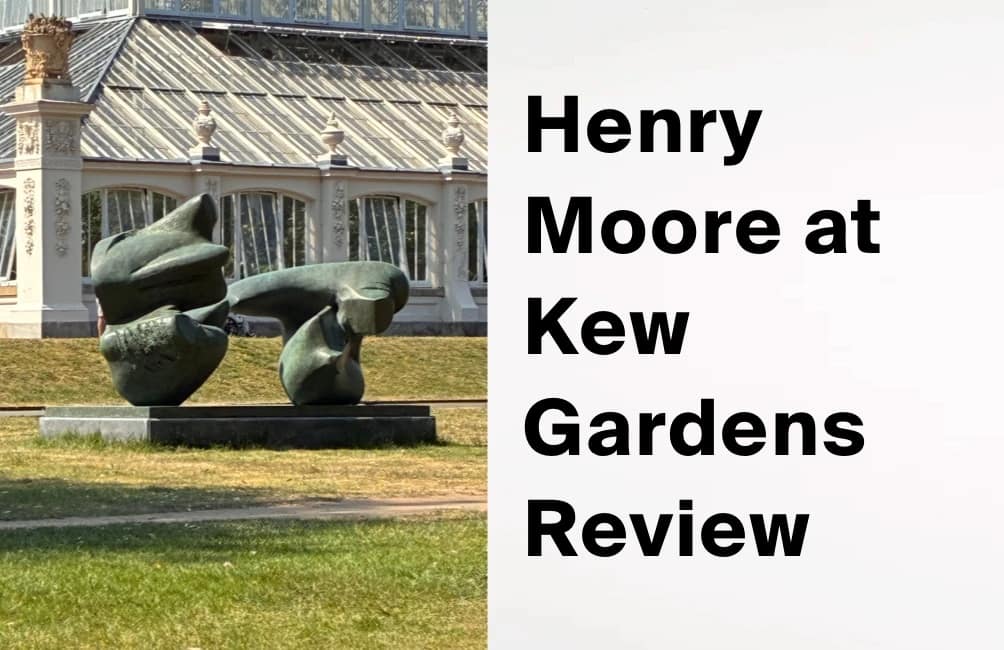
The Henry Moore Kew Gardens exhibition has finally arrived properly, and it is the show his work has always deserved. From 9 May 2026, thirty of Moore's monumental bronzes sit across Kew's 320 acres. This is the largest open-air Moore exhibition ever staged. Honestly, the sculptures look as though they grew there. So the gardens feel different because of them.
This is an opinion piece. Views expressed are the author's own and do not constitute professional advice.
This article contains affiliate or referral links. If you click through and sign up I may earn a commission or referral bonus at no extra cost to you. It does not affect my editorial view.
Cool Factor: 5/5
Cool Factor
★★★★★
5 out of 5 — Ice cold
What's on at Henry Moore Kew Gardens
Henry Moore: Monumental Nature opened at Kew on 9 May 2026 and runs until 31 January 2027. It is the largest outdoor Moore presentation ever mounted. Thirty monumental sculptures sit across the 320-acre UNESCO World Heritage Site. A companion show inside the Shirley Sherwood Gallery of Botanical Art holds more than 90 smaller works.
Significantly, this is the first major Henry Moore Kew Gardens exhibition in nearly two decades. The 2008 outing featured 28 bronzes concentrated in a few areas. By contrast, this one stretches across the entire estate. The show is organised in partnership with the Henry Moore Foundation. A selection of works on loan from Tate and the Sainsbury Centre for Visual Arts complements the Foundation's own collection.
Headline support comes from the Nora McNeely Hurley Foundation. Additional backing comes from Sotheby's and the Henry Moore Exhibition Supporters Circle. Entry to the exhibition is included with standard Kew admission.
Why Kew is the perfect Henry Moore setting
Moore was emphatic about where his work belonged. In his 1951 Tate Gallery statement, he wrote that "sculpture is an art of the open air". He also said he would rather see one of his pieces in any landscape than in the most beautiful building he knew. So Kew is not a compromise venue. It is a near-ideal one.
Sebastiano Barassi, Head of Henry Moore Collections and Programmes at the Foundation, has framed the pairing well. He says Moore's "deep affinity with the natural world makes Kew and Wakehurst ideal settings". Once you walk through the gates, you understand why. The trees, glasshouses and long sight-lines do something for these bronzes that no white-walled gallery could.
Furthermore, Moore wrote in his "Notes on Sculpture" that outdoor work needs scale, otherwise the sky reduces it. Thirty pieces. Thirty chances for that scale to land. Most of them succeed handsomely.
First impressions of the show
The first thing that strikes you is how casually the bronzes are positioned. There are no railings. There is no roped-off staging. So you simply round a corner and there they are, often framed by an avenue of plane trees or a ribbon of water.
Indeed, the curators have resisted the temptation to cluster works together. Instead, the show breathes. You walk for two or three minutes, and then suddenly Large Two Forms appears across a meadow. Walk further, and Sheep Piece sits on a slope as if pasturing. The pacing is deliberate, and it works.
However, that pacing comes with a trade-off. You will not see all thirty pieces in one visit unless you commit to a full day and serious mileage. More on that below.
The big bronzes: Large Two Forms, Sheep Piece and the Reclining Figures
The headliners are exactly what you would hope for. Large Two Forms (1969) sits in open grassland with sky punching through its hollows. Oval with Points reads as both ancient artefact and modernist gesture. Three Piece Sculpture: Vertebrae (1968-69) feels like a fossil unearthed by the gardens themselves.
Then there is Large Reclining Figure (1983-84), the show's most photographed piece. Photographer Errol Jackson's image of it features across the marketing. In person it is even more imposing. The bronze patina catches the changing light. Branches frame the negative space in ways no studio photograph can match.
Notably, Sheep Piece, Locking Piece, Reclining Woman: Elbow and Family Group (1948-49) round out a tightly chosen set of figures. Each one rewards walking around it. Moore understood that sculpture is something you orbit, not something you scan from the front.
The Temperate House encounter
Several smaller bronzes have been placed inside the Temperate House, the world's largest surviving Victorian glasshouse. This is the show's most theatrical move. The cast iron, the mature subtropical planting and the polished bronze talk to each other in an unexpected register.
For instance, Double Oval (1966) frames a view straight through to the canopy near the Palm House. The hollow becomes a lens. Suddenly, you are looking at palm fronds through Henry Moore. Hill Arches (1973) by water nearby is another standout vantage. These are the kinds of moments that justify the whole curatorial concept.
That said, the Temperate House also gets busy. Visitors photograph plants and sculptures with equal enthusiasm. So patience is occasionally required.
Inside the Shirley Sherwood Gallery
The indoor companion at the Shirley Sherwood Gallery of Botanical Art holds more than 90 works. Bronzes, stone and wood carvings, prints, drawings, models and sketchbooks all feature. Some of these have rarely been seen by the public.
Crucially, the gallery exhibition is curated thematically around natural forms. Bones, stones, roots and shells dominate. You see how Moore's process of "thinking through nature" actually worked on the page before it became bronze. The Foundation's curator Laura Bruni has edited the accompanying book, and her thematic eye is felt throughout the hang.
The gallery also runs a parallel show, Monumental Botanical Art, drawn from the Shirley Sherwood Collection. So you get botanical paintings in conversation with Moore's own organic abstractions. It is a clever pairing, and a quietly brilliant one.
Honest critical observations
For all that praise, the show is not flawless. First, the sheer geographical spread is genuinely demanding. Thirty sculptures across 320 acres means you are walking serious distances. Visitors with mobility limitations will struggle to see everything in one day.
Secondly, a few of the smaller pieces lose against the landscape. Moore predicted this himself in his "Notes on Sculpture", warning that thin linear forms tend to get lost outdoors. A handful of works here are simply not bulky enough to hold the sky. They feel a little orphaned.
Thirdly, the exhibition's runaway success is also its weakness. On weekends and during good weather, key sculptures attract small crowds and steady streams of phones. So the contemplative pacing the curators set up is occasionally interrupted by selfie queues. It is not the show's fault, but it is the show's reality.
Finally, there is a mild philosophical tension between the open-air ethos Moore championed and the heavily indoor Shirley Sherwood component. The gallery exhibition is excellent, yet it pulls in a slightly different direction from the headline thesis.
Why this Henry Moore Kew Gardens show matters now
Moore essentially invented British outdoor sculpture as a public format. In 1948 he sat on the organising committee of the London County Council's Open Air Exhibition of Sculpture in Battersea Park. According to Tate research, that show drew over 150,000 visitors. So this Henry Moore Kew Gardens exhibition is not a one-off. It is the culmination of a tradition Moore himself launched after the war.
Meanwhile, sculpture parks and open-air commissions have steadily reclaimed cultural ground in recent years. The Hepworth Wakefield, Yorkshire Sculpture Park and Moore's own Perry Green estate are obvious examples. Therefore, this exhibition arrives in a moment where the format has institutional momentum behind it.
Moreover, Kew has been quietly building a reputation as a serious commissioner. Marshmallow Laser Feast, Marc Quinn, Felicity Aylieff, Mat Collishaw, Rebecca Louise Law and Dale Chihuly have all shown here. So mounting the largest Moore exhibition in history is a confident bid. On the basis of this show, the bid succeeds.
There is also a parallel exhibition at Wakehurst, Kew's wild botanic garden in Sussex. Four Moore sculptures sit there alongside contemporary commissions from Rana Begum, Rafael Pérez Evans and Paloma Varga Weisz. That show runs from 5 June 2026 until 23 May 2027. Worth pairing with London if you can.
Value for money: tickets, membership and the after-4pm hack
Standard Kew adult tickets are £25 online during peak season (1 February to 31 October), or £28 at the gate. Significantly, the Henry Moore Kew Gardens exhibition is included in standard admission. So you are not paying a premium on top of the gardens themselves.
Now, here is the genuinely useful tip. Between 1 May and 30 September, Kew sells an after-4pm adult ticket online for £10 (£11 at the gate). That is roughly 60% off the standard price. For visitors specifically there for Moore, this is a smart play. The outdoor sculptures stay accessible until garden close (7pm on weekdays, 8pm on weekends and bank holidays during summer). So you get a long, low-light, low-crowd window across the 320 acres for less than half the price.
However, there is a fair caveat. The glasshouses close at 5pm and the Shirley Sherwood Gallery closes at 5pm. So if you go after 4pm, you will miss the Moore pieces inside the Temperate House and the entire 90-work indoor exhibition. For the full Henry Moore Kew Gardens experience, you really do need a daytime visit. The £10 ticket is best treated as either a budget-friendly intro or a second visit dedicated to the outdoor bronzes.
Notably, Kew also runs strong concession schemes year-round. Universal Credit, Pension Credit and Legacy Benefits holders pay £1. Young people aged 16 to 29 pay £10 online. Children aged 4-15 pay £2. Frankly, that is excellent access pricing for a major arts attraction.
For repeat visits, Kew membership is the smart move. Adult membership is £81 by direct debit, family £121. The show runs until 31 January 2027, so members can return through every season. Members also get 25% off entry to Henry Moore Studios & Gardens at Perry Green this year, which makes the Moore tie-in even sweeter. If you collect gallery memberships and museum passes, this is a strong addition. We have written separately on the National Art Pass and how it stacks up for keen gallery-goers.
Practical info: getting there, hours and what to expect
Kew Gardens is in Richmond, southwest London, postcode TW9 3AE. The easiest route is the District line to Kew Gardens station, a short walk from the Victoria Gate. The Overground also stops at Kew Gardens. National Rail to Kew Bridge is another option.
Opening hours during the exhibition vary by day and season. From 1 May to 31 August 2026, Kew's hours split by day. Weekdays run 10am to 7pm (last entry 6pm). Weekends and bank holidays run 10am to 8pm (last entry 7pm). Throughout September, the gardens close at 7pm daily. From October onwards, hours shorten further. So the long summer evenings are by far the best window for the outdoor Moore sculptures.
However, the glasshouses (including the Temperate House) close at 5pm daily, and the Shirley Sherwood Gallery also closes at 5pm. Therefore, if the indoor components are a priority, plan to arrive by mid-afternoon at the latest.
Daily guided walking tours run at 12.30pm and 2pm from the guides desk in Victoria Plaza. They are included with admission. Spaces are limited, however, and they fill up quickly on weekends. There is also a self-guided family trail keyed to 10 of the sculptures, aimed at children aged 5 to 12. Pick up the leaflet (it comes with a small pencil) at any entrance gate.
Additionally, Kew offers ticketed extras during the exhibition run. After Hours evenings happen on 26-27 June and 3-4 July 2026. Sunset Buggy Tours run on selected dates between 14 July and 11 August 2026. There is a photography walking tour on 30 July 2026 and Henry Moore Wine Walks on 12-13 June 2026. None of these are essential, but they are genuine treats.
Book tickets at Kew GardensThe verdict on Henry Moore at Kew
The Henry Moore Kew Gardens exhibition is a once-in-a-generation event, and it earns that label. The curation is confident. The loans are exceptional. The setting is the right setting. And the pacing trusts visitors to walk and look. So you leave thinking differently about both Moore and Kew.
Cool Factor: 5/5 Ice cold.
Final thoughts
Overall, a clean 5/5 Ice cold for Henry Moore at Kew. The bronzes finally have the room they were always meant to have. The gardens absorb them as if by long-standing right. And the Shirley Sherwood Gallery deepens the story without overwhelming it. The friction points are real. Distances are long, crowds gather and a few pieces get lost in the landscape. None of it drags the score down. Why? Because shows of this scale, calibre and curatorial confidence simply do not come around often. Indeed, the last time Kew did Moore properly was 2008. If you have any interest in twentieth-century British sculpture, you should see this. Soon.
Henry Moore Kew Gardens FAQs
Is the Henry Moore Kew Gardens exhibition worth visiting?
Yes. It is the largest open-air Moore exhibition ever staged, and it runs across Kew's full 320-acre site. The bronzes are placed in dialogue with the gardens, and the curation is unusually confident. For anyone interested in twentieth-century British sculpture, it is essentially unmissable.
How much does the Henry Moore Kew Gardens exhibition cost?
Entry is included with standard Kew Gardens admission. Adult tickets are £25 online during peak season (1 February to 31 October) and £28 at the gate. Concessions, young person, child and Universal Credit tickets are all available. There is also a discounted £10 after-4pm adult ticket between 1 May and 30 September, which is a great way to see the outdoor Moore sculptures cheaply. Just note the glasshouses and the Shirley Sherwood Gallery close at 5pm, so you would miss the indoor components on a late visit.
How long does Henry Moore: Monumental Nature run?
The exhibition opened at Kew Gardens on 9 May 2026 and runs until 31 January 2027. The parallel Henry Moore and more exhibition at Wakehurst in West Sussex runs from 5 June 2026 until 23 May 2027.
How many sculptures are on display?
Thirty monumental sculptures are placed across the gardens. A separate indoor exhibition at the Shirley Sherwood Gallery of Botanical Art holds more than 90 smaller works, including bronzes, stone and wood carvings, prints, drawings, models and sketchbooks. Together that is over 120 Moore works in one location.
What works can I see at Henry Moore Kew Gardens?
Highlights include Large Two Forms, Sheep Piece, Large Reclining Figure (1983-84), Oval with Points, Reclining Woman: Elbow, Locking Piece, Three Piece Sculpture: Vertebrae, Family Group (1948-49), Hill Arches (1973) and Double Oval (1966). The Shirley Sherwood Gallery adds bronzes, stone and wood carvings, prints, drawings, models and sketchbooks, alongside loans from Tate and the Sainsbury Centre for Visual Arts.
Can I see all 30 sculptures in one visit?
Technically yes, but realistically only if you commit to a full day and a lot of walking. The 320-acre site is genuinely large. So Kew membership at £81 a year for adults often makes more sense for visitors who want to return across seasons.
How does Kew compare to Yorkshire Sculpture Park for Moore?
Yorkshire Sculpture Park has hosted important Moore works for decades and remains a permanent home for several pieces. Kew's exhibition is temporary but considerably larger and concentrates Moore's career in one site. So the two are complementary rather than competing destinations.
More reviews and gift ideas from CoolCuration
- Tracey Emin's "A Second Life" at Tate Modern review — our take on Emin's confronting return to the Tate.
- V&A East museum review — first impressions of London's newest cultural opening.
- David Hockney London exhibition review — Hockney's blockbuster show, reviewed honestly.
- Gifts for artists and creatives — curated picks for the painters, sculptors and makers in your life.
- Tracey Emin Tate blanket — a piece of contemporary British art for the home.
- TrainPal review — cheaper UK train fares for getting to Kew, Yorkshire Sculpture Park or anywhere else worth visiting.
What's trending





Recent posts
- Siri AI on HomePod: Why Your Old Speakers Miss Out
 Smart homeSiri AI Last updated: 16 October 2026 By Stiv · Design, technology and personal finance The new Siri is coming to HomePod mini 2. Not to the HomePods I already own. Siri AI on HomePod stops at the new HomePod mini 2. Apple confirmed on 14 October 2026 that the original HomePod mini will… Read more: Siri AI on HomePod: Why Your Old Speakers Miss Out
 - Clocks Go Back 2026: The Date, the Time and 20 Clocks to Up Your Timekeeping GameThe clocks go back at 2am on Sunday 25 October 2026. What changes itself, what the darker evenings do to your energy bill, and 20 clocks to up your timekeeping game, from Alessi and Vitra to a MUJI cuckoo clock.
- Best Smart Lighting UK: What I Use at Home, and What I’d SkipThe best smart lighting UK picks from my own home: Hue bulbs, a lightstrip, switches and sensors, with prices and running costs.



No Comments.