
Last updated: 25 October 2026
By Tristan · Arts, exhibitions and creative culture
This is an opinion piece. Views expressed are the author's own and do not constitute professional advice.
Affiliate disclosure: This article contains affiliate links, which are paid links. If you click one and buy, I earn a commission at no extra cost to you. Publishers don't choose what I feature or what I say about their books.
Harper Lee was born a hundred years ago this year. Her first novel is still the one people argue about. So this To Kill a Mockingbird review asks one question: does it hold up for an adult reading it now? Mostly, yes. Scout's voice is as funny as I remembered, and the trial chapters are still gripping. But the book is weaker on Tom Robinson than its reputation suggests, because he barely gets a voice of his own. It is our Book of the Month for October 2026.
Want a copy?
Our pick is the 2025 Penguin paperback, which has bigger type than the pocket edition for about a pound more.
One book a month. This is my October 2026 pick. Every edition so far, newest first, is on the Book of the Month hub.
Why To Kill a Mockingbird, and why now
Harper Lee was born in Monroeville, Alabama, on 28 April 1926. For the centenary, Hutchinson Heinemann put out a new hardback in March 2026. Meanwhile, Aaron Sorkin's stage version toured the UK and Ireland from September 2025. It then came back to Wyndham's Theatre in the West End from June to September, with Richard Coyle as Atticus.
There is a British reason, too. For years this was a GCSE text, and plenty of readers my age met it in a classroom. Then the English Literature specification changed for courses starting in September 2015. Full Fact found it was never banned. But the new rules put a 19th-century novel and post-1914 British fiction first, so it stopped being a default set text. As a result, some adults half-remember it from school and others have never read it.
It is also on our own Bookshop.org list of the greatest books of all time. On that list we called it a quiet Southern novel that hits like a sledgehammer. Rereading it in my thirties, I wanted to test that line.
What happens in it
Scout Finch and her older brother Jem grow up in Maycomb, a small Alabama town, in the 1930s. Their widowed father, Atticus, is a lawyer. For the first half of the book, the children spend their summers with their friend Dill. They dare each other to approach the house of Boo Radley, a neighbour nobody ever sees.
Then Atticus agrees to defend Tom Robinson, a Black man accused of raping a white woman, Mayella Ewell. The town turns on the Finch family for it. The trial is the centre of the novel, and the evidence clearly points away from Tom. Even so, the all-white jury convicts him, and the final chapters follow what that does to the children.
The title comes from a line of Atticus's about the children's air rifles: it's a sin to kill a mockingbird
. A mockingbird harms nobody, so shooting one is cruelty for its own sake.
What still works
Scout is the reason to read it. She is nearly six when it starts, and she picks fights, corrects teachers and misreads adults constantly. Because she does not understand what she is seeing, the reader has to. That is how the book gets its racism across without lecturing, and it is also why the first hundred pages are so funny.
The trial chapters are tense even when you know the ending. Lee lets Atticus win every exchange in court while the reader slowly realises that winning the argument will not matter. Outside the jail, Scout breaks up a lynch mob by chatting to one of its members about his son. That scene is the method at full strength: the men leave because a child has reminded one of them that he is her neighbour.
Lee herself expected none of the success. In a 1964 radio interview with Roy Newquist, she said I was hoping for a quick and merciful death at the hands of the reviewers
. In the same interview she said all she wanted was to be the Jane Austen of South Alabama
. The comparison fits the first half, which is a comedy of small-town manners.
Where it falls short
The critics who disliked it in 1960 had a point. The Atlantic's August 1960 review, which Lit Hub has reprinted, called it pleasant, undemanding reading
. It also said the narration was impossible for a six-year-old. That second complaint is fair. Scout narrates as an adult looking back. But the voice slides between a child's view and a grown woman's vocabulary, and Lee never settles it.
The bigger problem is Tom Robinson. He is the victim at the centre of the plot, yet he barely speaks outside the witness box. The reader never sees his family's side of the story in any depth. The book is about what the trial teaches a white child, and that limits it.
In 2009, Malcolm Gladwell made the sharpest version of the case in The New Yorker, in an essay titled The Courthouse Ring. He argued that Atticus's hearts-and-minds approach is about accommodation, not reform
. Atticus is decent to everyone, including the men who want Tom dead, and he never challenges the system that convicts his client. I think Gladwell overstates it, because the novel does show the cost of that patience. Still, after reading him I could not see Atticus as a straightforward hero.
Go Set a Watchman made the question harder. Lee wrote it first and delivered it to her publisher in 1957, and it came out on 14 July 2015. It shows an older Atticus with paternalistic, racist views, attending a White Citizens' Council meeting. It is a draft rather than a sequel, but it shows Lee knew men like Atticus were more complicated than Scout could see.
Finally, a practical warning: the book uses the racist language of its setting throughout, including one slur that recurs. Parents buying it for a younger teenager should know that before they hand it over.
Which edition to buy

Harper Lee died on 19 February 2016, so the novel stays in copyright in the UK until the end of 2086. The three editions below all carry the same text and all come from Penguin Random House imprints, so the choice comes down to size and price. All the prices below are from 18 October 2026.
The 2025 Penguin paperback
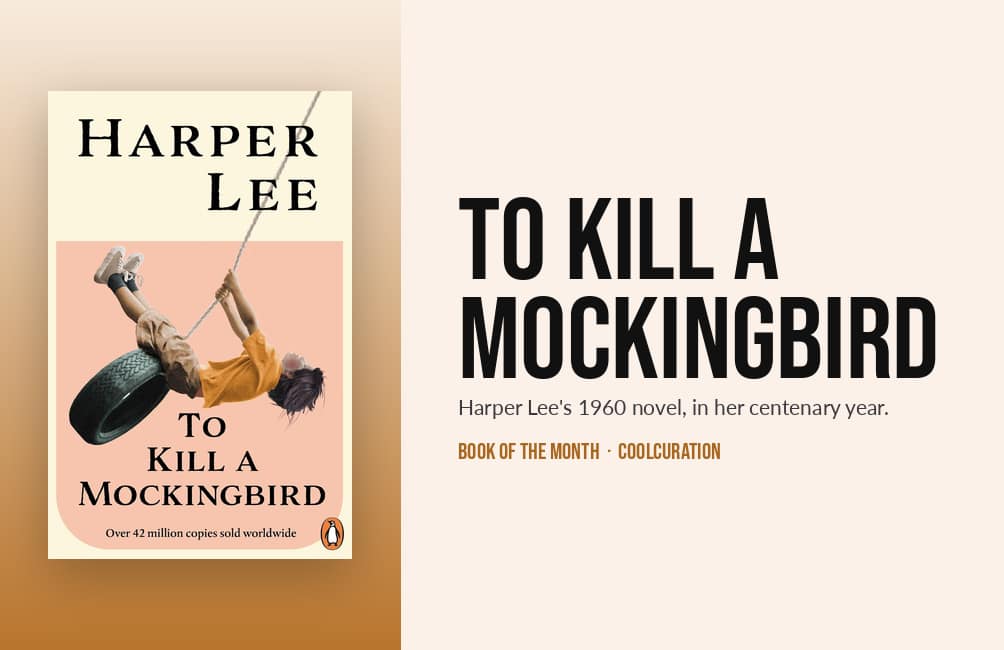
This is my pick. It came out on 31 July 2025 and runs to 320 pages. It measures 13cm by 20cm and has a new cover of a child on a tyre swing. The type is noticeably bigger than in the pocket edition. It costs £9.49 on Bookshop.org and £9.45 on Amazon UK.
Buy it: Bookshop.org or Amazon UK
The Arrow pocket paperback
This is the 60th anniversary edition, 11cm wide, so it fits a coat pocket. It is the cheapest new copy, at £8.54 on Bookshop.org and £8.35 on Amazon UK. The smaller type is the price you pay for that.
Buy it: Bookshop.org or Amazon UK
The centenary hardback
Hutchinson Heinemann published it on 26 March 2026 for Lee's centenary. It has the tyre-swing image in grey and orange on a dark cover, and it is the one to give as a present. It costs £20.90 on Bookshop.org and £16.39 on Amazon UK, against a published price of £22.
Buy it: Bookshop.org or Amazon UK
If you would rather listen, the unabridged audiobook read by Sissy Spacek runs 12 hours 17 minutes. It is a straight reading, not a dramatisation. All three editions, with page counts and ISBNs, are on our To Kill a Mockingbird detail page.
What to read next
Start with Lee's own first draft, Go Set a Watchman, which is £9.49 in the Arrow paperback. Read it as a draft rather than a follow-up, and it explains a lot about the finished novel.
Casey Cep's Furious Hours is subtitled Murder, Fraud and the Last Trial of Harper Lee. It covers the true-crime book Lee researched for years in Alabama and never finished. For a younger reader, Fred Fordham's graphic novel adaptation of To Kill a Mockingbird follows the novel closely in comic form.
If this month's pick works for you, the last classic on the list was Nineteen Eighty-Four, our August pick.
The verdict
Read it, especially if you last read it at school. Scout's voice and the trial chapters are as good as their reputation, and the first half is funnier than people remember.
But read it knowing what it leaves out. The novel tells Tom Robinson's story through a white child's eyes, and Atticus is more cautious than his legend suggests. Read Gladwell's essay or Go Set a Watchman afterwards and you will get far more out of a second read.
Our list called it a sledgehammer, and the trial chapters earn that. The rest of the book is gentler and more limited, but it is still a novel I would hand to anyone over fifteen.
FAQs
Is To Kill a Mockingbird worth reading as an adult?
Yes. Scout's narration is funnier than most people remember from school, and the trial chapters still hold up. As an adult you also notice its limits, especially how little the book gives Tom Robinson. That makes a reread more interesting than the first read.
How much does To Kill a Mockingbird cost in the UK?
The Arrow pocket paperback is £8.54 on Bookshop.org and £8.35 on Amazon UK. The 2025 Penguin paperback is £9.49 and £9.45, and the centenary hardback is £20.90 and £16.39. These are the prices as of 18 October 2026.
Why is To Kill a Mockingbird criticised?
Mainly for how it tells Tom Robinson's story. He is the victim, yet the book centres the white family that defends him. Malcolm Gladwell argued in The New Yorker in 2009 that Atticus accommodates racism rather than challenging it.
Is To Kill a Mockingbird still taught at GCSE?
Less often. The English Literature GCSE that started in September 2015 asks for a 19th-century novel and British fiction from 1914 onwards. Schools can still teach it, but OCR left it off its draft list in 2014.
Should I read Go Set a Watchman first?
No. Read To Kill a Mockingbird first. Go Set a Watchman is the earlier draft Lee wrote in the 1950s and published in 2015. It makes more sense once you know the finished novel.
How long is the To Kill a Mockingbird audiobook?
The unabridged audiobook read by Sissy Spacek runs 12 hours 17 minutes. It is a straight reading of the novel rather than a full-cast adaptation.
More from CoolCuration
- The Great Gatsby. Another novel from our greatest books list, with UK editions and prices.
- Gifts for bookworms. Our full shelf of presents for readers, sorted by who you are buying for.
- National Theatre at Home. What the streaming service costs and which stage productions it carries.
- Bookshop.org audiobooks. How the audiobook service works and how it supports independent bookshops.
- Best e-readers UK. Our pick of e-readers for anyone who would rather read the ebook.
I checked the prices and stock on Bookshop.org and Amazon UK on 18 October 2026.
Before you go. Book prices change often, so the final price is the one shown at checkout. This article contains affiliate links, which are paid links. If you click one and buy, I earn a commission at no extra cost to you. Publishers don't choose what I feature or what I say about their books.
What's trending


Recent posts
- To Kill a Mockingbird Review: Our Book of the Month
 Our Book of the Month: To Kill a Mockingbird by Harper Lee. Does it hold up in her centenary year? What still works, where it has dated, and which UK edition to buy. #BookOfTheMonth #ToKillAMockingbird #HarperLee #ClassicBooks #Bookworms
- Siri AI on HomePod: Why Your Old Speakers Miss OutSmart homeSiri AI Last updated: 16 October 2026 By Stiv · Design, technology and personal finance The new Siri is coming to HomePod mini 2. Not to the HomePods I already own. Siri AI on HomePod stops at the new HomePod mini 2. Apple confirmed on 14 October 2026 that the original HomePod mini will… Read more: Siri AI on HomePod: Why Your Old Speakers Miss Out
- Clocks Go Back 2026: The Date, the Time and 20 Clocks to Up Your Timekeeping GameThe clocks go back at 2am on Sunday 25 October 2026. What changes itself, what the darker evenings do to your energy bill, and 20 clocks to up your timekeeping game, from Alessi and Vitra to a MUJI cuckoo clock.

No Comments.