
Last updated: 15 October 2026. I checked every date and price in this Tom at the Farm review against the Barbican's own pages on 15 October 2026.
By Tristan · Arts, exhibitions and creative culture
This is an opinion piece. Views expressed are the author's own and do not constitute professional advice.
Cool Factor: 5/5
Tom at the Farm reviewTheatre / Barbican
A Brazilian thriller played out in real mud
This Tom at the Farm review covers the Brazilian production of Michel Marc Bouchard's play, which I saw at the Barbican Theatre on the evening of Wednesday 14 October 2026. It swings from intense drama to humour and back again, it is spiky and jarring in a good way, and the four-strong cast work incredibly well together.
Performed in Portuguese with English surtitles, Tom na Fazenda runs at the Barbican from Tuesday 13 to Saturday 17 October 2026. It lasts about two hours with no interval, it is rated 18+, and tickets start at £29.
See dates and tickets at the Barbican
01 / The play
What is Tom at the Farm?
A man goes to his boyfriend's funeral and finds the family never knew he existed.
Tom is a city advertising man who travels to a remote farm to bury his partner. When he arrives, the dead man's mother, Ágatha, has never heard of him. She does not know her son was gay. His older brother, Francis, knew everything, and he is ready to use force to keep his mother in the dark.
So Tom agrees to lie. Then he stays. Over the next two hours the farm pulls him in, and his relationship with Francis turns into something tender, violent and hard to look away from.
The Canadian playwright Michel Marc Bouchard wrote Tom à la ferme, and it was first staged in Montreal in 2011. Xavier Dolan then turned it into the 2013 film, which is how most people in the UK will know the story. This Brazilian version is a very different animal. Bouchard's preface carries the line that started the whole project: "Homosexuals learn to lie before they learn to love."
02 / The company
Ten years, 600 shows and one actor's gamble
It opened in a 63-seat theatre in Rio de Janeiro in March 2017.
Armando Babaioff, who plays Tom, is also the reason the show exists. He bought the rights in 2015, translated the text into Portuguese, put the team together and produced it. "I felt called by the play," he told Gay London Life.
Since then the production has toured Brazil, Montreal, Avignon, Paris, Brussels, Edinburgh and Busan in South Korea. According to the Barbican's press release, it has now won 27 national and international awards, played more than 600 performances and reached over 250,000 people. Babaioff has won several Best Actor awards for playing Tom, and Rodrigo Portella's direction has won Brazil's Shell and APCA awards.
Babaioff has also been open about the cost. In an interview with Man About Town, he explains that he left TV Globo in 2023 and paid to take nine people to the Avignon festival himself. That trip led to a 28-show run at Théâtre Paris-Villette, a European tour of 27 cities, the Edinburgh Fringe in 2025, and now London. New York is next.
03 / The venue
The Barbican Theatre
A big stage, and a building with a long record of Brazilian work.
The Barbican presents the show with AB Produções and the Pleasance, which brought it to Edinburgh, and Brazil's Ministry of Culture sponsors the London run. Toni Racklin, the Barbican's Head of Theatre and Dance, points to the venue's long history of Brazilian theatre in the press release for this run.
The stage suits it. In Edinburgh the production filled the huge Lennox Theatre at the conference centre, and the Barbican Theatre gives Portella's staging the same width. Melodrama magazine's interview with Babaioff calls the Barbican's raw concrete "a building the play might have grown out of". If you love the building itself, my page on the Barbican cross-section print covers the £12 A3 from the Barbican Shop.
04 / The stage
Mud, plastic and nowhere to hide
There is no house, no barn and no fence, just a plastic sheet covered in mud.
Aurora dos Campos designed the set, and it is very minimal. The cast perform on a plastic-covered floor layered with mud, with buckets of water and wet clay at the edges. Almost like if Richard Long had been here making mud paintings. Tomás Ribas lights it in hard, raking beams that do a lot - make doorways, highlight tensions and allude to sensations. Tom arrives in a sharp black suit, by the end he is wearing filthy farm clothes.
The mud works in two ways. When it is dry, every move the actors make stirs up clouds of dust, and the beautiful lighting picks them out, so you can see the motion of their bodies carried on into the air. It makes for a very atmospheric effect. When it is wet, the actors slip and fall in it, and it coats their clothes and their skin a little more as the performance goes on.
The mud was Portella's idea. Babaioff told Gay London Life that the cast never fully master that ground, however many times they perform the show, so they stay as off balance as the characters. Speaking to AnOther, he puts it more bluntly as "CrossFit in the mud".
Edinburgh critics picked up on the same physicality. Burnham Dramaturgy wrote that you can "taste the mud", and Culture Fix singled out the red light that floods the stage after a calf is delivered.
Because the stage shows nothing specific, you build the farm in your own head. That is deliberate. Babaioff says the farm "merely changes location", meaning the same family silence turns up in every country the show visits.
"Homosexuals learn to lie before they learn to love."
Michel Marc Bouchard, from the preface to Tom à la ferme
05 / The night
From intense drama to humour and back again
The tone keeps changing, and that is what makes it work.
I went on the evening of 14 October. The show changes gear constantly. It fluctuates from intense drama to humour, sometimes inside a single scene. It is spiky and jarring, in a good way, because you never settle into one mood long enough to feel safe.
That suits the story. Tom is grieving, scared and attracted to the man - his dead boyfriend's brother - who is threatening him, all at once. A show that played it straight as a thriller would lose that confusion. Here, a laugh can turn into a threat a second later, and you end up as wrong-footed as Tom. The Stage's Edinburgh review described a show that "pivots between suppressed desire and violence".
Babaioff has said he wants London audiences to laugh and be moved as well as feel unsettled, so the swings are deliberate.
06 / The cast
An incredible cast of four
Babaioff, Iano Salomão, Denise Del Vecchio and Camila Nhary.
The cast are incredible, and they work really well together. Babaioff plays Tom and Iano Salomão plays Francis, and most of the show rests on the push and pull between them. Denise Del Vecchio plays Ágatha, the mother, and Camila Nhary plays Sara, the friend Tom brings in to pose as his dead partner's girlfriend. She only appears towards the end of the play.
The Spy in the Stalls gave the Edinburgh run five stars and said Babaioff and Salomão "strike like flint". Culture Fix found that Salomão brings unexpected nuance to Francis, and that matches what Babaioff wants from the role. He told Gay London Life the production refuses to make Francis a monster, because a monster lets the audience keep a safe distance from him. British Theatre Guide noted that Sara's late arrival brings a short, well-timed burst of humour.
Four actors carrying two hours with no interval, on a floor that moves under their feet, leaves no room for one weak link. Babaioff has played Tom for nearly a decade, and he says listening to the other actors each night keeps it alive.
The production also stages a moment the text describes but, according to Babaioff, no earlier staging had attempted: Tom hanging upside down. He told Man About Town it was the only way to show the level of violence the play needed. When the show first went to Montreal, he found that "using a slur is enough to shock an audience", whereas Brazilian audiences needed the violence to be far more physical.
07 / The curtain call
A standing ovation, a flag and a speech
The night ended with a two-minute standing ovation, an altered flag and a speech about Brazil.
When the lights came up, the audience stood and applauded for about two minutes. Then Babaioff and Denise Del Vecchio unfurled a Brazilian flag with its centre removed. On the real flag, that blue disc shows the starry sky over Rio de Janeiro on 15 November 1889, with 27 stars for the 26 states and the Federal District, crossed by a white band carrying the motto "Ordem e Progresso". The design of the Brazilian flag is explained in full on Wikipedia. On this one, the stars and the words were gone.
An empty-centred flag has a history in Brazilian protest art. In 2018 the artist Raul Mourão began cutting the stars and the motto out of flags for his series The New Brazilian Flag, at a time when, as the historian Lilia Moritz Schwarcz writes in an essay on the work, many feared for the health of Brazilian democracy. To me, the flag on the Barbican stage read the same way: a statement about the state of democracy in Brazil.
Babaioff then gave an impassioned speech about the importance of freedom and love, and asked us to keep our eyes on Brazil. He was speaking 11 days before Brazilians vote in the presidential runoff on 25 October 2026, between President Luiz Inácio Lula da Silva and Senator Flávio Bolsonaro, according to Americas Quarterly.
Babaioff has been clear about where he stands. In his interview with Gay London Life ahead of the London run, he warned about far-right movements gaining ground in different parts of the world, hate speech returning to the centre of public debate, and rights that had seemed secure being called into question again. As a Brazilian, he said, violence against LGBTQIA+ people is still part of his country's reality.
His warning landed close to home. Babaioff did not name any British party, so the comparison is mine. Democracy is under strain in the UK too. In March 2026 the V-Dem Institute, which tracks democracy in 179 countries, added the UK to its list of countries moving away from democracy, mainly because of falling freedom of expression and media freedom.
Into that, Reform UK brings far-right rhetoric and policies I find cruel and hopeless. Its mass deportation plan would raise detention spaces to 24,000, expand detention on repurposed military sites and remove up to 600,000 people. It would also abandon the UK's commitment not to send people back to places where they face torture or death. On top of that, Reform wants to scrap indefinite leave to remain, so people who have already settled here would have to reapply for a visa every five years.
Reform also takes its lead from Donald Trump's America. In March 2025 Nigel Farage said "we need a British form of Doge, as Elon Musk has got in America", and that June Reform sent its own Doge team into Kent County Council. V-Dem's verdict on the US is that "the speed with which American democracy is currently dismantled is unprecedented in modern history". To me, that is a path towards dictatorship, and it is the model I fear Reform wants to bring here.
Queer people are under attack here too, as they are around the world. Reform's manifesto promises to "ban transgender ideology in primary and secondary schools" and rules out social transitioning and pronoun changes, as PinkNews sets out. In May 2025 Reform said its councils would fly no Pride flags, and this June Havering, London's only Reform-run council, dropped its annual Pride celebration. Police in England and Wales recorded 21,407 hate crimes based on sexual orientation and 3,955 against transgender people in the year to March 2026, according to the Home Office. ILGA-Europe now ranks the UK 22nd of 49 European countries for LGBTQIA+ equality, and as Consortium points out, a decade ago it was seen as one of the leaders. So when two actors held up a Brazilian flag with its centre cut out, in the middle of London, Brazil did not feel far away at all.
08 / The catch
What stops some people enjoying it
None of these lowered my score, but every one could put off the wrong person.
The content. The Barbican lists sexual content, physical violence, psychological violence and nudity, and the age guidance is 18+. This is not a date-night crowd-pleaser, and anyone who finds violence against gay characters hard to watch should know that going in.
Two hours with no interval. There is no break to stretch or reset. Use the loo before you go in.
The surtitles. The show is in Portuguese, so non-speakers read English surtitles throughout. With this much physical action on stage, that means looking away from the actors at points, which does take you in and out of the drama a little too much at times.
A big room. In Edinburgh, the reviewer at Bouquets & Brickbats felt the vast Lennox Theatre kept the audience too far from the mud. The Barbican Theatre is also large, so stalls seats close to the front are worth paying for if they are left. That said - mud and spit might still land on you.
Five nights only. The London run is 13 to 17 October 2026, which leaves very little time to book.
09 / The context
Why this Tom at the Farm review matters now
A play from 2011 that its lead actor says has only become more urgent.
Babaioff's Portuguese version takes the play out of Quebec and into Brazil. The Guardian, reviewing the 2025 Edinburgh run, called it "a staggering study of homophobia" and noted that Brazil is reported to have the world's highest rate of violent deaths of LGBTQ+ people. The same review credited Portella with adding a fierce physical awkwardness to Bouchard's text.
The other Edinburgh critics landed in a similar place. The Arts Desk called it "as shockingly beautiful as it is horrifyingly brutal". British Theatre Guide described "a visceral voyage that you take at your own risk", and Bouquets & Brickbats, despite its doubts about the room, called it "a haunting howl against prejudice".
But Babaioff argues the story is not only about Brazil. He told Gay London Life that the pressure on those rights in several countries is why the show keeps finding new audiences. For London's LGBTQ+ audience, a story about having to hide who you love at a funeral is not a period piece.
It sits well alongside other queer theatre I have reviewed this year, from the 5/5 Pride at the National Theatre to the much sillier Oh, Mary! in the West End. Tom at the Farm is far darker than either.
10 / The money
Value for money
From £29 for a production that has toured three continents.
Standard tickets start at £29, which includes a £4 transaction fee. Young Barbican members aged 16 to 29 pay £18, Barbican Members get 20% off with no booking fee, and students get 50% off on the Wednesday performance only.
That buys two hours of a touring international production with 27 awards behind it, at a price close to the cheapest West End seats.
If you miss the London dates, Babaioff has said he would love a West End transfer, though nothing is announced. Meanwhile, National Theatre at Home streams filmed stage plays you can watch from the sofa.
11 / Getting there
Practical info
- Venue: Barbican Theatre, Barbican Centre, Silk Street, London EC2Y 8DS. Enter on Level G and follow the signs.
- Dates: Tuesday 13 to Saturday 17 October 2026.
- Running time: about two hours, no interval.
- Language: Portuguese with English surtitles.
- Age guidance: 18+.
- Access: wheelchair spaces at the rear of the Stalls and in row B of the Upper Circle, both with companion seats. Assistance dogs are welcome if you tell the box office when booking.
- Tickets: from £29 on the Barbican website.
The nearest Tube stations are Barbican and Moorgate. The Barbican's accessibility pages cover captioned and audio-described performances in more detail.
12 / The verdict
Tom at the Farm review: the verdict
Cool Factor
★★★★★
5 out of 5
A play about grief and homophobia on a muddy farm could easily be two hours of misery. Instead, this one keeps switching between intense drama and humour, and that spiky, jarring quality is what makes it work. The cast of four are incredible, and they work really well together.
Overall, a 5/5 Ice cold. Tom at the Farm earns it with an incredible cast and a tone that never lets you settle. The content warnings, the two hours with no interval and a five-night run mean it will not suit everyone, but none of that takes anything away from what happens on that muddy stage.


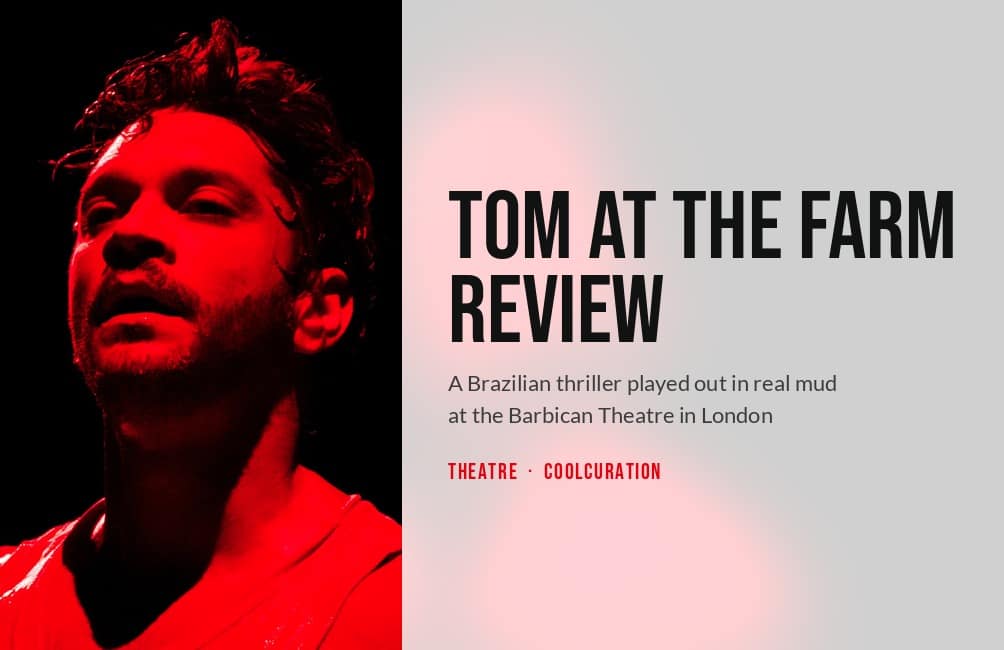
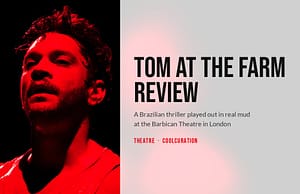
Featured image: Armando Babaioff in Tom at the Farm, photographed by Victor Pollak. Curtain-call photographs are my own.
FAQs
Is Tom at the Farm at the Barbican worth seeing?
I gave it 5/5. It swings between intense drama and humour, and the four-strong cast are incredible. It is rated 18+ for sexual content, violence and nudity, so it is not for everyone.
How long is Tom at the Farm?
About two hours, with no interval.
How much are tickets?
Standard tickets start at £29 including a £4 transaction fee. Young Barbican members aged 16 to 29 pay £18, and students get 50% off on the Wednesday performance. I checked these prices on the Barbican website on 15 October 2026.
Is Tom at the Farm in English?
No. It is performed in Portuguese with English surtitles.
Is the play the same as the Xavier Dolan film?
Both come from Michel Marc Bouchard's 2011 play. Dolan's 2013 film is set in rural Quebec. This stage version moves the story to Brazil and plays it on a bare floor covered in mud.
Who is in the cast?
Armando Babaioff plays Tom, Iano Salomão plays Francis, Denise Del Vecchio plays Ágatha and Camila Nhary plays Sara. Rodrigo Portella directs.
Will Tom at the Farm come back to London?
Nothing is announced. Babaioff has said he would love a West End transfer, and the production heads to New York next.
More from CoolCuration
- The V&A LGBTQIA+ tour review: a free volunteer-led tour of queer history through the museum's collection.
- LGBTQ+ gift guide: presents with a queer story behind them.
- The Faggots and Their Friends Between Revolutions: the queer classic worth having on the shelf.
- MUBI UK prices and free month: arthouse film streaming, plus a weekly cinema ticket on MUBI GO.
- MADE x Barbican Curve table lamp: a £50 lamp copied from the Barbican concert hall.
What's trending



Recent posts
- Tom at the Farm review: mud, menace and a standing ovation at the Barbican
 Armando Babaioff's mud-soaked Brazilian production of Tom at the Farm swings from intense drama to humour, with an incredible cast of four. Cool Factor 5/5.
 - Monzo Invest vs Freetrade vs Lightyear: Which App Costs Less?Last updated: 15 October 2026. I checked every fee in this Monzo Invest vs Freetrade comparison on each provider's own site on 14 October 2026. By Stiv · Design, technology and personal finance Affiliate disclosure: This article contains affiliate and referral links, which are paid links. If you click one and buy or sign up,… Read more: Monzo Invest vs Freetrade vs Lightyear: Which App Costs Less?
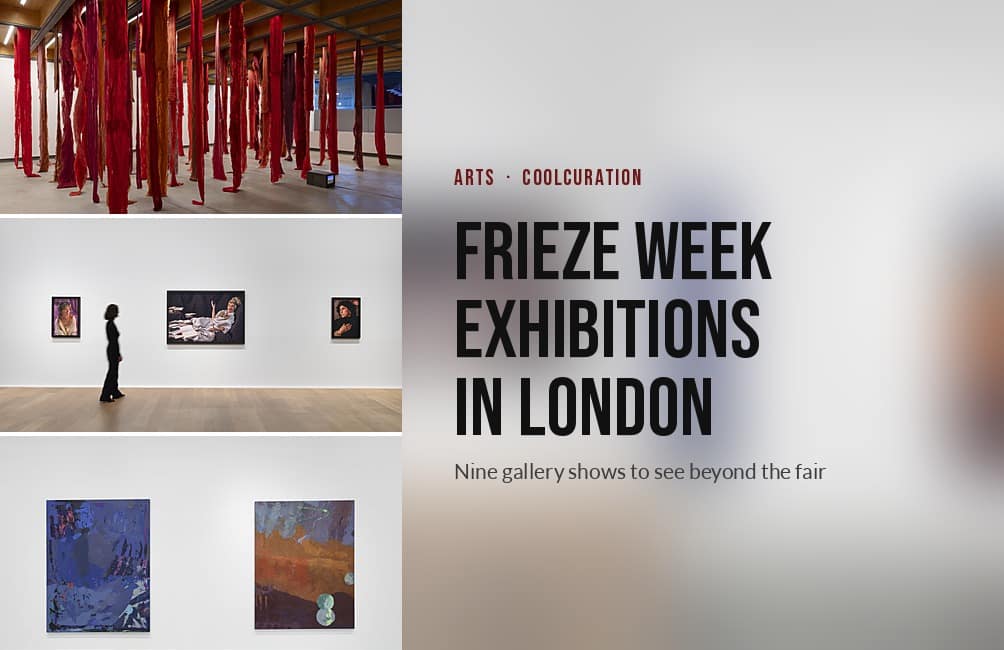
- Frieze Week Exhibitions 2026: Nine London Shows to See Beyond the FairNine London exhibitions to see during Frieze week 2026, from Cindy Sherman at Hauser & Wirth to Robert Ryman at the Barbican. Seven are free.


No Comments.