
Last updated: 2 July 2026
By Tristan · Arts, exhibitions and creative culture
This is an opinion piece. Views expressed are the author's own and do not constitute professional advice.
Our July pick costs nothing at all.
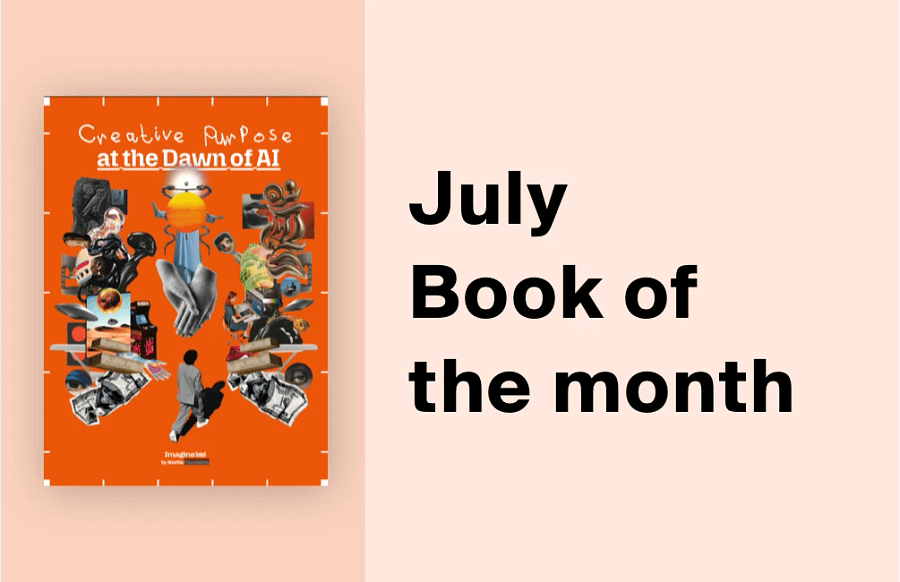
This month, we are doing something different. Our Book of the Month is the Imagine Intel zine, and it is not a book you buy. Instead, it is a free 100-page publication from the Mozilla Foundation about creative purpose at the dawn of AI. Best of all, you can download the whole thing as a PDF for nothing. So it is a proper reading pick with no price tag, and honestly, that is rather the point.
The Imagine Intel zine cover, art directed around Dakarai Akil's collage work. Image: Mozilla Foundation.
Section 01 / The pick
What is the Imagine Intel zine?
A free, well-made publication about creativity and AI, and where the two collide.
The Imagine Intel zine is a 100-page publication from the Mozilla Foundation, the open-internet nonprofit behind Firefox. Mozilla published it in January 2026, and it forms part of the Foundation's Creative Futures programme. Its full title is "Imagine Intel: Creative Purpose at the Dawn of AI".
Crucially, it is free. You can download the digital zine as a PDF at no cost. Mozilla also printed a tiny run of just 500 physical copies in the UK, through PARK Press. So, to be clear, the free part is the download.
The content grew out of the Imaginative Intelligences Assemblies. These were five participatory sessions, run with the Berggruen Institute in early 2025. In total, 91 creatives, technologists and thinkers took part. Mozilla held the first two at the Bradbury Building in Downtown Los Angeles. Then it ran the final three at the Hearst Estate in Beverly Hills. The facilitator Gabriel Kahan led each six-hour session using a method called the Creative Assembly.
Naturally, the zine turns all of that into something readable. It runs across eight themed chapters, and these move from Process and Experience through to Value, Morale and Friction. Along the way, it mixes essays, survey data and original collage art by the Los Angeles artist Dakarai Akil.
Section 02 / Timing
Why the Imagine Intel zine feels so timely
It lands right in the middle of a very loud argument about AI and creative work.
First, consider the moment. Right now, the fight over AI and creativity is everywhere, and it keeps escalating. In September 2025, for example, Anthropic agreed to pay authors 1.5 billion dollars to settle a claim that it trained its chatbot on pirated books. Meanwhile, musicians, illustrators and film workers keep asking who benefits when a model can copy their style in seconds.
On top of that, the language itself has shifted. In fact, "vibe coding" was named Collins Dictionary's Word of the Year for 2025. So we now describe whole creative acts as something you prompt rather than make. Because of all this noise, a calm, sourced, human-made take feels genuinely useful. That is exactly the gap the Imagine Intel zine tries to fill.
It also refuses the usual binary. Rather than pick panic or hype, the zine aims for the thoughtful middle. Above all, it centres working creatives instead of tech chief executives, which makes a nice change.
Section 03 / Inside
What is actually inside
Data, a glossary, a tools directory, and one very Hollywood framework.
So what do you get for your nothing pounds? Quite a lot, as it turns out. The centrepiece is "Hollywood's 8 Rules for AI", a set of demands drawn straight from the Assemblies. In short, the rules argue that AI policy should move beyond copyright alone, and instead centre human purpose, sustainable creative ecosystems and collective benefit.
Then there is the data. The findings come from a small group, so treat them as directional rather than gospel. Still, they are striking. Nearly 97% of participants had used AI in some form. Yet 40% did not feel it had actually scaled their creative output. Meanwhile, over 63% of creatives and 75% of technologists said they do not feel represented by any institution in the fight for creative rights in tech.
Elsewhere, the zine plays. There is an AI glossary, a "history of slopification" timeline, and a directory of more mindful creative tools. If you like design magazines, you will also enjoy the layout, because it treats the whole subject like a proper editorial spread rather than a report. For a similar itch, our guide to switching between AI assistants covers the practical tooling side.
AI is aggregated human intelligence. It's collective, not artificial.
An Imaginative Intelligences Assembly participant, quoted in the zine.
Section 04 / The free bit
Why the zine being free matters
A nonprofit gives away a considered counter-narrative, on message and on principle.
Here is the neat bit. Mozilla's whole argument is that creatives should not be quietly extracted from. So giving the zine away, rather than gating it, fits the message perfectly. As Executive Director Nabiha Syed writes in the foreword, "While others race to automate creativity, Mozilla Foundation is demonstrating that human imagination cannot be replaced."
Because the download is free, anyone can read it. A student, a jobbing illustrator or a curious musician can all grab the same PDF. That democratic access matters, especially when so much AI commentary sits behind a paywall or a product pitch. Do remember, though, that only the digital version is free. The 500 printed copies are a collector's item, not the main event.
Download the Imagine Intel zine free
Download the 100-page zine free as a PDF, direct from the Mozilla Foundation.
Section 05 / The honest bit
Honest thoughts, and where it falls short
Warm verdict, but this is not a neutral, global study, and it does not pretend to be.
Now for the fair criticism, because no pick is perfect. First, it is very US and very Hollywood. The 91 participants were largely Los Angeles entertainment creatives, and the flagship framework is literally "Hollywood's 8 Rules for AI". To its credit, the zine half-admits this, since one participant flags the "white wealthy norm". Even so, read it as a narrow, West Coast slice, not a global survey.
Secondly, it is a vibe piece more than a rigorous study. The sample is small, so the numbers are suggestive rather than solid. Thirdly, it can get a little insider-y. It is dense with neologisms like "slop" and "sloptimism", which is fun, yet not always practical.
Finally, Mozilla is not a neutral observer. It runs Creative Futures and champions the open internet, so this is advocacy with a worldview. That is fine, but worth naming. By design, too, the zine raises more questions than it answers. It closes on positioning, above, beside or below the machine, rather than firm instructions. Some readers will find that liberating. Others will find it frustrating.
Section 06 / Verdict
Who the Imagine Intel zine is for
Anyone who makes things and feels a bit uneasy about where AI is heading.
So who should read it? In short, anyone making things right now. Designers, writers, musicians and illustrators will all recognise the anxieties on show. Moreover, if you have felt torn between using these tools and resenting them, this zine names that tension well.
On balance, it is a generous, smart and genuinely handsome piece of work, and the price is unbeatable. It will not settle the AI debate, of course. Still, as a free, human-made counter-narrative, the Imagine Intel zine is well worth an evening. For last month's edition, see our June Book of the Month, which took a very different, printed route.
Read and download it from Mozilla
Imagine Intel zine FAQs
What is the Imagine Intel zine?
It is a free 100-page publication from the Mozilla Foundation, titled "Imagine Intel: Creative Purpose at the Dawn of AI". Basically, it captures how working creatives feel about AI, and it does so through essays, data and collage art.
Is the Imagine Intel zine really free?
Yes, the digital version is completely free. You simply download the PDF from Mozilla at no cost. However, the physical print run is limited to 500 copies, so the free option is the download rather than the printed edition.
Who made the Imagine Intel zine?
The Mozilla Foundation published it as part of its Creative Futures programme, with the Berggruen Institute. Furthermore, it draws on the Imaginative Intelligences Assemblies, five sessions with 91 creatives held in Los Angeles in 2025. The cover and chapter collages are by the artist Dakarai Akil.
Is it worth reading if you are not an artist?
Honestly, yes. If you use AI tools at all, the zine will make you think about what gets lost and what gets gained. That said, it is written for a creative audience, so a few references do assume some art-world context.
More from around the site
- Best AI assistant UK: weigh up the big AI helpers before you let one near your creative work.
- Mobbin review: see whether the design-inspiration library earns a designer's subscription.
- The Creative Act by Rick Rubin: a natural companion read on making things that matter.
- Gifts for artists and creatives: present ideas for the makers in your life.
- Penpot: a free, open-source design tool that shares the zine's open ethos.
What's trending



Recent posts
- Is Monzo Perks Worth It? A Year of Paying for It
 A year of paying £9 a month for Monzo Perks, with the honest maths on what I actually claim and what earns nothing.
 - Should You Fix Your Energy Tariff Before October?Last updated: 31 August 2026 By Stiv · Design, technology and personal finance EnergyFix or float · October 2026 Ofgem says fix. I checked the sums. Ofgem reckons you can beat the October cap by £100 or more, so the obvious question is whether to fix your energy tariff before it lands on 1 October.… Read more: Should You Fix Your Energy Tariff Before October?
- V&A LGBTQIA+ Tour Review: The Free Queer Tour Worth Planning AroundFree, monthly, unbooked and almost unknown. A queer walk through the V&A with a volunteer guide, and the case for going in person.



No Comments.