
Last updated: 10 July 2026
By Tristan · Arts, exhibitions and creative culture
This is an opinion piece. Views expressed are the author's own and do not constitute professional advice.
Cool Factor: 1/5
Let me be honest from the first line, because there really is no kind way to dress this up. To my eye, the Jack White exhibition at Newport Street Gallery is a misfire. It is a talented musician's forced, derivative leap into fine art, and it adds almost nothing you have not seen done better elsewhere. Titled These Thoughts May Disappear, it is White's first public showing of his visual work. Moreover, it sprawls across two floors of Damien Hirst's south London gallery, with more than 100 pieces of sculpture, furniture and installation. There is colour, there is noise, and there is a great deal of borrowed glamour. What there is not, sadly, is much art worth crossing London to see. I went in hoping to be proven wrong. I was not.
Section 01 / The show
What's on: These Thoughts May Disappear
The undisputed facts, before we get anywhere near the opinions.
First, the basics. These Thoughts May Disappear runs from 29 May to 13 September 2026 at Newport Street Gallery in Lambeth, and entry is free. White arranged it in association with HENI, and he curated it with Connor Hirst, Damien's son. Together they gathered work made across more than twenty years. Some pieces date back to his teens. Others were built specially for these rooms.
Born in Detroit and now based in Nashville, White is best known as one half of The White Stripes and the founder of Third Man Records. Long before any of that, however, he trained as an upholsterer, opening his own shop, Third Man Upholstery, at twenty-one. Keep that detail in mind. It is the one part of this Jack White exhibition that survives close inspection. The rest, unfortunately, does not.
Section 02 / The venue
The setting: Damien Hirst's Newport Street Gallery
A grand room that lends instant authority to whatever it holds.
Start with the room, because the room does a great deal of the work here. Newport Street Gallery is Hirst's own space, opened in 2015 to show pieces from his personal collection. The architects Caruso St John designed it, and the building won the RIBA Stirling Prize in 2016. As a result, the galleries are tall, white and immaculate. They are exactly the sort of rooms that lend instant gravity to whatever hangs in them. You can read more on the Newport Street Gallery website.
That gravity is precisely the problem. A debut show in a space this grand arrives wrapped in an authority its maker has not earned. White did not apply, wait or climb any ladder. Instead, Hirst simply offered, after the pair met when White opened a London Third Man Records shop near Hirst's Soho studio. As a friendship, it is charming. As art-world process, though, it means this Jack White exhibition starts with an enormous, unearned advantage. Even that cannot save it.
Section 03 / First impressions
First impressions: colour, and far too much of it
Loud, immediate and, before very long, exhausting.
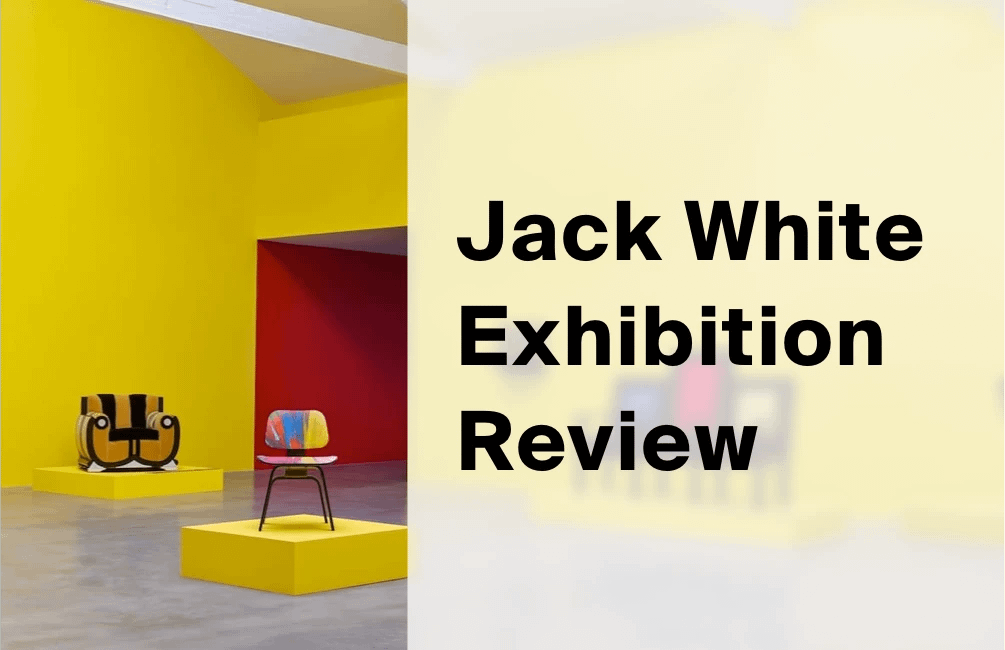
Walk in, and colour hits you before anything else. White works in hard blocks of red, yellow, blue, black and white, the palette he has favoured since long before The White Stripes made it a trademark. The effect is loud and immediate. Frankly, it feels more funfair than gallery.
Then the sheer volume defeats it. White himself admits he first assumed he might "have enough for the first room", and feared the rest would stand empty. Instead, he filled the entire building, and the strain shows on every wall. The best exhibitions are ruthlessly edited. This one, by contrast, is simply crammed, as though quantity might stand in for quality. For each piece that earns its place, several more feel like wallpaper.
Section 04 / Ukulele Joe
Ukulele Joe, again and again
A one-note gag, repeated until the charm wears clean off.
Consider the first thing you meet: Ukulele Joe. White found a small figurine of a ukulele player in a junk shop, then copied him relentlessly, life-size and in a rainbow of smaller 3D-printed resin versions. Sing into a microphone hidden in the large Joe's ear, and your voice emerges from his mouth. As a single gag, it does raise a smile. "I just idolise him," White says of the character.
Unfortunately, Joe will not stop. He returns again and again, restyled through assorted finishes, until whatever charm he had drains away. White clearly adores the motif. Adoring a motif, however, is not the same as saying something with it. These bright, patterned repetitions feel less like art than merchandise. Early on, then, they announce the show's central failing: a thin idea, endlessly reheated.
Section 05 / The centrepiece
The Red Tree: a pastiche of better art
The strongest image in the building, and still second-hand.
The centrepiece is The Red Tree, a resin tree painted vivid red that rises through a double-height room. It is the show's strongest image, which rather tells you something. The piece remakes a 2015 project, when White painted a dying tree in his Nashville garden. He describes bringing it "back to life in a fake version of it", and as a private gesture about loss, it is quietly affecting.
As contemporary art, however, it is thoroughly second-hand. Placing a tree inside a gallery is one of the oldest moves in the modern book. Giuseppe Penone, among others, explored this territory decades ago, with far more mystery and menace. To my eye, therefore, The Red Tree reads as pastiche. It borrows the shape of profound art without the substance. In truth, the idea is fifty years old, and that gap defines this Jack White exhibition.
Section 06 / The furniture
The furniture: competent joinery, not compelling art
Where the craft is real, yet craft is not the same as art.
If anything here deserves respect, it is the furniture, and I want to be fair about it. White's upholstery training is real, and it shows. The chairs are properly made. Several also conceal hidden amplifiers and speakers, along with odd surprises. A bag of scented cedar sits tucked inside one. Under another, out of sight, lies a samurai sword. His whole approach grows from a scavenger's instinct. "Does this thing still have the potential to be beautiful and come alive again?" he asks of his materials, and he plainly means it.
Here is the catch, though. This is a fine-art exhibition, hung and judged as such. On those terms, lovely joinery is not enough. A beautifully upholstered chair is a beautifully upholstered chair. It is skilled craft, and I would happily own one. Yet craft is not the same as art, and a room of well-made furniture does not add up to a compelling show. Even at its best, then, this Jack White exhibition offers accomplished design where it promises significant art.
A very famous address, a billionaire's blessing, and still the art cannot hold the wall.
Section 07 / The finale
Famous friends and phoned-in favours
The celebrity scaffolding, right where you cannot help but see it.
The show ends with its biggest name-drop. Six artists, including Damien Hirst and Ai Weiwei, were each handed the amplifier White designed for Fender in 2024 and asked to remake it. "There was only one rule," White says. "It has to still be able to play." Because the instruments can be plugged in, the space hums with latent noise.
On paper, that is a generous finale. In the room, however, it is where the celebrity scaffolding becomes impossible to ignore. Two globally famous artists have, in effect, dashed off a favour for a friend. The result feels like a private joke rather than serious work. The Guardian's Jonathan Jones put it sharply in his one-star review: "Not even the collaborations with Ai Weiwei and Damien Hirst can save this show." On that, at least, we agree.
Section 08 / The honest bit
Honest critical observations: a lame leap into art
What did not work, and why it is worth saying plainly.
So to the blunt question this show forces. Is any of it good art? For me, no. Take away Hirst, HENI and the White Stripes legend, and precious little of this would hold a wall on merit. The furniture is fine design. The rest, I am afraid, is pastiche.
What frustrates most is how forced the whole leap feels. Musicians can, of course, make wonderful art. Here, though, the jump reads as a tangential move, propped up by borrowed prestige rather than any real visual idea. Little wonder, then, that this Jack White exhibition met open scepticism on arrival. One art critic, writing as Art Lust, dismissed the art world's validation of such "vanity art" outright, and was then doxxed and harassed online by White's fans for saying so.
To be scrupulously fair, none of this looks cynical. By every account, White is sincere, and he has made these objects privately for two decades. Sincerity, however, is not the same as quality. You can mean every word and still make a show that, judged as art, simply does not work. That, in the end, is what stops it clearing even the lowest bar.
Section 09 / The bigger picture
Why this Jack White exhibition matters now
A textbook case of celebrity standing in for merit.
Step back, because the surrounding story is revealing. Musicians crossing into galleries is nothing new, from David Bowie's canvases to Bob Dylan's ironwork. White's case, however, has become a flashpoint, precisely because the art establishment scrambled to anoint it. When a billionaire artist gifts a rock star a Stirling Prize-winning gallery, it is fair to ask what is really being celebrated: the art, or the fame attached to it.
That question matters well beyond one show. As the art commentator Jeff Magid noted, White's work drew wall-to-wall coverage while countless artists fight for any attention at all. Meanwhile, White told the Associated Press that fame in one field can be "a curse", since "everyone wants you to just do that for the rest of your life". He is sincere, and a fine craftsman. Even so, the gap between the platform this Jack White exhibition commands and the art it delivers says something faintly depressing about how the machine works.
Section 10 / Value
Value for money: free, and still not worth the trip
The one point in its favour, and why it is not quite enough.
There is exactly one point in the show's favour: it costs nothing. Ordinarily, that buys plenty of goodwill. Were this a twenty-pound ticket, I would tell you to run. Because it is free, however, you can wander in, poke the singing Joe, sit in the handsome chairs, raise an eyebrow at the amps and leave, all for nothing.
Even so, free entry does not turn weak art into strong art, and I would not build an afternoon around it. For contrast, if you want a colour-drenched London show where the art truly earns its scale, our Katharina Grosse review covers one that does. This Jack White exhibition is a diverting fifteen minutes if you happen to be nearby and curious. As a destination, though, it is not worth your time, and that is ultimately what a 1/5 records.
Section 11 / Plan your visit
Practical info: hours, access and getting there
Everything you need, should curiosity win out in the end.
A few practical notes, then. Newport Street Gallery sits at 1 Newport Street, London SE11 6AJ, a short walk from Vauxhall and Lambeth North. It opens Tuesday to Sunday, from 10am to 6pm, and it closes on Mondays. Entry is free, and no ticket is required. For full visitor and access information, check the official gallery website before you travel.
There is also a shop on site, plus the Pharmacy 2 restaurant if you want to make an afternoon of the area. Since the interactive pieces are the only real draw, weekday mornings tend to be quietest for a hands-on look. Do sing through Joe and sit in the chairs if you go. A show this tactile is wasted from a polite distance, although on this occasion polite distance may be no bad thing.
The verdict
The verdict: loud, sincere and derivative
Real craft in the chairs, and not a great deal else.
Cool Factor
★☆☆☆☆
1 out of 5
So where does that leave us? These Thoughts May Disappear is loud, sincere, sporadically charming and, to my eye, almost entirely derivative. White is a superb musician and a skilled upholsterer. As a visual artist filling a major London gallery, however, he is out of his depth, and not even the most famous names in art can hide it. There is competent furniture here. There is also a mountain of filler, hoisted up by borrowed prestige and a very famous address.
Overall, this is a 1 out of 5, a Lame result, and I do not award it lightly. The Jack White exhibition offers real craft in its chairs and a single free ticket. Neither is enough, though, when the work is presented and judged as fine art. The ideas are second-hand, the scale is wildly over-extended, and the whole thing leans on Hirst's gallery, HENI and a very grand room to pass as significant. Go only if it is free, nearby and you are curious. For me, in the end, this Jack White exhibition simply proves the doubters right.
Frequently asked questions
Is the Jack White exhibition worth visiting?
For us, not really. The Jack White exhibition has moments of fun, and it is free, but as a serious art show it is derivative and slight. That is why it scores just 1/5. If you are passing and curious, however, a quick look does no harm.
How much does These Thoughts May Disappear cost?
Nothing at all. Admission to These Thoughts May Disappear at Newport Street Gallery is free, and you do not need to book ahead. Free entry is welcome, but in our view it does not rescue the work itself.
When does These Thoughts May Disappear close?
The show runs until 13 September 2026. It opened on 29 May 2026, and it is open Tuesday to Sunday, so there is no rush. Even so, weekday mornings are usually the quietest time to visit.
Is Jack White actually a good artist?
He is a hugely talented musician and a clearly skilled upholsterer. As a fine artist, though, and on the evidence of this show, his work is derivative in our opinion. Tellingly, his furniture is the strongest thing on display, and that is craft rather than art.
Where is Newport Street Gallery?
It sits at 1 Newport Street, London SE11 6AJ, in Lambeth. The nearest stations are Vauxhall and Lambeth North. The gallery is Damien Hirst's own space, and it usually shows work from his personal collection.
Do you need to know his music to enjoy it?
Not really. Knowing The White Stripes adds context, but the show is really about making objects from found materials. Still, die-hard fans will get more from it than neutral visitors, which rather proves the point.
More from CoolCuration
- Royal Academy Summer Exhibition: another big, busy London show, and our take on whether all that maximalism actually works.
- The Creative Act by Rick Rubin: the legendary producer on the creative process, for anyone chewing over what makes an idea original.
- How Music Works by David Byrne: a musician thinking hard about making, and a sharper cross-discipline read than this show manages.
- Gifts for audiophiles: our edit of presents for the serious music lover in your life.
- Gifts for artists and creatives: ideas for the makers, tinkerers and studio dwellers you know.
What's trending





Recent posts
- New on Mobbin October 2026: Jomo, Delphi, Lloyds and More
 New on Mobbin October 2026: Jomo, Delphi, Lloyds and five more apps, with the consent, search and unlock screens worth studying.
 - British Art Fair 2026 ReviewArt fairsSaatchi Gallery A Sickert study best in show, a Hockney for £800, and naff AI art Last updated: 28 September 2026. I checked every price and date in this British Art Fair review against the dealers' labels and the fair's own pages. By Tristan · Arts, exhibitions and creative culture This is an opinion… Read more: British Art Fair 2026 Review
- Quentin James McCaffrey at Alison Jacques ReviewLast updated: 6 October 2026 By Tristan · Arts, exhibitions and creative culture This is an opinion piece. Views expressed are the author's own and do not constitute professional advice. Cool Factor: 3/5 Quentin James McCaffrey's first UK solo show was on at Alison Jacques from 3 September to 3 October 2026. Comprising fifteen small… Read more: Quentin James McCaffrey at Alison Jacques Review


No Comments.