
Last updated: 3 May 2026
By Tristan · Arts, exhibitions and creative culture
This is an opinion piece. Views expressed are the author's own and do not constitute professional advice.
Cool Factor
★★★★★
5 out of 5 – Ice cold
Katharina Grosse at White Cube Bermondsey is, hand on heart, the most spectacular free exhibition currently on in London. I Set Out, I Walked Fast opened on 22 April 2026 and runs until 31 May, and it delivers something genuinely rare: a show that is immersive, generous, and varied enough that you walk back out onto Bermondsey Street feeling slightly rearranged. We visited this week, and we have a lot to say about it.
What is it?
I Set Out, I Walked Fast brings together new paintings, a monumental in-situ installation, and rarely-seen archival works across all three exhibition spaces of White Cube Bermondsey. It runs from 22 April to 31 May 2026 and, importantly, it is the first major UK exhibition to fully encompass the breadth of Katharina Grosse's practice. Her first show with White Cube took place in 2002, when the gallery occupied its original Hoxton Square location. Antipodes 2, as that show was called, was a tighter affair. By contrast, this one is enormous, sprawling, and unmistakably a statement.
Since then, Grosse's reputation has grown substantially. She is now jointly represented by White Cube, Gagosian, Galerie Max Hetzler, and Galerie nächst St. Stephan. Furthermore, she will open a major solo, Black Bed, at MUNCH in Oslo in September 2026. In the meantime, this Katharina Grosse White Cube show is the place to encounter her practice at full volume.
The title comes from Charlotte Brontë's Jane Eyre (1847). Grosse was rereading the novel in her New Zealand studio and found herself drawn to Jane's constant forward motion: a woman who propels the narrative simply by walking. Likewise, the exhibition moves sideways rather than chronologically. Works made fifteen years apart sit in the same room and, as Grosse herself puts it, "almost repaint" each other through proximity. She describes the structure as "poly-perspectival," a single ecology rather than a timeline.
White Cube Bermondsey: a gallery built for this kind of work
White Cube Bermondsey is, frankly, a serious building. Opened in 2011 and designed by architects Casper Mueller Kneer, it occupies more than 5,440 square metres of interior space, which makes it Europe's largest commercial gallery. There are three principal exhibition spaces: a cavernous North Gallery used here for the in-situ installation, the smaller, double-height, naturally-lit cube known as 9x9x9, and South Gallery II, which alone covers 778 square metres. Additionally, the building houses an auditorium, a bookshop, and private viewing rooms.
The architecture matters here, because Grosse's practice has, for decades, been about paint that refuses to stay put. The spray gun, her signature tool since the late 1990s, is what she calls "a conceptual extension of the brush." It allows her to paint as far as she can see, marking surfaces with colour that registers not just an image but the physical sweep of her body. Consequently, you need a building that can absorb that energy and still feel like a building afterwards. Bermondsey can.
It is also worth noting how quiet the show is. We visited on a weekday and walked straight in. There was no queue, no booking, and no fuss. Stretches of the main installation were almost entirely ours alone. Weekends, naturally, will be busier, but if you can go on a weekday, the experience improves immeasurably.
The rubble room: paint as terrain
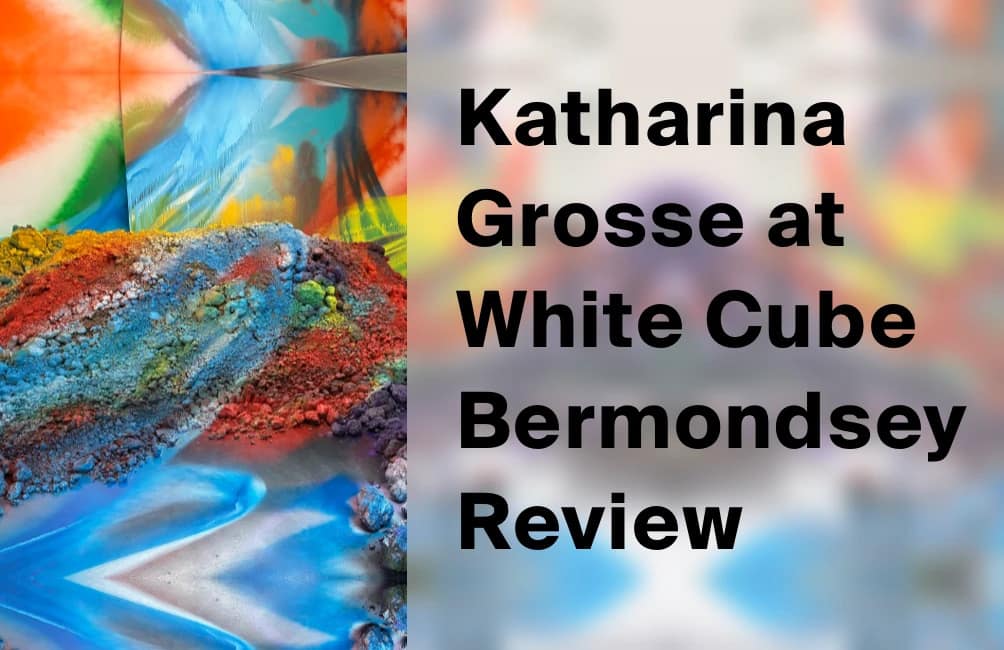
To the right of the entrance, the North Gallery is given over to a single work: Untitled, 2026, made from acrylic, bronze, canvas, and what the materials list charmingly calls "puddle clay." It is the centrepiece of the Katharina Grosse White Cube exhibition, and it is, simply, extraordinary.
The space has been transformed into something between a landscape and a chromatic event. Mounds of crushed pigment-saturated rubble rise from the floor in waves of orange, blue, red, purple, yellow, and green. Each clump holds its individual colour, yet the whole forms a single rolling terrain. Pools of sprayed blue and silver paint spread across the polished concrete floor as if the colour has melted off the rubble and run loose. Loose rocks of intensely coloured pigment scatter at the edges. At the back, a large painted canvas serves as the work's far wall, with passages of vivid blue, yellow, orange, and black sprayed across it in great vertical drips. Crucially, a second canvas sits within the rubble itself, dropped into the pigment landscape so that only its top edge pokes out, like a buried object slowly revealing itself.
Grosse has called colour, in works like this, "an unexpected guest" and, more vividly, "a hot iron applied to invisible ink." Both phrases land here. The paint binds soil, fabric, and bronze into a continuous work, yet none of those things lose their identity in the process. The mounds remain mounds. The bronze remains bronze. The canvas, although embedded in the landscape, remains a canvas. As a result, the room reads as a kind of weather rather than a picture.
It also happens to be the part of the show most clearly aligned with Grosse's career-defining in-situ work. From Untitled (green corner) at Kunsthalle Bern in 1998, her first sprayed in-situ piece, through Das Bett in her own bedroom and the celebrated Rockaway! on a hurricane-damaged building in New York, she has consistently made paint behave less like decoration and more like an environmental force. The North Gallery installation here belongs to that lineage. It is, on its own, worth the trip.
The canvases: brilliant, restless, sometimes contained
Now, an honest note. Once you leave the rubble room, the canvases are uneven. We will say that plainly, because it is true, and because pretending otherwise would not be the CoolCuration way.
The standout, for us, is an enormous horizontal painting in the back room. It runs across an entire wall in dripping bands of acid yellow, deep green, electric blue, and bloody red. The paint pools so heavily it has run right off the bottom edge of the canvas, leaving a visible halo of pigment on the wall and floor below. In other words, the work simply refuses to end where the canvas does. Looking at it, you start to understand why Grosse describes her relationship with canvases as "the difference between swimming in a pool and swimming in the sea." Even at this scale, even with this much paint, the canvas is the pool. The rubble room is the sea.
Another strong piece is smaller in scale but striking in directness. Broad, rapid brushstrokes of acid green sweep horizontally across the canvas, while three dark, almost burned-looking inky pools sit within the green like ruptures in foliage. It is one of the most painterly works in the show, and it rewards close looking.
However, not every canvas lands. Some, particularly a few of the smaller works in the back room, feel slightly held-in by their own frames. The spray gun, so generous in three dimensions, has had to compress itself onto a flat surface, and you can occasionally feel the strain. Even so, the hit rate on the genuinely extraordinary pieces is high enough that the inconsistencies feel like part of the texture of the show rather than a flaw in it.
The 9x9x9 series: New Zealand in two halves
The smaller cube space, on the left of the entrance, holds a tighter group of works from the artist's New Zealand studio. Grosse has spoken openly about her time on a clifftop overlooking the sea, working in what she describes as "elemental" conditions: "rain, burning sun and gale force winds. I am unwatched. I can put myself together again." That isolation has clearly shaped these paintings.
Each canvas in the series stands over two metres tall and is split vertically down the middle. Grosse paints one half while masking the other, then reverses the process repeatedly, building a "soft edge" between the two zones that feels almost biological. As she notes, "It's hard to negotiate seeing both parts at the same time." That tension is, in fact, the point. These are works that ask you to choose where to focus, and then quietly punish you for choosing.
The 9x9x9 paintings are quieter than anything else in the show. Nonetheless, they are some of its most rewarding pieces. Sit with them, and they unfold.
The South Gallery: an artist's full range
The third space, at the far end, holds a varied hang from across Grosse's career. Several of these works have not previously been publicly exhibited, including large panoramic canvases the artist refers to as "landscapes." Some of these were originally painted as part of past in-situ installations, then removed and brought into the exhibition, where they now carry, in Grosse's words, "the structure and thought of that past show" into a new context.
You can see the precision in her early use of stencils and masking tape, where portions of the canvas were protected during painting to produce hard-edged geometric boundaries. Subsequently, those edges are crossed by drifts of overspray and haze. The tension between the controlled edge and the unruly spread of colour is, consistently, thrilling. Furthermore, seeing works from across more than fifteen years gathered in one room reveals something important: Grosse's approach has never been a fixed method but a restless, evolving system.
It is in this room that you grasp the show's real argument. Each painting, as Grosse puts it, is a "plot point" or "node within a spider's web that constantly generates new strands of activity." The hang invites that kind of cross-reading. As a result, you find yourself moving back and forth between works, watching them quietly rewrite each other.
Why this Katharina Grosse exhibition matters now
Painting, as a medium, has been declared dead more times than anyone can count. Yet Grosse, more than almost any artist working today, makes that declaration look ridiculous. Her work treats paint as a living material, capable of behaving like weather, like architecture, like terrain. Moreover, her insistence that "painting has such an independence from space" turns out, on the gallery floor, to be more than a slogan. The rubble room genuinely demonstrates it.
Notably, this show comes at a particular moment. In 2025, Grosse installed CHOIR at Art Basel's Messeplatz, a vast outdoor work covering 1600 by 9100 by 5500 centimetres of asphalt and fabric. She also completed bLINK, a permanent commission on the Västlänken railway bridge in Gothenburg for the Swedish Public Art Agency. These are not the projects of an artist easing off. The Bermondsey show is best understood as one stop in a year of relentless ambition, but it happens to be the one that British audiences can actually visit.
Value for money
Entry is free. That alone makes this an easy recommendation. Crucially, you are getting access to one of the most significant painters working today, in a world-class space, at no cost. Notably, no prices are displayed on the walls. White Cube is a commercial gallery, and every work is presented on a "price on request" basis only. Given Grosse's market standing, expect prices firmly in blue-chip territory. For visitors, however, that detail does not change much: the show is free, and you can give every work as much time as you want without anyone steering you toward a sale.
If you visit galleries regularly, it is also worth knowing about the National Art Pass, which provides free or discounted entry across hundreds of UK venues. As a result, days like this become much easier to build a full itinerary around.
Bermondsey Street itself, beyond the gallery, is well worth your time. There are good independent cafes and restaurants within a short walk, so arriving early and staying for lunch is a sensible plan.
Practical info: getting there, hours, accessibility
White Cube Bermondsey is at 144-152 Bermondsey Street, London SE1 3TQ. The nearest Underground station is Bermondsey on the Jubilee line, with London Bridge also within walking distance. Hours are Tuesday to Saturday, 10am to 6pm, and Sunday, 12pm to 6pm. The gallery is closed on Mondays. The public gallery, bookshop and auditorium are on the ground floor and are wheelchair accessible. Additionally, accessible toilets and baby-changing facilities are available on site.
The verdict
This Katharina Grosse White Cube exhibition is one of those shows you will be glad you caught. The North Gallery installation alone justifies the trip, and the rest of the building, with its varied hang and quieter rooms of canvases, only deepens the impression. It is painting treated as an ecological event rather than a decorative act, and experiencing it in person is the difference between understanding that idea on paper and actually feeling it in your body.
Cool Factor: 5/5 Ice cold. Overall, this is a 5/5 Ice cold show. Yes, the canvases are uneven, and yes, some of the smaller works feel held back by their own frames in a way that the in-situ installation gloriously is not. Even so, the rubble room is one of the most extraordinary single gallery spaces we have stepped into in years. Furthermore, the breadth and ambition of the rest of the show, the prolific quality of the hang, and the sheer variety of registers Grosse moves through push this firmly into Ice cold territory. A few inconsistent pieces do not stop a show being a spectacle, and this is, unequivocally, a spectacle. Go before 31 May 2026. For full exhibition details, visit the White Cube website.
Frequently asked questions
Is the Katharina Grosse White Cube exhibition free to visit?
Yes. Entry to White Cube Bermondsey is free, and no advance booking is required. I Set Out, I Walked Fast runs from 22 April to 31 May 2026. Hours are Tuesday to Saturday, 10am to 6pm, and Sunday, 12pm to 6pm.
Where is White Cube Bermondsey?
White Cube Bermondsey is at 144-152 Bermondsey Street, London SE1 3TQ. The nearest Underground station is Bermondsey on the Jubilee line, and London Bridge is also within walking distance. The gallery is wheelchair accessible, with accessible toilets and baby-changing facilities on site.
How busy is the exhibition?
From our visit, surprisingly quiet. We walked straight in on a weekday with no queue and had stretches of the main installation almost entirely to ourselves. Weekends will, naturally, be busier, but if you can go on a weekday, the experience is significantly enhanced by having space to move around the work.
Are the works in the exhibition for sale?
Yes. White Cube is a commercial gallery, and although the show is free to visit, the works are all available for purchase. However, prices are not displayed in the gallery; everything is presented on a "price on request" basis. Given Grosse's market standing and her joint representation across White Cube, Gagosian, Galerie Max Hetzler, and Galerie nächst St. Stephan, expect prices firmly in blue-chip territory.
Who is Katharina Grosse?
Katharina Grosse is a German painter born in 1961 in Freiburg im Breisgau. Since the late 1990s she has worked primarily with acrylic paint and an industrial spray gun, creating installations and paintings that spread across architecture, landscape, and found objects. Her first sprayed in-situ work, Untitled (green corner), was made at Kunsthalle Bern in 1998. She is jointly represented by White Cube, Gagosian, Galerie Max Hetzler, and Galerie nächst St. Stephan. A solo exhibition, Black Bed, opens at MUNCH in Oslo in September 2026.
Is the exhibition suitable for children?
Generally, yes. The show is visually striking and tends to engage visitors of all ages. There is no troubling or mature content. As with any commercial gallery, children should be supervised, especially around the in-situ installation, where painted mounds of pigment-saturated rubble and pools of sprayed paint may invite curious hands.
How does this exhibition compare to other free London art shows?
Exceptionally well. The scale of the in-situ installation is unusual even by the standards of London's larger free venues. Unlike many survey shows, this one is genuinely experiential: it changes how you feel in the space rather than simply presenting objects to look at. If you have enjoyed large-scale free shows at Tate Modern or the Serpentine, this is absolutely worth adding to your list.
More from CoolCuration
- Rose Wylie at the Royal Academy: our review of another essential London art moment
- William Nicholson at Pallant House: a quietly stunning show, reviewed
- David Hockney in London: what to know before you visit
- The National Art Pass: is it worth it for regular gallery-goers?
- Great Women Artists: the book every art lover should own
- Gifts for artists and creatives: our curated picks
What's trending





Recent posts
- Premium Bonds Alternatives UK 2026: Prize Savings Accounts Compared
 Four Premium Bonds alternatives open to new savers, with each provider's published odds, prize tables, access rules and protection.
 - Best Audiobooks October 2026: 10 UK Listens RankedTen new audiobooks for October 2026, from a full-cast Dracula with Jonathan Bailey to Russell T Davies reading his own television memoir.
- Louis Fratino at David Zwirner ReviewLast updated: 4 October 2026 By Tristan · Arts, exhibitions and creative culture This is an opinion piece. Views expressed are the author's own and do not constitute professional advice. Exhibition reviewMayfair Saunas, subway cars and a lot of skin in Mayfair Louis Fratino at Zwirner is the American painter's first solo show in London,… Read more: Louis Fratino at David Zwirner Review


No Comments.