
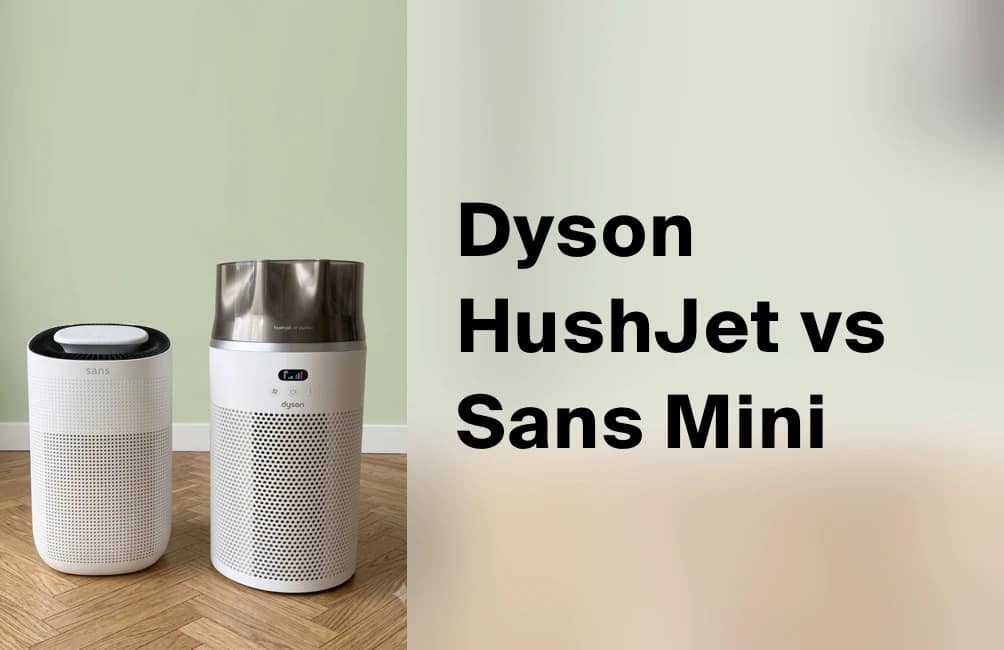
Dyson HushJet vs SansAir Quality
Dyson HushJet vs Sans. Two small purifiers, one plug socket, only one stays.
Last updated: 9 August 2026
By Stiv · Design, technology and personal finance
I bought both purifiers with my own money. Both have run in the same one bedroom Victorian conversion. I swapped them between rooms across a full hay fever season, so this comes from living with them rather than reading spec sheets.
This is an opinion piece. Views expressed are the author's own and do not constitute professional advice.
This article contains affiliate or referral links. If you click through and sign up I may earn a commission or referral bonus at no extra cost to you. It does not affect my editorial view.
Cool Factor: 4/5 (Sans Air Purifier Mini) · 3/5 (Dyson HushJet Purifier Compact)
Damp Victorian conversions, a main road outside, and a pollen season that starts earlier every year. Clean air at home is harder than it should be. That is why Dyson HushJet vs Sans has quietly become one of the UK's most searched purifier questions. So I bought both and ran them for months. The honest answer turned out messier than either brand would like.
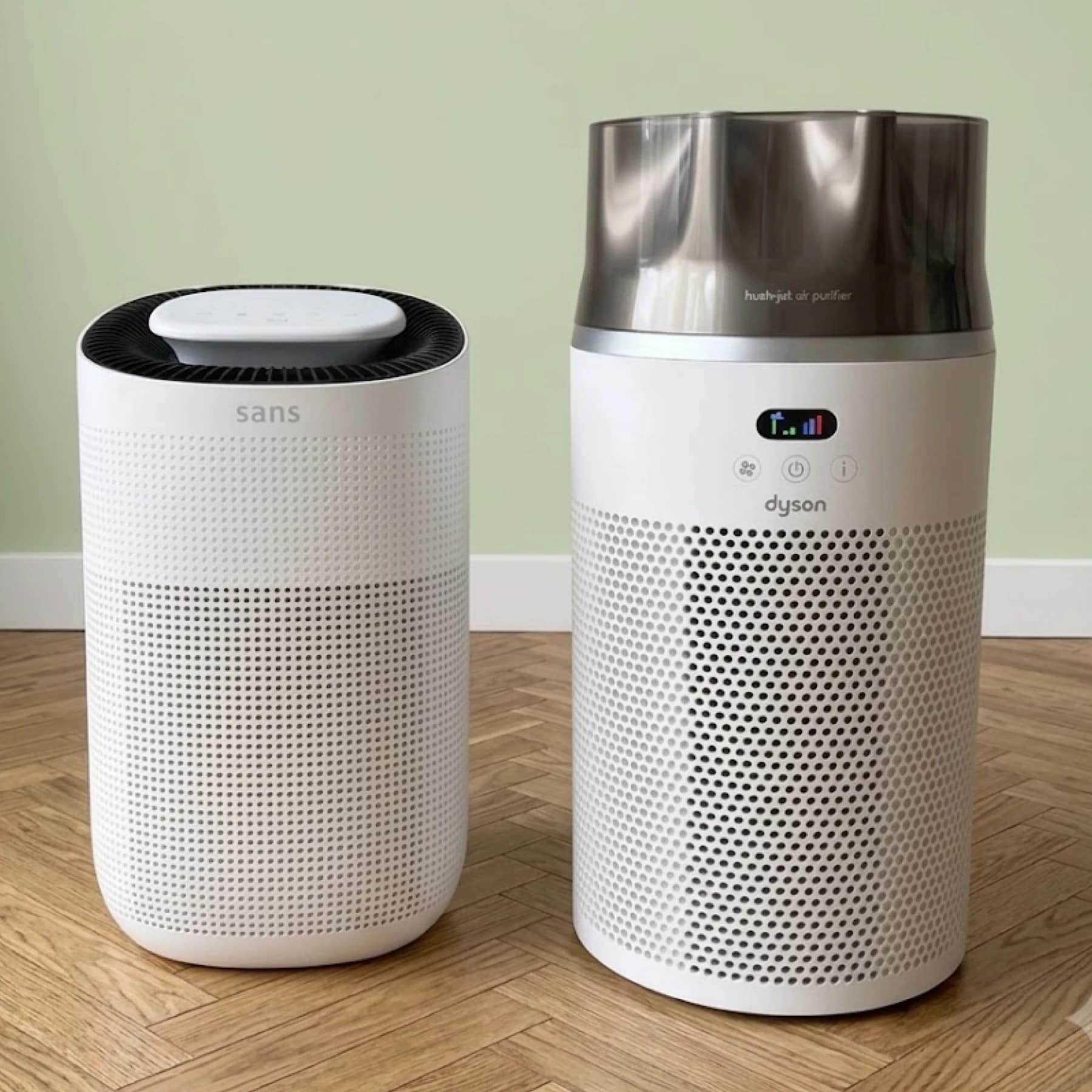
Sans Mini on the left at 36cm, Dyson HushJet on the right at 47cm. The word "compact" is doing some work.
Buy either purifier
Both units sit on Amazon UK. Prices there move around far more than the brand sites do, so it pays to compare before you commit.
Check the Sans Mini on Amazon Check the Dyson HushJet on Amazon
Section 01 / The line-up
Dyson HushJet vs Sans: meet the contenders
One is a household name with a jet engine obsession. The other is a bootstrapped upstart that nobody had heard of five years ago.

The Sans Mini in White. It looks like furniture, which is most of the point.
Sans Air Purifier Mini
Sans is the newer name here. Adam Bedford and John Fanelly started the company in 2020 after sharing a Covid bubble in California. Crucially, they never took outside money. Today the business is on track to pass 100 million dollars in revenue, according to Entrepreneur. The team is around fifteen people. The Mini is the smallest thing they make.
for the flat that needs clean air without a hospital aesthetic
£199.99 (RRP £249.99)

The HushJet nozzle, borrowed from jet engine hush-kit design. Genuinely clever, and this is Dyson's own render.
Dyson HushJet Purifier Compact
Dyson needs no introduction. The HushJet arrived at IFA in September 2025 as the brand's first desktop purifier. TIME then gave it a Best Inventions special mention, calling it "a cool, quiet room refresher". Matt Jennings, Dyson's Engineering Director for Home, put the approach simply: "Our HushJet Nozzle technology is a completely new way for us to move air."
for the person who wants the clever bit, and will pay for it
£349.99
Section 02 / Arrival
First impressions from two very different boxes
Unboxing tells you a lot about a brand. The Dyson arrives the way Dyson things always arrive. Moulded pulp, a printed quick-start card, a smug little sense of occasion. Then you lift it out and pause. At 47cm tall, it is not really a desktop object. On my bedside table it looked like a small lighthouse.
The Sans, by contrast, is properly small. It stands 36cm high, weighs 3.2kg and disappears into a room within about a day. Setup took under a minute because there is no app to install and no account to create. You plug it in, twist the dial and it starts working.
Neither approach is wrong. Still, the difference in ceremony sets the tone for everything that follows. Dyson wants you to notice the machine. Sans wants you to forget it exists.
Section 03 / Money
Price: the Dyson HushJet vs Sans gap is bigger than the sticker
At the time of writing the Sans Air Purifier Mini sells for £199.99, reduced from an RRP of £249.99. The Dyson HushJet Purifier Compact sits at £349.99. That is a £150 difference before you have opened either box, and the gap widens once you own them.
Sans sells replacement filters through its Clean Air Club subscription at £26.99, delivered every three months. Consequently you spend roughly £108 a year on the recommended cadence. Dyson uses two separate filters instead. First, a 360 electrostatic filter rated for up to five years at £50. Second, a 360 activated carbon gas and odour filter, replaced annually at £35.
On paper Dyson wins the running costs argument comfortably. Roughly £45 a year beats £108 a year, and it is not close. However, there is a catch that nobody mentions on the product page.
I checked the Dyson UK spare parts listing on 9 August 2026. The £50 electrostatic filter showed as out of stock, with only a notify-me option. The carbon filter was available. Admittedly you do not need a five year filter in a hurry. Even so, it makes the cheap running cost feel slightly theoretical.
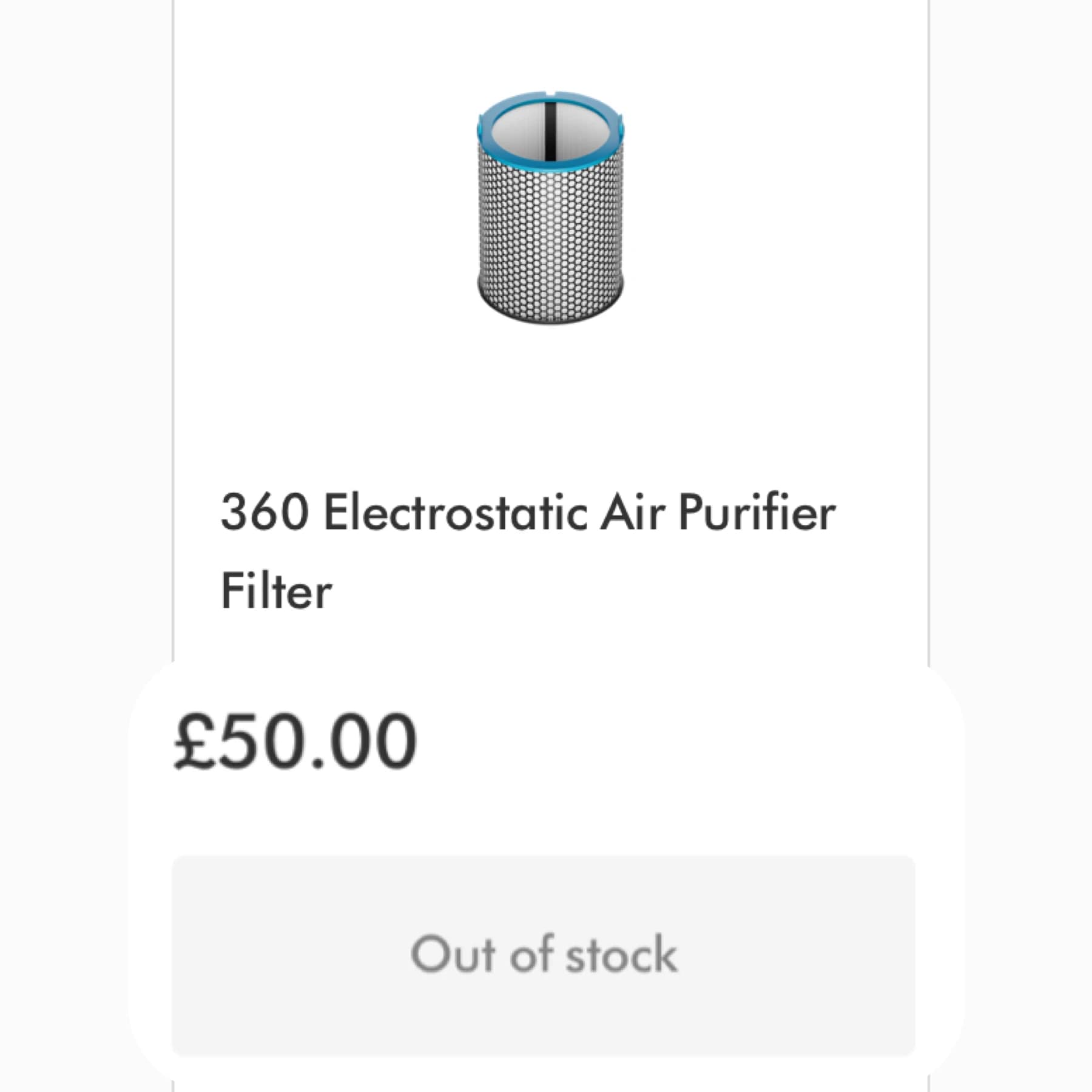
Dyson's own spare parts page, 9 August 2026. Fifty pounds, and you cannot buy it.
Sans also throws in a three year guarantee, a 30 day home trial, and free delivery and returns. Dyson offers a two year warranty plus 24 months on spare parts. Therefore, on upfront price and ownership confidence, Sans takes this round of the Dyson HushJet vs Sans fight.
Section 04 / Filtration
Dyson HushJet vs Sans filtration: HEPA 13 versus electrostatic
Here is where the marketing gets slippery, so let us be precise. The Sans Mini uses a genuine HEPA 13 filter, a pre-filter and roughly a pound of activated carbon. On top of that, it runs an internal UV-C lamp. It also carries CARB certification confirming zero ozone output. Sans rates it to capture 99.97% of particles down to 0.3 microns.
Dyson does not use HEPA in the HushJet. Instead it fits 360 electrostatic filtration, paired with a carbon gas and odour filter. Dyson also rates the system at 99.97% of particles down to 0.3 microns. Notably, that is the same headline number by a different route.

The Sans cartridge. One part, twist and lift, about ten seconds.

Dyson's filter change. This is Dyson's own image rather than ours, so the machine shown is the teal model and not the white one we own.
So does the label matter? To a point, yes. HEPA is a defined standard with a defined test. Electrostatic media carries a charge instead. Charged media can lose efficiency as it loads with dust, so the five year lifespan claim deserves a raised eyebrow. Dyson counters that the charge lives in the media rather than in an electrical field. Independent testing so far backs strong real-world capture.
Meanwhile the sensors differ too. The HushJet tracks PM2.5, PM10, VOCs and nitrogen dioxide. That is a broader picture than most compact units offer. The Sans reports air quality through a simpler coloured display. So Dyson clearly has the better sensing hardware. Unfortunately, the software wrapped around it undoes most of that advantage, as the app section below explains.
Same 99.97% claim, two completely different philosophies, and only one of them tells you what it just caught.
Section 05 / The confusing bit
Coverage: where Dyson HushJet vs Sans gets confusing
Most comparisons get this part wrong, including the sponsored ones. Sans lists coverage at 46 square metres, or 490 square feet. Its CADR is 110 cubic metres per hour. Dyson's UK page lists 100 cubic metres instead, which describes room volume rather than floor area.
Convert that and you get roughly 42 square metres at a standard 2.4 metre ceiling. On that basis, Sans looks marginally ahead. Dig into Dyson's own US specification, though, and a different picture appears. There the figure is a CADR of 131 cubic feet per minute, for rooms up to 203 square feet.
Do the maths and 131 CFM works out at about 222 cubic metres per hour. In other words, the Dyson moves roughly twice as much clean air as the Sans. Yet it claims less than half the floor area. That is not a contradiction. Dyson simply uses a stricter air changes per hour assumption, while Sans uses a generous one.
Consequently the fair conclusion is uncomfortable for both. Dyson's machine is genuinely more powerful. Sans's coverage figure is optimistic. Anyone telling you Sans wins on raw effectiveness has not checked the arithmetic.
Cool Factor: Sans Air Purifier Mini
★★★★☆
4 out of 5 · Stone cold
Cool Factor: Dyson HushJet Purifier Compact
★★★☆☆
3 out of 5 · Cool
Section 06 / Noise
Noise: Dyson HushJet vs Sans in a real bedroom
On paper this round of Dyson HushJet vs Sans looks like a tie. In a real bedroom it is not.
Sans markets the Mini at 25dB and calls it "meditation quiet". Retail listings put the full range at 25 to 45dB. Dyson claims 24dBA in night mode. Reviewers measured the top end differently, though. T3 reported the low 40s. TechRadar logged up to 55dB on the highest setting.
In my bedroom both machines vanish on their lowest setting. Above that, they behave differently. The HushJet's nozzle produces a smoother, lower pitched rush. I find it easier to sleep through. Sans, by contrast, has a fizzier tone at speed three. It took me about a week to stop noticing.
Here is the practical problem, though. The Dyson sensor is extremely sensitive, so it ramps up more often. T3 flagged the same thing. In a dusty flat that means more time above 40dB. Therefore the theoretical quietness advantage rarely survives a real home.
Section 07 / Living with them
Design and the small daily annoyances
Sans clearly wants to be furniture. Four colourways exist, namely White, Midnight, Sand and Agave, and the lights-out mode kills every LED completely. That last detail matters more than it sounds if you sleep lightly.
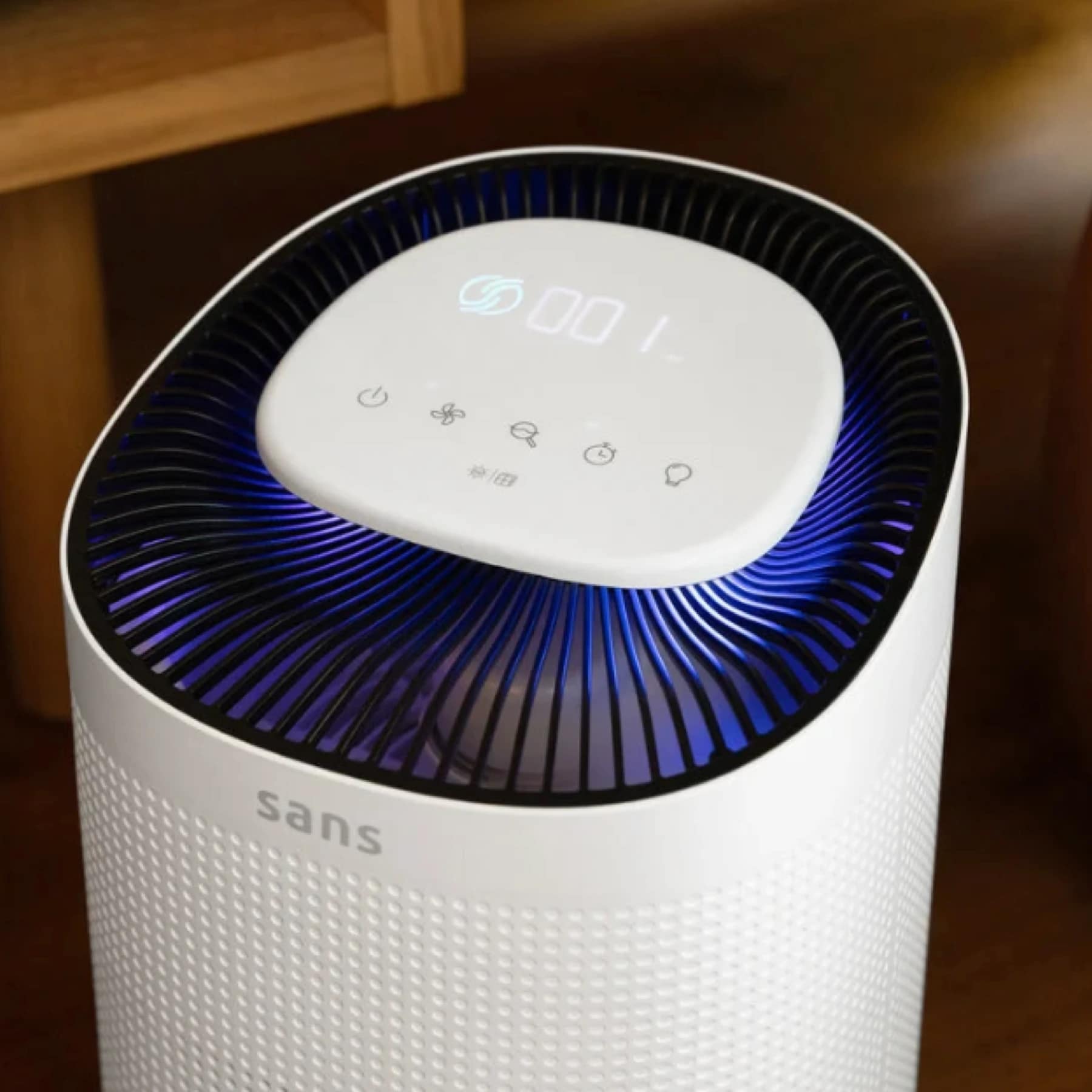
The Sans with everything lit. Switch on night mode and all of this goes dark, which is exactly the point.
Dyson offers White/Silver and Black/Teal only. The machine also looks like a Dyson, which you will either love or tolerate. Meanwhile the HushJet has almost no physical controls, so you reach for your phone constantly. It also lacks a carry handle. That is an odd omission for a purifier people will move between rooms. The Sans has a dial, a handle-friendly shape and nothing to configure.
Section 08 / Software
The MyDyson app is the worst part of owning one
Great sensors, buried under software that feels like nobody senior ever used it.
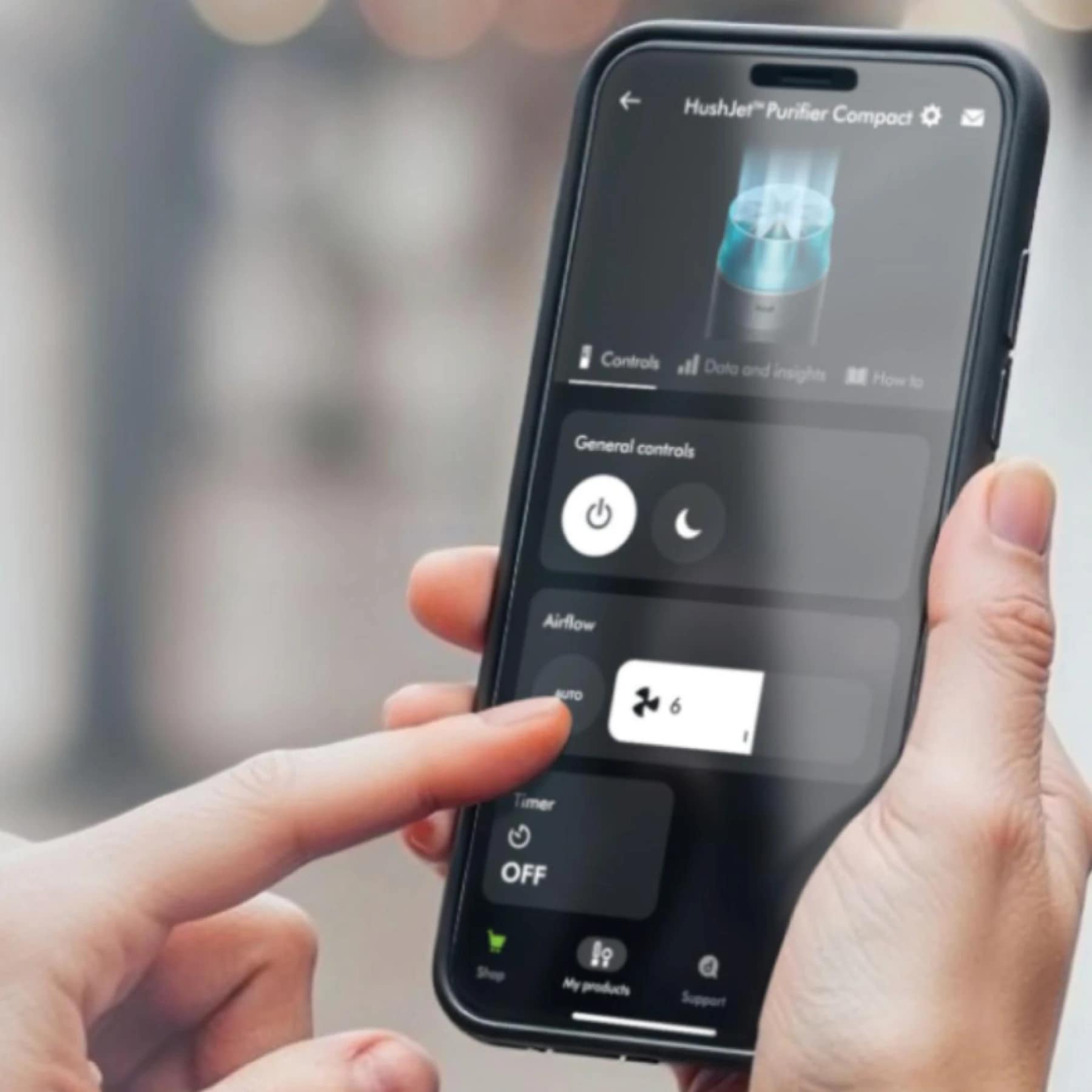
MyDyson running the HushJet. This is Dyson's own image rather than ours, though it is an accurate picture of the interface.
Let us start with a number. MyDyson sits at 3.8 out of 5 from more than 33,000 Google Play reviews. For a brand that charges Dyson prices, that is a poor score. It also matches my experience exactly.
The app feels like an afterthought. Navigation is clunky, and basic controls hide behind tabs that all look the same. The "data and insights" screens look impressive in a press shot, yet they rarely tell you anything you can act on. Knowing your PM2.5 spiked at 19:40 helps nobody unless the app explains why or does something about it. Mostly it just draws a line.
Then there is reliability. Connectivity complaints dominate the recent negative reviews, and I have had the HushJet drop offline more than once. Consequently you end up walking over to a machine with almost no buttons on it. Dyson needs an experience team on this product, because the hardware deserves far better.
The fix already exists, and Dyson is holding it back
Here is the frustrating part. Dyson already supports Matter, the open smart home standard. In September 2025 the company announced Matter firmware for three purifiers: the Purifier Cool PC2 De-NOx, the Purifier Hot+Cool HP2 De-NOx and the Purifier Humidify+Cool PH2 De-NOx. The HushJet is not one of them.
So the capability exists. Dyson simply chose not to put it in this machine. With Matter you could run the HushJet from Apple Home, Google Home, Alexa or Home Assistant, alongside everything else you own, and never open MyDyson again. Without it, a £350 purifier stays locked to an app rated 3.8.
Therefore my ask is simple. Roll Matter out across the premium range, lean into integrations, and let people control these machines from whatever they already use. Until that happens, the app is a real reason to think twice.
Section 09 / The honest bit
Dyson HushJet vs Sans: honest critical observations
Neither machine is above criticism. Most sponsored Dyson HushJet vs Sans comparisons skip this part entirely.
Starting with Sans, the filter subscription is the weak spot. The brand pushes a three month replacement cycle at £26.99. Meanwhile at least one authorised UK retailer lists filter life as six to twelve months. Those two statements cannot both be optimal. Follow the subscription blindly and you may spend double what you need to. Check the filter before you swap it.
Sans also under-reports. You get no app, no historical data and no breakdown of what the unit caught. For a product sold on health outcomes, that is a real gap. Additionally, the 490 square feet coverage claim looks generous, as the CADR maths above shows.
Moving to Dyson, the price is the obvious issue. It is not the worst one, though. A £350 purifier skipping HEPA is harder to defend. Dyson's own five year filter was also out of stock when I checked. Furthermore, "compact" does heavy lifting for a 47cm machine with no handle. Worst of all, the app is poor and there is no Matter support to route around it.
Finally, both brands lean on the same 99.97% figure. Neither publishes full independent test data for UK conditions. Until that changes, treat the headline number as a starting point rather than a verdict.
Section 10 / Context
Dyson has a bigger problem than this purifier
Context matters when you spend £350 on a brand. Earlier this year we reviewed the Dyson Spot+Scrub AI robot vacuum. We gave it 0 out of 5, the only Meltdown score we have ever handed out. The reasons were specific. Less suction than the model it replaced. A £1,049.99 price. Apparent outsourced manufacturing, plus a docking station that felt cheap.
The HushJet is a far better product than that vacuum. Tarring it with the same brush would be lazy. Still, the pattern is worth naming. Dyson increasingly charges a premium for engineering stories rather than measurable superiority. Buyers have noticed. On Dyson's own UK site the HushJet sits at 4.2 out of 5 from 215 ratings. The Sans Mini shows 4.9 out of 5 from 884 reviews on its own store.
Both figures are first-party and therefore worth treating carefully. Even so, the gap in volume and score is large enough to mean something.
Is the Dyson worth £150 more?
Only if you want the sensing. Nitrogen dioxide detection and raw airflow both beat the Sans. Almost everything else favours the cheaper machine, including the protection standard, the guarantee length, the 30 day home trial and the fact that you never have to open MyDyson.
buy the Dyson for the sensors, then resent the app
Section 11 / Value
Dyson HushJet vs Sans on value for money
Over three years, the sums look like this. Sans costs £199.99 plus roughly £324 in filters if you subscribe. Call it £524 all in. Dyson costs £349.99 plus two carbon filters at £35, so around £420. That assumes the electrostatic filter lasts and returns to stock.
Interestingly, that flips the Dyson HushJet vs Sans value story over a long enough horizon. Keep the machine for five years, then stretch the Sans filters to the six month interval retailers cite. The numbers converge again. Neither brand makes this easy to work out, which is presumably the point.
Where Sans pulls clearly ahead is risk. You get a 30 day home trial plus a three year guarantee. So you can find out whether a purifier changes anything, without committing £350 first. Do you track running costs across the house? Our Tapo P110M smart plug review covers a cheap way to measure what either unit adds to your bill.
Section 12 / Before you buy
Practical info before you buy
Measure your room first, and be realistic. For a typical UK bedroom of 12 to 15 square metres, either machine is comfortably enough. For an open plan living space above 30 square metres, the Dyson's airflow advantage becomes the deciding factor.
Check your sockets too. Both units draw modest power, with Sans rated at 30W. Running costs are therefore pennies rather than pounds. Next, think about placement. Neither purifier works well behind a sofa, because both need clear air on all sides.
Finally, remember what a purifier cannot do. It will not fix damp. Pollen still drifts in through an open window. Ventilation remains a separate job entirely. Filtration only helps with what is already in the room, which is a smaller job than the marketing implies.
Section 13 / Verdict
Dyson HushJet vs Sans: the verdict
Sans wins the Dyson HushJet vs Sans contest, but on points rather than by knockout. You get true HEPA 13 filtration, a UV-C stage and ozone-free certification. Add four colourways, a three year guarantee and a 30 day trial for £150 less. For most UK flats and bedrooms, that combination is simply the smarter buy.
Dyson deserves more credit than the sponsored comparisons give it. The HushJet moves roughly twice the air and senses more pollutants. It also represents real engineering, not a rebadged reference design. Nevertheless, it costs £350, skips HEPA and has no handle. A key filter was out of stock when I looked, and the app is genuinely poor.
Overall, the Sans Air Purifier Mini takes a solid 4 out of 5, Stone cold. It earned that on price, protection, and the fact that I stopped noticing it within a week. That is the highest compliment you can pay a purifier. It missed Ice cold for two reasons. The coverage claim is optimistic, and the filter subscription nudges you to spend more than you need. The Dyson HushJet lands at 3 out of 5, Cool. It is a properly clever machine, held back by a price its filtration standard does not justify and by software that undoes its best advantage.
Buy the Sans Mini on Amazon Buy the Dyson HushJet on Amazon
Dyson HushJet vs Sans FAQs
Dyson HushJet vs Sans: which one should I actually buy?
For most UK homes, the Sans Mini. It costs £150 less and uses certified HEPA 13 filtration with a UV-C stage. It also comes with a three year guarantee plus a 30 day home trial. Dyson still wins on airflow and sensing, so the answer depends on what you want.
Does the Dyson HushJet use a HEPA filter?
No. The HushJet uses a 360 electrostatic filter alongside an activated carbon gas and odour filter. Dyson rates it at 99.97% of particles down to 0.3 microns, which matches HEPA 13 on paper. However, the machine carries no HEPA classification.
How much do replacement filters cost?
Sans charges £26.99 per filter on its three month subscription, or roughly £108 a year. Dyson charges £50 for the electrostatic filter, rated up to five years. The annual carbon filter costs £35. Check stock before you rely on those figures.
Which purifier is quieter in practice?
Both sit around 24 to 25dB on their lowest setting. However, the Dyson's sensor ramps up more often. In a dusty home it therefore spends more time above 40dB. In daily use the Sans usually feels quieter.
Are these purifiers big enough for a living room?
For rooms up to about 20 square metres, either works well. Above 30 square metres, the Dyson HushJet vs Sans comparison tilts towards Dyson. Its CADR of roughly 222 cubic metres per hour is around double the Sans figure of 110.
Is the MyDyson app any good?
Not really. It holds 3.8 out of 5 across more than 33,000 Google Play reviews, and connectivity complaints are common. The HushJet also lacks Matter support, which Dyson has only rolled out to its De-NOx flagships, so you cannot bypass the app with Apple Home or Home Assistant.
Where should I buy them in the UK?
Both sell on Amazon UK and direct from the brands. Amazon pricing moves more often, so compare before you commit. Sans also runs a 30 day home trial when you buy direct, which Dyson does not match.
More from CoolCuration
- Dyson CameraJet toothbrush – Dyson's £419.99 camera toothbrush, with the specs, refill costs and the returns rule before you spend it.
- Philips Hue Bridge Pro review – is the upgrade worth it for a sprawling smart home?
- Gifts for homebodies – more things that quietly make a flat nicer to be in.
- Octopus Energy guide – what switching actually saves, and how the referral works.
- Shop app – keep track of every Amazon and direct delivery in one place.
- TP-Link Wi-Fi 7 travel router – a small box that fixes hotel internet for good.
Sources
- Sans Air Purifier Mini, official UK product page
- Dyson HushJet Purifier Compact, official UK product page
- Dyson innovation briefing on HushJet nozzle technology
- Matter Alpha on Dyson adding Matter to its De-NOx purifiers
- MyDyson on Google Play, current rating and reviews
What's trending




Recent posts
- Philips OneBlade Review UK: 4/5 After Five Years
 Five years with the same Philips OneBlade. One handle, a new blade every four months, and blades that work out at £1.65 a month. Here is what wore out, which blade I stopped buying, and the one design flaw that will eventually kill it. #philipsoneblade #grooming #shaving #ukreviews #coolcuration
 - Best Smart Home Starter Kit UK 2026: Apple, Google or AlexaThree ways into a smart home and one box you replace if you change your mind. Apple, Google and Alexa priced side by side, plus the Matter kit that works with all three.
- Best Refurbished AirPods UK 2026: Where to Buy and What It SavesRefurbished AirPods UK prices at Back Market, Amazon Renewed and Apple, set against the cheapest new price at Argos, AO and Currys.
No Comments.