
Last updated: 31 August 2026
By Stiv · Design, technology and personal finance
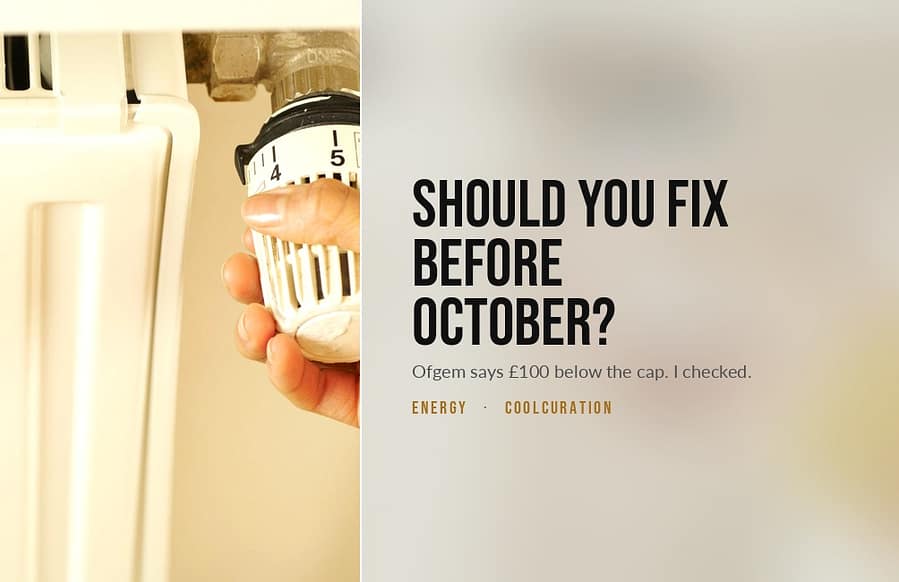
Ofgem says fix. I checked the sums.
Ofgem reckons you can beat the October cap by £100 or more, so the obvious question is whether to fix your energy tariff before it lands on 1 October. So I ran the only supplier prices you can check without handing over a postcode against Ofgem’s own regional cap tables. Indeed, Octopus’s twelve month fix does beat the cap in every region of Britain. It beats it by £47 to £82, though, and not once by £100.
This article contains affiliate or referral links. If you click through and sign up I may earn a commission or referral bonus at no extra cost to you. It does not affect my editorial view.
This is not financial advice, and CoolCuration is not FCA authorised. Tariffs, rates and offers change constantly, so always check the supplier’s own site before you commit.
Thinking about switching as well as fixing?
My Octopus Energy page keeps the current switching credit and the sign-up steps up to date, so you are never working from a stale offer.
See the Octopus referral offer
Section 01 · The mechanicsWhat fixing your energy tariff actually locks
Not your bill. Your unit rate and your standing charge.
Most people think a fix freezes what leaves their bank account each month. However, it does not work that way. When you fix your energy tariff you lock the price of a unit of gas and a unit of electricity, plus the daily standing charge for each fuel. Octopus puts it plainly in its own help pages: your unit rates and standing charge will not change for the duration of your contract, but your monthly Direct Debit amount is not fixed.
Suppliers still recalculate your Direct Debit against estimated usage, seasonal weighting and whatever balance your account is carrying. So a cold December will push your payment up on a fixed tariff exactly as it would on a variable one. In other words, fixing removes the risk that the price per unit rises. It leaves the risk that you burn more units entirely where it was.
Equally, a fix has an end. Octopus moves you onto a flexible tariff at the end of the term unless you tell them otherwise, and most suppliers work the same way. So a twelve month fix quietly turns into a default-tariff decision if you forget about it. Set a reminder for eleven months in.
Section 02 · The testTesting Ofgem’s £100 claim
One regulator, one number, and fourteen regions where it does not quite land.
Neil Kenward, Ofgem’s Director General for Markets, made an unusually direct case for fixing when the October cap was announced on 26 August.
Savings are available by choosing a fixed tariff, which are available at £100 or more below the October price cap.
Neil Kenward, Ofgem Director General for MarketsNaturally I wanted to check that before telling anyone to fix their energy tariff on the strength of it. That turned out to be harder than it sounds, because almost nobody actually publishes a fixed-tariff price. E.ON Next, British Gas and So Energy all gate their rates behind a postcode. Octopus does the same on its website. However, Octopus also runs a public tariff API, and that API returns real unit rates and standing charges for all fourteen distribution regions.
So I took Octopus 12M Fixed, the tariff that went live on 27 August 2026, and priced it at Ofgem’s own typical consumption of 2,500 kWh of electricity and 9,500 kWh of gas. Then I held each region against that same region’s cap, using Ofgem’s published benchmark tables for 1 October to 31 December. Electricity carries no VAT from 1 October, and gas keeps VAT at 5%, so both sides of the comparison are on the same footing.
Region by region, the fix against the October cap
| Region | October cap | Octopus 12M Fixed | Below the cap |
|---|---|---|---|
| East Midlands | £1,672 | £1,603 | £69 |
| Eastern England | £1,713 | £1,631 | £82 |
| London | £1,706 | £1,626 | £80 |
| Merseyside and North Wales | £1,804 | £1,757 | £47 |
| North East England | £1,723 | £1,655 | £68 |
| North West England | £1,685 | £1,629 | £56 |
| North Scotland | £1,717 | £1,657 | £60 |
| South East England | £1,734 | £1,665 | £69 |
| South West England | £1,746 | £1,693 | £53 |
| Southern England | £1,719 | £1,651 | £68 |
| South Scotland | £1,734 | £1,668 | £66 |
| South Wales | £1,744 | £1,681 | £63 |
| West Midlands | £1,708 | £1,639 | £69 |
| Yorkshire | £1,724 | £1,662 | £62 |

Every region beats the cap. Not one of them beats it by the £100 Ofgem quoted.
What the numbers say about the £100
My regional cap figures average out at exactly £1,723, which is Ofgem’s own headline, so the two sides line up. The fix wins in all fourteen regions. Even so, the average gap is £65, and the strongest region in Britain still falls £18 short of Kenward’s £100.
To be fair to Ofgem, the claim is about the market as a whole rather than any one supplier, and a smaller supplier may well be pricing lower. Nevertheless, Ofgem’s own state of the market report puts Octopus at 25% of the domestic electricity market, ahead of British Gas on 21%. So this is not a fringe tariff, and it is the only large fix whose price you can verify in public. If a quarter of the country lands at £65, treat £100 as an upper bound rather than a floor. You can check the underlying numbers yourself on Ofgem’s unit rates and standing charges page and in the Ofgem press release carrying the quote.
For the cap figures themselves, and why you will see both 4% and 3.6% reported, I covered the whole announcement in my energy price cap October 2026 explainer.
Section 03 · The catchExit fees, and when they bite
Charged per fuel, so a dual fuel exit costs double the headline.
Crucially, exit fees are quoted per fuel, not per household. A £50 exit fee on a dual fuel account is therefore £100 to leave, and the tariff pages rarely spell that out.
| Tariff | Term | Exit fee | Dual fuel cost to leave |
|---|---|---|---|
| Octopus 12M Fixed | 12 months | £50 per fuel | £100 |
| E.ON Next Fixed 12m | 12 months | £50 per fuel | £100 |
| E.ON Next Fixed 24m | 24 months | £100 per fuel | £200 |
| E.ON Next Pledge | Tracker | £25 per fuel | £50 |
| British Gas Fix & Fall | 24 months | None stated | Free switching |
Notably, those figures come from each supplier’s own tariff page, checked on 30 August 2026. Octopus states the £50 per fuel fee in its published tariff data, having previously left the number off its consumer help pages altogether. British Gas, meanwhile, advertises free switching on its fixed tariffs, which removes the penalty entirely.
There is one guaranteed escape, though. As Citizens Advice explains, you can switch away from a fixed contract with 49 days or less left to run, and no exit fee applies. Outside that window the sums change fast. Specifically, a £100 dual fuel exit fee wipes out eighteen months of a £65 annual saving in one go.
Section 04 · The betWhy a fix can lose
Nobody knows what January brings, and the announcement lands after the decision.
Fundamentally, the decision to fix your energy tariff is a bet on where the cap goes next. Beat the October cap by £65 and you are ahead for one quarter, certainly. However, a twelve month fix runs through January, April and July too, and the cap resets every three months. Therefore, fall behind in two of those quarters and the October win disappears.
The timing makes it worse. Specifically, Ofgem has confirmed it will announce the January to March 2027 cap by 25 November 2026. Anyone deciding in early September is therefore committing eleven weeks before the next number exists. In other words, you are not weighing a fix against a known future. You are weighing it against a guess.
Recent history cuts both ways as well. The July 2026 cap sat at £1,663 and October moves to £1,723, so this quarter rewards a fix taken in the summer. Wholesale costs have climbed 11% over three months, largely because of the conflict in the Middle East. Should that unwind, January could fall as quickly as October rose, and a September fix would then look expensive for nine months.
Consequently a fix is not a saving in any guaranteed sense. You are paying a known amount, £65 a year at Octopus prices, for a rate that cannot move against you, and you are giving up whatever January might have handed you instead.
Section 05 · The middle pathTariffs that promise to sit under the cap
Cap trackers give up the fixed rate but keep the discount.
There is a third option that gets much less attention than fixing. Several suppliers now sell tariffs that track the price cap and guarantee to undercut it, so your rate still moves every quarter but always lands below the default.
For example, E.ON Next Pledge promises prices guaranteed to stay below the Ofgem cap, which E.ON puts at £50 on average annual consumption, and charges £25 per fuel to leave. British Gas runs a tracker on the same principle, also quoted at £50 below the cap. Both sit further from the £65 Octopus is offering on a fix, so you are paying roughly £15 a year for the option to benefit if January falls.
British Gas has gone a step further with Fix & Fall, a two year deal where prices cannot rise but do drop if the cap falls. Specifically, British Gas checks the July 2027 cap against July 2026 and lowers your rates automatically if it has fallen. It quotes a saving of around £50 over twelve months on typical use, and switching away is free. Naturally that optionality has to be paid for somewhere, and here it is paid for in a smaller headline discount.
Section 06 · Payment methodHow you pay costs more than the fix saves
Prepayment now sits £45 under direct debit, and standard credit £138 over it.
This one requires no bet at all. The cap sets a different level for each payment method, and the spread between them is wider than the discount on most fixes.
| Payment method | Jul to Sep 2026 | Oct to Dec 2026 | Against direct debit |
|---|---|---|---|
| Prepayment meter | £1,620 | £1,678 | £45 cheaper |
| Direct debit | £1,663 | £1,723 | Baseline |
| Standard credit | £1,796 | £1,861 | £138 dearer |
| Economy 7, direct debit | £1,039 | £1,046 | Different usage basis |

The spread between payment methods is wider than the discount on most fixed tariffs.
Importantly, those are Ofgem’s published cap levels, all on the same typical consumption. Kenward described prepayment customers as paying the lowest price cap rates, and said the method could save about £45 compared with direct debit. The arithmetic backs him up exactly.
Standard credit is the one to look at hardest. Meanwhile, paying on receipt of a bill costs £138 a year more than paying by direct debit, which is more than double the discount on a decent fix. If you pay when the bill arrives and you could move to monthly direct debit, that is the larger saving and it involves no lock-in whatsoever. My guide to cutting household bills in the UK covers the other levers worth pulling first.
Prepayment carries real trade-offs, mind. Running out of credit means the supply stops, and topping up is a chore that falls on somebody every week. So the cheaper cap rate is not on its own a reason to move onto one.
Section 07 · The smart optionSmart meters and off-peak tariffs
Ofgem flagged these specifically, and they suit a particular kind of household.
Kenward’s statement pointed at a third route as well: many suppliers offer tariffs with cheaper electricity to smart meter customers for electricity used out of peak times. These are worth a look if you can genuinely move consumption.
Octopus runs several of these, including Agile Octopus, Octopus Tracker, Intelligent Octopus Go, Cosy Octopus and Octopus Flux. E.ON Next sells Next Smart Saver, which carries fixed prices with no exit fees, plus Next Drive for electric vehicles and Next Pumped for heat pumps. Similarly, British Gas offers PeakSave, an EV tariff and a heat pump tariff. Prices for every one of them depend on your postcode.
Above all, these tariffs reward a shifted load. Charging a car overnight, for example, or running a heat pump on a timer, or putting the dishwasher on after midnight. Without one of those, an off-peak rate rarely pays for the peak-time premium that comes with it. If you are weighing two of the Octopus options against each other, I compared them in Octopus Agile vs Tracker.
Section 08 · The callWho fixing suits, and who it does not
What a fix is worth depends on how badly a surprise bill would hurt.
A fix tends to suit households on a tight monthly budget, where a surprise rise causes real problems, and gas-heavy homes that would feel a January increase hardest. Equally, it suits anyone who would rather not think about energy again until next autumn. The £65 is real today, whereas a January cut is still a forecast.
A fix suits you less if you might move house within the year, since exit fees follow you, or if you are already on a smart tariff that beats the cap on your usage pattern. Likewise, if you think January will fall and you are comfortable riding that out, staying flexible keeps the option open at no cost. Notably, flexible tariffs at Octopus carry no exit fees at all, so staying put costs nothing to undo. If you do decide to move supplier at the same time, my Octopus Energy referral page has the current switching credit and the eligibility rules that catch people out.
Before you fix your energy tariff, check three things on your latest bill. Firstly, which tariff you are actually on, since plenty of people are mid-fix without realising. Secondly, how you pay, because that is the £138 question. Thirdly, your annual usage in kWh, because every figure quoted here assumes a typical household and yours probably is not one. My walkthrough on how to read an energy bill in the UK shows where each of those sits.
Section 09 · The limitsWhat I do not know
Four gaps that sit underneath every number above.
Firstly, nobody knows where the cap goes in January. Ofgem announces it by 25 November 2026, and until then every comparison of a fix against a full year is a projection rather than a result.
Secondly, most fixed prices are not public. E.ON Next, British Gas and So Energy all require a postcode before showing a rate, so my regional test covers one supplier rather than the market. A cheaper fix may exist and I cannot see it from here.
Thirdly, every annual figure above, mine and Ofgem’s alike, rests on typical consumption of 2,500 kWh of electricity and 9,500 kWh of gas. Consequently, use half that and the standing charge dominates your bill, which changes the ranking. Use double and the unit rate does.
Finally, a switch takes time. Ofgem’s faster switching rules mean around five working days once your cooling-off period ends, and a tariff quoted today can be withdrawn before that completes. So the price you see is a price on offer, not a price secured.
Should you fix your energy tariff? FAQs
Should I fix my energy tariff before October 2026?
Ultimately, whether you fix your energy tariff depends on how much you value a known rate. Octopus 12M Fixed currently sits £47 to £82 below the October cap depending on your region, so fixing does save money against the cap today. However, that saving only holds if the January and April caps stay at or above October’s level, and Ofgem does not announce January until 25 November 2026.
Are fixed tariffs really £100 below the October price cap?
Ofgem says savings of £100 or more are available across the market. However, on my own regional comparison of Octopus 12M Fixed against Ofgem’s cap tables, the gap runs from £47 to £82 and averages £65. So the claim may hold at a smaller supplier, but it does not hold at the largest one.
What happens if the price cap falls after I fix?
You keep paying your fixed rate while everyone on the cap pays less. Leaving early usually means an exit fee, charged per fuel, unless you are within 49 days of the end of the contract. Cap-tracking tariffs and British Gas Fix & Fall exist precisely to cover this risk, though both discount less than a straight fix.
Do fixed energy tariffs have exit fees?
Usually, and they are charged per fuel. Octopus 12M Fixed and E.ON Next Fixed 12m both charge £50 per fuel, so £100 for a dual fuel home. Meanwhile E.ON Next Fixed 24m charges £100 per fuel. By contrast, British Gas advertises free switching on its fixed tariffs, and Octopus flexible tariffs carry no exit fees at all.
Is prepayment cheaper than direct debit?
Under the October cap, yes. Specifically, prepayment sits at £1,678 a year against £1,723 for direct debit, a difference of £45 on typical use. Standard credit is the expensive one at £1,861. That said, prepayment brings the risk of self-disconnection, so the cheaper rate is not the whole picture.
Does fixing protect me from standing charge rises?
Yes. A fix locks the daily standing charge as well as the unit rate for the length of the contract. It does not lock your monthly Direct Debit, though, which your supplier still adjusts against estimated usage and your account balance.
Will I lose the electricity VAT cut if I fix?
No. Indeed, the Government has removed VAT from domestic electricity from 1 October 2026 to 31 March 2027, and Ofgem confirms suppliers apply the discount automatically to customers already on fixed tariffs. So the VAT change reaches you either way and is not an argument for or against fixing.
Worth a look while you are here
- Energy switching offers: the current sign-up deals across suppliers, in one place and kept current.
- Save money on winter energy: the low-effort changes that matter most once the heating goes on.
- Tapo P110M smart plug: measures what each appliance actually costs you to run.
- Airtime Rewards: chips away at your phone bill while you shop, with no subscription.
- New home gift guide: for anyone setting up a place and picking a supplier from scratch.
- SMARTY mobile: another monthly bill worth attacking while you are in the mood.
Disclaimer: tariffs, rates, exit fees and offers change frequently, and every figure here was checked on 30 August 2026. Nothing in this article is financial advice, and CoolCuration is not FCA authorised. Consider speaking to a qualified adviser about your own circumstances, and always check the supplier’s own site for current terms before you switch. Finally, this article contains affiliate or referral links. If you click through and sign up I may earn a commission or referral bonus at no extra cost to you. It does not affect my editorial view.
What's trending





Recent posts
- Should You Fix Your Energy Tariff Before October?
 Last updated: 31 August 2026 By Stiv · Design, technology and personal finance EnergyFix or float · October 2026 Ofgem says fix. I checked the sums. Ofgem reckons you can beat the October cap by £100 or more, so the obvious question is whether to fix your energy tariff before it lands on 1 October.… Read more: Should You Fix Your Energy Tariff Before October?
 - V&A LGBTQIA+ Tour Review: The Free Queer Tour Worth Planning AroundFree, monthly, unbooked and almost unknown. A queer walk through the V&A with a volunteer guide, and the case for going in person.
- Best Commuter Backpacks UK 2026Eleven commuter backpacks from £45 to £450, every price checked in Britain on 28 August 2026, and one honest downside named for every single pick.



No Comments.