
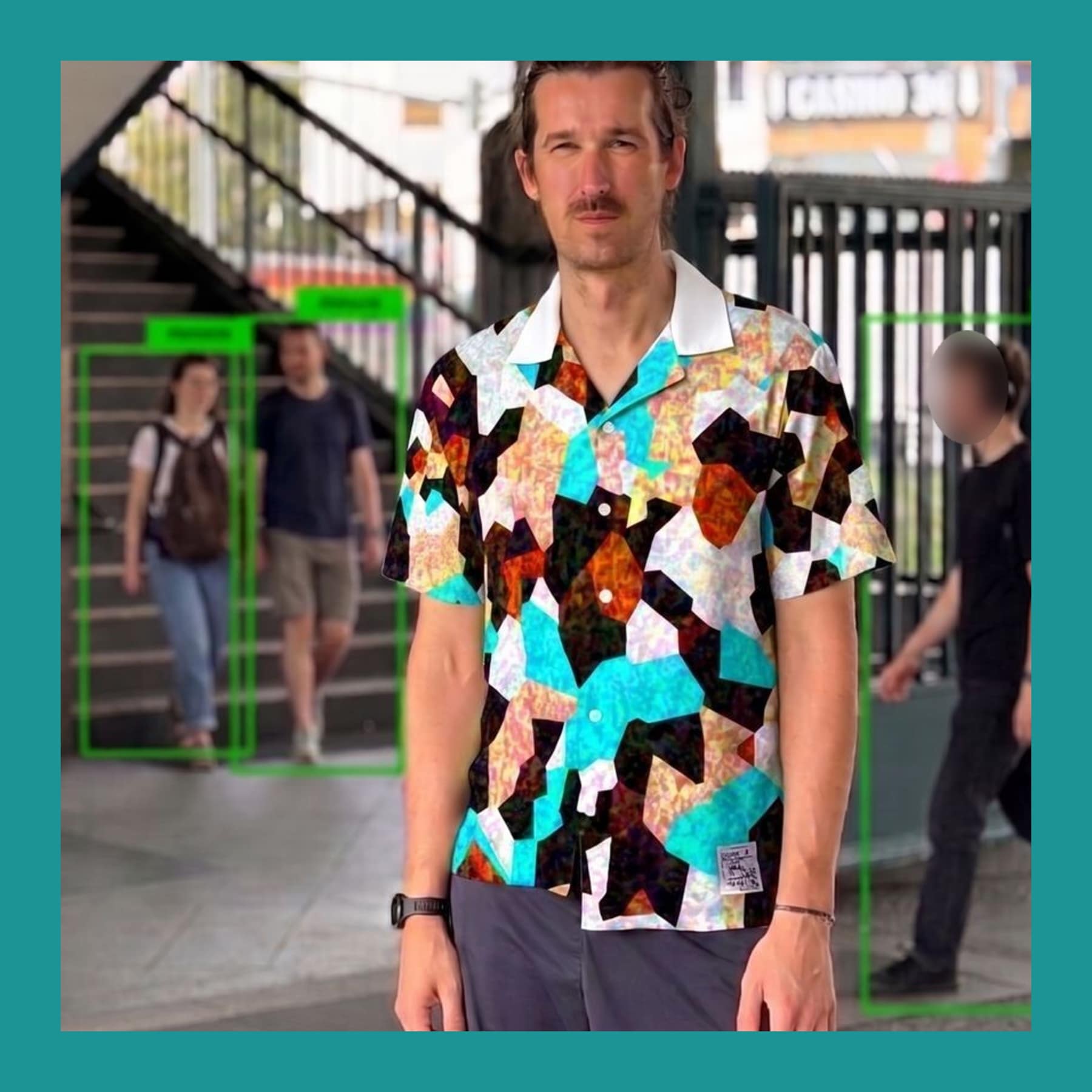
Digital Camouflage shirt, by Simon Weckert
Last updated: 16 September 2026
The Digital Camouflage shirt is a loose, oversized short-sleeved shirt printed with a pattern built to stop a computer noticing there is a person wearing it. Simon Weckert, the Berlin artist who makes it, says that in his own tests against YOLOv3 the wearer was often not registered as a person at all. It sells for £73.90, and shipping to a UK address adds £11.08. The shop bills in US dollars, so the basket reads $115 and shows roughly £84.98 beside it. Every figure here comes from the shop's own product, terms and returns pages, checked on 5 September 2026.
What the Digital Camouflage shirt is
The Digital Camouflage shirt is, first of all, a shirt. Camp collar, short sleeves, seven buttons, cut deliberately loose. The print runs edge to edge in turquoise, burnt orange, white and black, in hard-edged shapes that look hand-cut rather than drawn. Weckert sells three shirts and one coat under the Digital Camouflage name, and this is version 2.1 of the Digital Camouflage shirt.
The interesting part is what the print is for, which is not decoration. It is an attempt to break one specific piece of software. Weckert is straightforward about the limits of that, though. His own product page calls the whole thing an art project rather than a security product.
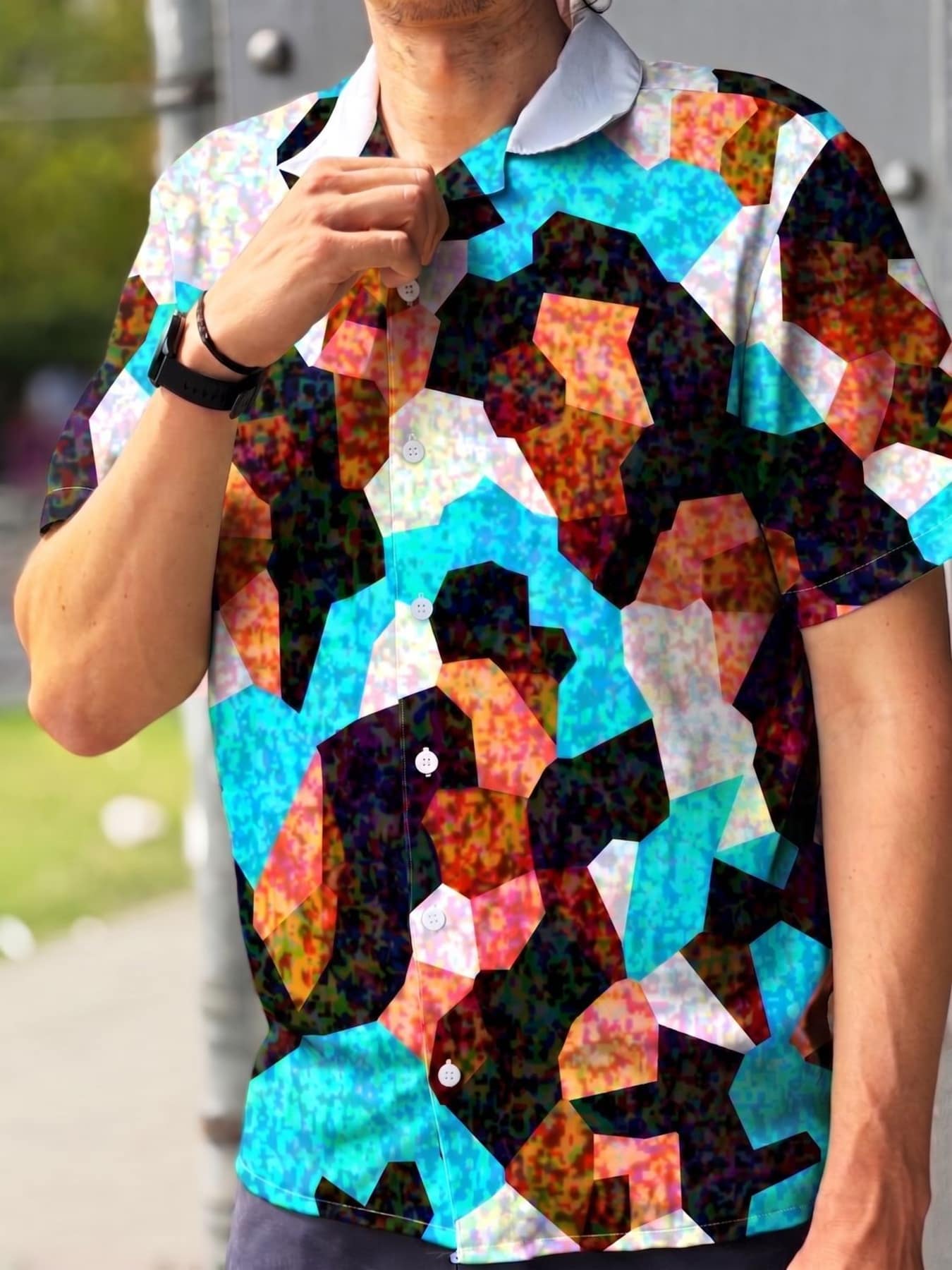
The pattern repeats across the seams, so the whole garment is the attack surface. Photograph: Digital Camouflage / Simon Weckert.
The Digital Camouflage shirt is printed on a cotton-like polyester at 100 g/m², so it hangs rather than holds a shape. It is breathable, moisture-wicking and rated UPF50+, which reads more like a summer shirt than an art object.
Sizes run XS to 3XL. Every shirt is printed to order, then shipped from whichever production site is nearest, so nothing sits in a warehouse waiting.
There is a small woven label at the hem carrying the project mark. Otherwise there is no branding on it at all.
An adversarial pattern is the opposite of camouflage
The Digital Camouflage shirt is not camouflage in the ordinary sense. Ordinary camouflage works by matching. It borrows the colours and shapes of the background, so a watching eye reads the wearer as more scenery. Olive, brown, grey, and outlines broken up until they stop looking like a body.
An adversarial pattern does the reverse. It adds visual information instead, deliberately, until a neural network stops being confident it is looking at a person. Below a certain confidence, the software simply does not report you. The result is a shirt nobody could miss and a detector that often does. That inversion is why this one is bright turquoise rather than olive drab.
The method underneath is published research. Weckert's pattern builds on Adversarial Texture for Fooling Person Detectors in the Physical World. Zhanhao Hu and five co-authors published it at CVPR 2022. Their technique, Toroidal-Cropping-based Expandable Generative Attack, produces a repeating texture rather than a single patch. Because it repeats, it survives folds, seams and a change of viewing angle. That is exactly where the earlier chest-patch attacks fell apart. Their own summary is blunt: printed onto clothes, it "could fool person detectors in the physical world".
What it was tested against, and what it does not touch
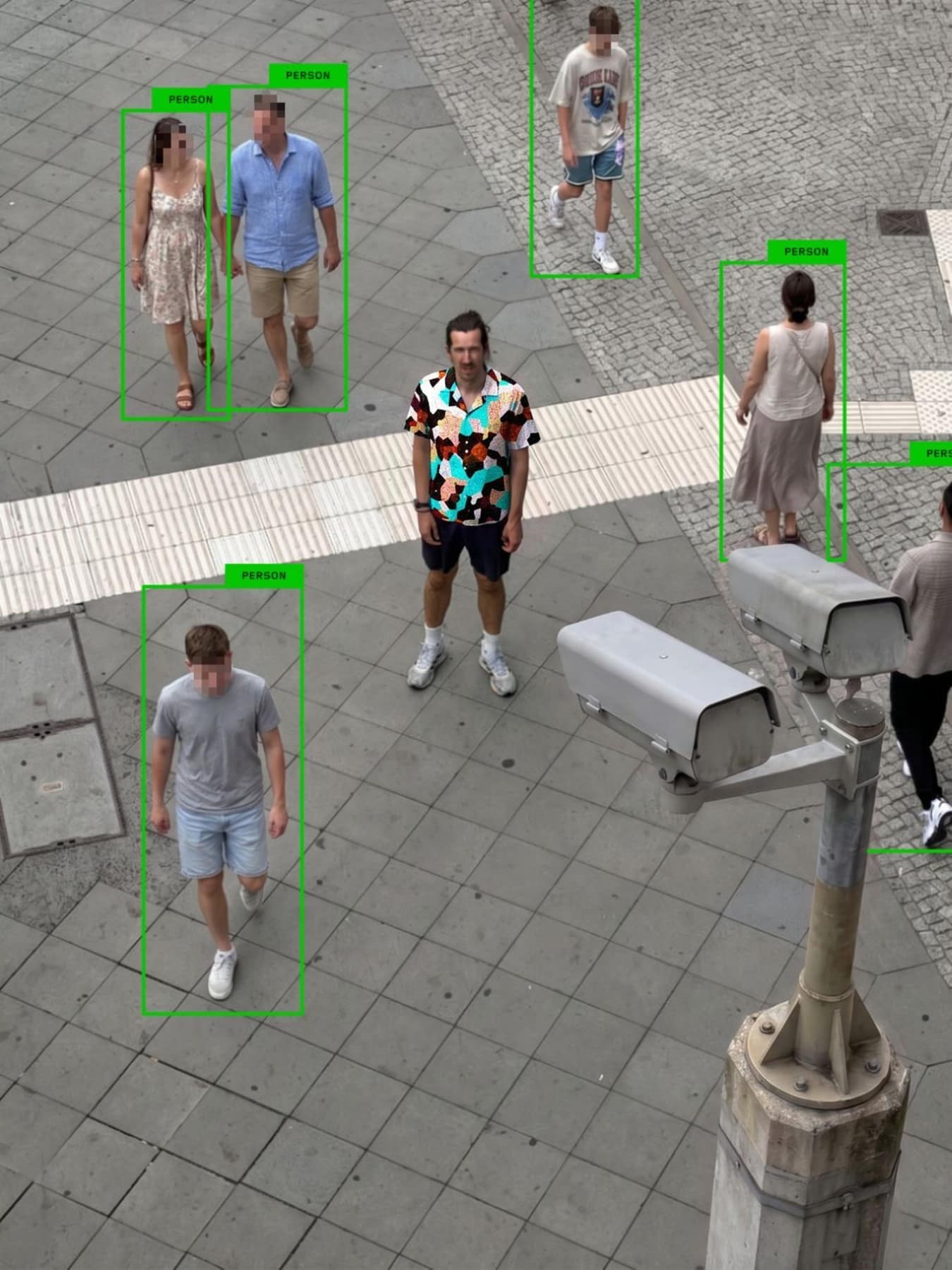
Five passers-by are boxed and labelled PERSON. The man in the middle is not. Photograph: Digital Camouflage / Simon Weckert.
The claim on the Digital Camouflage shirt's product page is narrow, so read it in its own terms. In tests with YOLOv3, it says, the wearer was frequently not identified as a person under the documented test conditions.
Note the three limits packed into that sentence. One named model. Frequently, not always. Under conditions the seller documented rather than conditions you will meet on a Tuesday in Hackney.
The terms go further and remove any promise at all. Weckert offers no assurance that the shirt makes anyone invisible to cameras. Nor does he claim it prevents, hinders or otherwise affects detection.
The Digital Camouflage shirt is not facial-recognition camouflage either, and Weckert says so directly. Person detection and face recognition are different steps. The first asks whether there is a human in the frame; the second asks which human. This shirt aims at the first question. A system that has already found you and is now matching your face is untouched by it.
One more limit sits in the terms. Detection models get retrained and replaced. So a pattern that worked against a 2018 model may do nothing against next year's. Weckert writes that into the contract rather than the marketing.
Kottbusser Tor, and why the shirt is set there

Kottbusser Tor, with a dome camera overhead. Photograph: Digital Camouflage / Simon Weckert.
Weckert photographs the Digital Camouflage shirt at Kottbusser Tor in Kreuzberg. Berlin police began installing around 30 AI-assisted cameras there on 18 August 2026. The city intends to extend the system to Warschauer Brücke and other sites next.
Officials describe it as behaviour analysis rather than facial recognition. The software turns people into stick figures and watches how they move. The police will not say which movements set off an alert.
Netzpolitik reported that the raw video is kept for up to a month, faces included, and that officers can pull it. So the line between watching behaviour and identifying people is thinner than the framing suggests.
Weckert has done this before, from the other direction. In 2020 he pulled 99 smartphones through Berlin in a handcart. Google Maps duly reported a traffic jam on streets that were empty. Google Maps Hacks fed a system false data, where the shirt withholds data from one. Six years apart, both ask how much these systems actually know.
Fabric, sizing and fit
The Digital Camouflage shirt's specification splits by where the order ships from, which is unusual enough to set out in full.
| Detail | Figure |
|---|---|
| Product | Digital Camouflage v2.1, oversized short-sleeved shirt |
| Price | £73.90, excluding shipping, in stock on 5 September 2026 |
| Sizes | XS, S, M, L, XL, 2XL, 3XL |
| Fabric, EU orders | 65% recycled polyester, 35% polyester, 100 g/m² |
| Fabric, US orders | 100% recycled polyester, 110 g/m² |
| Finish | Breathable, moisture-wicking, UPF50+ |
| Certification | OEKO-TEX STANDARD 100, certificate 24.HMX.84998 (Hohenstein Laboratories) and SH050 203996 (TESTEX AG); recycled content certified to the Global Recycled Standard |
| Made | To order. Weaving and dyeing in Mexico or China |
| Shipped from | Latvia or Mexico per the product page; the terms name Lithuania, Mexico and North America |
| Delivery estimate | 17 to 19 days |
| Sold by | Simon Weckert, Rödelwaldstr. 24, 09123 Chemnitz, Germany. VAT ID DE 356 320 285 |
Two things in that table do not agree with each other. The product page says the shirt is made in Mexico or Latvia. The terms say orders leave from Lithuania, Mexico or North America. Latvia and Lithuania are different countries, and only Weckert can say which is right. Everything else is consistent across both pages.
Sizing is published as flat measurements in inches. The three figures are half the chest width, the body length and the sleeve length.
| Size | Half chest | Length | Sleeve |
|---|---|---|---|
| XS | 21 1/4 in | 30 1/2 in | 10 1/4 in |
| S | 22 in | 30 7/8 in | 10 1/4 in |
| M | 22 3/4 in | 31 1/4 in | 10 1/4 in |
| L | 24 3/8 in | 32 1/8 in | 10 3/8 in |
| XL | 26 in | 32 7/8 in | 10 5/8 in |
| 2XL | 27 5/8 in | 33 3/4 in | 10 3/4 in |
| 3XL | 29 1/8 in | 35 in | 11 in |
The manufacturer's chart on the product page runs from 2XS to 6XL. The shop's own size menu stops at XS and 3XL. So four of the sizes printed on that chart cannot actually be ordered.
Because the print is polyester, the seller adds one line most makers leave out. This item releases plastic microfibres into the environment when washed. That is his wording, not ours. If synthetic fabric shipped from three continents is the part that bothers you, our post on UK-made clothing and why it matters argues the other side.
What the Digital Camouflage shirt costs in the UK
The Digital Camouflage shirt is priced in sterling on the page, but the shop does not bill in sterling. The terms state that all prices are final prices in US dollars, and that billing happens in dollars. So the pound figure on the page is the shop converting for display. Your own bank does the real conversion, at its own rate. It may add a non-sterling transaction fee on top.
| Line | Amount |
|---|---|
| Shirt | £73.90 |
| Shipping to a London address | £11.08 |
| Basket total as the shop shows it | $115.00, or about £84.98 |
| Customs duty | None. The consignment is under £135 |
| UK VAT | Nothing is added for it at the basket |
That last line needs a sentence of its own. Gov.uk's guidance on goods sent from abroad says customs duty does not apply to non-excise goods worth £135 or less. On purchases under that figure, it adds, the seller will have included VAT in the total you paid. This basket adds nothing for UK VAT. Meanwhile the terms put import charges, import VAT and customs handling fees squarely on the buyer. So budget for a bill on delivery rather than assuming there will not be one.
Delivery is estimated at 17 to 19 days. That is what made-to-order printing on another continent costs you in time. The other three items in the range price like this.
| Item | Price, excluding shipping |
|---|---|
| Digital Camouflage v1 | £56.90 |
| Digital Camouflage v2.1 | £73.90 |
| Digital Camouflage v2.2 | £73.90 |
| The Panopticon Chore Coat v1 | £176.61 |
Buy the Digital Camouflage shirt, £73.90
The warning, and where not to wear it
A printed safety notice ships with every order. The same text sits on the product page and in the terms. It is not boilerplate, and it should be read before anyone buys.
Art object, not a safety or protective product.
The pattern can affect automated recognition systems unpredictably, and in both directions. A system may detect you poorly, not at all, or incorrectly. Equally, the effect you expect may simply fail to appear.
So do not wear it anywhere automated person detection serves safety or triggers a protective function. Weckert names road traffic, driver-assistance and emergency braking systems, and autonomous vehicles. Then workplaces with machinery, robots or forklifts that detect people. Then automatic doors, gates and barriers. Then camera-based alarm, fall and drowning detection, people counting and evacuation systems. Finally search and rescue.
Never rely on the pattern working, or on it not working. His notice ends with the risk of serious or fatal injury.
The Digital Camouflage shirt's terms carry the commercial half of the same point. No effect against any recognition system forms part of the agreed quality of the goods. So an absent effect is not a defect, and it is not grounds for a return.
On UK law, briefly, and this is not legal advice. There is no general offence here of wearing a garment with a pattern on it, and this shirt does not cover the face. The nearest rule is section 60AA of the Criminal Justice and Public Order Act 1994. It lets an officer require removal of an item worn wholly or mainly to conceal identity. Even then, a senior officer has to have authorised it for that locality first.
Returns, copyright and the small print
The withdrawal position on the Digital Camouflage shirt has a wrinkle. The site advertises a 14-day withdrawal period from delivery. The returns page then sets out the full statutory 14 days without conditions. The terms, though, also invoke the made-to-order exception, which removes the right for goods produced to a customer's own specification. Those two readings pull against each other. So treat the stated right as 14 days, and confirm it with Weckert before ordering rather than after.
Return postage is yours either way. Returns go to Simon Weckert, Tempelhofer Ufer 10, 10963 Berlin. Because the UK is outside the EU, the returns page adds a second cost. You also carry any customs charges, taxes and import fees raised on the parcel's way back to Germany. It asks you to mark the package clearly as returned goods, so that it does not stall at the border.
The purchase covers the garment and nothing else. The pattern stays Weckert's copyright, so you may not reproduce it, transfer it onto other objects, distribute it digitally or exploit it commercially. Exhibition and press licensing goes through him.
Two more things sit in the small print. German law governs the contract, with Chemnitz as the venue for business buyers. Weckert also states that he is neither obliged nor willing to take part in consumer dispute-resolution proceedings. That removes the arbitration route a UK buyer might otherwise reach for.
Digital Camouflage shirt FAQs
Does the Digital Camouflage shirt actually work?
Weckert says that in his own tests against YOLOv3, the wearer was frequently not identified as a person. That is the whole of the claim. His terms then promise no effect at all. Whether a pattern affects a given system depends on the model, the distance, the angle and the light. So treat it as an art project that sometimes does something, rather than as a device.
Does it stop facial recognition?
No, and the seller does not say it does. Person detection and face recognition are separate steps, and the pattern aims at the first one. A system that has already found you and is matching your face is unaffected.
Is it legal to wear in the UK?
There is no general UK offence of wearing a patterned shirt, and this one does not cover the face. Section 60AA of the Criminal Justice and Public Order Act 1994 lets a constable require removal of an item worn wholly or mainly to conceal identity. That power needs a prior authorisation for a specific locality, though. This is general information rather than legal advice.
How much does it cost delivered to the UK, and will there be customs to pay?
£73.90 for the shirt and £11.08 for shipping, which the shop totals as $115.00 or roughly £84.98. Customs duty does not apply below £135. Nothing is added for UK VAT at the basket, though, and the terms make import charges the buyer's responsibility. So allow for import VAT and a courier handling fee on delivery.
What sizes does it come in?
XS to 3XL. The measurement chart on the page runs 2XS to 6XL, but the ordering menu does not, so four of those sizes cannot be bought. Measurements are published in inches as half chest, length and sleeve.
What is it made of?
Orders shipped within the EU are 65% recycled polyester and 35% polyester at 100 g/m². Orders shipped in the US are 100% recycled polyester at 110 g/m². Both are OEKO-TEX STANDARD 100 certified, and the recycled content is certified to the Global Recycled Standard.
Can I wash it normally?
Weckert publishes no full care label. His terms do name washing too hot, tumble drying and ironing over the print as misuse that voids a complaint. So a cool wash, no dryer, and no iron on the pattern. He also states that the shirt releases plastic microfibres when washed, which is what polyester does.
Is it the same as CV dazzle makeup?
No. CV dazzle uses hair and makeup to break up the facial features an algorithm looks for, so it targets the face. This shirt targets the earlier question of whether a person is there at all. It also uses a published texture rather than a styling technique.
What else does Simon Weckert sell?
Three shirts and one coat. Digital Camouflage v1 is £56.90, v2.1 and v2.2 are £73.90 each, and The Panopticon Chore Coat v1 is £176.61. He is better known for Google Maps Hacks. In that 2020 piece, 99 phones in a handcart produced a traffic jam on Google Maps that did not exist.
More from CoolCuration
- Brave: the browser that blocks the trackers following you between sites, with the settings worth changing.
- Darren Cullen protest mug: another object that argues with something, this time over breakfast.
- Gifts for techies: the full guide, for anyone who will ask how the pattern was generated.
- Susan Kare Happy Macintosh print: computing history on the wall, from the designer who drew the icons.
- LOOW t-shirt: a plainer shirt, for days when you would rather not have a conversation about it.
- Gifts for designers: presents chosen for people who notice how things are made.
Prices, stock, shipping and terms change. Everything here was checked on 5 September 2026. The sources are Simon Weckert's own product, terms and returns pages, the CVPR 2022 paper behind the pattern, and gov.uk's guidance on goods sent from abroad.
More things like this:








Follow us: Instagram
Copyright 2026 CoolCuration | Privacy Policy | Cookie Policy | Affiliate Disclosure | Cool Factor
-----------
We are proud supporters of a safer more private internet via encouraging people to use Brave browser and are actively taking on Spammers as part of ProjectHoneypot. This site is hosted on servers that run on 100% renewable energy in the UK thanks to GreenWebHosting.
This site contains affiliate links, including to Amazon.com and Amazon.co.uk. We may earn a commission if you make a purchase or sign up for a service via these links, at no extra cost to you. All offers and promotions are accurate at the time of publication but are subject to change or withdrawal by the businesses featured. We cannot guarantee their continued availability. Read our full affiliate disclosure.
Reviews and opinions on CoolCuration reflect the personal experience of our writers at the time of publication. They are not professional endorsements and your experience may differ. Scores use our Cool Factor rating system and are given independently of any commercial relationship.
All content on CoolCuration is provided for informational and entertainment purposes only. It does not constitute financial advice, investment recommendations or an endorsement of any product or service. We are not authorised by the Financial Conduct Authority and do not offer personalised financial guidance. You should always do your own research or consult a qualified financial advisor before making any financial decisions.