
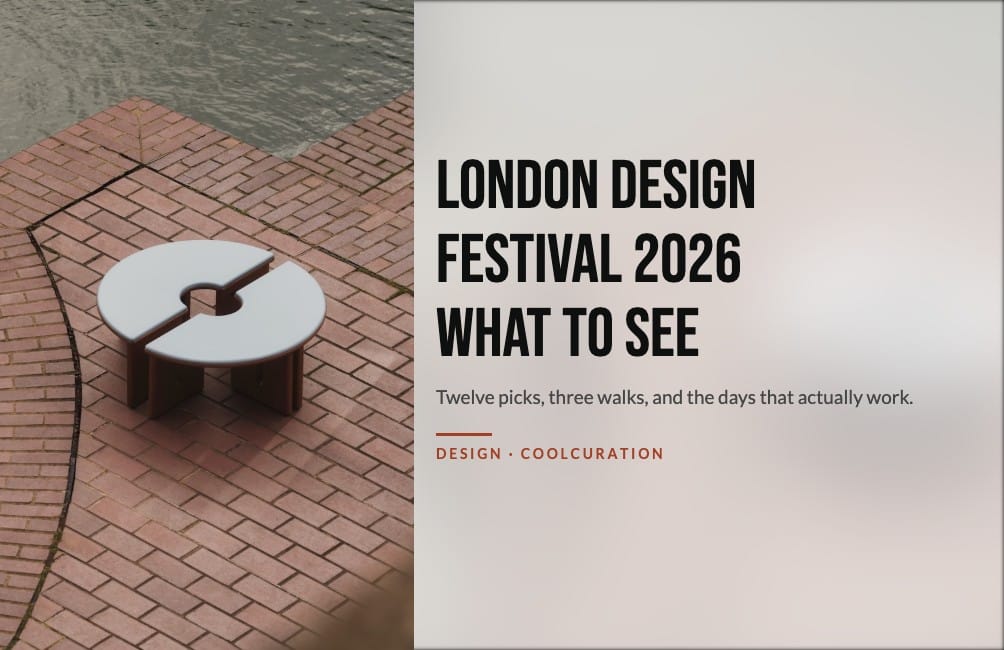
Last updated: 15 September 2026. London Design Festival 2026 runs from Saturday 12 to Sunday 20 September, and I checked every date, opening time and price below against the venue's own listing on 4 September 2026.
By Tristan · Arts, exhibitions and creative culture
This article contains affiliate or referral links. If you click through and sign up I may earn a commission or referral bonus at no extra cost to you. It does not affect my editorial view. Nothing here is financial advice, and opening times and prices move, so check the venue before you travel.
Coming into London for it?
A railcard takes a third off most UK rail fares for a year, and my railcard page has the current TrainPal new-customer discount and the steps to claim it.
One day gets you eight of the nine. It is a Monday.
London Design Festival 2026 is the 24th edition. It runs from Saturday 12 to Sunday 20 September across eleven design districts, and almost all of it costs nothing. So I put the nine headline things side by side and read the dates properly. Two of them have not opened by the first Saturday. Two more have finished before the last one starts.
Eleven picks, and where they are
Ten of those eleven cost nothing. Only the Design Museum's NIGO show charges, and two of the free ones still want you to book a seat first. I have grouped them by where they are rather than by what they are, so that you can walk between them.
Update, 15 September: I have removed The Speaking Oasis from this guide. London Design Festival took its listing down before the festival opened and it has not reappeared, and The Lavery lists nothing either.
Section 01 / South Kensington
Three things inside one museum
All three sit inside the V&A, so you can do them in one visit without crossing a road. If you only have a morning, spend it here.

Fushi, Mino Yaki x David Caon. Photo: Masayuki Hayashi
Craft x Tech Tokai Project
Six Japanese artisans from the Tokai region, six international designers, six new pieces. Yohei Ito of Fudogama built the modular ceramic console Fushi with the Australian designer David Caon. Hiroyuki Murase of Suzusan made illuminated works with Bethan Laura Wood out of Arimatsu Narumi Shibori. Shigeyuki Ando worked with Philippe Malouin on cloisonne. Takanori Senda reinterpreted the shoji screen in Mino Washi paper with Lanzavecchia + Wai.
Six artisans, six designers, six objects, one room
The room is Medieval & Renaissance 64b, the Simon Sainsbury Gallery, which is a long way from the Cromwell Road doors. Then again, the V&A gives you a map. My one warning: this is six pieces in a single room, so it will not fill an afternoon on its own.
Free, no ticket. 12 to 20 September, 10:00 to 17:45, and until 22:00 on Friday 18

your golf course made my GPU, by Sam Ghantous. Image credit: YveYANG Gallery
V&A x LDF26: Awakenings
Ten works dropped into the permanent galleries, co-curated by Carrie Chan and Kristian Volsing. Albert Yonathan Setyawan's Metamorphic Modulation uses over 700 clay pieces. He modelled them by hand, slip-cast them in red terracotta and left them unglazed. Andre Williams has put a longcase clock and encased speakers in the mirrored 18th century room in Europe 1600 to 1800. They play his own mixtapes through the day. Aziza Kadyri answers the V&A's suzani collection with hand embroidery. A bespoke AI model invented the motifs, then artisans in Nurota, Uzbekistan stitched them.
Playfool, this year's V&A Emerging Design Commission, built a piece about the one museum job automation has not taken: cleaning. Linda Dounia Rebeiz shows 50 invented flower species in the Learning Centre. Sam Ghantous follows sand from the ground into a graphics card.
Because it is scattered rather than gathered, you will walk. Most of these stay up until 18 October, though, so this is the part of the festival you can come back for.
Free. 12 September to 18 October

The Global Design Forum at the V&A in a previous year. Image: London Design Festival
Global Design Forum
Three days of talks in the V&A's Lydia and Manfred Gorvy Lecture Theatre. Rhiarna Dhaliwal guest-curates this year, under the title Worlds in Motion. Saturday is Designing Futures and opens with Es Devlin CBE in conversation with the festival's director Ben Evans CBE. Sunday is Designing Atmospheres. It pairs the Bowmore master blender Dr Calum Fraser with Alex Mustonen of Snarkitecture, and it opens with a whisky tasting. Monday is Designing Common Grounds, with Yang Lan of Sun Media Group and Natalie Melton of the Crafts Council.
The talks are free but you need a ticket, and they are the reason the opening weekend still earns your time. Even so, the whole forum has finished by Monday evening. Come on Thursday and you have missed it entirely.
The festival also named its 2026 London Design Medal winners ahead of the opening weekend: Jonathan Anderson takes the London Design Medal, Sir Christopher Frayling the Lifetime Achievement Medal, Anab Jain the Design Innovation Medal and Solveiga Pakštaitė the Emerging Design Medal.
Free, ticket required. 12 to 14 September only
Section 02 / Kensington High Street
The Design Museum, and the day it shuts
Two shows in one building, one of them the only pick here you pay for. Check the date before you go, because the museum closes to the public all day on Friday 18 September.

NIGO photographed at the Design Museum. Photo: Elliot James Kennedy
NIGO: From Japan with Love
Over 700 objects tracing thirty years from A Bathing Ape in Harajuku to the artistic directorship of KENZO. The museum has recreated NIGO's teenage bedroom. There is also a life-size glass tea house built for the show, plus ceramics he threw himself. The festival bills this as the world's first retrospective on him. The museum's own wording is narrower and more accurate: the first museum retrospective outside Japan, and his first UK exhibition.
It runs until 4 October, so it outlasts the festival by a fortnight. That is worth knowing, because at £15.29 for an adult it is the one pick here that competes with everything else for your money.
Adult from £15.29, child from £7.65, student and concession from £11.47. Until 4 October

Negress chaise lounge by Simone Brewster, NOW Gallery 2023. Photo: Charles Emerson
PLATFORM: Simone Brewster
Brewster's first museum show, wrapped around the four walls of Level 1, and free. It runs in four parts: Passages, Everyday Ornaments, Scales of Emotion and Body Narratives. Expect painted studies of the female form, jewellery from her Ebony Revolution series and stepping stools in ebonised tulipwood. A 2.5 metre pillar first shown at London Design Festival 2023 stands with them. The new piece is a bench called Negrita.
Two dates to know if you want more than the display. Hadeel Eltayeb, who curated it, gives a guided tour on Saturday 12 September. Then on 15 September Brewster joins Laxmi Hussein, Emefa Cole and Hettie Judah for a talk on design practice and motherhood, chaired by the museum's Danielle Thom.
Since it stays up until January 2027, this is the one thing here you can safely postpone.
Free. Until January 2027
The talks end on the Monday. Somerset House opens on the Wednesday. There is no day that gives you both.Global Design Forum, 12 to 14 Sept. Reviving Craft, from 16 Sept
Section 03 / The Strand and the City
One walk, four stops, ends late
Strand Aldwych and Somerset House share a pavement. St Paul's is up the road and stays lit until ten. The Barbican is open until eleven.

Presentation drawing of The Pangolin Shield by Studio Saar and Atelier One, supported by Secure
06 Landmark ProjectThe Pangolin Shield
Studio Saar and the engineers Atelier One have built a bamboo grid shell. Then they layered it, like a pangolin's scales, with two things that were never meant to meet. One is the cane and bamboo riot shield carried by Indian police. The other is the knup, the woven rain shield that farmers in north-eastern India wear on their backs. Stack them together and the shields stop being about confrontation and start being a roof.
Riot shields and farmers' rain shields, stacked into a roof
The bamboo came from Meghalaya, Punjab and Karnataka. The site is not an accident either: Strand Aldwych is the pedestrianised space behind the Indian High Commission, near the bust of Jawaharlal Nehru. So the pavilion argues about colonial legacies while standing in the middle of them.
It is outdoors and unstaffed. You can turn up at any hour of any festival day. But the weather is the experience, and there is nowhere to shelter except under the thing itself.
Free, no ticket. 12 to 20 September, all day

Symbiosis of Chrysanthemums II by Huang Lu, part of Reviving Craft: Reflection of the Mind
Reviving Craft: Reflection of the Mind
More than 60 artisans and designers fill the Embankment Galleries. Su Dan of the Chinese Traditional Culture Museum curates it with Yang Lan of Sun Media Group. The show runs in three parts: Clear the Mind, Nourish the Mind and Refine the Mind. Its argument is that an object carries the inner life of whoever made it.
Rosalie Huang's Ming Yellow embroidered wedding dress took 25 craftspeople and 36,435 hours. Yao Jianpin's four-panel screen uses Suzhou embroidery. He Hongbing weaves bamboo jars, Wang Huaiqing rebuilds a red-lacquered Chinese gate, and Chen Qingqing spins a garment out of ramie fibre. Huang Lu, who works in up-cycled materials, shows Symbiosis of Chrysanthemums II.
It opens on Wednesday 16 September, five days into a nine-day festival, and then runs on until 27 September. Half the people planning a festival day will therefore miss it, and the other half can see it after everything else has packed up.
Free, no ticket. 16 September 11:00 to 16:00, then 17 to 27 September 11:00 to 18:00

Visualisation of Soul at St Paul's Cathedral, by Mykola Kabluka, produced by Expolight. Visualisation: Expolight
08 Landmark ProjectThe Point of Unity and Soul
Two works by Mykola Kabluka, the Ukrainian lighting designer who founded Expolight. The Point of Unity is a mirrored light sculpture carrying 3,500 fibre-optic points, making its UK debut after Burning Man last year. By day it reflects the sky. At night the fibre optics turn it into a field of stars, with a soundtrack built from astronomical data. Soul is the other half, an audiovisual work thrown onto the cathedral facade in the evenings. Its imagery does not exist in advance. It emerges through light, glass and movement, so no composition repeats.
Kabluka made both while Russia's war against Ukraine continues. Neither depicts it. Both ask how you keep your own light in the dark. There has been a cathedral on that site for more than 1,400 years, so the building has heard the question before.
A mirrored sculpture carrying 3,500 fibre-optic points
The festival lists it as free with no ticket. That is not the same as free entry to St Paul's, because the cathedral's own sightseeing ticket is a separate £27 for an adult and £10.50 for a child, Monday to Saturday. And the installation is dark on 12 and 13 September, the first two days of the festival. The festival published the times on 10 September, and they run well past the festival itself: Soul is projected onto the facade from 20:00 to 23:00 every night from 14 to 27 September, while The Point of Unity opens on 16 September from 13:00 and then runs 10:00 to 23:00 daily from 17 to 26 September.
Free, no ticket. Soul 14 to 27 September, 20:00 to 23:00. The Point of Unity from 16 September, 10:00 to 23:00 until 26 September

The MADE x Barbican collection. Photo: Felix Speller
MADE x Barbican
MADE went into the Barbican Archive and came out with a 23-piece collection of furniture, lighting, textiles and accessories. The research leans on Miriam Howitt, the designer whose work shaped the estate's residential interiors. In the Level G Hub Space the archive imagery hangs next to the objects it produced.
It is a product launch as much as an exhibition, and the collection is on sale at MADE.COM. If the estate itself is the draw rather than the sofas, my page on the Barbican Cross Section art print covers the £12 version you can take home.
It has the longest opening hours of any pick here. Level G runs from eight in the morning until eleven at night, every day of the festival, so this is the one you can bolt onto the end of a long day.
Free, no ticket. 12 to 20 September, 08:00 to 23:00
Section 04 / East
Wapping and Shoreditch, on their own clocks
Both sit well east of everything else, and neither runs on the same dates as the rest of the festival. Read the days twice.

Max Cooper in his studio. Image: Ella Mitchell
10 Special ProjectThe Art of Sound
Wapping Hydraulic Power Station was built in 1890 and has been shut to the public for thirteen years. It reopens for five days, under the Glass Castle Foundation, filled with spatial audio by L-Acoustics.
Max Cooper's Feeling is Structure runs twenty minutes and began life as a live commission for the Royal Albert Hall. Rebuilt as an installation, it stops being a piece you listen to and becomes a room you stand inside. Chris Watson's Trent Falls takes the other approach entirely. It is a journey down the Humber estuary, from the reeds and bitterns of Faxfleet to the seals at Spurn Point. On the way it passes under the Humber bridge and through Hull Fair and a Hull Kingston Rovers home crowd. Works by Hollie Buhagiar and Helen Lyon, made with the Alliance for Women Film Composers, appear through the programme.
Closed to the public for thirteen years, open for five days
So book. It is free, but the ticket is not optional, and it finishes on 15 September. Go looking for it on the closing weekend and you will find a locked door.
Free, ticket required. 11 September 10:00 to 16:00, then 12 to 15 September 10:15 to 17:30
Shoreditch Design Week
The festival's largest official district, grown out of the old Shoreditch Design Triangle, covering more than 60 showrooms, galleries and studios.
Four curated exhibitions sit at the centre of it and they run for three days only, from 15 to 17 September. House of ICON takes interiors. OnOffice curates Design at Work around the workplace. Material Matters covers materials, and ND Selects brings New Designers' pick of businesses one to five years old. Neuroplaces, a conference on neuroinclusive and accessible design, joins Design at Work at Protein Studios. AHEC brings its Wood for the Trees show over too.
This is the trade-led end of the festival, so expect showrooms and product launches rather than art. Visitors register for a free badge. Also note the dates: the district opens three days after the festival does, and its four anchor exhibitions are gone again by Thursday.
Free, register for a badge. 15 to 20 September, exhibitions 15 to 17 September
Which day of London Design Festival 2026 to pick
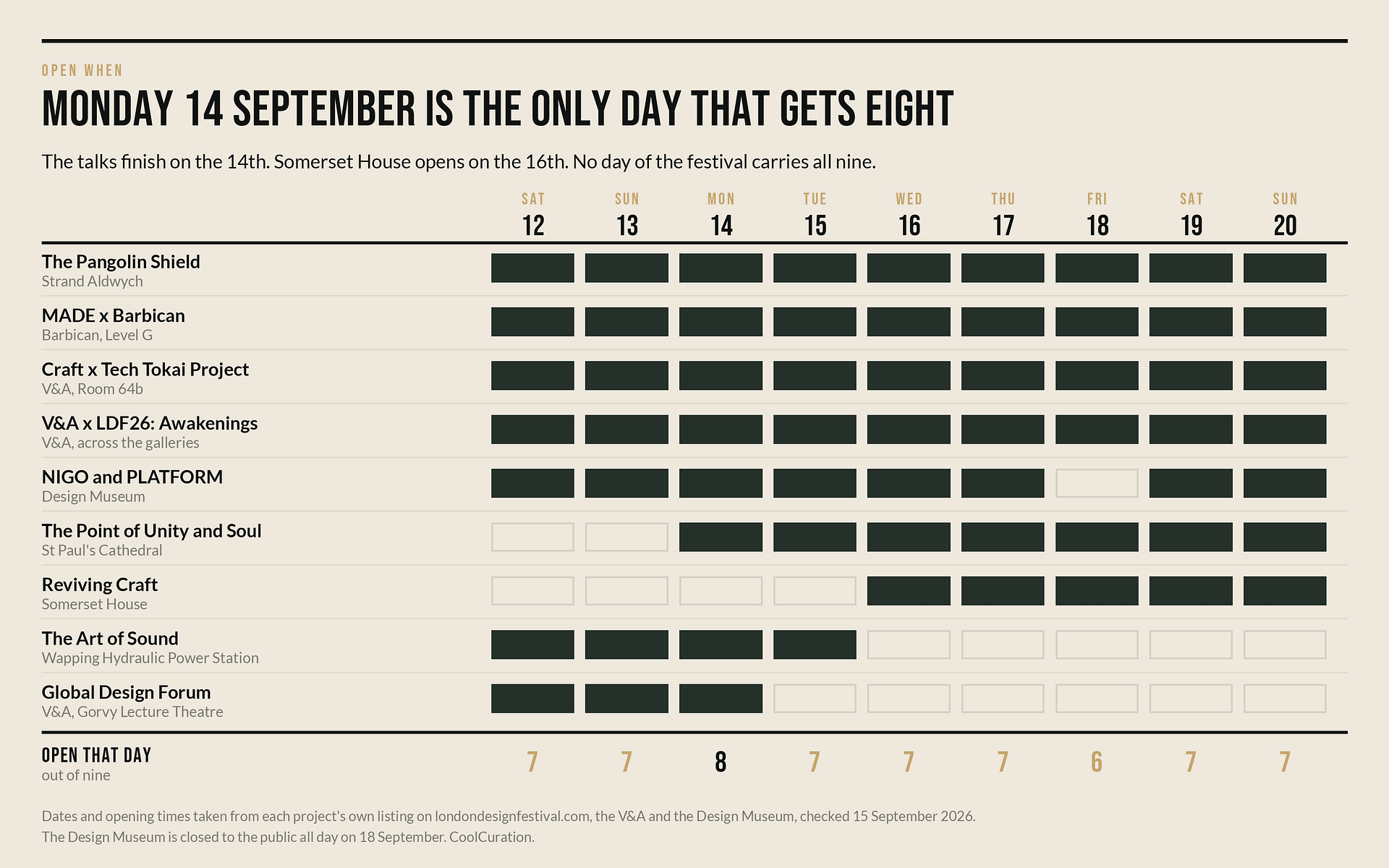
I put all nine headline things on that grid and counted what is open on each of the nine days. Monday 14 September is the only day that gets to eight out of nine. On that Monday the Global Design Forum is still running. St Paul's has just opened, and the Wapping sound piece has not yet closed. The only thing missing is Somerset House.
The opening weekend is thinner than it looks, at seven of nine, because St Paul's and Somerset House are both still dark. It does hold the Es Devlin keynote, though, so it is not a wasted trip. Friday 18 September is the weakest day of all, at six, because that is the one date the Design Museum shuts completely.
If you can only do a weekend, the two now tie on count. Saturday 19 and Sunday 20 also reach seven. However, they swap the talks and the Wapping sound piece for St Paul's and Somerset House. They also add the V&A's Digital Design Weekend. So take the second one, unless the talks are what you came for.
The District Days, which decide the other half
Each of the eleven districts picks one day to concentrate its programme, with late openings and a fuller schedule. So the day you choose also chooses which part of London you get.
| Date | District Day |
|---|---|
| Sat 12 Sept | Park Royal, for the first Manufactory festival across its warehouses and studios |
| Mon 14 Sept | Mayfair |
| Tue 15 Sept | Shoreditch Design Week |
| Wed 16 Sept | Bankside, Fleet Street Quarter and Soho, the new eleventh district |
| Thu 17 Sept | Brompton, Chelsea and EC1 |
| Sat 19 Sept | Blackhorse Creates and Dalston to Stokey |
Wednesday and Thursday are therefore the two busiest days on the district map, with three districts each. Alex Tieghi-Walker curates Brompton this year, under the title Perfectly Imperfect, across twelve exhibitions. It also happens to sit on top of the V&A cluster. If you want one day that combines a district and the picks above, Thursday 17 is the strongest pairing.
Three walks that actually work
Each of these is half a day. None of them needs a car and only one needs a booking.
The South Kensington morning
Start at the V&A on Cromwell Road. Do Room 64b for Craft x Tech first, because it is the furthest from the entrance and the easiest to run out of energy for. Then pick up the Awakenings works on the way back through the galleries. If you are here on the 12th, 13th or 14th, book a Global Design Forum talk and build the morning around it.
The Strand to the City afternoon
Strand Aldwych for the Pangolin Shield, then Somerset House next door if it is the 16th or later. Walk or take the Central line east to St Paul's, which stays lit until ten. Then head north to the Barbican, open until eleven. That order matters: both of the late venues are at the end, so you are not racing a closing time.
The east day
Wapping first, with a ticket booked. It is the only fixed appointment here and it closes at 17:30. Then north to Shoreditch, which runs into the evening and keeps its four exhibitions inside one district. Shoreditch opens on 15 September and Wapping closes on 15 September, so there is exactly one day when you can do both, and it is Tuesday.
What it costs, honestly
Ten of my eleven picks are free. The exception is NIGO at the Design Museum, from £15.29 for an adult. Two of the free ones need a ticket in advance: the Global Design Forum and The Art of Sound. Shoreditch Design Week wants a visitor badge, which is also free.
The festival's own listing makes the St Paul's installation free. The cathedral's ordinary sightseeing ticket still costs £27 for an adult, so do not arrive expecting the building thrown in. V&A admission is free anyway. That is why my guide to V&A Membership spends its time on what membership buys you beyond a free door.
If a festival day turns into a shopping day, my gift guide for designers is the sensible place to spend instead of the museum shop.
Where this guide stops
I have not seen any of it. The festival is running now. So everything above comes from the venues' own listings, the two press releases London Design Festival put out on 19 and 27 August, and the museums' own pages. It is not a review and I have not stood in any of these rooms.
Two of my picks can only be pictured as a visualisation or a presentation drawing, because the works were not built when I wrote this. Every caption says which. Expect the finished pieces to look different from the drawings, particularly the two at St Paul's.
Eleven picks does not cover the festival either. It lists hundreds of events across eleven districts and I have taken the headline programme plus two museums. Whole districts get a single line here, which is unfair to them.
Finally, opening times change. Nobody had published the projection times for Soul when I checked on 4 September. The V&A and the festival also give different end dates for Craft x Tech. The V&A says 20 September; the festival lists extra dates from 24 to 30 September. Check the venue on the morning you travel.
Getting there
Everything in sections 01 to 03 sits inside Zone 1 and most of it is walkable in pairs. Wapping Hydraulic Power Station is the outlier, on Wapping Wall, and the Overground to Wapping is the sane route. Shoreditch is Old Street or Shoreditch High Street.
Travelling into London for it? A railcard takes a third off most UK fares for a year, and it pays for itself in about two return journeys. My railcard discount code page has the current TrainPal new-customer offer and how to claim it.
London Design Festival 2026 FAQs
When is London Design Festival 2026?
Saturday 12 to Sunday 20 September 2026. It is the 24th edition and it runs across eleven design districts. Six of the individual projects run on past the 20th, and two of them start late.
Is London Design Festival free?
Mostly, yes. Ten of the eleven picks here cost nothing. That includes both Landmark Projects, everything at the V&A and the Global Design Forum talks. Only NIGO at the Design Museum charges, from £15.29 for an adult.
Which day should I go?
Monday 14 September, if the choice is free. Eight of the nine headline things are open that day and only Somerset House is missing. If you need a weekend, the second one edges it.
Do I need to book anything?
Three things. The Global Design Forum talks are free but ticketed. The Art of Sound at Wapping is free but ticketed. Shoreditch Design Week asks visitors to register for a free badge. Everything else here is walk-in.
Where are the Landmark Projects this year?
There are two. The Pangolin Shield by Studio Saar and Atelier One is on Strand Aldwych. The Point of Unity and Soul by Mykola Kabluka are at St Paul's Cathedral.
Is the Design Museum open during the festival?
Yes, apart from Friday 18 September, when it closes to the public all day. Normal hours are 10:00 to 17:00 Monday to Thursday and 10:00 to 18:00 Friday to Sunday.
What is on at the V&A for London Design Festival 2026?
Three things at once. Awakenings puts ten new works through the permanent galleries until 18 October. Craft x Tech Tokai Project takes Room 64b, and the Global Design Forum runs in the Gorvy Lecture Theatre from 12 to 14 September. The Friday Late on 18 September previews the Digital Design Weekend, which runs on 19 and 20 September.
More from CoolCuration
- Gifts for artists and creatives: what to buy the person whose flat is already full of prints.
- Projecting British Design: the book on how British design got sold to the rest of the world.
- V&A East review: what the newest V&A building is actually like to walk around.
- Anglepoise Paul Smith edition: every colourway and the current UK prices for the design classic.
- theprintspace discount code: 50 percent off your first order if the festival leaves you wanting to print your own work.
- Margaret Calvert: Woman at Work: the designer behind every British road sign you have ever read.
What's trending




Recent posts
- Best Audiobooks October 2026: 10 UK Listens Ranked
 Ten new audiobooks for October 2026, from a full-cast Dracula with Jonathan Bailey to Russell T Davies reading his own television memoir.
 - Louis Fratino at David Zwirner ReviewLast updated: 4 October 2026 By Tristan · Arts, exhibitions and creative culture This is an opinion piece. Views expressed are the author's own and do not constitute professional advice. Exhibition reviewMayfair Saunas, subway cars and a lot of skin in Mayfair Louis Fratino at Zwirner is the American painter's first solo show in London,… Read more: Louis Fratino at David Zwirner Review
- What Is a Sprive Boost? Seven Days, and What It Actually PaysA Sprive boost lifts your cashback rate for seven days, and it arrives on its own. What mine paid, and why Supercharge is a display toggle rather than extra cashback.

No Comments.