
Last updated: 29 September 2026
By Stiv · Design, technology and personal finance
A keyboard that thinks it is a design object. Mostly, it is right.
This Work Louder Knob1 review comes from my own desk, not a spec sheet. I imported one. I have typed on it daily. I have also paired it with my Figma Creator Micro as one setup. So this is real use, warts and all.
This is an opinion piece. Views expressed are the author's own and do not constitute professional advice.
Cool Factor: 4/5
In short, the Work Louder Knob1 is one of the most beautiful bits of kit I own. However, it is also one of the most expensive, and a couple of choices stop it short of perfect. Let me explain.
What is the Work Louder Knob1?
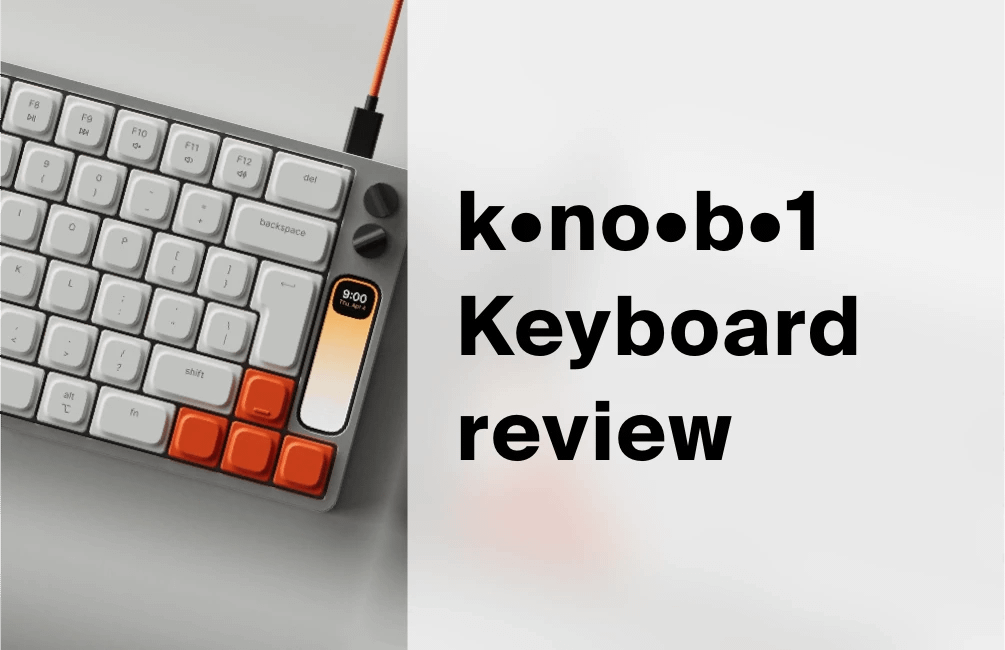
First, the basics. The Knob1 is a low-profile mechanical keyboard. It has a small vertical screen on the right edge and two rotary dials up top. Work Louder calls it 'the low-profile mechanical keyboard of your dreams'. For a certain kind of person, that is fair.
Underneath, it is properly specced. The strip display is a 100 x 310 pixel IPS TFT panel in full colour. Above it sit two rotary encoders, the 'knobs' in the name. Meanwhile the switches are Work Louder's own low-profile design. They are a 55g silent linear with a regular MX stem, and they are hot-swappable. So you can pull and replace them without a soldering iron.
It was designed by 3D artist and motion designer Ben Fryc and developed by Work Louder Inc. You customise everything through Work Louder's Input keymap tool. Connection is USB-C or Bluetooth Low Energy, and it works with Mac, iOS, Windows and Android. As a result, this Work Louder Knob1 review applies whether you are on a MacBook or a PC.
Work Louder, and where it sits
Now for context. Work Louder built its name on the Creator Micro, a compact macropad aimed at editors and designers. The Knob1 is its first full keyboard, so it matters to the brand.
It reminds me of Logitech's colourful Pop range from the late 2010s. Yet Work Louder takes the quality to a completely different level. The best way I can describe it is this.
Like if Teenage Engineering made a keyboard.
That places it firmly in the custom-keyboard world, near the likes of Keychron and Nuphy. Even so, it has a bolder, more art-directed streak. Furthermore, Work Louder runs a designer profit-share programme, Wrk.shop, and ships worldwide with EU GPSR compliance. In other words, this is a small studio behaving like a serious hardware brand.
First impressions and unboxing
Straight away, the details set the tone. In the box you get the Knob1, a braided USB-C cable, and two spare dials with a key puller. The braided cable is a small thing, yet it signals care.
The shells are the star. The top enclosure is CNC aluminium in anodised silver, while the bottom is CNC aluminium in gun metal. My unit pairs grey keycaps with orange esc and modifier keys. As a result, it looks like studio equipment rather than an office accessory. Underneath, the rubberised feet are magnetically detachable, which is a very satisfying touch. Then the strip screen wakes up with the time, and the whole thing feels alive.
Build quality and physical engineering
This is where the Knob1 earns its keep. In fact, for this Work Louder Knob1 review, the build is the part I trust most. The physical engineering is exceptional, and the build quality is fun. Pick it up and it has real heft. Turn a dial and it clicks with confidence.
Because the frame is machined aluminium top and bottom, it feels like it was over-built on purpose. Work Louder puts it plainly on its own page: the shells are 'built with an aluminum top and bottom shell for maximum durability.' In use, that is not marketing fluff. Consequently, any developer or designer who cares about their desk should at least consider it. Above all, it is the kind of object you want to touch.
The strip screen and the dials in practice
Here is the clever bit. Work Louder took the Apple Touch Bar idea, the one Apple itself abandoned, and turned it into a module on the right of the board. On my setup, the strip display shifts to suit whatever app I am working in, driven through the Input software.
Crucially, you do not tap the screen. Instead, you drive everything with the two dials above it. For volume, I just spin the top dial. For editing, I scrub through an After Effects timeline with a flick of the wheel. It feels wonderful once it clicks. Work Louder describes Input as a way to 'map shortcuts and custom actions to any key, dial, or joystick'. That is exactly how it plays out.
That said, I do wish the screen were touch-sensitive. It is not, so it stays a display you control by hand rather than by finger. Still, as a control surface, it is the part of this Work Louder Knob1 review I keep coming back to.
Typing feel and the switches
Typing is quietly excellent. For this Work Louder Knob1 review, the typing was a real surprise. The 55g linear switches are silent and smooth, and the low profile keeps my wrists happy. Because the layout is staggered, it feels familiar from the first minute.
Moreover, the dye-sub PC keycaps have a pleasant, slightly textured finish. If you fancy a different feel later, the hot-swap sockets let you change switches in seconds. For a first keyboard from a macropad company, the fundamentals are seriously good.
The Knob1 and Figma Creator Micro setup
I do not run the Knob1 alone. Instead, I pair it with the Figma edition of Work Louder's Creator Micro, a 12-key macropad with two dials. As a result, the two look like one designed system on the desk.
The Creator Micro is a whole review in itself, so its verdict lives in my separate Figma Creator Micro review. For now, the Knob1 is the anchor of the setup. Work Louder has since released a Creator Micro 2, which I have not tried.
Honest critical observations
So what holds it back? This is the toughest part of any Work Louder Knob1 review. First, the price. At 439 US dollars before shipping, this is a small fortune for a keyboard. My wallet felt every penny. My running joke is simple. The thing that made me feel like a knob was the price, not the product.
Second, and more seriously, the battery. The Knob1 uses a sealed 3000mAh lithium-ion cell that you cannot easily swap. As a result, its lifespan is capped by that battery, because rechargeable cells degrade over years. Repair advocates like iFixit have argued this point for years. Here, it clearly applies. In fairness, independent reviewers have also flagged short battery life. So it is worth going in with open eyes.
Third, buying it. I could not find the Knob1 on Amazon UK. So I had to import it, with all the cost and hassle that brings. If you want a repairable, modular alternative, our Framework wireless touchpad keyboard page is worth a look. None of this makes the Knob1 bad. Rather, it stops a near-perfect object from being flawless.
Why the Work Louder Knob1 matters now
Zoom out and the timing is interesting. Apple killed the Touch Bar, yet the idea of a small adaptive control strip never really died. Meanwhile, creators keep reaching for tactile control, from Stream Decks to dials to macropads.
The Knob1 lands right in that gap. It brings back physical knobs and a live screen, but wraps them in a keyboard you actually want on show. Consequently, this Work Louder Knob1 review is really about a wider shift: hardware becoming personal again, and desks becoming curated rather than cluttered.
Value for money
Let me be blunt about value. You are paying a heavy premium for design, machining and that screen. For less money, a Keychron or Nuphy board covers the typing. A separate Stream Deck covers the shortcuts. Together they would cost far less than the Knob1. That tension runs through this whole Work Louder Knob1 review.
However, that misses the point slightly. The Knob1 folds all of it into one gorgeous object, and there is real value in that. It is the same calculation I weighed in our reMarkable Paper Pro review. There, the question was never raw specs, but whether the experience justifies the outlay. For me, most days, it does. For a tighter budget, it plainly does not.
Practical info for UK buyers
Now the bit UK readers actually need. The sticker price is 439 US dollars. That works out at roughly 330 pounds at mid-July 2026 rates. That is only the start, though.
Because it ships from abroad, you also pay international shipping. Then comes UK import VAT at 20 percent, plus a courier handling fee on delivery. In my case all three landed, so the real cost climbed comfortably past 400 pounds. The government explains it on its goods sent from abroad guidance. It is worth reading first.
On availability, Work Louder still lists the Knob1 as a pre-order, with shipping quoted for Q2 2026. Mine has already arrived, so units are landing. Still, do check the current lead time before you buy. Reassuringly, Work Louder offers the ISO UK layout. Spare dials and a key puller come in the box, and you can replace the hot-swap switches. Support, however, runs mainly through Work Louder's Discord and email rather than a UK high-street network.
The verdict on the Work Louder Knob1
Cool Factor
★★★★☆
4 out of 5
Overall, the Knob1 is a 4 out of 5, a Stone cold result in our Cool Factor system. It nails form, function and engineering in a way almost nothing else on my desk manages. Yet the price and the sealed battery keep it just shy of the top mark.
There is no Amazon UK listing, so the official Work Louder site is the place to order, import charges included.
To sum up, this Work Louder Knob1 review lands at a confident 4 out of 5, Stone cold. The form, the function and the sheer physical engineering earned it, from the CNC shells to the braided cable to those satisfying dials. It missed Ice cold for two clear reasons: the price is a genuine splurge, and the non-swappable battery caps how long it will last. So it is not perfect. Even so, it is the first thing I show anyone who sits at my desk, exactly like the design object it wants to be. If your budget can stretch and you value beautiful tools, the Knob1 is very easy to love.
Work Louder Knob1 review: FAQs
Is the Work Louder Knob1 worth it?
For the right person, yes. If you value design, build quality and tactile control, this Work Louder Knob1 review lands at 4 out of 5. However, on a tight budget it is hard to justify, because cheaper boards type just as well.
How much does the Work Louder Knob1 cost in the UK?
The list price is 439 US dollars, roughly 330 pounds. Once you add shipping, 20 percent import VAT and a handling fee, though, expect the landed cost to pass 400 pounds.
Can you buy the Knob1 on Amazon UK?
Not at the time of writing. I could not find it on Amazon UK, so I imported mine directly from Work Louder. As a result, you should budget for import charges and a longer wait.
Knob1 vs Creator Micro: which do you need?
They do different jobs. The Knob1 is a full keyboard with dials, while the Creator Micro is a macropad for shortcuts. I run the Knob1 with the Figma edition of the Creator Micro, but if you only want one, start with the keyboard. My separate Figma Creator Micro review covers the macropad in detail.
Can you replace the Knob1 battery?
Not easily. The 3000mAh cell is sealed inside, so it is not a user swap. Therefore its lifespan is tied to that battery over the long run, which is my main criticism.
You might also like
- Mobbin review: is it worth it? Another designer tool put through the honest worth-it test.
- Penpot app Free, open-source design software for the creators this keyboard is built for.
- Affinity by Canva The design suite whose shortcuts these dials and keys were made to drive.
- Daylight Computer Another design-led piece of tech worth having on your radar.
What's trending






Recent posts
- Figma Creator Micro Review: Beautiful, But Do You Need It?
 My Figma Creator Micro review: beautiful design and admirable build, but a price I found hard to justify. Cool Factor 3/5.
 - New on Mobbin October 2026: Jomo, Delphi, Lloyds and MoreNew on Mobbin October 2026: Jomo, Delphi, Lloyds and five more apps, with the consent, search and unlock screens worth studying.
- British Art Fair 2026 ReviewArt fairsSaatchi Gallery A Sickert study best in show, a Hockney for £800, and naff AI art Last updated: 28 September 2026. I checked every price and date in this British Art Fair review against the dealers' labels and the fair's own pages. By Tristan · Arts, exhibitions and creative culture This is an opinion… Read more: British Art Fair 2026 Review



No Comments.