
Last updated: 4 July 2026
By Stiv · Design, technology and personal finance
This is an opinion piece. Views expressed are the author's own and do not constitute professional advice.
This article contains affiliate or referral links. If you click through and buy or sign up, I may earn a commission or referral bonus at no extra cost to you. It does not affect my editorial view.
Cool Factor: 5/5
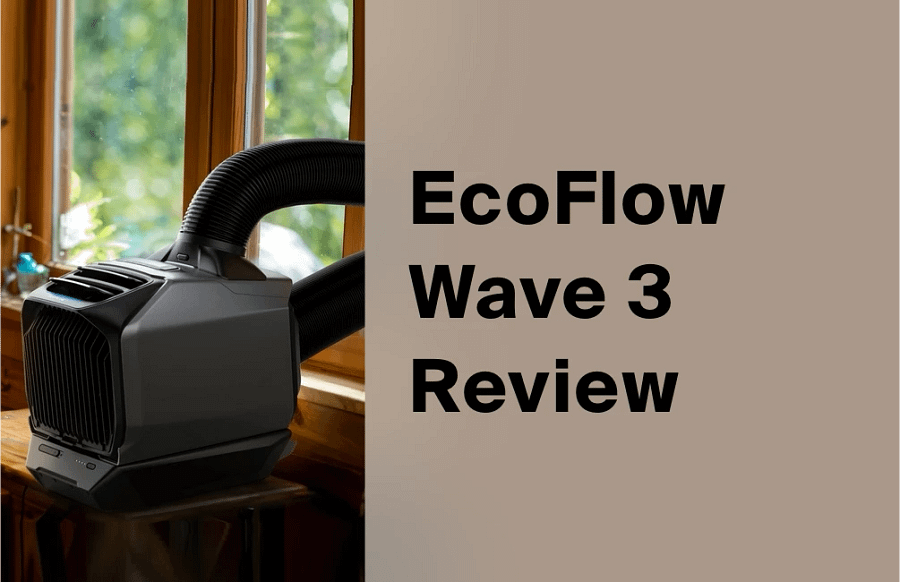
Welcome to my EcoFlow Wave 3 review. I have lived with this portable air conditioner every day through a very sticky British summer. In short, it changed how I sleep and how I work from home. I still rate it as the best portable air con I could find in the UK.
My flat has no fitted cooling, like most UK homes. So when the heatwaves kept coming, I went hunting for a fix. I wanted something small, efficient and easy to live with. This EcoFlow Wave 3 review is the result of that search, plus months of daily use. Below, I cover cooling, noise, my Octopus battery trick, my custom window setup, and the honest downsides too.
Save on the EcoFlow Wave 3
New customers currently get 10% off through my EcoFlow referral link. The latest offer always sits on EcoFlow's referral page, and terms can change, so do check first.
Get 10% off with my EcoFlow referral
What is the EcoFlow Wave 3?
The EcoFlow Wave 3 is a portable air conditioner that also heats and dehumidifies. It launched worldwide in May 2025 as the successor to the Wave 2. Importantly, it uses heat-pump technology rather than a simple resistive element. On paper, it delivers 6,100 BTU of cooling and 6,800 BTU of heating. As a result, it works all year round.
Crucially, it is a dual-hose unit. It also pairs with an optional Add-on Battery for cord-free use. The rest of the spec is compact and clear. It weighs 15.6 kg and measures 519 x 297 x 336 mm. Moreover, it moves 330 m³/h of air, uses greener R290 refrigerant, and carries an IPX4 splash rating. EcoFlow quotes noise of 44 to 58 dB, and rates it for rooms up to around 17 m². You can verify all of this on the official EcoFlow UK product page.
For trust, it helps that a UK-registered entity stands behind it. The distributor is ECOFLOW INNOVATION UK LTD, based at 41 Devonshire Street, London W1G 7AJ. The unit also comes with a two-year warranty. So UK buyers get proper local support rather than a grey import.
Why I bought it: the dual-hose problem nobody else solves
Here is the key insight in this EcoFlow Wave 3 review. Most cheap portable units are single-hose. A single hose pulls already-cooled room air and pushes it outside. Consequently, it creates negative pressure. Warm air then gets sucked in from the rest of the house through every gap. In effect, the unit fights itself.
A dual-hose design fixes that. One hose draws intake air from outside. Meanwhile, the other exhausts heat outside. Therefore the cooled room stays sealed, and the machine works far more efficiently. For me, that efficiency is the whole point, especially when I run it from a battery.
So I went looking for a dual-hose portable in the UK. Honestly, I could not find another one. I checked Meaco, Pro Breeze, Honeywell and Samsung. Yet every option was either single-hose or a fixed, dual-connection install. Then I found the Wave 3, and I was amazed by how small it is. Next to those rivals, it is tiny.
Setting it up: my custom acrylic window panel
Setup is the part most people struggle with. After all, you must route two hoses through a window and seal the gaps. EcoFlow does include a cardboard template and adapters. However, I wanted something cleaner and reusable. Because of my design background, I took a different route.
First, I designed a panel in CAD with two neat holes, one for intake and one for exhaust. Then I uploaded the file to Simply Plastics. They professionally cut a piece of 8 mm acrylic to fit my window. Finally, I slot it into the frame whenever I want to cool the room.
The result is a clean, sealed, dual-hose window fit. That is exactly the thing the hoses normally make ugly. Moreover, it takes seconds to install and remove. It is a small bit of effort, yet it transformed the everyday experience. If you are handy, or you have access to CAD, I would honestly suggest doing something similar.
First impressions: a rugged 25 kg camping unit
My first impression, once it arrived, was clear. This is an American outdoor product at heart. The build quality is excellent, and the plastic casing feels thick and properly engineered. T3 agreed, calling the finish "top notch build quality with premium finish". I would not argue with that.
That said, it is heavy. The unit alone is 15.6 kg. My Add-on Battery then adds another 9.7 kg. Together, they reach roughly 25 kg, which EcoFlow itself flags as a two-person lift. In practice, I move it occasionally rather than daily, so the weight rarely bothers me. Still, nobody should expect to carry this between rooms one-handed.
Cool Factor
★★★★★
5 out of 5
Cooling performance in my 18 m² bedroom
In this EcoFlow Wave 3 review, cooling is the headline. My bedroom is about 4 m by 4.5 m, so roughly 18 m². That actually sits at the very top of the Wave 3's rated range. As a result, the performance impresses me more, not less. EcoFlow claims an 8°C drop in 15 minutes. That figure comes from a tiny 10 m³ test space, though, so treat it as a best case.
In my real room, it does not turn the space into a fridge. However, it brings the temperature down quickly. Then it holds it steady all night. Because my acrylic panel seals the room, it never has to fight leaks. Consequently, it settles into a gentle rhythm and cycles on and off by itself.
Independent testers found the same limits, which reassures me. Notebookcheck concluded it is "only an efficient solution for smaller rooms". Similarly, T3 warned it is "limited to small, well-insulated spaces". Both match my experience. For a bedroom, an office or a nursery, though, it is genuinely brilliant.
Noise: can you actually sleep with it on?
For this EcoFlow Wave 3 review, I slept beside it for weeks. Noise is where it quietly wins me over. For a fully integrated unit, it is remarkably restrained. A split system hides its loud bits outdoors, of course. My property cannot take an external unit, though, so integration matters to me.
In Sleep mode, I drop off without any trouble. EcoFlow rates that mode at 44 dB. It likens that to a quiet conversation, and that roughly matches what I hear at night. At full power, meanwhile, it is clearly louder. Notebookcheck measured up to 57 dB flat out and 47 dB while charging. That lines up neatly with EcoFlow's 44 to 58 dB claim.
One extra endorsement, for what it is worth. My cats love it. They regularly stretch out beside the vent to sleep. To me, that says it is both cool and quiet enough to relax next to.
The Octopus trick: charging cheap, sometimes free
Here is the design-meets-finance part I am most pleased with. I run the Wave 3 off the Add-on Battery during the day. Then I charge that battery when electricity is cheapest. Because I am on Octopus Agile, the price changes every half hour.
When Octopus tells me power is cheap, or occasionally free, I trigger charging remotely. Specifically, I use an Eve smart plug with Apple HomeKit. It switches the battery on, then off once it is full. On Agile, prices sometimes fall to zero, or even go negative during plunge events. So now and then the top-up costs nothing, or I am paid a little to use power. That is not the norm, to be clear. Mostly, it is simply very cheap overnight electricity.
If you want the tariff detail, my guide on Octopus Agile versus Tracker explains how each one works. If you fancy trying it yourself, the current switch offer sits on my Octopus Energy referral page. This is what works for me, though, and it is not financial advice. Energy prices and tariff terms change, so always check current rates first.
Battery life and water drainage
EcoFlow says the Add-on Battery gives up to 8 hours of cooling in Eco mode. I have found that about right. On a cool night, it comfortably lasts until morning. Occasionally, I even squeeze nearly two days from one charge. Mostly, though, it is a one-charge-one-night rhythm. I simply do a top-up charge on the next cheap slot.
The battery itself is a 1,024 Wh LFP pack. It is rated to 4,000 cycles to 80%, plus IP65 for weather resistance. It also recharges fast, in roughly 75 minutes on mains power. Because the unit cycles on and off, rather than running flat out, the real-world runtime stretches further than the raw figure suggests.
Water drainage is the other daily chore. In practice, I empty the tank every other day. I could probably leave it longer, and I have not tried continuous drainage yet. The app drain alert is genuinely useful rather than annoying. After all, it warns me before anything overflows. Worth noting, T3 hit a leak in automatic drainage mode and switched to manual. So I have stuck with manual too.
Heating mode: the heat pump I have not fully tested
I will be honest here, because this is a review and not a brochure. I have not yet run the Wave 3 as a heater through a proper cold snap. So I cannot give you my own winter verdict on the heating.
What I can say is that it uses genuine heat-pump technology. In heating mode, therefore, it moves warmth into the room. It does not burn energy to create it, which makes it more efficient than a plug-in fan heater. Given how strong the cooling is, I expect the 6,800 BTU heating to perform well too. For corroboration, T3 tested the heating in a chilly shed office. Reportedly, it lifted a small space from about 10°C to a workable 18°C in around 30 minutes. I will update this EcoFlow Wave 3 review once I have used it hard over a British winter.
Honest critical observations: what actually bugs me
No 5/5 product is perfect. Every honest EcoFlow Wave 3 review needs a real cons list, so here is mine. The price is the worst thing by a distance. This is a serious investment. The Add-on Battery is also sold separately, which roughly doubles the cost. T3 put it bluntly, calling the price "verging on ridiculous". I understand why some people will stop reading right there.
Storage is my second gripe. The hoses shoot out at awkward angles. They are also fiddly to connect, and annoying to pack away neatly. Consequently, it is not something you can tuck out of sight in seconds.
Then there is the aesthetic. As a designer, I find it too rugged for a modern home. It looks like adventure gear for the back of a Land Rover, not a considered object for a living space. Honestly, every brand does this. I wish someone would design a unit with minimalist, Rams-like or Muji-style calm. In other words, something that looks like furniture, not an office appliance. That is a category-wide failure, not just EcoFlow's, yet I still feel it every day.
Is the EcoFlow Wave 3 the best portable air con in the UK?
So, is it the best portable air con UK buyers can get? For my needs, yes. I say that as a considered opinion, not an absolute claim. The reasoning is simple. It is dual-hose, unusually small, battery-capable and quiet. Critically, no mainstream UK rival ticks all four boxes.
On pure value, though, the Wave 3 loses. A single-hose MeacoCool MC Series Pro 9000 costs around £369 to £400 and pushes 9,000 BTU. A Pro Breeze 9000, meanwhile, lands near £200. Both give you more cooling per pound out of the box. If raw value and higher BTU matter most, one of those is the sensible buy. I would happily point you there.
However, they cannot match the Wave 3 on efficiency, size, quietness or battery running. That combination is exactly why I chose it. It is also why I keep recommending it to friends who cannot fit a fixed system. For the wider money-saving picture, my take on whether switching to Octopus is worth it pairs neatly with owning one.
Value for money and where to buy
Value matters in any EcoFlow Wave 3 review. Prices move constantly, so always check before you buy. At the time of writing, the unit alone sits around £699 to £799. The Wave 3 plus Add-on Battery bundle then runs around £1,099 to £1,299. I bought my bundle on Amazon for about £1,099. It often sells out, though, so stock is worth watching.
Check EcoFlow Wave 3 stock on Amazon
Alternatively, you can buy direct and grab a discount. New customers currently get 10% off through my EcoFlow referral link. The current offer always sits on EcoFlow's referral page, and terms can change.
Get 10% off with my EcoFlow referral
For a bedroom, an office or a nursery, this little box genuinely changed my summer.
The verdict
Overall, this EcoFlow Wave 3 review lands on a confident 5/5. It is efficient, superbly built, and quiet enough to sleep beside. Better still, it is cheap to run once you pair it with a battery and a smart tariff. For a small, well-sealed room, it does exactly what I need. Frankly, it does it better than anything else I could buy in the UK.
It is not flawless, though, and honesty demands I say so. Overall, a clear 5/5 Ice cold. The Wave 3 earns it on efficiency, cooling, build and running cost. Its dual-hose design also still feels almost unique in the UK market. What stops it being a "perfect" object, rather than a perfect score, is threefold. Namely, the eye-watering price, the fiddly hose storage, and the rugged aesthetic that never quite suits a design-led home. Even so, it changed my summer, my cats have adopted it, and I would buy it again tomorrow.
EcoFlow Wave 3 review: frequently asked questions
Is the EcoFlow Wave 3 worth it?
For me, yes. That holds true if you value efficiency, quietness, small size and battery use. If you just want maximum cooling for the lowest price, a single-hose Meaco or Pro Breeze makes more sense. So the Wave 3 justifies its cost mainly through its dual-hose design and portability.
How much does the EcoFlow Wave 3 cost in the UK?
At the time of writing, the unit alone is around £699 to £799. The bundle with the Add-on Battery is roughly £1,099 to £1,299. Prices shift with EcoFlow's frequent sales, and stock varies by retailer. Therefore, always confirm the current figure before buying.
Is the EcoFlow Wave 3 the best portable air con in the UK?
In my opinion, it is the best portable air con UK buyers can get for a compact, quiet, dual-hose, battery-capable unit. On value alone, it is not, since cheaper single-hose rivals deliver more BTU per pound. So the honest answer depends on what you prioritise.
Why does dual-hose matter?
A single-hose unit creates negative pressure and pulls warm air back into your home. In effect, it works against itself. A dual-hose unit like the Wave 3 draws intake from outside instead. That keeps the room sealed and cools far more efficiently. This efficiency is central to this EcoFlow Wave 3 review.
Can you run the EcoFlow Wave 3 on battery overnight?
Yes. With the Add-on Battery, EcoFlow quotes up to 8 hours in Eco mode. I usually get through a night on one charge. I charge the battery on cheap Octopus Agile slots, then run the unit off it during the day. Runtime depends on the mode and how hot the room is.
Does the EcoFlow Wave 3 heat as well as cool?
Yes, it is a year-round heat pump rated at 6,800 BTU for heating. I have not yet tested the heating through a full winter, so I cannot give a personal verdict there. Independent testing by T3, however, found the heating warmed a cold shed office to a comfortable working temperature.
More from CoolCuration
- Energy price cap, July 2026: what the latest cap means for what your gadgets cost to run.
- Energy switching offers: the current switch deals worth a look before you commit.
- Tapo P110M smart plug: an energy-monitoring plug for automating off-peak charging.
- Zeze cat cooling mat: for pets who love the cool as much as mine do.
- Gift guide for techies: more gadget ideas for the tech lover in your life.
What's trending





Recent posts
- Is Monzo Perks Worth It? A Year of Paying for It
 A year of paying £9 a month for Monzo Perks, with the honest maths on what I actually claim and what earns nothing.
 - Should You Fix Your Energy Tariff Before October?Last updated: 31 August 2026 By Stiv · Design, technology and personal finance EnergyFix or float · October 2026 Ofgem says fix. I checked the sums. Ofgem reckons you can beat the October cap by £100 or more, so the obvious question is whether to fix your energy tariff before it lands on 1 October.… Read more: Should You Fix Your Energy Tariff Before October?
- V&A LGBTQIA+ Tour Review: The Free Queer Tour Worth Planning AroundFree, monthly, unbooked and almost unknown. A queer walk through the V&A with a volunteer guide, and the case for going in person.



No Comments.