
Last updated: 21 July 2026
By Stiv · Design, technology and personal finance
This review contains affiliate links. If you buy through one of them I may earn a small commission at no extra cost to you. It does not affect my opinion.
This is an opinion piece. Views expressed are the author's own and do not constitute professional advice.
Cool Factor: 4/5
This Nothing Headphone (1) review is not a first-impressions piece. I have worn the white Nothing Headphone (1) since November 2025, so roughly eight months, and I have used them properly. In that time they have come with me on the commute, onto trains and flights, out on long walks and back to my desk for work calls. As a result, I know exactly what still delights me and what quietly wore thin.
So consider this the long-term verdict on Nothing's first over-ear headphones, the pair tuned by British hi-fi legend KEF. Overall I still like them a lot. However, after eight months the score lands at a considered 4 out of 5, and in this Nothing Headphone (1) review I explain precisely why.
If you already know you want a pair, here is where to buy. Prices move often, so check the live figure first.
Check white on Amazon UK Check black on Amazon UK Buy direct from Nothing
Cool Factor
★★★★☆
4 out of 5, Stone cold
What is the Nothing Headphone (1)?
The Nothing Headphone (1) is Nothing's first over-ear, noise-cancelling headphone. It arrived in July 2025 at £299, and it sits above the brand's Ear buds in the range. Since then Nothing has added a cheaper sibling, the Headphone (a), so the Headphone (1) is now the premium over-ear option rather than the only one.
Crucially, the sound is tuned by KEF, the Kent hi-fi maker with six decades of speaker heritage. Inside each cup sits a custom 40mm dynamic driver. On top of that you get Hi-Res Audio, spatial sound with head tracking, and LDAC, AAC and SBC codecs over Bluetooth 5.3. In other words, the spec sheet reads seriously for the money. For the plain facts and the latest price, our Nothing Headphone (1) detail page keeps the numbers current, while this Nothing Headphone (1) review is where I give the honest opinion.
The design, and how eight months changed my view
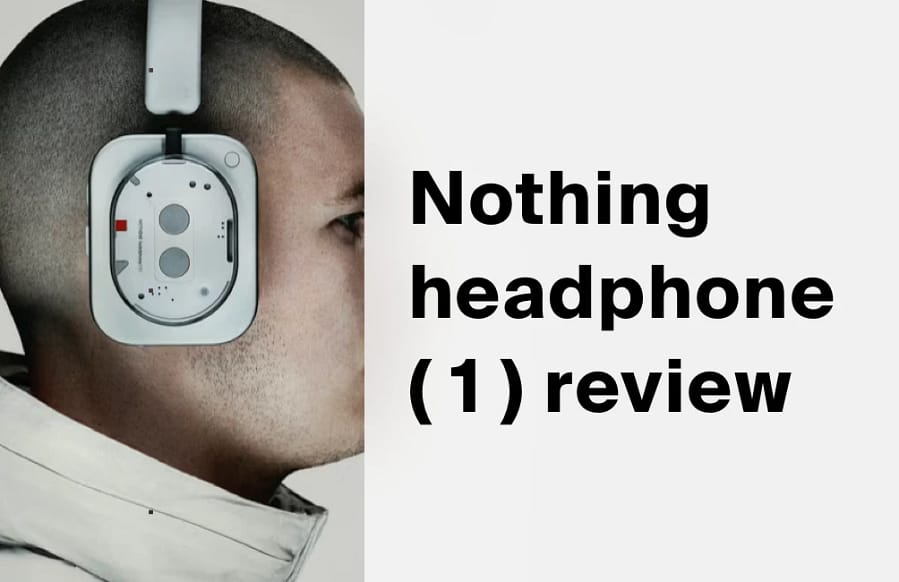
First, the look. The Nothing Headphone (1) wears the brand's transparent, cassette-deck industrial style, with a visible aluminium skeleton and little exposed screws. Honestly, it divided my friends on day one. Some called it a design classic. Others thought it looked like a prop from a science-fiction film.
Eight months later, my own view has settled firmly in the "still love it" camp. Because so many rivals look identical, that see-through styling has aged into a genuine talking point rather than a gimmick. Adam Bates, Head of Design at Nothing, said the goal was for the pair to "feel different the moment you pick it up", and on that narrow point they delivered. My white pair has picked up only light marks, and it still turns heads on the train.
That said, design is personal. If minimal black plastic is your taste, this loud, mechanical aesthetic may never win you over. For me, though, it remains one of the best things about them.
The controls: roller, paddle and button
Here is where the Nothing Headphone (1) genuinely pulls away from the pack. Instead of a fiddly touch panel, Nothing fitted three physical controls to the right cup. There is a roller, a paddle and a customisable button, and after eight months they are still my favourite feature.
So how do they work? First, the roller adjusts volume as you spin it, and a firm press plays or pauses. Next, the paddle pushes forward and back to skip tracks, with a satisfying click of resistance each time. Finally, the small button can be set to a shortcut of your choice, such as switching noise modes. Even reviewers who cooled on the headphones, like What Hi-Fi, praised the roller as "a pleasingly tactile way" to change volume.
In gloves, in pockets, in the cold, these controls simply work. Touch panels smear and mis-fire. Physical toggles do not. Consequently, this is the one area where I would happily take the Nothing over a Sony or a Bose. If you take one thing from this Nothing Headphone (1) review, make it the controls.
Sound and the KEF tuning
Now for the important part, and here the Nothing Headphone (1) shines. Sound is the make-or-break of any Nothing Headphone (1) review, so this section matters most. With KEF on the box, expectations run high, and the sound quality is genuinely standout. Music sounds great through them. The custom 40mm drivers push a big, weighty, confident sound with plenty of low-end punch, so pop, hip-hop and podcasts all come alive on a noisy commute.
Jack Oclee-Brown, KEF's Vice President of Technology, said the team set out to deliver "natural, balanced sound with incredible precision". In practice, I would call it rich and fun rather than clinically neutral. Moreover, LDAC and wired USB-C playback at 24-bit/96kHz give you a real step up on the right tracks.
Still, keen listeners should note one oddity. The bass-enhancement setting only takes effect when noise cancelling or transparency is switched on. With both off, it does nothing, which left me perplexed for a while. Once I understood the rule, the sound improved a lot, but it is a strange bit of design.
ANC and transparency on a real commute
Noise cancelling is where the Nothing Headphone (1) surprised me most, and it is a real highlight of this Nothing Headphone (1) review. Nothing quotes up to 42 dB of adaptive cancellation, and while that is the brand's own lab maximum, the real-world result is very impressive. In co-working spaces and on the tube, it effectively cancels the world out. As a result, I use it constantly.
To be fair, Bose and Sony still edge ahead on outright hush at the very top end. For me, though, the Nothing has more than enough. Transparency mode is the weaker sibling here. Specifically, it can be overzealous with background chatter, so voices sometimes rush in louder than expected. It takes some getting used to, yet it does the job for platform announcements.
Comfort, weight and the 329g question
At around 329g, the Nothing Headphone (1) is not the lightest pair going. Even so, comfort has been a non-issue for me. The weight feels fine over long wears, the headband adjusts easily, and the fit settles nicely on my head. After eight months, I happily wear them for hours.
There is one ergonomic gripe, though. When they hang around my neck, the flat, square cups catch the underside of my chin, and turning my head knocks into them. On top of that, the cold aluminium can be a mild shock on a winter morning. It is a small niggle rather than a dealbreaker, but the squared-off shape was clearly styled first and worn second.
Battery life against the claimed 80 hours
The headline number is huge. Nothing claims up to 80 hours with ANC off, and around 35 hours with it on, both under lab conditions. Realistically, I never hit 80. Still, with ANC on and LDAC streaming, I comfortably get a working week or more between charges, and battery has never once been an issue.
Better still, fast charging is excellent. Five minutes on the cable buys up to five hours of playback, and a full charge takes about two hours. Frankly, after eight months I almost never think about battery, which is the highest praise a wireless headphone can earn.
Nothing X and the Nothing-phone lock-ins
All the tuning happens in the Nothing X app, on iOS 13 and Android 6 or newer. Pairing, setup and firmware updates have all worked smoothly for me, which is not a given with newer brands. On the whole the app is clean and quick, with an equaliser and ANC modes. However, it is also where Nothing plays favourites.
For instance, Channel Hop, the quick device-swap feature, works only with Nothing phones. Likewise, the lowest 110ms latency for gaming arrives only when you pair a Nothing phone and switch on Game Mode. As an iPhone owner, I get neither. To be fair, most core features still work everywhere, but the best tricks are fenced off, and that is worth knowing before you buy.
Honest critical observations
No Nothing Headphone (1) review is complete without the niggles, and after eight months I have collected plenty. None are dealbreakers on their own. Together, though, they are exactly why my score stops at four.
- The carry case zip. It looks smart, yet the zip is poorly thought through and snags almost every day. Small thing, constant irritation.
- Half-locked controls. You can map the button's single and long press to almost anything. Yet the big roller press is stuck on play and stop only, with no way to change it. Customisable and restrictive at once.
- Dual-device pairing. I wanted music on my phone to pause when I joined a Zoom call on my Mac. Instead, once the Mac connected, the headphones ignored my phone entirely, so the feature was useless for me.
- The Siri shortcut. I set the button to trigger Siri, but Siri then listened through my phone rather than the headphone microphones. Coming from AirPods, that broke the seamless habit fast, so I turned it off. I suspect Apple's grip on Siri is partly to blame, though I hope a firmware update fixes the routing.
- Sporadic wear detection. Taking the cups off should pause the music, and often it does. Occasionally, though, it just does not, and that inconsistency nags.
- No easy repairs. The battery is not user-replaceable, and the ear cushions do not appear swappable either. For a premium headphone, both should be simple, and here neither is.
- Support let me down. When I asked about the bass and transparency quirk, the team pushed a generic script, telling me to unpair from my iPhone rather than reading the actual issue. If something genuinely breaks, I am not confident they will help.
To be clear, build and material quality feel very strong, so none of this reads as flimsy. These are polish problems, not fundamentals.
Why they matter now, and value for money
Here is the twist that reframes everything. The Nothing Headphone (1) launched at £299. Today, Nothing's own store lists them at £249, while Amazon shows around £166 for white and £209 for black through third-party sellers. Those marketplace prices carry a little risk, so buy from a seller you trust. Either way, the value equation has shifted hugely since launch, and early buyers like me paid a real premium.
At today's price, the comparison flatters Nothing. The Sony WH-1000XM6 and Bose QuietComfort Ultra cancel a touch more, and honestly I rate these over the pricier AirPods Max on value. Against design-led rivals like the Sonos Ace and the repairable Fairphone Fairbuds XL, the Nothing undercuts on price while matching them for character. If repairability is your priority, mind you, the Fairbuds let you swap parts and the Nothing does not. For the wider field, our best noise-cancelling headphones guide lines them all up. That price collapse sits at the heart of this Nothing Headphone (1) review.
Practical info before you buy
A few practical notes. The Nothing Headphone (1) comes in white or black, and it carries an IP52 rating, so light dust and splashes are fine. There is a standard manufacturer warranty, and everything is controlled through the Nothing X app. Remember, though, that the battery and cushions are not designed to be swapped at home.
One more thing to flag: Nothing lists contact materials including nickel, acrylates and cyclosiloxanes, with an allergy caution, so factor that in if your skin reacts. On safe listening, the World Health Organization suggests keeping the volume down and taking breaks, which matters when a headphone this loud makes it easy to overdo it. Finally, if the price still stings, buying refurbished is smart, and our Back Market discount code knocks £10 off a refurbished pair.
The verdict
So, is this a buy? For the right person, absolutely. After eight months, the Nothing Headphone (1) remains a distinctive, tactile, great-sounding pair that finally makes financial sense now the price has fallen. The controls are the best in the business, the KEF-tuned sound is a treat, the noise cancelling genuinely impresses, and the battery is a non-issue.
Yet the niggles are real. The snagging case, the half-locked controls, the flaky wear detection, the Nothing-phone lock-ins and the underwhelming support all chip away at an otherwise lovely product. For that reason, this Nothing Headphone (1) review lands at 4 out of 5, Stone cold.
Eight months in, the sound still delights me and the controls still beat every touch panel I have tried.
Overall, a confident 4 out of 5, Stone cold. The Nothing Headphone (1) win on design, controls, sound, cancellation and battery, and the price drop makes them a smart buy. However, they miss Ice cold because the case, the app quirks, the sporadic wear detection and a weak support experience stop them feeling truly finished. Fix those in software and rethink that case, and a future pair could easily go the distance. For now, though, they are a headphone I still reach for daily, and one I would happily recommend to anyone who values character and value over the last few decibels of hush.
Nothing Headphone (1) review FAQs
Are the Nothing Headphone (1) worth it?
Yes, especially now. At the £299 launch price they were a hard sell, but at roughly £166 to £249 they are strong value. You get standout KEF-tuned sound, superb physical controls, impressive noise cancelling and long battery life. If flawless cancellation is your one priority, though, Sony and Bose still edge ahead. In short, this Nothing Headphone (1) review lands firmly on the "worth it" side at today's price.
How much do the Nothing Headphone (1) cost in the UK?
They launched at £299. Today Nothing's own store lists them at £249, while Amazon shows around £166 for white and £209 for black through third-party sellers. Because prices move so often, always check the live figure before you buy, and stick to sellers you trust.
Nothing Headphone (1) vs Sony WH-1000XM6: which is better?
It depends on what you value. The Sony cancels a little more and folds smaller for travel. However, the Nothing costs a lot less, sounds bigger and bolder, and has far nicer physical controls. For me, the Nothing wins on fun and value, while the Sony wins on outright quiet.
Do the Nothing Headphone (1) work with an iPhone?
Yes, they pair and work well with an iPhone over Bluetooth or AAC. However, a couple of features are Nothing-phone only, namely Channel Hop and the lowest gaming latency via Game Mode. The Siri shortcut also routes through the phone rather than the headphone mics, which is my main iPhone gripe.
How long does the battery really last?
Nothing claims up to 80 hours with ANC off and about 35 hours with it on. In my real-world use with ANC on and LDAC, I get a working week or more per charge. Moreover, a five-minute quick charge adds up to five hours, so you are rarely caught short.
More from CoolCuration
- Loop earplugs review - when you want to block noise without any music at all.
- 1Blocker app - cut a different kind of noise by blocking ads and trackers.
- Best wireless earbuds UK - prefer buds to over-ears? Start here.
- Soundcore Sleep A20 sleepbuds - tiny buds made for drifting off in silence.
What's trending





Recent posts
- Is Monzo Perks Worth It? A Year of Paying for It
 A year of paying £9 a month for Monzo Perks, with the honest maths on what I actually claim and what earns nothing.
 - Should You Fix Your Energy Tariff Before October?Last updated: 31 August 2026 By Stiv · Design, technology and personal finance EnergyFix or float · October 2026 Ofgem says fix. I checked the sums. Ofgem reckons you can beat the October cap by £100 or more, so the obvious question is whether to fix your energy tariff before it lands on 1 October.… Read more: Should You Fix Your Energy Tariff Before October?
- V&A LGBTQIA+ Tour Review: The Free Queer Tour Worth Planning AroundFree, monthly, unbooked and almost unknown. A queer walk through the V&A with a volunteer guide, and the case for going in person.



No Comments.