
Last updated: 16 August 2026
By Tristan · Arts, exhibitions and creative culture
This is an opinion piece. Views expressed are the author's own and do not constitute professional advice.
Cool Factor: 5/5
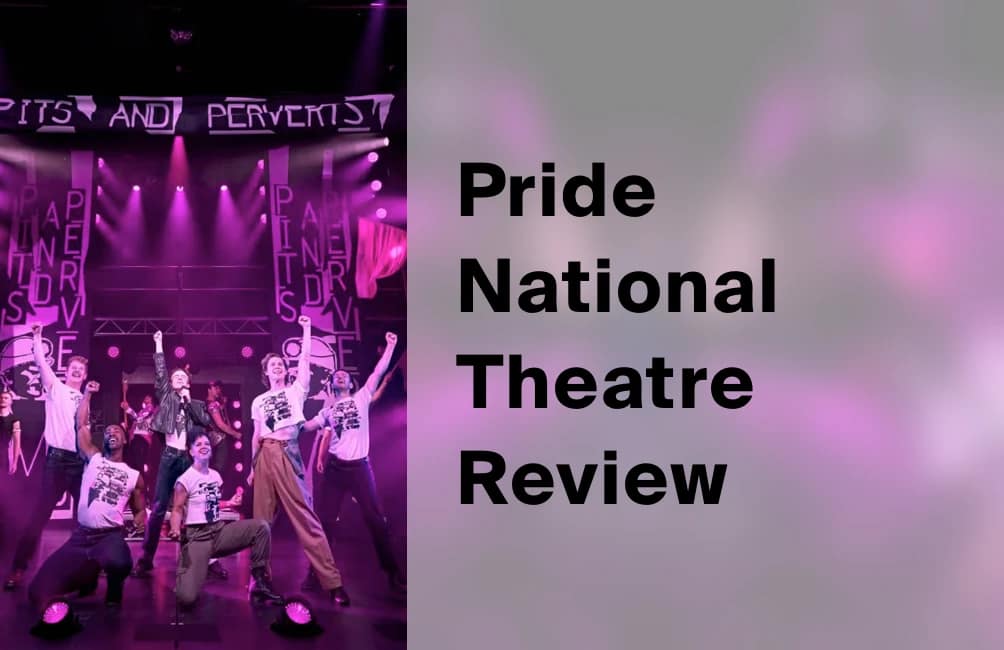
I walked into the Dorfman on Saturday expecting a pleasant night out. Instead, the Pride National Theatre production loudly and proudly kept me laughing and crying throughout. By the closing sequence there was not a dry eye in the house. Standing ovations are given too freely these days. Not in this case, though. The whole audience rose as the actors took their bows.
Here is why a musical about a 1984 bucket collection is the best thing I have seen on a London stage this year.
Pride National Theatre: what the show is actually about
Pride is a new musical based on the 2014 film of the same name. Stephen Beresford wrote both, and Matthew Warchus directed both, so the show arrives with its DNA fully intact. The music comes from Christopher Nightingale, Josh Cohen and DJ Walde. Furthermore, Beresford's screenplay won the BAFTA for Outstanding Debut and the Queer Palm at Cannes, which tells you the story already had legs.
Beresford has said the story felt built for this form. Speaking to London Theatre, he called it a tale whose "soaring, epic nature of this story seemed tailor-made for musical theatre". On the evidence of Saturday, he was right.
The Pride National Theatre run began on 11 June 2026 and closes on 12 September 2026. It follows a sold-out world premiere at the Sherman Theatre in Cardiff earlier in the year.
The true story behind the musical
The real events are almost too neat for fiction. In June 1984, the activist Mark Ashton rattled a bucket at the London Pride march and decided the money should go to striking miners. Lesbians and Gays Support the Miners, or LGSM, was born days later. Two marginalised communities then found each other in the middle of a national fight.
Eventually the London group raised roughly £22,500 for the mining communities of the Dulais Valley. Their December 1984 benefit gig at Camden's Electric Ballroom, headlined by Bronski Beat, brought in £5,650 in a single night. Sadly, Ashton died of an AIDS-related illness in 1987. He was 26.
Jhon Lumsden plays Ashton here, all restless conviction and Northern Irish steel, and he anchors the London half of the show. Around him, Matthew Durkan plays Mike, Ashton's best friend and the man actually running LGSM day to day. Courtney Stapleton plays Steph, the sole lesbian among the founders, while Jordan Shaw plays Reggie. Meanwhile, Chris Jenkins plays Gethin, the Welsh exile who runs Gay's the Word with his partner Jonathan. Their bookshop becomes the group's headquarters and, fairly quickly, its heart.
The Dorfman is the right room for Pride National Theatre
Here is the first clever decision. This show could have gone into the Olivier, which seats around 1,150. Instead it sits in the Dorfman, which holds up to 450. As a result, you share the emotional volume of the piece with the actors and with everyone around you.
That choice also says something about the building. Indhu Rubasingham is the National's seventh Director, and the first woman and first person of colour in the role. Moreover, this is her inaugural season. Notably, she has said she wants the Dorfman to become a home for new musicals. Pride National Theatre is the first real proof of that policy, and it lands.
First impressions: 1984 on a loop
Before anything begins, a screen across the front of the stage runs a sepia montage of the mid-eighties. A young Charles and Diana. Freddie Mercury. Punks with mohawks. Thatcher and Reagan. It is efficient scene-setting, though it also does something sneakier. It reminds you how recent all this is.
Then the screen lifts and Bunny Christie's set does the rest. It is a sparse scaffold and gantry structure with the band perched up top, hung with hand-painted banners, dressed in dungarees and Doc Martens. Hugh Vanstone's lighting does the heavy lifting from there. Consequently the same frame becomes Gay's the Word, a Welsh miners' welfare club and, devastatingly, an empty chair in a doctor's waiting room.
Lewis Cornay's Bromley grows in front of you
Lewis Cornay plays Bromley, a closeted student who wanders into the LGSM orbit and slowly works out who he is. At the start Cornay plays him almost entirely in the shoulders. Meanwhile, he hovers at the edge of scenes. He half-starts sentences. Frankly it would be easy to miss him early on, which is precisely the point, because the arc builds across Act One and into Act Two.
Then he detonates. His big number towards the close, "I'm Into Guys", is a proper showstopper. Indeed, Cornay sings it like a man who has been holding his breath for two decades. There is a recurring "mum" motif in earlier scenes that seems throwaway at first. It is not. In fact, it returns in the family confrontation and takes the roof off.
Critics clocked it too. London Theatre wrote that Cornay "beautifully sketches newcomer Bromley's coming-of-age and coming out journey", which fairly sums up a performance built almost entirely out of small increments.
Cornay is not a newcomer, though. He trained at Guildford School of Acting, and his stage CV already runs long. Previously he played Elder Davis in The Book of Mormon in the West End, the title role in The SpongeBob Musical, Arpad in She Loves Me at Sheffield Crucible and Titanic the Musical on tour. He also won an Offie for John and Jen at Southwark Playhouse, and he turned up in Doctor Who. Even so, Bromley feels like a different order of thing. I would be surprised if this is not the role that changes his career.
That motif does not stay with Bromley, either. It hands straight over to Gethin, who finally goes home to Wales and meets the mother he has not seen for seventeen years. Two doors opening, with "mum" as the bridge between them.
Samuel Barnett and the Act Two showstopper
Samuel Barnett plays Jonathan, partner to Chris Jenkins's Gethin and one of the first people in Britain diagnosed with HIV. Barnett has form for playing the boy who feels everything too keenly. Twenty-two years ago, in this very building, he originated Posner in Alan Bennett's The History Boys. That performance won him a Drama Desk Award, plus an Olivier nomination and a Tony nomination on Broadway. He then reprised it in Nicholas Hytner's 2006 film.
There is a quiet symmetry here, incidentally. Cornay also has The History Boys on his CV, from a later production at Theatre Royal Bath. Two Bennett alumni, two decades apart, now share a Dorfman stage in a show about generations passing something along. I doubt that was planned. Nevertheless it fits.
Barnett gets the evening's most audacious sequence. What could easily have been a mournful ballad about mortality instead becomes a full glitterball cabaret: sequins, feather fans and a tap routine performed with grim, glorious defiance. It should feel tasteless. Instead it feels like a refusal.
Earlier, Barnett also gets the scene that turns the whole plot. Faced with a hostile Welsh welfare club, he simply dances. As a result, the room thaws. Lizzi Gee's choreography does more narrative work in ninety seconds than most books manage in an act. On the night I went his voice was a tad pitchy at first, yet he had warmed up by the end of the number, and the sheer flamboyance of the character forgives any wobble.
Pride's always felt to me like a romantic comedy between two ostensibly hostile entities, who eventually become soulmates.
That is Matthew Warchus, the director, speaking to the Guardian in June. Watch the welfare club scene and you can see exactly what he means.
The Welsh half of the story
Meanwhile, the villagers are not treated as a backdrop. Kirsty Malpass plays Hefina and Mared Williams plays Margaret. Sarah Pugh plays Siân, whose solo about wanting more than a life as a wife and mother is one of the show's quieter gut punches. Incidentally, the real Siân James later became MP for Swansea East.
The men get their due as well. Matthew Woodyatt's Dai welcomes the LGSM delegation, and the awkward warmth that follows stems from him. Darren Lawrence's Cliff holds the show's most tenderly withheld secret. Gillian Elisa's Gwen and Caroline Sheen's Maureen mark out the two poles of village opinion, one welcoming and one very much not.
Musically, the Welsh material is where the score is bravest. A full choral number in Welsh, "Y Ddraig Ar Ein Baner", sits a few minutes away from disco and eighties pop. On paper that should not work. In the room it absolutely does.
What the film left out, and what the musical puts back
Here is the change I did not see coming. The 2014 film has drawn steady criticism over the years for its near-total absence of Black characters. LGSM was a London group, formed in a city that was never remotely white, so the omission always sat awkwardly. This version does something about it.
Reggie barely registered on screen. On stage, as The Reviews Hub noted, he "has been recreated and is now a Black man (Jordan Shaw)". He also sits inside the group's core rather than at its edges.
That is not a decorative nod to diversity. Rather, it is an overt choice to be more representative, and I think it is the boldest thing Beresford has done in the rewrite. The parallel with the lesbians is exact. Women did huge amounts of the organising and the fundraising, and some of them set up Lesbians Against Pit Closures so they could do it on their own terms. Yet the popular version of 1984 rarely remembers them. Queer Black people have had the same treatment, only more thoroughly.
Why the National Theatre stage makes it matter more
Writing someone back in matters, and the venue makes it matter more. This is the National Theatre, publicly funded, with a stage that confers a kind of official memory on whatever stands on it. Consequently a whole host of people, of every skin colour, will watch Reggie and see something of themselves up there. Some of them will be seeing it for the first time in this story.
It is a small correction, on one stage, in one season. Even so, it is a start, and it is the right one. Moreover, it makes the show's own argument land harder. Solidarity is not selective. Any telling of this story that quietly leaves people out is arguing against itself, and the Pride National Theatre production plainly knows it.
Honest critical observations
So why is this not a flawless piece of theatre?
First, the balance is uneven. The gay characters get full arcs, while the miners largely share one collective arc between them. The Telegraph made this point hard in a two-star pan. Although I think two stars is absurd, the underlying complaint has substance. After all, the pits close. Then the strike is lost. Whole towns are gutted. Yet the show hurries past that devastation to reach its reconciliation.
Second, Act One reaches for the gag a little too often. Certainly the laughs land, but the prejudice of 1984 has been sanded smoother than it deserves. Real hostility is largely represented by one or two grumbling villagers, then dispatched.
Third, the ending uses archival footage of the real 1985 Pride marchers, which is emotionally unanswerable. Is that slightly unfair? Probably. Even so, it works, and it works because the previous two hours have earned it.
I still give it 5/5, and here is my reasoning. A show can be structurally imperfect and still be the most valuable use of an evening available in London right now. Certainly this one is. There was a reason the run sold out. There was a reason all 450 people in that room were pulled the same way at the same moment. It resonates deeply, whoever you happen to be.
Why Pride matters in 2026
Solidarity stories can feel like nostalgia. This one does not, because the argument is still live.
In August 2025, the Reform UK-controlled Durham County Council withdrew its funding from Durham Pride. The council had previously invested up to £12,500 in the festival. The event survived because the trade union movement stepped in, including the Durham Miners' Association. Equity then donated £7,200, presented at the Miners' Hall in Durham in May 2026. In other words, forty years on, miners were once again passing the bucket.
The DMA chairman Stephen Guy put it plainly when the cut was announced, telling the BBC that "Reform councillors across County Durham have underestimated the resolve of the LGBT+ community and the support of allies across the trade union movement". You could not write it, and Pride National Theatre does not need to.
If that thread interests you, our review of The Future in Our Past covers the general strike from the other direction.
Pride National Theatre tickets and value for money
Tickets run at £25, £49, £79 and £99, plus a £4 booking fee per order, waived for members. At £25 in a 450-seat room, that lower band is one of the best value seats in London. Even at £99, given what this cast is doing, I would not argue.
However, the entire run is now sold out. Therefore your realistic routes in are these.
- Friday Rush. £10 tickets go live online at 1pm every Friday for the following week. Maximum two per production. Be logged in and ready.
- Entry Pass. Heavily discounted seats for anyone aged 16 to 25.
- Returns and day tickets. Worth checking the National Theatre listings daily, and worth signing up for alerts.
A West End transfer has not been confirmed, though most critics assume one is coming. No NT Live cinema broadcast has been announced either. For now, then, the room is the only way to see it.
Practical information for your visit
The National Theatre sits on the South Bank, London SE1 9PX. Conveniently, Waterloo is the nearest station, roughly a five-minute walk. Embankment across the bridge and Southwark also work.
Running time is around two and a half hours including a twenty-minute interval. Be aware the production uses strobe lighting, flashing effects and haze. The National currently lists no formal age guidance, though I would say the themes suit confident teenagers upwards.
For food, Lasdun is the proper sit-down option. Forza Wine handles the rooftop cocktail approach, while The Understudy does riverside beer with KERB street food traders if you want something faster. Arrive earlier than you think, because the foyer on a sold-out night is busy.
If you are pairing the trip with a gallery day, our Whistler at Tate Britain review covers a show a ten-minute walk along the river.
The Pride National Theatre verdict
Cool Factor
★★★★★
5 out of 5
Pride is funny, angry, generous and completely unembarrassed about wanting you to feel something. It has a great central performance from Lewis Cornay, a showstopping one from Samuel Barnett, and a design that turns scaffolding into a whole decade. Above all, it argues that solidarity is a practical act rather than a slogan.
Overall, this is a straight 5/5 Ice cold, and I do not award those lightly. Pride National Theatre earns it through Cornay's slow-burn Bromley, Barnett's glitterball defiance and an ending that had a sold-out Dorfman openly weeping before it stood up. It is not a perfect script. The miners' side of the story deserves more room, and Act One occasionally chooses the joke over the wound. Yet perfection was never the assignment. This show set out to make a room full of strangers feel briefly, fiercely on the same side, and on Saturday night it did exactly that. You will leave saying "where are my lesbians?" in a terrible Welsh accent, with a broad smile on your face.
Pride National Theatre: FAQs
Is Pride at the National Theatre worth seeing?
In my opinion, yes, emphatically. It is the most emotionally effective night I have had in a theatre this year, and the audience response on the night I attended was extraordinary. Bear in mind it is a fixed run, closing on 12 September 2026.
Is this the same as The Pride by Alexi Kaye Campbell?
No, and this trips people up constantly. Alexi Kaye Campbell's The Pride is a 2008 Royal Court play about a gay love triangle across two timelines. This one is a new musical based on the 2014 LGSM film, with book and lyrics by Stephen Beresford. In short, they are entirely separate works.
How is the musical different from the 2014 Pride film?
The bones are the same, since Beresford and Warchus made both. However, the stage version widens the ensemble. The Welsh villagers get far more room, and Reggie, a minor figure on screen, becomes a fully written Black gay member of the group.
How much are Pride National Theatre tickets?
Currently, prices are £25, £49, £79 and £99, plus a £4 booking fee per order. The run is sold out, so Friday Rush £10 tickets, Entry Pass and returns are the practical routes in.
Who plays Bromley in Pride at the National Theatre?
Lewis Cornay plays Bromley. Previously he trained at Guildford School of Acting, and he has appeared in The Book of Mormon in the West End and The History Boys at Theatre Royal Bath. He won an Offie Award for John and Jen.
How long is Pride at the National Theatre?
Around two hours and thirty minutes, including a twenty-minute interval. The show uses strobe lighting, flashing effects and haze.
Will Pride transfer to the West End?
Nothing has been officially announced as of August 2026. However, the National is collecting ticket alert sign-ups for future dates, and several critics have predicted a transfer.
More from CoolCuration
- Tom at the Farm review: another queer story about hiding who you love, staged in mud at the Barbican.
- The Odyssey on IMAX 70mm review: another big-format night out, reviewed at BFI Waterloo.
- Archduke at the Royal Court review: our take on another London stage show that plays history for keeps.
- LGBTQ+ gift guide: thoughtful presents from queer-owned and queer-led brands.
- Common Press membership: a bookshop membership that makes a proper gift for a reader.
- Rainbow lanyard: a small, everyday way to fly the flag.
- Uber referral code: handy for getting home after a late South Bank curtain.
What's trending




Recent posts
- Tom at the Farm review: mud, menace and a standing ovation at the Barbican
 Armando Babaioff's mud-soaked Brazilian production of Tom at the Farm swings from intense drama to humour, with an incredible cast of four. Cool Factor 5/5.
 - Monzo Invest vs Freetrade vs Lightyear: Which App Costs Less?Last updated: 15 October 2026. I checked every fee in this Monzo Invest vs Freetrade comparison on each provider's own site on 14 October 2026. By Stiv · Design, technology and personal finance Affiliate disclosure: This article contains affiliate and referral links, which are paid links. If you click one and buy or sign up,… Read more: Monzo Invest vs Freetrade vs Lightyear: Which App Costs Less?
- Frieze Week Exhibitions 2026: Nine London Shows to See Beyond the FairNine London exhibitions to see during Frieze week 2026, from Cindy Sherman at Hauser & Wirth to Robert Ryman at the Barbican. Seven are free.


No Comments.