
Last updated: 22 March 2026
By Tristan · Arts, exhibitions and creative culture
This is an opinion piece. Views expressed are the author's own and do not constitute professional advice.
This article contains affiliate or referral links. If you click through and sign up I may earn a commission or referral bonus at no extra cost to you. It does not affect my editorial view.
Cool Factor: 3/5
The Christine Kozlov Raven Row exhibition is a sprawling deep dive into the work and world of one of conceptual art's most overlooked figures. Housed in the gorgeous 18th-century rooms of Raven Row gallery in Spitalfields, Conceptual Art and Christine Kozlov brings together an expansive collection of Kozlov's output alongside works by her peers, including On Kawara, Lawrence Weiner, Joseph Kosuth, and Art & Language. It's free, it's ambitious, and it's open until 26 April 2026. But does it hold together as a show? Our honest verdict below.
What's on at the Christine Kozlov Raven Row exhibition?
Conceptual Art and Christine Kozlov runs from 19 February to 26 April 2026 at Raven Row, 56 Artillery Lane, London E1 7LS. It's free to visit, open Wednesday to Sunday, 11am to 6pm. The show is curated by Rhea Anastas in collaboration with the Christine Kozlov Estate and Alex Sainsbury, Raven Row's director.
Christine Kozlov (1945 to 2005) was an American conceptual artist who helped shape the movement from its earliest days in 1960s New York. She co-founded the Lannis Gallery (later the Museum of Normal Art) with Joseph Kosuth, participated in landmark exhibitions curated by Seth Siegelaub, Kynaston McShine, and Lucy Lippard, and later collaborated with Art & Language, Joan Jonas, and Robert Rauschenberg. Despite all of this, she was largely written out of art history after emigrating to the UK in 1977 and gradually withdrawing from public life. This show sets out to correct that.
The exhibition fills Raven Row's multiple floors and galleries with nearly all of the works Kozlov contributed to public exhibitions during her active years, alongside pieces by her friends and interlocutors: On Kawara, Lawrence Weiner, Adrian Piper, stanley brouwn, Douglas Huebler, and others.
First impressions
Before you even get to the art, the space itself is worth the trip. Raven Row occupies a pair of listed 18th-century Huguenot silk mercers' houses, beautifully converted by 6a architects in 2009. The building blends original Rococo-era rooms on the upper floors with clean, modern gallery spaces at the rear, including charred timber rooflights that reference a 1972 fire. It's one of the most atmospheric gallery spaces in London, and it's completely free.
Walk in and you're immediately confronted with conceptual art's signature aesthetic: documents in vitrines, typewritten pages, telegrams, and printed text. There's a lot of paper. A lot of lists. If you've never spent time with this kind of work before, it can feel like walking into someone's meticulously organised filing cabinet.
The highlights: where the Christine Kozlov Raven Row show really shines
Several individual works genuinely stop you in your tracks. Information: No Theory (1970) is Kozlov's most celebrated piece, and seeing it in person makes you understand why. A reel-to-reel tape recorder fitted with a continuous loop tape and microphone records the ambient sounds of the gallery, but the loop means new recordings constantly overwrite old ones. The concept is brilliant: a machine ceaselessly capturing information while simultaneously erasing it. It hums away quietly in the corner, doing its thing, and there's something deeply satisfying about watching it work.
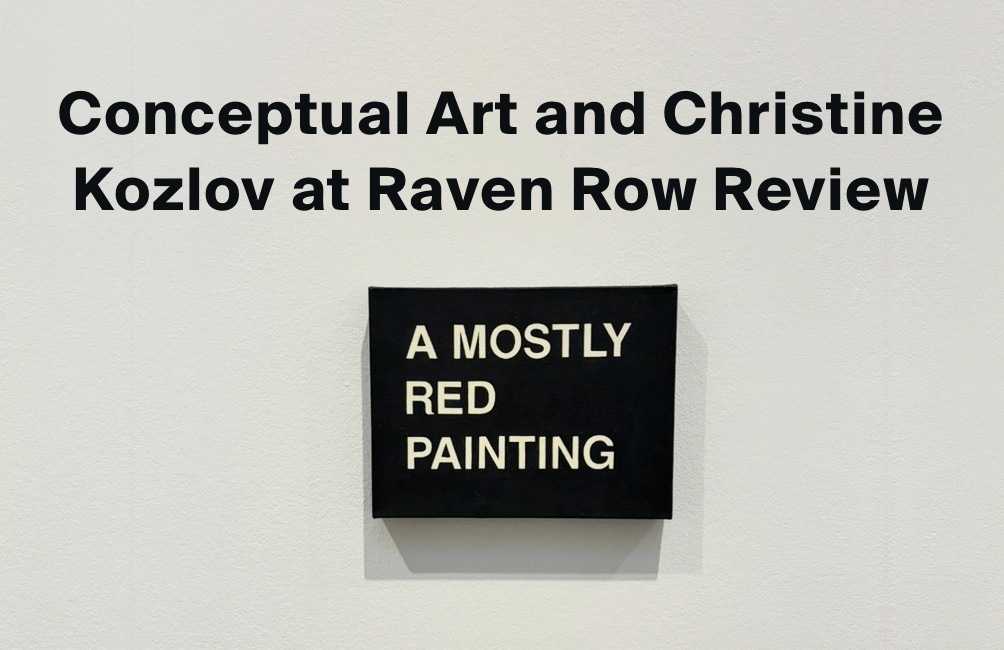
Then there's A Mostly Painting (Red) (1969), one of only two actual canvases in the entire exhibition. It features white text on a dark grey ground with no red visible at all, playing on the homonym of "red" and "read". It's a small, unassuming object, but it's packed with wit. Kozlov was, by her own admission, fond of taking the piss, and this painting is a quiet masterclass in it.
Among the works by Kozlov's peers, On Kawara's date painting NOV. 18, 1967 (1967) is a standout. These paintings, part of Kawara's decades-long Today series, feature nothing but the date rendered in white lettering on a dark background. This particular one carries extra resonance: its subtitle records Kozlov, Kosuth, Kawara, and Hiroko going to see Bonnie and Clyde together at the Charles Theatre in New York. It's a tiny, human detail that anchors a friendship at the heart of this entire movement.
Lawrence Weiner's text-based works from the 1960s sit comfortably alongside Kozlov's own language-driven practice, and the Art & Language audio work adds a welcome change of pace and texture. Upstairs, the unreleased film Mostly about Rauschenberg (1975) plays on loop, offering a rare window into Kozlov's work as a film editor and her creative relationships.
Where it falls short
Here's the thing, though. For all its ambition and the strength of individual pieces, the exhibition as a whole can feel a bit one-note. Conceptual art, by its nature, tends towards a certain visual sameness: typed pages, printed lists, telegrams, documentation. When you fill multiple gallery rooms with this material, the cumulative effect can tip from "immersive" into "repetitive".
The show doesn't do a great job of building a narrative arc or creating flow between the rooms. You move from vitrines of documents to more vitrines of documents, and while the curatorial decision to withhold wall text is intellectually interesting (reinforcing Kozlov's own interest in absence and withholding), it can leave you feeling a bit adrift. Without guidance, it's hard to trace the development of Kozlov's thinking or understand why certain works are placed together.
There are moments of variety, like the Joan Jonas video Two Women (1973) and the Red Krayola collaboration footage, but they feel like islands in a sea of framed paper. If you're not already invested in conceptual art as a practice, you might find your attention wandering after the first floor.
Value for money
It's free. There is genuinely no reason not to go. Raven Row is a non-profit gallery funded by the Glass-House Trust, and there's no entry fee, no suggested donation box, no guilt. The nearest tube is Liverpool Street, and the gallery is a short walk from there.
For a free show of this scale, featuring works that have appeared in MoMA, the Venice Biennale, and landmark group exhibitions across the globe, the value is exceptional. If anything, the fact that it's free makes the "one-note" criticism less of an issue. You can pop in for 30 minutes, see the highlights, and leave. You can come back another day and sit with the pieces that didn't click the first time.
The verdict
This is an important exhibition. Kozlov was systematically excluded from the conceptual art canon despite being right there at the centre of it, and Raven Row deserves real credit for helping to restore her place in history. The building is stunning, the collection is expansive, and individual works like Information: No Theory and A Mostly Painting (Red) are genuinely thrilling to see in person.
But as an overall experience, the show struggles with pacing and variety. It's a lot of the same kind of thing, and without a strong curatorial narrative to guide you through, it can feel like you're reading the same sentence over and over, which, to be fair, is kind of the point of conceptual art, but that doesn't make it any easier to sit with.
Sometimes the things we aren't sure about at first are the ones that grow on us over time. This feels like a show worth returning to. Let the works settle, come back with fresh eyes, and see if the puzzles start to click. At the very least, it's a beautiful space to spend a quiet afternoon in, and you might come away seeing conceptual art a little differently.
Cool Factor
★★★☆☆
3 out of 5
Overall, a solid 3/5 Cool. The Christine Kozlov Raven Row exhibition is a welcome and overdue corrective to art history, set in one of London's finest gallery spaces. The standout works are brilliant, and the fact that it's free makes it an easy recommendation. It didn't quite reach Stone cold because the show lacks narrative flow and leans too heavily into the repetitive tendencies of its subject matter, but there's enough here to reward multiple visits, and that's no small thing for a free gallery in Spitalfields.
FAQs
Is the Christine Kozlov exhibition at Raven Row free?
Yes. Raven Row is a non-profit gallery and all exhibitions are free to visit. No booking required.
How long is the Christine Kozlov Raven Row show on for?
The exhibition runs from 19 February to 26 April 2026. The gallery is open Wednesday to Sunday, 11am to 6pm.
Where is Raven Row gallery?
Raven Row is at 56 Artillery Lane, London E1 7LS, in Spitalfields. The nearest tube station is Liverpool Street. Take the Bishopsgate exit and it's a short walk.
Who is Christine Kozlov?
Christine Kozlov (1945 to 2005) was an American conceptual artist who was active in New York's art scene from the mid-1960s. She co-founded the Lannis Gallery with Joseph Kosuth, participated in major exhibitions at MoMA and elsewhere, and later collaborated with Art & Language. She moved to the UK in 1977 and gradually withdrew from showing work publicly.
Is the Christine Kozlov show worth visiting?
If you have any interest in conceptual art, yes. Even if you don't, the Raven Row building alone is worth the trip. The show is expansive and some individual works are genuinely brilliant. It can feel repetitive overall, but it's free and you can always return for a second look.
What other artists are in the exhibition?
The show includes works by On Kawara, Lawrence Weiner, Joseph Kosuth, Adrian Piper, stanley brouwn, Douglas Huebler, Art & Language, Joan Jonas, Lizzie Borden, Red Krayola, and Robert Rauschenberg, among others.
More from CoolCuration
- Rose Wylie at the Royal Academy review — our take on another unmissable London art exhibition.
- David Hockney London exhibition — another heavyweight London show worth your time.
- National Art Pass — get discounted entry to galleries and exhibitions across the UK.
- Art on a Postcard — affordable art editions that support great causes.
- Audible — fill your commute to the gallery with a great audiobook.
What's trending





Recent posts
- Quentin James McCaffrey at Alison Jacques Review
 Last updated: 6 October 2026 By Tristan · Arts, exhibitions and creative culture This is an opinion piece. Views expressed are the author's own and do not constitute professional advice. Cool Factor: 3/5 Quentin James McCaffrey's first UK solo show was on at Alison Jacques from 3 September to 3 October 2026. Comprising fifteen small… Read more: Quentin James McCaffrey at Alison Jacques Review
 - Premium Bonds Alternatives UK 2026: Prize Savings Accounts ComparedFour Premium Bonds alternatives open to new savers, with each provider's published odds, prize tables, access rules and protection.
- Best Audiobooks October 2026: 10 UK Listens RankedTen new audiobooks for October 2026, from a full-cast Dracula with Jonathan Bailey to Russell T Davies reading his own television memoir.


No Comments.