
Last updated: 25 September 2026
By Tristan · Arts, exhibitions and creative culture
This is an opinion piece. Views expressed are the author's own and do not constitute professional advice.
Affiliate disclosure: This article contains affiliate and referral links, which are paid links. If you click one and buy or sign up, I earn a commission or referral bonus at no extra cost to you. Brands don't choose what I feature or what I say about them.
Not financial advice. I write about books, not money, and CoolCuration is not authorised by the Financial Conduct Authority. Nothing below is a personal recommendation to invest. For free and impartial guidance, there is MoneyHelper, which is backed by government.
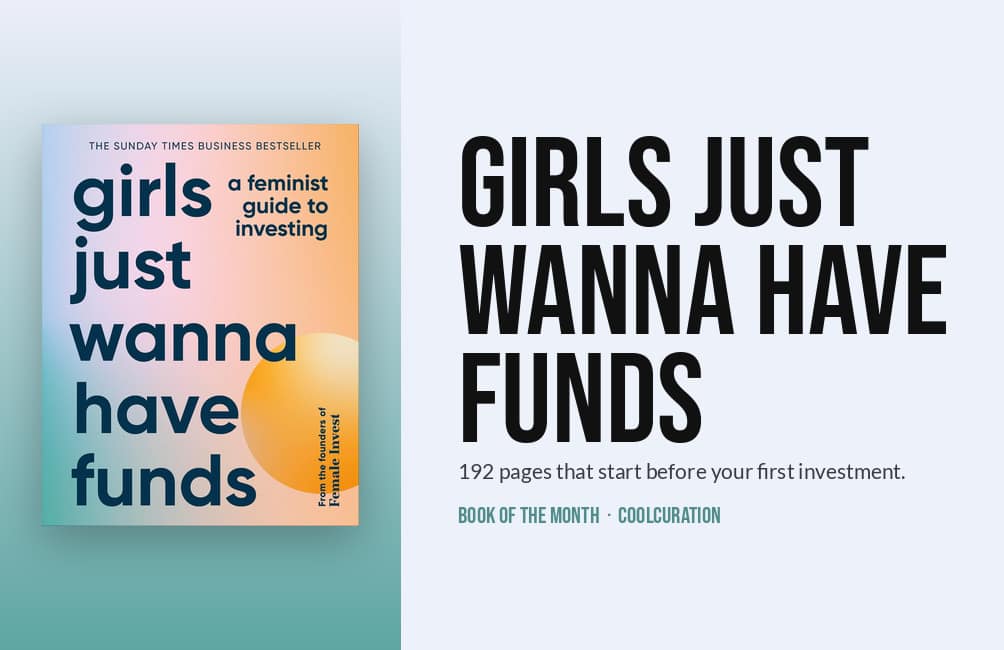
I have avoided personal finance books for most of my thirties. The ones I picked up seemed to be written by men who wanted me to know they had beaten the market. So this Girls Just Wanna Have Funds review comes from someone the book was not really written for, but I read it anyway. I want to have funds too. It is our Book of the Month for September 2026 and it costs less than three pints. It covers all the basics, even if it is not tailored to the UK tax rules.
Want a copy?
The hardback was £14.24 on Bookshop.org and £12.35 on Amazon UK when I checked on 18 September 2026, against a published price of £14.99.
One book a month. This was my September 2026 pick. Every edition so far, newest first, is on the Book of the Month hub.
Why this book, and why now
Three Danish women in their twenties could not find an investing book that spoke to them, so they wrote one. Anna-Sophie Hartvigsen, Emma Due Bitz and Camilla Falkenberg had already built Female Invest into a business teaching women about money. DK published the result in December 2022. It has sold well enough to carry the Sunday Times business bestseller line on the cover.
A friend put it in my hands. I would have left it there if the argument had not kept proving itself. The House of Commons Library puts the pay gap at 6.9% for full-time employees in April 2025. Across all employees it is 12.8%, because far more women work part time. Add a cost of living squeeze that has not let up. Add the long drift of wealth away from the people who earn it, towards the people who already have it. Starting earlier is one of the few things on that list a reader can do anything about.
It first appeared on this site as a bonus pick in our women's health books roundup. The argument there was that money decides whether someone can take unpaid leave or pay for a private scan. That is the pick readers asked about afterwards.
The authors are direct about what they are doing. Anna-Sophie Hartvigsen has described the book as a symbol of rebellion
. It rebels, she says, against the idea that women can't handle money, and that we don't want to learn about it
. Camilla Falkenberg puts the diagnosis more flatly: Women are interested in investing, they just don't feel included in the financial world as it is today.
Both quotes are from Female Invest's own account of writing it.
It starts in the right place
There are six chapters, and only the last two are about buying anything. That is the right call, because most people who never start are stopped by their bank balance rather than by not knowing what a share is. The book opens with the gender pay gap, then money mindset, then budgeting, then an emergency fund, and only then explains what a share is.
The emergency fund gets a real number rather than a gesture: three to six months of fixed costs, held somewhere you can reach it. Kindle readers have highlighted that line more than almost anything else in the book. It is basic as money guidance goes, which is a fair measure of how many readers it resonated with.
There is also a running strand on money set aside specifically so that a job or a relationship does not have to be endured. The book gives that pot a blunter name than I am going to write here, but the point is a good one. Having a safety net matters for life's unforeseen ups and downs, long before any of the money gets invested.
The interviews carry it
Between the chapters are interviews with women about their own money. They name what they earn, what they owe and what frightens them. Real salaries next to real debts, rather than a worked example with round numbers.
One woman explains that she never opened her pension statements, because she was afraid of what they would say. That is the barrier the book is really about: confidence rather than maths.
The book has been carefully designed, too, and reviewers keep noticing. Wide margins, colour-block spreads and heavy paper stock, at least on the hardback. You can see and feel the attention that went into it. One reviewer says it is nice enough to leave out as decoration. That is also what makes it work as a gift, where typically buying someone a book about money can easily read as a judgement on how the recipient handles their finances.
Where it loses a UK reader
My biggest frustration is that you cannot always tell which country a section is describing. It was the commonest complaint on the review sites I checked before reading, too. The publisher's own description sets the tone by talking about starting with a $1 savings fund. One UK reviewer said the same thing about the book itself: in places they could not tell whether a passage meant the UK or the US. Another simply wanted more UK focus. The types of account, tax set-up and tools a British investor would actually use are not covered in depth. That means the ISA allowance, the Lifetime ISA, pension tax relief, and the platform charges that decide what a small pot costs to run.
A UK reader can finish the book convinced, open an account and put the money somewhere that costs them tax they never needed to pay. The principles carry over, but the ISA and pension rules do not.
Reader opinion is also more split than the cover suggests. Amazon UK has it at 4.4 out of 5 from 686 ratings. Goodreads has 3.75 from 2,790, and The StoryGraph 3.73 from 195, where 4% of readers did not finish it. Those figures are from 18 September 2026. The lower scores mostly say the same thing: it stays at beginner level throughout, and if you already invest there is little here.
That criticism is fair, and it does not change who the book is for. It is a first step and says so. That is why most readers will want something more detailed before they actually start. One of the two UK books further down will do it, as will the government-backed MoneyHelper investing guides. Failing that, go where people argue about it in public: the MoneySavingExpert savings and investments board, or Monevator.
Capital at risk. The value of investments can go down as well as up and you may get back less than you invested. Past performance is not a reliable indicator of future results. Tax treatment depends on the individual circumstances of each client and may be subject to change in future. This article is about a book and is not a recommendation to invest.
Which format to buy
There is no paperback. Bookshop.org and Amazon UK both list the 2022 DK hardback as the only print edition on sale here. The real choice is print, ebook or audio.
Take the print one if you can stretch to it. Reviewers keep saying the same thing about this book. The bite-size sections and the white space are what make the information easy to take in, and both are much harder to read on a phone screen. The hardback was £14.24 on Bookshop.org and £12.35 on Amazon UK. A secondhand copy is the cheap route to the same object.
The ebook is £6.99, so it is the cheapest way in. The colour spreads reflow badly, though, so you lose most of the design that makes the print version work.
The audiobook runs 3 hours 41 minutes, read by Charlotte Gosling, and it is a straight reading rather than an adaptation. At £8.49 it is fine for the interviews. The worksheets and charts are much less engaging without the book in front of you.
Every price, format and figure sits on our Girls Just Wanna Have Funds detail page, which we keep updated.
Bookshop.org, £14.24 Amazon UK, £12.35
What to read next
The same three authors wrote Girls Just Wanna Have Impact Funds, which came out in November 2023 and is about sustainable investing. It goes sideways into ethical funds rather than deeper into the basics, so it does not fix the UK gap.
For that, two British books do the job. Claer Barrett's What They Don't Teach You About Money is written from inside the UK tax system by the Financial Times consumer editor. Iona Bain's Own It! covers investing for people who did not inherit a deposit. Either one covers the UK rules this book leaves out.
The verdict
This is a good first book, and it is useful to anyone starting with the basics of investing. It is the most welcoming introduction I have read. It refuses to make the reader feel stupid, and it spends its first half on the things that actually stop people starting.
It does not cover everything, though. The rules it explains are not the ones a British reader lives under. Line up the sequel, or one of the two UK books above, to read straight after it.
Buy it for someone who has never invested and thinks the whole subject is for other people. Buy them a UK investing book at the same time, like Claer Barrett's What They Don't Teach You About Money or Iona Bain's Own It!. On its own it will get them started and cover the basics. They will still need the UK rules from somewhere else.
FAQs
Is Girls Just Wanna Have Funds worth reading?
If you have never invested, yes. It spends its first four chapters on mindset, budgeting and an emergency fund before it explains what a share is. That is the part most beginner books skip. If you already invest, it will be revision.
How much does Girls Just Wanna Have Funds cost in the UK?
The hardback is £14.24 on Bookshop.org and £12.35 on Amazon UK, against DK's published price of £14.99. The ebook is £6.99 and the audiobook £8.49. All four were checked on 18 September 2026. Book prices move, so check before you buy.
Is it written for UK readers?
No. It is written for an international audience and the publisher's own description uses a dollar figure. ISAs, the Lifetime ISA and pension tax relief get less depth than a British reader needs. I would pair it with a UK book.
How long is the audiobook?
3 hours 41 minutes, unabridged, read by Charlotte Gosling and published by DK. It is a straight reading of the book rather than an adaptation. The charts and worksheets are much less engaging without the book in front of you.
Who are Female Invest?
Female Invest is a financial education company founded by the book's three authors. They run courses and an app for women, joined Y Combinator in 2021, and appear on the Forbes 30 Under 30 list in finance. The book came out of their course material.
Does this Girls Just Wanna Have Funds review count as advice?
No. It is my opinion of a book. CoolCuration is not authorised by the Financial Conduct Authority and nothing here is a personal recommendation. For free and impartial help with money decisions, MoneyHelper is the place to start.
More from CoolCuration
- Gifts for bookworms. Our full shelf of presents for readers, sorted by who you are buying for.
- InvestEngine. Our factual guide to the platform fees, the sign-up offer and the conditions attached. Capital at risk.
- The Creative Act by Rick Rubin. Rick Rubin on the creative process, with every UK edition and price.
- Best savings accounts UK. The current rates, updated, for money you want to keep rather than invest.
- Structured. The day planner we picked as App of the Month, with its UK pricing and what the free tier covers.
Before you go. Rates, prices and terms change. This is not financial advice and CoolCuration is not authorised by the Financial Conduct Authority. Consider speaking to a qualified adviser before making a decision about your money, and use MoneyHelper for free and impartial guidance. This article contains affiliate and referral links, which are paid links. If you click one and buy or sign up, I earn a commission or referral bonus at no extra cost to you. Brands don't choose what I feature or what I say about them.
What's trending
Recent posts
- Best Affordable Art UK 2026: 15 Prints and Originals Under £500
 Fifteen prints and originals under £500 from UK gallery shops, print studios and Saatchi Art, plus how editions, framing and Own Art work.
 - Apple Welcome Home Event: What It Means for Your UK Smart HomeApple Welcome Home event, UK view: HomeView, Apple TV 4K and HomePod mini 2 prices, release dates and the new LG cameras.
- iPhone Duo Pre-Order UK: Price, Timing and Whether to BotherThe iPhone Duo pre-order opens at 1pm UK time on 16 October. Every UK price, the case and folio, trade-in values, the eSIM catch and who should skip it.


No Comments.