
Last updated: 7 October 2026
By Stiv · Design, technology and personal finance
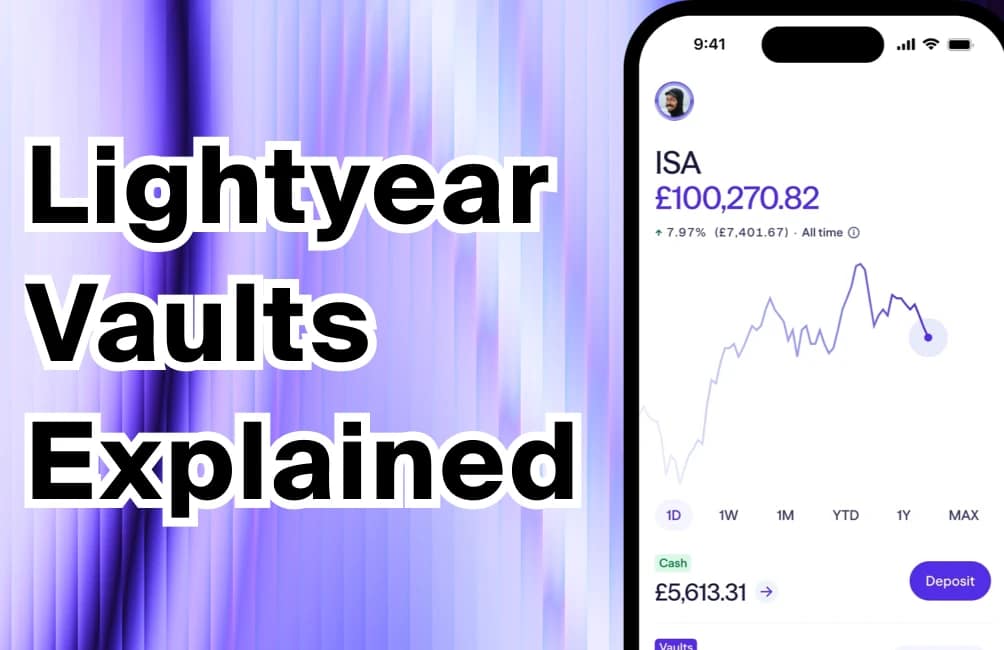
If you have been looking at Lightyear and wondering what Lightyear Vaults actually are, you are not alone. Vaults are one of the platform's standout features, yet the name does not immediately explain what they do. In short, Lightyear Vaults let you earn interest on cash through low-risk money market funds. So, here is a clear guide to how they work, the current rates by currency, the fees, the risks, and how they compare to a savings account.
Capital at risk. The value of investments can go down as well as up and you may get back less than you invested. Past performance is not a reliable indicator of future results.
What are Lightyear Vaults?
Lightyear Vaults are money market funds (MMFs) offered inside the Lightyear investing app. When you move cash into a Vault, your money goes into an AAA-rated fund managed by BlackRock, the world's largest asset manager. These funds hold short-term debt from governments, banks and other highly rated institutions, which is why they are considered low risk next to shares or other funds. You can read Lightyear's own explanation on its Vaults page.
Even so, your capital is still at risk, because Vaults are investments rather than savings accounts. However, the risk is low, and the returns track close to the relevant central bank rate. In the UK, that means the GBP Vault follows the Bank of England base rate, which currently sits at 3.75% according to the Bank of England.
Lightyear Vault rates by currency
Vaults come in three currencies, and each tracks a different central bank, so the rates differ. All three sit in AAA-rated BlackRock funds. Here are the current figures, taken from Lightyear's live Vault pages and shown net of the fund fee.
| Currency | Rate (AER, variable) | Annual fee | Fund |
|---|---|---|---|
| Pounds (GBP) | 3.84% | 0.20% | BlackRock ICS Sterling Liquidity Fund |
| Dollars (USD) | 3.89% | 0.25% | BlackRock ICS US Dollar Liquidity Fund |
| Euros (EUR) | 2.44% | 0.20% | BlackRock ICS Euro Liquidity Fund |
As you can see, the GBP and USD Vaults pay far more than the EUR Vault right now, simply because UK and US interest rates are higher than the eurozone's. Naturally, these rates are variable and move with their central banks, so always check the live figure in the app before you commit.
How do Vaults work in practice?
Using Vaults is straightforward. First, open the Lightyear app and go to the Vaults section. Then choose your currency, and transfer cash from your Lightyear balance. After that, your money starts earning interest daily, paid monthly, and you can withdraw back to your main balance at any time with no lock-in period. There is also no minimum, so you can start from as little as £1.
On fees, Lightyear charges 0.20% a year on GBP and EUR Vaults, or 0.25% on USD Vaults. Crucially, the advertised rate is the net rate after this fee, so what you see is what you get. For example, the Sterling fund's gross yield is higher, but Lightyear quotes the 3.84% figure once the 0.20% fee is taken off. You can confirm the current pricing on the Lightyear pricing page.
Vaults vs a savings account
The most common question is how Vaults compare to a normal savings account. There are two differences that really matter.
First, protection works differently. A bank savings account is covered by the Financial Services Compensation Scheme (FSCS). Eligible deposits are protected up to £120,000 per eligible person per UK-authorised bank, building society or credit union by the FSCS (since 1 December 2025), so your cash is safe even if the bank fails. By contrast, Lightyear Vaults are investments, so your capital is at risk. In theory, if the underlying money market fund fell in value you could lose money, although this is very rare for AAA-rated funds.
Second, access and rates compare well. Vaults often match or beat easy-access savings accounts, and the money stays instantly accessible inside the Lightyear app. Therefore, if you are already investing with Lightyear, Vaults can be a convenient home for cash between trades.
Vaults vs the Cash ISA and uninvested cash
Lightyear also offers a Cash ISA paying 3.75% AER (variable), which tracks the Bank of England base rate. Unlike Vaults, the Cash ISA is a genuine cash product with flexible access, and the interest is tax-free within your annual £20,000 ISA allowance. So, the Cash ISA may suit those prioritising tax-free interest and savings-like behaviour. Vaults, meanwhile, sit within your General Investment Account or Stocks and Shares ISA.
Tax treatment depends on the individual circumstances of each client and may be subject to change in future. On top of that, Lightyear now pays around 1% on uninvested GBP cash, so idle money earns a little even before you move it into a Vault. For cash you plan to invest soon, leaving it in your main balance is fine. For longer-term cash, a Vault or the Cash ISA makes more sense. You can weigh up the wider options in our guide to the best investment ISA for 2026.
Are Lightyear Vaults safe?
The funds behind Vaults are managed by BlackRock and rated AAA by major credit agencies. Because they invest in very short-term, high-quality debt, they are among the lowest-risk investment products available. Still, they are not savings accounts, and they are not covered by FSCS deposit protection.
On the platform itself, Lightyear U.K. Ltd is authorised and regulated by the Financial Conduct Authority (FRN 987226), and client assets are held separately from Lightyear's own. Eligible investments are protected up to £85,000 per person per FCA-authorised firm by the FSCS. Importantly, Lightyear holds customer cash with UK banks such as Citibank and NatWest, alongside the money market funds, and it confirms that FSCS protection applies to client money held with banks, not to money held in the money market funds. So, as with all investing, your capital is at risk.
Who are Vaults best suited to?
Vaults work well if you want to earn interest on cash while you decide what to invest in, need a flexible place to park money between trades, want returns close to the base rate without opening a separate account, or simply prefer keeping everything in one app. However, they are less ideal if you need guaranteed FSCS deposit protection on every penny, in which case a high-interest bank savings account would suit you better.
How to get started with Vaults
You need a Lightyear account to use Vaults. If you do not have one yet, you can sign up through the referral link on our Lightyear referral page and qualify for a free share reward (terms and qualifying conditions apply; rewards are randomly selected from a pool and most are small).
Capital at risk. The value of investments can go down as well as up and you may get back less than you invested. Past performance is not a reliable indicator of future results.
See the Lightyear sign-up offer
For the full breakdown of fees, ISAs, pros and cons, read our Lightyear review UK.
Frequently asked questions
Can I lose money in Lightyear Vaults?
Technically yes. Vaults invest in money market funds, which carry a small amount of risk. However, these are AAA-rated funds managed by BlackRock and designed to preserve capital, so the risk of loss is very low, though never zero.
What rate do Lightyear Vaults pay?
As of 7 October 2026, GBP Vaults pay 3.84% AER (variable), USD Vaults 3.89% and EUR Vaults 2.44%. Each rate is shown after Lightyear's fund fee and moves with the relevant central bank, so it can change at any time.
Are Vaults better than a savings account?
It depends on your priorities. Vaults offer competitive rates and instant access inside the app, but they are not FSCS deposit-protected like a bank savings account. If guaranteed protection matters most, a savings account is safer. If convenience and rates within your investing app matter more, Vaults are a strong option.
Can I hold Vaults inside an ISA?
You can hold Vaults within the General Investment Account or the Stocks and Shares ISA. For tax-free interest on cash specifically, Lightyear's Cash ISA at 3.75% AER is usually the simpler choice.
How quickly can I withdraw from Vaults?
Withdrawals back to your Lightyear cash balance are processed quickly, usually on the same working day. There is no lock-in period or notice requirement.
More from CoolCuration
- Best savings accounts UK: compare FSCS-protected easy-access rates against the Vault figures.
- Cheapest investment app UK: FX fees compared: see how Lightyear stacks up on currency costs.
- Gift guide for foodies: treat someone while your Vaults quietly earn interest in the background.
- Emma app: track your Lightyear holdings alongside your other accounts in one dashboard.
- Octopus Energy referral: trim your energy bill and feed the difference into your Vault.
Disclaimer: This article is for information only and does not constitute financial advice or a personal recommendation. Rates, fees and terms are variable and can change, so always check Lightyear's latest terms and consider speaking to a qualified financial adviser before investing. Capital at risk. The value of investments can go down as well as up and you may get back less than you invested. Past performance is not a reliable indicator of future results. CoolCuration is not authorised by the Financial Conduct Authority. This article contains affiliate and referral links, which are paid links. If you click one and buy or sign up, I earn a commission or referral bonus at no extra cost to you. Brands don't choose what I feature or what I say about them.
What's trending





Recent posts
- New on Mobbin October 2026: Jomo, Delphi, Lloyds and More
 New on Mobbin October 2026: Jomo, Delphi, Lloyds and five more apps, with the consent, search and unlock screens worth studying.
 - British Art Fair 2026 ReviewArt fairsSaatchi Gallery A Sickert study best in show, a Hockney for £800, and naff AI art Last updated: 28 September 2026. I checked every price and date in this British Art Fair review against the dealers' labels and the fair's own pages. By Tristan · Arts, exhibitions and creative culture This is an opinion… Read more: British Art Fair 2026 Review
- Quentin James McCaffrey at Alison Jacques ReviewLast updated: 6 October 2026 By Tristan · Arts, exhibitions and creative culture This is an opinion piece. Views expressed are the author's own and do not constitute professional advice. Cool Factor: 3/5 Quentin James McCaffrey's first UK solo show was on at Alison Jacques from 3 September to 3 October 2026. Comprising fifteen small… Read more: Quentin James McCaffrey at Alison Jacques Review


No Comments.