
Last updated: 27 August 2026
By Stiv · Design, technology and personal finance
This article contains affiliate and referral links, which are paid links. If you click one and buy or sign up, I earn a commission or referral bonus at no extra cost to you. Brands don't choose what I feature or what I say about them.
If you run a small business in the UK and you want to switch business energy, you're in the right place. Most business owners never actively choose their energy supplier. They just inherit whoever supplied the premises and carry on paying whatever lands in the inbox. That's an expensive way to run things, and once you understand why, the fix is surprisingly simple.
This article is for informational purposes only and does not constitute business or financial advice. Energy prices change frequently. Always verify current rates directly with suppliers.
Business energy is a different world to domestic. There's no price cap protecting you, the VAT is higher, and the market is full of brokers trying to lock you into long contracts. Several of us on the CoolCuration team are freelancers or run small businesses, so we've been through this process ourselves. Here's what we learned.
Why business energy is different to domestic
The single biggest difference between domestic and business energy is protection. If you're a household customer, Ofgem's energy price cap limits what suppliers can charge per unit. For Q4 2026, the domestic cap sits at £1,723 per year for a typical household. That cap does not apply to business energy at all.
As a result, businesses are fully exposed to market rates. On top of that, standard VAT on business energy is 20%, compared to 5% for domestic customers. You also pay the Climate Change Levy on every kilowatt-hour of electricity and gas you use. For a small business, these extra charges add up fast.
To put it plainly: nobody is protecting you. There's no Energy Price Guarantee for businesses. You're on your own in the market, which is exactly why choosing the right supplier matters more than it does at home.
What are businesses actually paying?
In early 2026, average small business electricity rates sit around 27 to 29p per kWh, with standing charges of roughly 42 to 46p per day. Medium-sized businesses pay closer to 26p per kWh. These figures vary by region, contract type, and consumption level. However, they remain significantly higher than pre-2021 levels, when most businesses paid under 10p per kWh for electricity.
Watch out for business energy brokers
If you've ever received a cold call about your business energy contract, you've already encountered the broker market. Business energy brokers earn commission from the supplier when they place you on a tariff. In theory, they help you compare deals. In practice, some brokers lock businesses into three-to-five-year contracts with hefty exit fees, and the commission structure means they don't always have your best interests at heart.
Cold-calling business energy brokers are a well-documented problem in the UK. Ofgem has raised concerns about third-party intermediary practices, and Citizens Advice regularly fields complaints from businesses who feel misled.
Our advice: if someone cold-calls you about your business energy, hang up. You can switch directly with most major suppliers online in minutes. There's no need for a middleman, and you'll have full visibility of exactly what you're signing up for.
How to switch business energy
If you want to switch business energy, the actual process is more straightforward than most people expect. Here's what you'll need to hand before you start:
- Your business name and premises address
- Your current energy supplier name
- Your meter serial number (printed on your meter or on your bill)
- Your estimated annual consumption in kWh (also on your bill, or you can ask your current supplier)
Once you have those details, visit the website of the supplier you want to move to, enter your postcode, and get a quote. If you're happy with the price, you can sign up online. Your new supplier handles the rest of the switch, including notifying your old supplier.
How long does it take?
Under the Energy Switch Guarantee overseen by Energy UK, the switch should take no more than 21 calendar days from the date your new supplier receives your completed application. In practice, many switches complete in two to three weeks. Your energy supply won't be interrupted at any point. The same wires and pipes deliver your electricity and gas regardless of who bills you.
Before switching, check your current contract terms. If you're still within a fixed-term contract, your existing supplier may charge an exit fee. However, if you're within 49 days of your contract end date, suppliers cannot charge exit fees under Ofgem rules. If your contract has already ended and you haven't renewed, you're likely on a costly "deemed rate" or rollover tariff, which means you can switch immediately with no penalty.
Why we switched to Octopus Energy for business
When we first set up as a business, energy was the last thing on the list. We just stayed with whoever supplied the premises. Eventually, we compared rates and decided to switch business energy to Octopus. The process was the same as domestic: enter your postcode, compare, switch. No broker, no phone calls, no lock-in on the flexible tariff.
Here's what stood out to us:
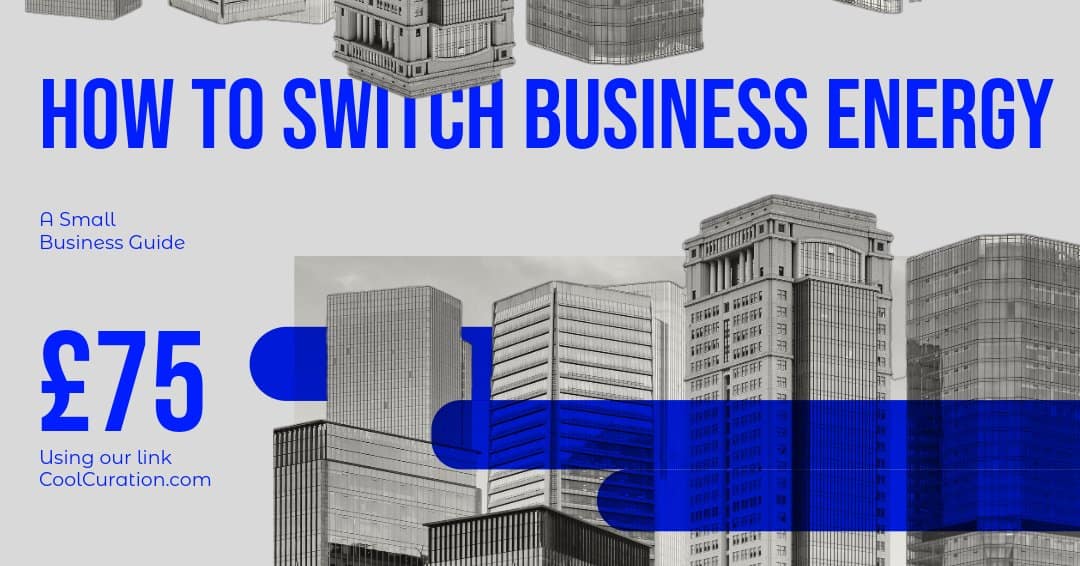
- £75 referral credit for new business customers when you join through a referral link
- No exit fees on the flexible (variable) business tariff, so you're free to leave whenever you like
- 100% renewable electricity backed by Renewable Energy Guarantees of Origin
- The same app and customer service that domestic customers rate so highly
- Online switching with no need for a broker or phone negotiation
The fact that you can switch to Octopus without a broker, without a long contract, and without exit fees on the flexible tariff is unusual in business energy. Most suppliers don't make it this easy. Fixed-term business tariffs (12 or 24 months) may carry exit fees if you leave early, so check the terms before committing if you prefer a fixed rate.
If you're interested, our referral page has the full details and a direct link:
Switch your business to Octopus (£75 credit)This is a referral link. If you switch through it, both you and CoolCuration receive credit. It doesn't affect the price you pay.
Do I qualify for 5% VAT on business energy?
This is a big one, especially for sole traders and home-based businesses. Most UK businesses pay 20% VAT on their energy bills by default. However, you may qualify for the reduced 5% rate if your energy usage falls below the de minimis thresholds set by HMRC.
The de minimis thresholds are:
- Electricity: less than 1,000 kWh per month (roughly 33 kWh per day)
- Gas: less than 4,397 kWh per month (roughly 145 kWh per day)
If your consumption falls below these levels, your supplier should charge you 5% VAT instead of 20%. In addition, charities using energy for non-business purposes and mixed-use premises where over 60% of energy use is domestic also qualify for the reduced rate.
The catch? Suppliers assume you're paying 20% unless you tell them otherwise. Many eligible businesses overpay for years simply because they never submitted a VAT declaration form. Contact your supplier, request the form, and check your bills. You can also claim back overpaid VAT for up to four years.
What about the Climate Change Levy?
The Climate Change Levy is an environmental tax charged on every unit of energy supplied to UK businesses. From 1 April 2026, the CCL rate for both electricity and gas is 0.801p per kWh. For a small office using around 2,000 kWh of electricity per month, that adds roughly £16 per month, or about £192 per year.
Importantly, if you qualify for the reduced 5% VAT rate (because you're below the de minimis thresholds), you're also exempt from paying the CCL. So checking your eligibility for reduced VAT can save you twice over.
Larger businesses in energy-intensive industries can apply for a Climate Change Agreement through the Environment Agency, which offers discounts of up to 92% on electricity CCL and 89% on gas CCL. For most small businesses, though, the de minimis exemption is the relevant one.
Sole traders and freelancers working from home
If you work from home, you probably don't need to switch to a business energy contract at all. Your domestic gas is charged at 5% VAT, domestic electricity now carries none, and you are protected by the Ofgem price cap. Switching to a business contract would mean losing both of those benefits.
Instead, you can claim a proportion of your domestic energy bill as a business expense through your self-assessment tax return. HMRC offers two methods:
Simplified expenses (flat rate): If you work from home for at least 25 hours per month, you can claim a flat monthly amount based on your hours. The rates for 2025/26 are £10 per month (25 to 50 hours), £18 per month (51 to 100 hours), or £26 per month (101 hours or more).
Actual costs method: You calculate the proportion of your household running costs (heating, electricity, broadband, council tax) used for business purposes, typically based on the number of rooms and hours worked. This method often produces a higher claim, but requires more detailed record-keeping.
For full details, see the HMRC simplified expenses guidance on GOV.UK.
If you work from home and you're on domestic energy with Octopus, you're already on the right track. Our domestic Octopus referral page gets you £50 credit when you switch.
Is Octopus competitive for business energy?
Octopus has grown to serve over 7 million UK customers across domestic and business accounts, and it consistently ranks highly for customer service. For small businesses, the main draw is transparency. Pricing is clear, contracts are flexible, and you don't need to negotiate through a broker to get a decent rate.
That said, the right supplier for your business depends on your usage, location, and whether you want a fixed or variable rate. Always compare quotes from at least two or three suppliers before making a decision. If you're coming off a fixed contract, start comparing around six weeks before it ends to avoid rolling onto an expensive deemed rate.
For broader context on how Octopus is regulated and what protections apply, see our post on whether Octopus Energy is regulated by Ofgem. And if you want to know about exiting any energy contract, our guide to whether you can leave Octopus anytime covers the details.
This article is for informational purposes only and does not constitute business or financial advice. Energy prices and tariff terms change regularly. Always verify current rates and contract details directly with the supplier before switching. If you're unsure about your tax position, consider speaking to a qualified accountant. This article contains affiliate and referral links, which are paid links. If you click one and buy or sign up, I earn a commission or referral bonus at no extra cost to you. Brands don't choose what I feature or what I say about them.
Frequently asked questions
Is business energy more expensive than domestic?
Generally, yes. Business energy attracts 20% VAT, against 5% on domestic gas and none on domestic electricity, the Climate Change Levy adds further cost, and there's no price cap to limit what suppliers can charge. However, some small businesses with low usage can qualify for the reduced 5% VAT rate and CCL exemption, which narrows the gap.
Does the energy price cap apply to business energy?
No. The Ofgem energy price cap only applies to domestic customers on standard variable tariffs or prepayment meters. Business energy is priced on the open market, which means your rates depend entirely on your contract and supplier.
Can I switch business energy without a broker?
Yes. Most major suppliers, including Octopus Energy, EDF, British Gas Business, and E.ON, allow you to get a quote and switch entirely online. You don't need a broker, and switching directly gives you full control over what you're signing up for.
How long does it take to switch business energy in the UK?
Under the Energy Switch Guarantee, the process should take no more than 21 days. Many switches complete within two to three weeks. Your supply won't be interrupted during the switch.
What VAT rate do I pay on business energy?
Most businesses pay 20% VAT. However, businesses using less than 1,000 kWh of electricity per month or 4,397 kWh of gas per month qualify for the reduced 5% rate. Charities and mixed-use premises may also qualify. You'll need to submit a VAT declaration form to your supplier.
Can I get Octopus Energy for my business?
Yes. Octopus is licensed as both a business electricity and business gas supplier. You can switch online in about five minutes. New business customers who join through a referral link receive £75 account credit.
Is Octopus Energy good for small businesses?
It works well for small businesses that value transparency, flexible contracts, and 100% renewable electricity. The flexible tariff has no exit fees, so you're not locked in. For the latest rates, get a quote directly from Octopus using your business postcode.
Can I claim energy costs if I work from home?
Yes. If you're self-employed, you can claim a proportion of your home energy costs as a business expense. HMRC's simplified expenses method offers flat rates of £10 to £26 per month depending on hours worked. Alternatively, you can use the actual costs method to claim a proportion of your household bills. Employees may also be able to claim £6 per week if their employer doesn't reimburse home working costs, though the rules are tightening from April 2026.
More from CoolCuration
- Cut your household bills in the UK — practical tips for reducing energy, broadband, insurance, and subscription costs across the board.
- Wise (formerly TransferWise) — if your business sends or receives money internationally, Wise offers some of the best exchange rates available.
- Aeropress Premium coffee maker — the home office essential we didn't know we needed. Excellent coffee, minimal fuss.
- Chip savings app — automated savings that work alongside your business or personal accounts.
- Best savings account UK — where to park your business reserves or personal savings for the best rates right now.
- TopCashback referral code — earn cashback on business essentials like insurance, broadband, and office supplies.
What's trending




Recent posts
- iPhone Duo Pre-Order UK: Price, Timing and Whether to Bother
 The iPhone Duo pre-order opens at 1pm UK time on 16 October. Every UK price, the case and folio, trade-in values, the eSIM catch and who should skip it.
 - Best Desk Accessories UK 2026: 10 Picks From My DeskLast updated: 5 October 2026. I checked every price in this best desk accessories UK guide at the shop each button points to that day. By Stiv · Design, technology and personal finance Affiliate disclosure: This article contains affiliate and referral links, which are paid links. If you click one and buy or sign up,… Read more: Best Desk Accessories UK 2026: 10 Picks From My Desk
- Freelands Painting Prize 2026 Review: Twelve New Painters, One DisagreementTwelve new UK painters, free near the Barbican until 31 October. We gave the Freelands Painting Prize 2026 a 4/5, and our favourite wasn't the winner.


No Comments.