
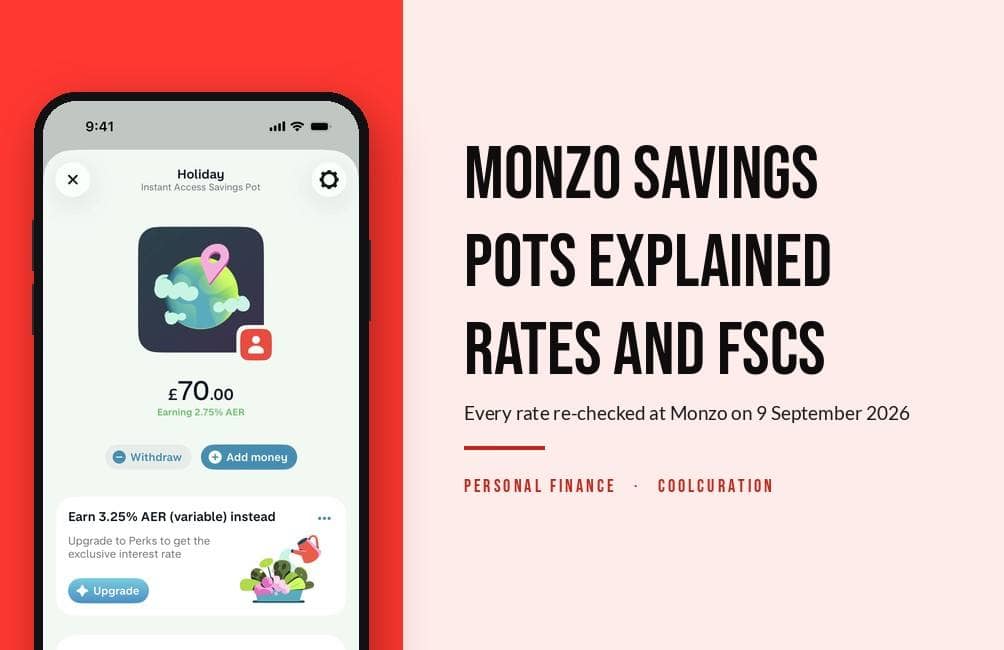
Last updated: 13 October 2026. I re-checked every Monzo savings pots rate against Monzo's own pages on 13 October 2026.
By Stiv · Design, technology and personal finance
Monzo savings pots are one of the most useful things in UK banking. Yet plenty of people with a Monzo account still leave spare cash in the main balance, earning nothing. A pot takes about thirty seconds to set up. Better still, it starts earning the same day. No paperwork, no second app, no waiting.
I keep six or seven pots running at any one time. Bills, holiday, an emergency fund, two savings pots earning interest. Plus one labelled "don't touch" that I absolutely do touch. Below is what each type pays, what the higher rates cost, and where the money actually sits.
This article is for general information only and does not constitute financial advice. Savings rates are variable and change often. Always check the current rate in the Monzo app or at monzo.com first. CoolCuration is not authorised by the Financial Conduct Authority. This article contains affiliate and referral links, which are paid links. If you click one and buy or sign up, I earn a commission or referral bonus at no extra cost to you. Brands don't choose what I feature or what I say about them.
Not on Monzo yet?
Sign up through my referral link. A random reward from £5, up to £50 (sometimes up to £100), arrives once you make your first card payment.
Want the wider Monzo picture? My Monzo guides hub has the account review, the paid plans and the investing side, all in one place.
What are Monzo pots?
A pot is a space inside your account where money sits apart from your main balance. You name it, add a photo and set a goal, and it stops the money looking spendable. Monzo now offers three kinds. Only one pays interest, so the distinction matters.

Monzo's own Choose a type of Pot screen, September 2026.
Regular pots
First, regular pots earn no interest. Instead they do the organising: bills, groceries, the holiday fund you keep raiding. Their real trick, however, is that money can leave them directly. Monzo lets you pay Direct Debits and standing orders straight from a Regular pot. Furthermore, on a paid plan you can point a virtual card at one, so card spending leaves that pot rather than your main balance.
Still, one honest catch sits in Monzo's own wording. If the pot runs short, Monzo takes what is there. Then it covers the rest from your main account, and from your overdraft if you have one enabled. A bills pot therefore protects your budget, not your balance.
Collection pots
Collection pots are the newest of the three, and they are the reason this guide needed rewriting. Monzo describes them as a way to collect money from other people for birthdays, trips, meals or group purchases. You either invite people who already use Monzo or share a link, and contributions land in the pot.
They solve the group-chat spreadsheet problem rather than the saving problem. Monzo lists interest against savings pots only. So treat a Collection pot as somewhere to gather money, not to grow it. For a shared holiday fund, collect there and move the balance into a savings pot afterwards.
Savings pots
Finally, savings pots are the ones that pay. Monzo offers two shapes, Instant Access and Select Access, plus a Cash ISA version of each. Importantly, the rate on all four depends on your plan. You can hold up to 20 pots on a personal or joint account.
What rates do Monzo savings pots pay?
Every rate below is AER and variable. I read all of them on Monzo's own savings page on 13 October 2026. Because the rate you get depends on your plan, the table is split by tier rather than by product.
Instant Access savings pots
Typically this is the one I use most. Money moves in and earns from that day. It comes back out instantly, with no penalty and no notice. There is no minimum deposit, so a penny is enough to open one, and the cap is £1,000,000. Monzo then pays the interest into the pot on the 1st of each month.
Rates by plan: 2.75% AER (variable) free, 3.00% AER (variable) Extra, 3.25% AER (variable) Perks, 3.50% AER (variable) Max. In other words, Perks adds half a point over the free rate. Max adds three quarters.
Select Access savings pots
Select Access, by contrast, pays more for withdrawing less. It runs at 3.15% AER (variable) on free and Extra, and 3.65% AER (variable) on Perks and Max. That is conditional: two or fewer withdrawals a year from that pot. The minimum deposit is £500 and the cap is again £1,000,000.
Make a third withdrawal and the rate drops until that pot's anniversary. It falls to 2.60% AER (variable) on a free account, or 3.10% AER (variable) on Perks, Max, Plus and Premium. Crucially, though, the money is never locked. Monzo states plainly that you can always take it out instantly. In short, the penalty is a lower rate, not a delay.
The allowance is counted per pot. So split a big balance across two or three Select Access pots, and one withdrawal only costs you the rate on the pot you touched. That is the most useful thing on this page and Monzo does not advertise it.
Cash ISA pots
Monzo mirrors both shapes as Cash ISAs, and the rates match exactly. Instant Access: 2.75% / 3.00% / 3.25% / 3.50% AER (variable). Select Access: 3.15% / 3.15% / 3.65% / 3.65% AER (variable). The ISA allowance for 2026/27 is £20,000 across all your ISAs. Moreover, Monzo's Cash ISAs are flexible. Money taken out and replaced in the same tax year does not eat the allowance twice. You can also run several pots inside one ISA.
Tax treatment depends on the individual circumstances of each client and may be subject to change in future.
Trust the app, not this page. Every figure above is variable and Monzo can change it at any time. I checked them on 13 October 2026. The Bank of England's next rate decision falls on 5 November 2026, so they could move within days. The rate shown in your Monzo app, and on monzo.com, is the one to act on.
Is the higher rate worth paying for?
Ultimately that depends on your balance. A plan fee is a fixed cost; a rate boost is not. Perks costs £9 a month, or £108 a year. Meanwhile the gap between the free and Perks Instant Access rates is half a percentage point. Half a point only covers £108 once you are holding somewhere around £21,600.
Savings alone rarely justify the upgrade, then. The plan makes sense when the other benefits are worth something to you. Otherwise it does not. I have gone through the full sums in my Monzo Perks verdict. Meanwhile the tier prices and dates live in my Monzo Perks price increase breakdown.
Get Monzo (rewards from £5, up to £50)
How FSCS protection works with Monzo savings pots
Monzo used to run a savings marketplace. Partner banks such as Shawbrook held the money, and Monzo supplied the app. Now that has gone. Today Monzo's savings and Cash ISA pages name no partner bank. Instead, Monzo says your deposits sit with Monzo itself, under its own banking licence.
So the protection is straightforward. Eligible deposits are protected up to £120,000 per eligible person per UK-authorised bank, building society or credit union by the FSCS (since 1 December 2025). The deposit-taker here is Monzo Bank Limited, FRN 730427.
Watch the total rather than the individual pots, though. Your current account, regular pots, savings pots and Cash ISA count as one pool for FSCS purposes. They all sit with one bank. Two people with a joint account get their own limits, so £120,000 each. The FSCS sets out exactly what counts if you are close to the ceiling.
Setting up your first Monzo savings pot
Setting one up usually takes under a minute. Open the app and go to the savings area. Tap to create a pot, pick Instant Access or Select Access, name it, then make the first deposit. Essentially, that is the whole job.
After that, two features do the saving for you. Round-ups take every card payment up to the nearest pound and send the change to a pot. It adds up faster than it sounds. Similarly, Salary Sorter splits your pay between pots on the day it lands. I sort £200 into a savings pot on payday, before I can spend it. That is the entire strategy.
There is also the 1p Saving Challenge, which saves 1p on day one, 2p on day two and so on. Notably, its pot pays 5% AER (variable), beating every standard savings pot. However, it needs a paid plan rather than the free account. Worth knowing: it runs on Extra at £3 a month, so it is never an argument for paying for Perks.
What is new for 2026/27
Three things have changed since I last rewrote this guide, and one of them is a whole new pot type.
Collection pots arrived. Group saving used to mean one person holding everyone's money in a regular pot and keeping a tally. Now Monzo does the tallying, and people who do not bank with Monzo can contribute through a shared link.
The savings marketplace is properly gone. Everything now sits under Monzo's own licence. Admittedly, that simplifies the FSCS picture. On the other hand, you can no longer shop between providers inside the app, which is a real loss for anyone chasing a headline rate.
The Cash ISA allowance changes in 2027. From 6 April 2027 the cash ISA limit drops to £12,000 a year for savers under 65, announced at Autumn Budget 2025. Two details usually get dropped in the retelling. The overall £20,000 ISA allowance is unchanged. Savers aged 65 and over keep the full £20,000 in cash. The HMRC factsheet has the rest.
Monzo has also expanded into investing, with a Stocks and Shares ISA in the same app. Meanwhile my Monzo Invest review covers the fees. Remember that investing is a different proposition to a savings pot. Capital at risk. The value of investments can go down as well as up and you may get back less than you invested. Past performance is not a reliable indicator of future results.
Monzo savings pots vs the alternatives
Monzo is not the top of any rate table, and it does not try to be. So here is how it looks beside the accounts people weigh it against. Again, I checked all of them at the provider on 13 October 2026.
Monzo vs Chase
Chase's standard saver pays 2.25% AER variable (2.23% gross), which tracks 1.50% below the Bank of England base rate. New customers joining from 29 December 2025 can open a boosted saver within their first 31 days. That adds 2.25% fixed for 12 months, taking it to 4.5% AER variable (4.41% gross). One per customer, and afterwards you drop back to the standard rate. The deposit-taker is J.P. Morgan Europe Limited.
So Chase wins clearly for the first year, then loses. Monzo's free 2.75% sits above Chase's standard 2.25%. My Monzo vs Chase comparison goes further.
Monzo vs Chip
Chip's Easy Access Account pays 3.50% AER (variable tracker). New customers get 3.81% AER for 12 months from opening: that standard rate plus a 0.31% boost. Deposits are held with ClearBank Limited, so check for an overlap if you already save elsewhere through ClearBank.
The catch is the withdrawal rule, and it bites harder than Monzo's. Chip allows three penalty-free withdrawals in a 12-month period. A fourth cuts the rate by 2.10 points, to 1.71% or 1.40% AER for the rest of the period. Monzo's equivalent penalty takes Select Access from 3.65% to 3.10%. My Chip Prize Saver comparison covers their other account.
Monzo vs Zopa
Zopa rebuilt its account during 2026, so older comparisons are out of date. Its Access pots pay 2.95% AER (variable), from £1 up to £250,000, with withdrawals anytime. A newer Limited Access pot pays up to 4.56% AER, dropping to 2.00% AER after a fourth withdrawal, and fixed-term pots pay up to 4.65% AER. The Biscuit current account itself pays 1% AER (1% gross, variable) as standard, plus one switchable benefit a month.
Zopa therefore beats Monzo's free easy-access rate and loses to Monzo's Perks rate on Select Access. My Monzo vs Biscuit piece weighs the accounts rather than just the rates.
Monzo vs Marcus by Goldman Sachs
Marcus is the plain comparison. Its Online Savings Account pays 3.75% AER (3.69% gross, variable). That includes a 0.49% gross bonus fixed for the first 12 months. Afterwards the underlying rate is 3.24% AER (3.19% gross, variable). The deposit-taker is Goldman Sachs International Bank.
On rate alone Marcus wins today and still wins once the bonus falls away. What it does not do is budgeting, pots or bills. So the choice is between a better rate and a better account.
Trading 212 Cash ISA
Trading 212's Cash ISA tracks 0.15% below the Bank of England base rate. The Bank held that at 3.75% on 17 September 2026, so the standard rate is 3.60% AER today. Promotional boosts for new customers come and go, so read the live figure and its end date before applying. Withdrawals can take up to three business days. Consequently it is a poor emergency fund, despite being easy access on paper.
NS&I Premium Bonds
Premium Bonds pay no interest at all. Instead the annual prize fund rate funds a monthly draw. It sits at 4.35% variable from the September 2026 draw, with odds of 21,000 to 1 for each £1 bond. You can hold between £25 and £50,000, and prizes are free of UK income tax and capital gains tax.
Two things to hold in mind, though. The prize fund rate is what the pot pays out overall, not what you will get. Most holders win less than it implies, or nothing. NS&I is also backed by HM Treasury rather than the FSCS. That is a different kind of protection, not a weaker one.
Each of these beats Monzo somewhere. Chase for a first year, Marcus for the plain rate, Zopa for a mid-range easy-access rate, Premium Bonds for the lottery. None of them puts saving, spending and budgeting in the same place, which is the thing Monzo is actually selling. My best savings accounts guide ranks the market properly, and my best investment ISA guide covers the stocks and shares side. There is also every current referral offer in one place. Alternatively, see how Monzo stacks up against Starling.
Frequently asked questions
How do Monzo savings pots work?
Monzo savings pots are spaces inside your account where you set money aside and earn interest on it. You create one in the app, choose Instant Access or Select Access, then deposit money. It earns from that day. Interest is calculated daily and paid into the pot on the 1st of each month. You can name pots, set goals, and let Round-ups and Salary Sorter feed them automatically.
What interest rate do Monzo savings pots pay?
As at 13 October 2026, Instant Access pots pay 2.75% AER (variable) free, 3.00% Extra, 3.25% Perks and 3.50% Max. Select Access pots pay 3.15% AER (variable) on free and Extra. Perks and Max get 3.65%, for two or fewer withdrawals a year. All of these are variable and Monzo changes them. So check the current figure in the app, or on monzo.com, before you decide.
What is the difference between a regular pot, a Collection pot and a savings pot?
Regular pots earn nothing and exist to organise money. You can pay bills and card spending straight out of them. Collection pots let other people chip in for a group present, trip or meal. They join by invite or shared link. Savings pots are the only type that pays interest. They come as Instant Access or Select Access, each with a Cash ISA version.
Are Monzo savings pots FSCS protected?
Yes. Monzo Bank Limited (FRN 730427) holds its own UK banking licence. Therefore eligible deposits are protected up to £120,000 per eligible person per UK-authorised bank, building society or credit union by the FSCS (since 1 December 2025). That single limit covers your current account, regular pots, savings pots and Cash ISA together. They all sit with the same bank.
How many Monzo savings pots can you have?
You can hold up to 20 pots on a personal or joint account. Mix Regular, Collection and savings pots as you like. You can also run several pots inside one Cash ISA. That splits a single year's allowance across different goals.
What happens if I withdraw too often from Select Access?
Nothing is locked or delayed. The withdrawal allowance is two per year per pot. A third drops that pot's rate until its anniversary: 2.60% AER (variable) on a free account, or 3.10% AER (variable) on Perks, Max, Plus and Premium. Because the count is per pot, spreading money across two or three pots limits the damage.
Is Monzo better than Chase for savings?
For a first year, usually not. Chase's boosted saver pays 4.5% AER variable for 12 months to eligible new customers. That is well ahead of Monzo. Afterwards Chase drops to 2.25% AER variable, which is below Monzo's free rate of 2.75%. My Monzo vs Chase guide covers the switching maths.
Does Monzo have a Cash ISA?
Yes, in both Instant Access and Select Access forms, at the same rates as the standard savings pots. The allowance for 2026/27 is £20,000 across all ISA types. Monzo's Cash ISAs are flexible, so you can withdraw and replace money in the same tax year without losing that part of your allowance. From 6 April 2027 the cash ISA limit falls to £12,000 for savers under 65. Those aged 65 and over keep the full £20,000.
More from CoolCuration
- Best current account UK. The switching bonuses and account perks worth having, compared side by side.
- Railcard discount code. Knock a third off rail fares, and pay less for the card itself.
- 1Blocker. A quiet, fast content blocker that makes the whole web less exhausting.
- FYTA Beam plant sensor. Tells you what your plants need before they start dying about it.
- Gift guide for designers. Objects a design-obsessed person will actually keep on the desk.
This article is for general information only and does not constitute financial advice. All rates quoted were checked at the provider on 13 October 2026 and are variable unless stated. Savings rates, offers and terms can change at any time. Always verify the current figure directly with the provider first. Investing carries risk and your capital can go down as well as up. Consider speaking to an independent financial adviser if you need personalised guidance. CoolCuration is not authorised by the Financial Conduct Authority. This article contains affiliate and referral links, which are paid links. If you click one and buy or sign up, I earn a commission or referral bonus at no extra cost to you. Brands don't choose what I feature or what I say about them.
What's trending





Recent posts
- iPhone Duo Pre-Order UK: Price, Timing and Whether to Bother
 The iPhone Duo pre-order opens at 1pm UK time on 16 October. Every UK price, the case and folio, trade-in values, the eSIM catch and who should skip it.
 - Best Desk Accessories UK 2026: 10 Picks From My DeskLast updated: 5 October 2026. I checked every price in this best desk accessories UK guide at the shop each button points to that day. By Stiv · Design, technology and personal finance Affiliate disclosure: This article contains affiliate and referral links, which are paid links. If you click one and buy or sign up,… Read more: Best Desk Accessories UK 2026: 10 Picks From My Desk
- Freelands Painting Prize 2026 Review: Twelve New Painters, One DisagreementTwelve new UK painters, free near the Barbican until 31 October. We gave the Freelands Painting Prize 2026 a 4/5, and our favourite wasn't the winner.



No Comments.