
By Stiv · Design, technology and personal finance
This is an opinion piece. Views expressed are the author's own and do not constitute professional advice.
This article contains affiliate or referral links. If you click through and sign up I may earn a commission or referral bonus at no extra cost to you. It does not affect my editorial view.
Cool Factor: 5/5
Ten stops, one hour, and nobody asked me for a penny
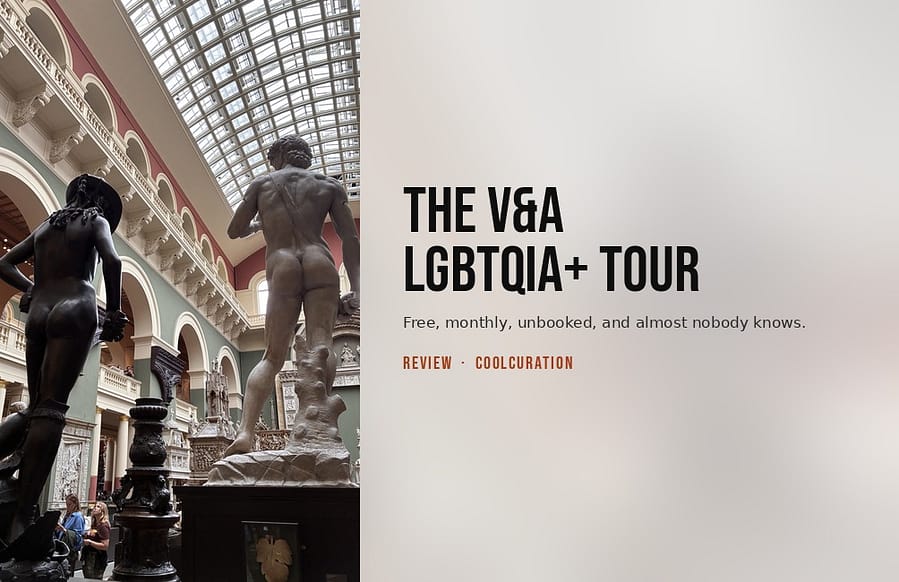
On the last Saturday afternoon in August I went along to the V&A LGBTQIA+ Tour, which is free, runs for an hour, needs no booking at all, and which almost nobody seems to know exists. I have been going to that museum for years.
What follows is the V&A LGBTQIA+ Tour in the order I saw it, stop by stop, with the discussions and insights our guide opened up along the way. Some of those got very big indeed for a Saturday afternoon.
One thing before we go in. I am queer, and this is just my view. These are my reflections after my second queer tour of the V&A, funnily enough with the same guide both times. I am not speaking for anyone else. There is no single LGBTQ+ view on any of this. Plenty of people will look at these same objects and see something completely different, and nobody appointed me to represent them. I am not the community spokesperson.
Before we start walking
What the V&A LGBTQIA+ Tour actually is
One hour, once a month, led by a volunteer, and free like everything else in the permanent collection.
The V&A's What's On page calls it the LGBTQIA+ Tour: 16.00 to 17.00, last Saturday of every month except December, free and not ticketed. Confusingly, the museum's LGBTQ page files the same thing under "Gallery tours" with no time at all, so look at What's On. The V&A's LGBTQ Working Group runs it and volunteer guides deliver it.
The short version. Free. No booking. 4pm, last Saturday of the month, nothing in December. In through the Cromwell Road entrance, then left behind the main desk, under the light-up sign in the corner. Next one: Saturday 26 September 2026, then 31 October, then 28 November.
One thing worth knowing before you go. The museum publishes an "Out in the museum" trail of ten objects online. My tour visited two of them. Everything else was our guide's own choosing, which is exactly why turning up beats reading the page.
Stop one
Apollo, Zephyr, and Hyacinth, a queer tragedy
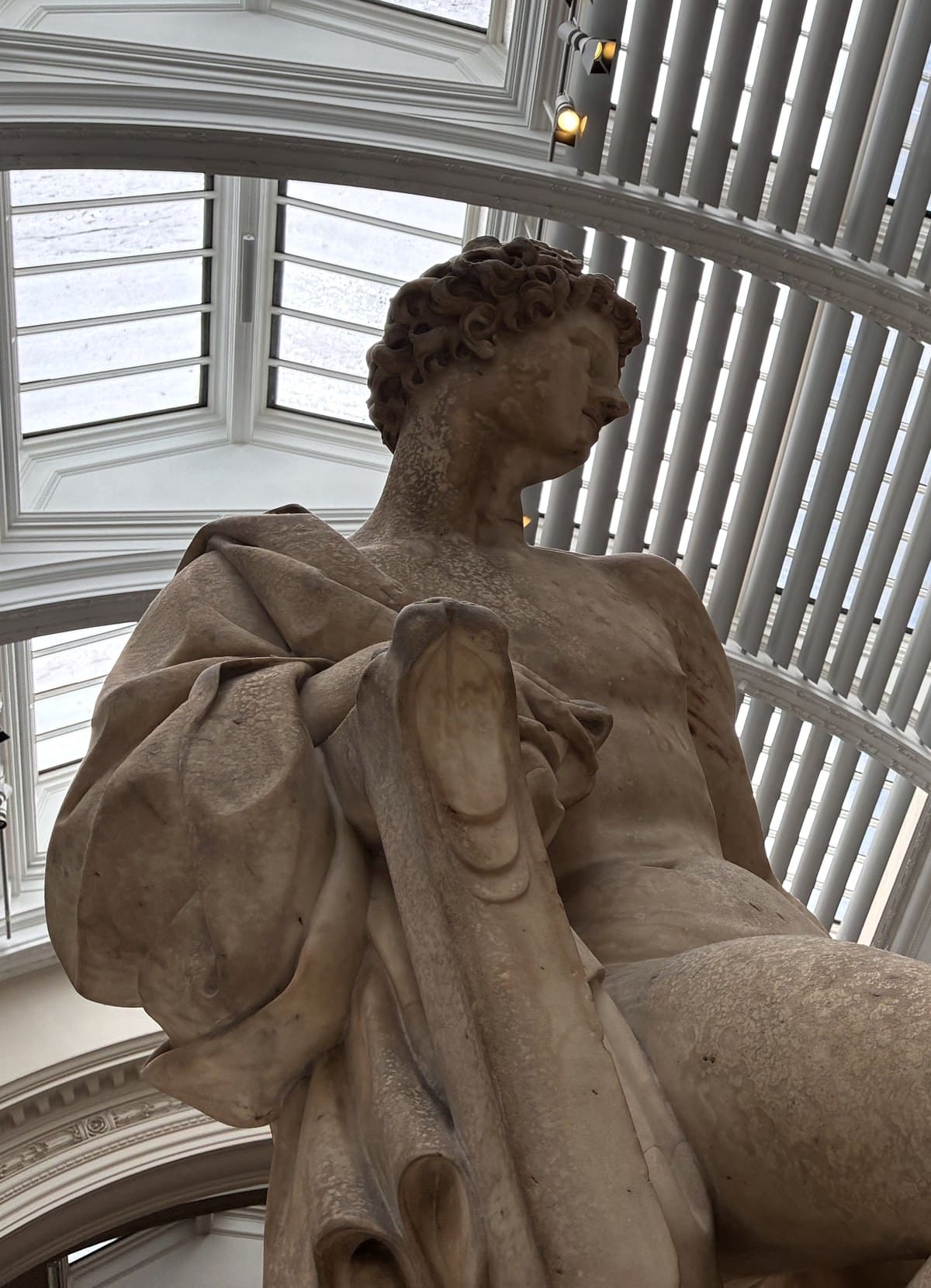
We started in Room 50a, in front of two big marbles. Apollo and Zephyr survive from thirteen figures commissioned from Pietro Francavilla in 1574, on Giambologna's recommendation, for a villa near Florence. Frederick, Prince of Wales bought the lot in 1750 and died before they shipped. They sat in crates in a shed at Kew, several vanished, and these two turned up in the grounds in 1852. Kew still owns them, which links back rather neatly to our Henry Moore at Kew review.
The myth, and the boy who keeps getting regendered
Then our guide told us the myth, which is why they are on a queer tour at all. Apollo loved Hyacinth, who was, despite Hyacinth now reading as a woman's name, a boy. Zephyrus, the west wind and a demigod in his own right, loved him too, and hated what Apollo and Hyacinth had enough to end it. A discus, blown off course by a vengeful Zephyrus, caught the boy in the face and killed him. From his blood Apollo grew a flower. A hyacinth, naturally.
The jealous wind belongs to Lucian and Philostratus. Ovid, in Metamorphoses Book 10, tells it as a plain accident with no wind in it at all, so the murder is a Greek addition to a Roman story.
Stand in that room, though, and you get the two of them side by side with a space maybe ready for Hyacinth in between. Both wanted the same boy. One killed him to stop the other having him, which is a proper queer tragedy, and one I would love to see made into an IMAX special by Nolan.
It is also a story that has been retold and recast plenty of times since with Hyacinth as a woman. Queer erasure, anyone?
The gap between them may or may not be intentional on the curator's part, but it was poignant to me, and as you will read further down, queer presence recorded as an absence or erasure turned out to be a theme of the afternoon.
Queer people and flowers, a little geek-out on the history
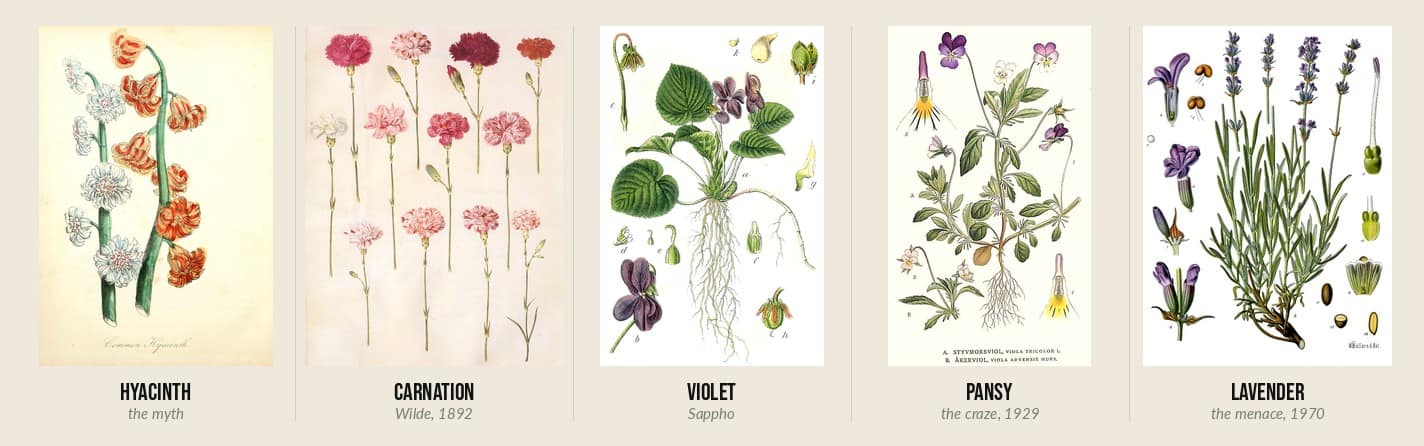
Our guide planted the bulb here, and my mind ran off with it. Queer people have used flowers as code for centuries. It works because the people meant to read the signal can read it, and everybody else just sees a nice flower. Kew, who lend the statues, have published their own piece on flowers that became queer symbols, which is a pleasing circle.
Hyacinth is where this starts, for me anyway. A boy loved by two gods, killed by the jealousy between them, and left behind as the flower that carries his name.
Green carnations. Wilde and friends wore them to the first night of Lady Windermere's Fan in 1892. Asked what it meant, he said "nothing whatever, but that is just what nobody will guess". Two years later Robert Hichens published The Green Carnation anonymously. Its two leads were plainly Wilde and Lord Alfred Douglas, and the flower stuck to them both. The book was pulled after the 1895 trial. Historians doubt it ever really worked as a badge at the time, though. The coded reading looks like something we added afterwards, which is its own small lesson about reading meaning back into objects.
Violets, pansies and lavender
Violets. Sappho, the poet from Lesbos, gives us both lesbian and sapphic. Violets turn up in the garlands her surviving fragments describe. Writers reclaimed her in the late nineteenth century. So by the early twentieth century, women in Paris who read Sappho wore violets as a signal that they loved women. The 1926 play The Captive then put an exchange of violets on stage between two women. Women in the New York audience wore them in solidarity.
Pansies. This one arrives as an insult. Pansy meant an effeminate man, and it stuck hard enough to name an era. The pansy craze was the queer nightlife of the late 1920s and early 1930s, running in New York, Chicago, Los Angeles and San Francisco. Drag performers played to mixed crowds in the open. Then Depression-era policing and moral campaigning shut it down.
Lavender. Same pattern, later. The colour had attached itself to queer people by the mid twentieth century. That is why the American purge of gay and lesbian government workers is remembered as the Lavender Scare. Then in 1969 Betty Friedan, running NOW, called lesbians a lavender menace. She thought they threatened the women's movement's image. On 1 May 1970 the women she meant printed the phrase on t-shirts and wore it at the Second Congress to Unite Women. Insult into badge, again.
Flowers were one secret language, Polari was another
The two overlap. Polari, the British queer slang, called the police Lily Law. It did the same job with words, and it was built out of fairground Parlyaree, rhyming slang, backslang, Italian, Yiddish and Romani. It let people talk to each other in public while homosexuality was still a crime. Then Julian and Sandy took it to around nine million Round the Horne listeners a week in the 1960s. There is a decent argument that the exposure is what killed it, because a secret language stops working once everybody is in on the joke.
Notice as well that queer, pansy and lavender all started life as insults and got taken back. I use queer about myself, though I would not mind being called a hyacinth either. Just keep me away from the discus, please.
Stop two
The Jameel Gallery, where beauty was not sorted by gender
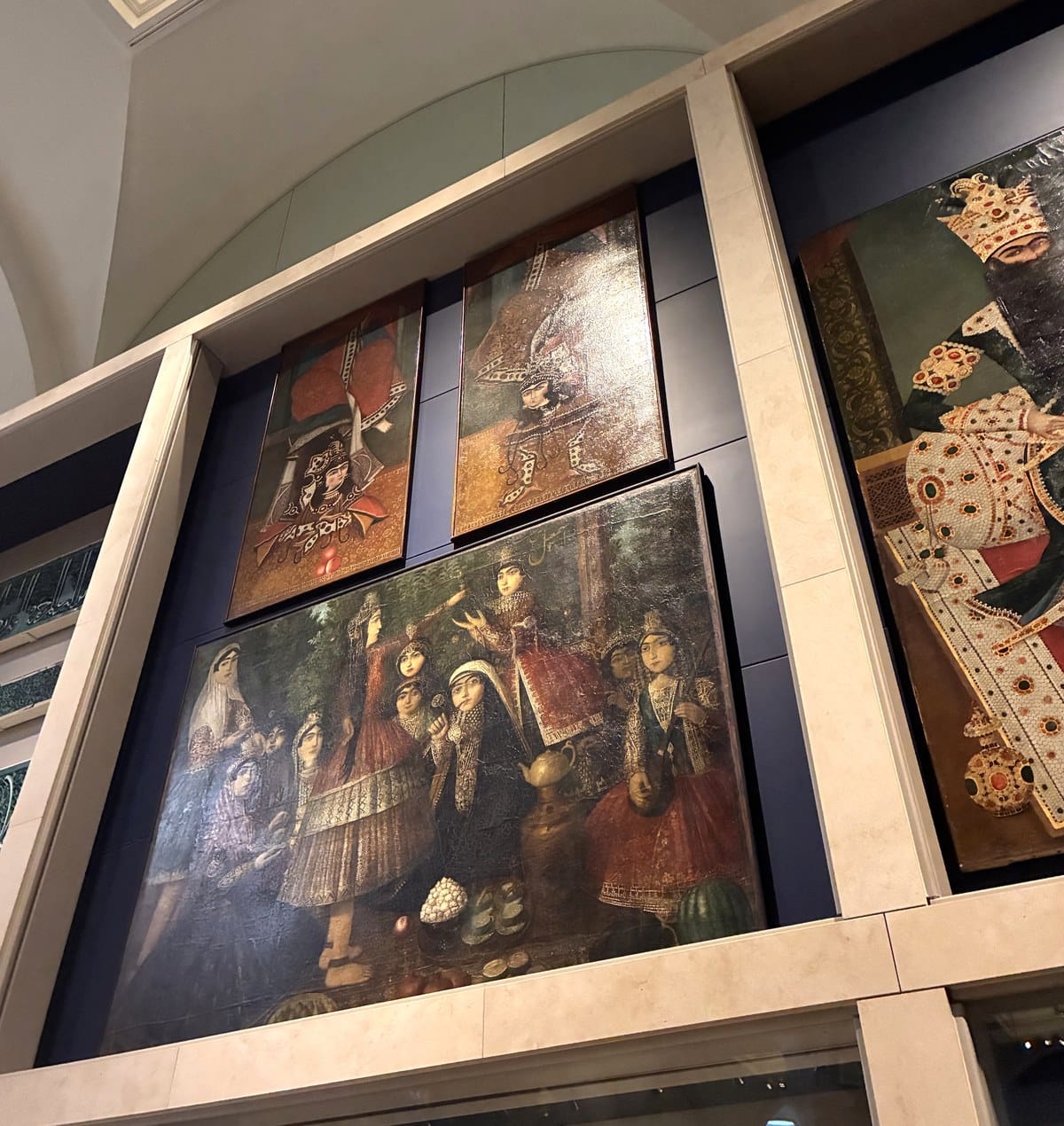
A few rooms along the same floor, the Jameel Gallery holds a wall of Qajar-period Persian oils from a culture that did not appear to need gender codified in the way we do now. Try sorting the figures by gender using the faces alone. You give up fast and start reading the headgear instead.
That is not a failure of technique, our guide explained, and the scholarship backs it. Afsaneh Najmabadi's Women with Mustaches and Men without Beards (University of California Press, 2005) argues that early Qajar beauty was largely undifferentiated by gender. The same adjectives of beauty applied to everybody. That includes the ones we in the West now reserve almost entirely for women. A beautiful man was not a strange premise there and then, and arguably should not be one in the here and now. Painters even added moustaches to women, because a faint one was thought attractive. What Najmabadi describes, and our guide too, is a system organised by age rather than by gender. Beauty was the ideal, and it did not belong to one gender.
Then Europe arrived
Then the nineteenth century closed, travel to Europe increased, and Iranian images of beauty started imitating European ones. Mary Elaine Hegland, reviewing the book in the American Historical Review in October 2006, summed up where Najmabadi takes it: "the binarization of male and female required by modernity and the modern state". In short, the flattening was imported. Colonialism did not only take things out of a place. It forced ideas in too. In its wake it decimated and muted a genderless, celebratory attitude to beauty. It stripped the colour out of how people expressed that in clothes.
And then men gave up colour
I could not stop thinking about that room on the way out of it. Look at what we wear now. The psychologist John Flügel named the shift in 1930: the Great Masculine Renunciation. At the end of the eighteenth century, he wrote, "Man abandoned his claim to be considered beautiful. He henceforth aimed at being only useful." Western men dropped colour, pattern, heels and ornament, and kept only differences of cut. Flügel blamed politics and the new respectability of work, not religion.
So two mechanisms, roughly contemporary, pushing the same way. Christianity is the documented vector for the fig leaves and the chisel, which we get to shortly. European modernity is the vector for the mutedness. Both got exported. And the result is still on the rails: walk into any charity shop anywhere in the UK and try to find colourful menswear. Or stand in your local Westfield for ten minutes and watch the crowds go past. Mostly it is arty mums and queer men who dare. For a man, colour still reads as a statement rather than a preference, which is a small sad thing to notice on your way out of a room absolutely full of it.
Stop three
Shiva, Parvati, and the god behind the hoarding
Ardhanarishvara, the gender blending god, is in a store room until 2028.
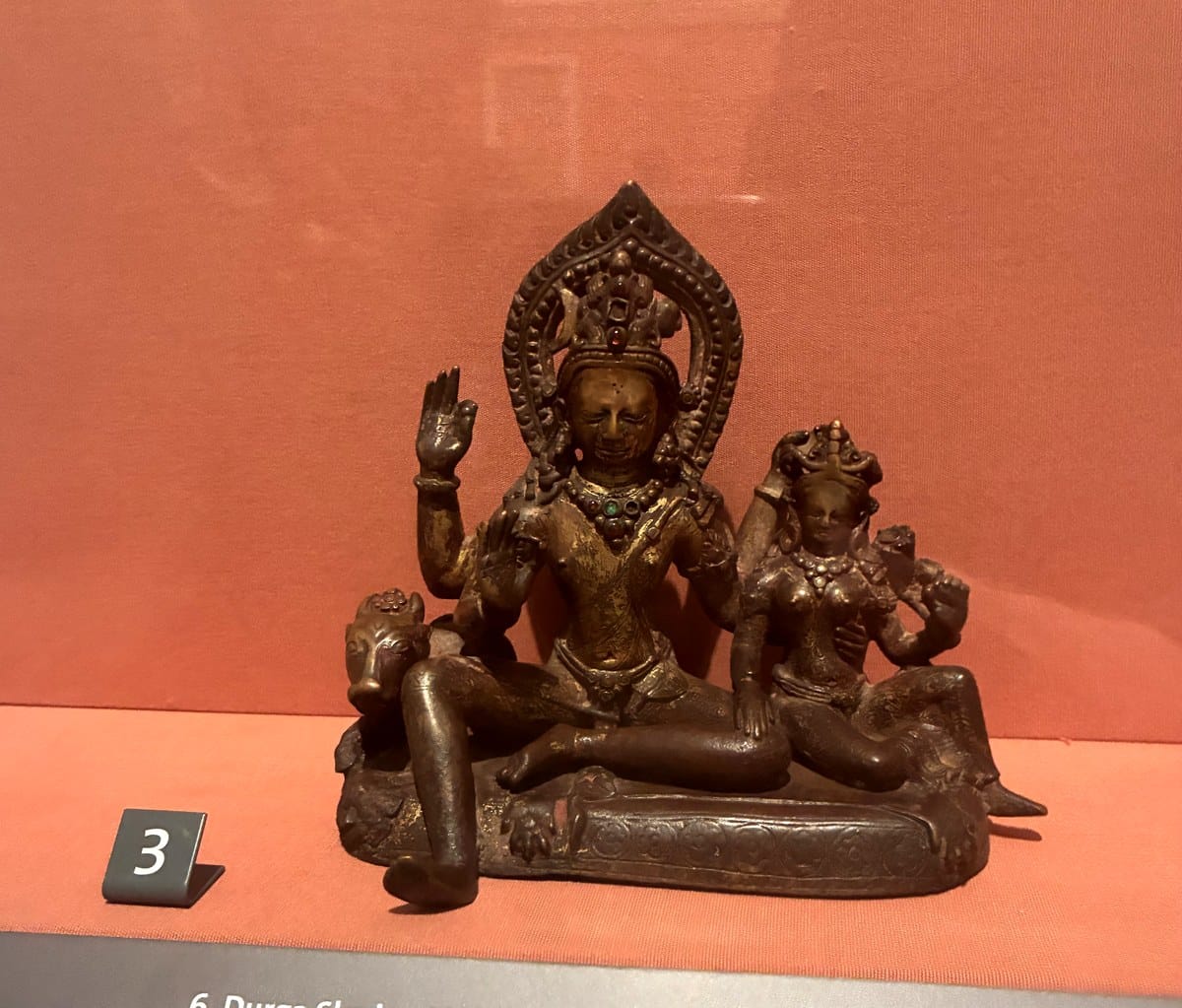
That idea, that our categories got exported along with everything else, walked with us into the next room. Room 47a, and a small gilded Uma-Mahesvara: sixteen centimetres of Shiva and Parvati on a cushion throne draped with a tiger skin. His lower left hand rests at her waist. A crescent moon and a human skull sit in his matted hair, and Nandi the bull is tucked in at the side.
In the tradition the two merge into Ardhanarishvara, the lord who is half woman. One body, both. The V&A owns a superb early example, Shiva Ardhanarishvara, red sandstone, late second century, museum no. IM.5-1931. We could not see it. Rooms 41 and 47b closed in March 2026 for refurbishment and reopen in spring 2028, so it is in store, and our guide described the half-and-half form and then pulled it up on their iPad instead. The museum's "Out On Display #5: Lord Who Is Half Woman" is the next best thing.
Our guide also made a really important point worth thinking deeply about. These are religious images first. The lens most of us bring to them is Abrahamic without our noticing: God as a man, Adam and then Eve, male and female. That was simply not the heritage or framework these objects came from. Placing a modern transgender identity straight onto a tenth-century Nepalese bronze, painting or image flattens it. It does not do the object, or its creators' intent, real justice.
Stop four
The Progress Pride flag, and community visibility
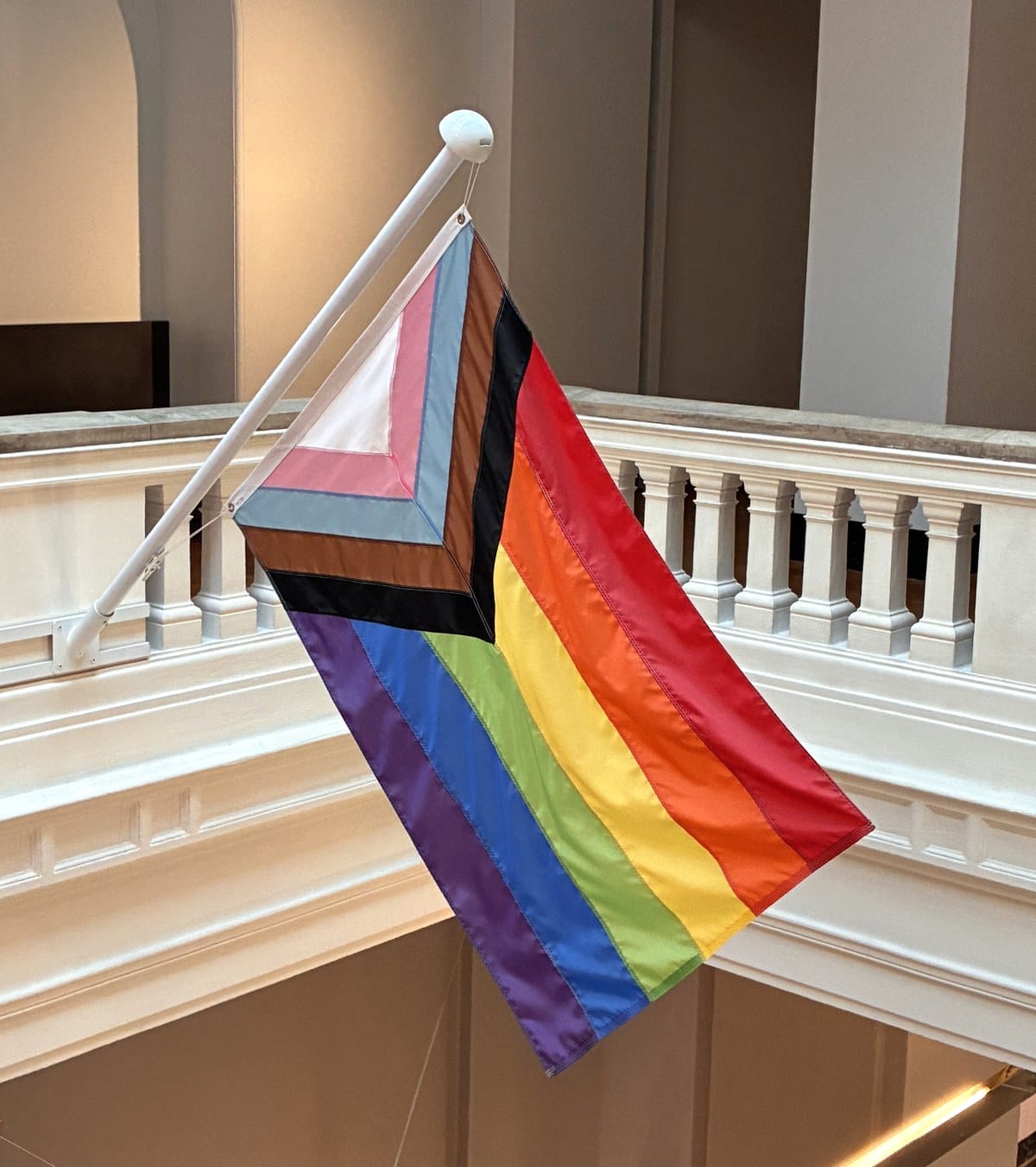
The Ardhanarishvara was in store and we never got to see it. The flags were the opposite, impossible to miss. They fly high above the Hintze Sculpture Galleries, the long marble corridor you reach down the ramp from the shop. You stand and crane up at them, and they are lovely. Our guide used them to talk through the history, and how the rainbow was a powerful way of showing up, rallying together and refusing to be erased. It is hard to miss a rainbow. Harder still in a country that has been draining the colour out of menswear since the eighteenth century.
How the flag keeps evolving with the community
Gilbert Baker's 1978 original had eight stripes with a meaning each, from hot pink for sex to violet for spirit, and it was never about sexuality or gender as such; it was about shared experience. Baker never sought to control or licence the design. Refusing to copyright it and lock its use is a queer rebellion in itself in a capitalist world. It is also the most inclusive way to design universally, for everyone and anyone, because nobody has to ask permission. Daniel Quasar's 2018 Progress redesign adds a chevron. The light blue, pink and white come straight from the trans flag. The black and brown stripes are, in Quasar's own published framing, for "marginalised LGBT communities of colour". Black also carries those living with AIDS and those we lost to it. Then in 2021 Valentino Vecchietti of Intersex Equality Rights UK added a yellow triangle with a purple circle inside it, for intersex people. That circle comes from the intersex flag designed by Intersex Human Rights Australia in 2013, and it is deliberately unbroken, standing for wholeness. Each version brings more people inside the community, and more representation of our shared struggle for visibility and acceptance.
Stop five
Buddhism, Room 18, and a bodhisattva who changed on the road
A bodhisattva whose gender depiction and body shape changed on the road east, and a torso identified by proximity and a little sign.
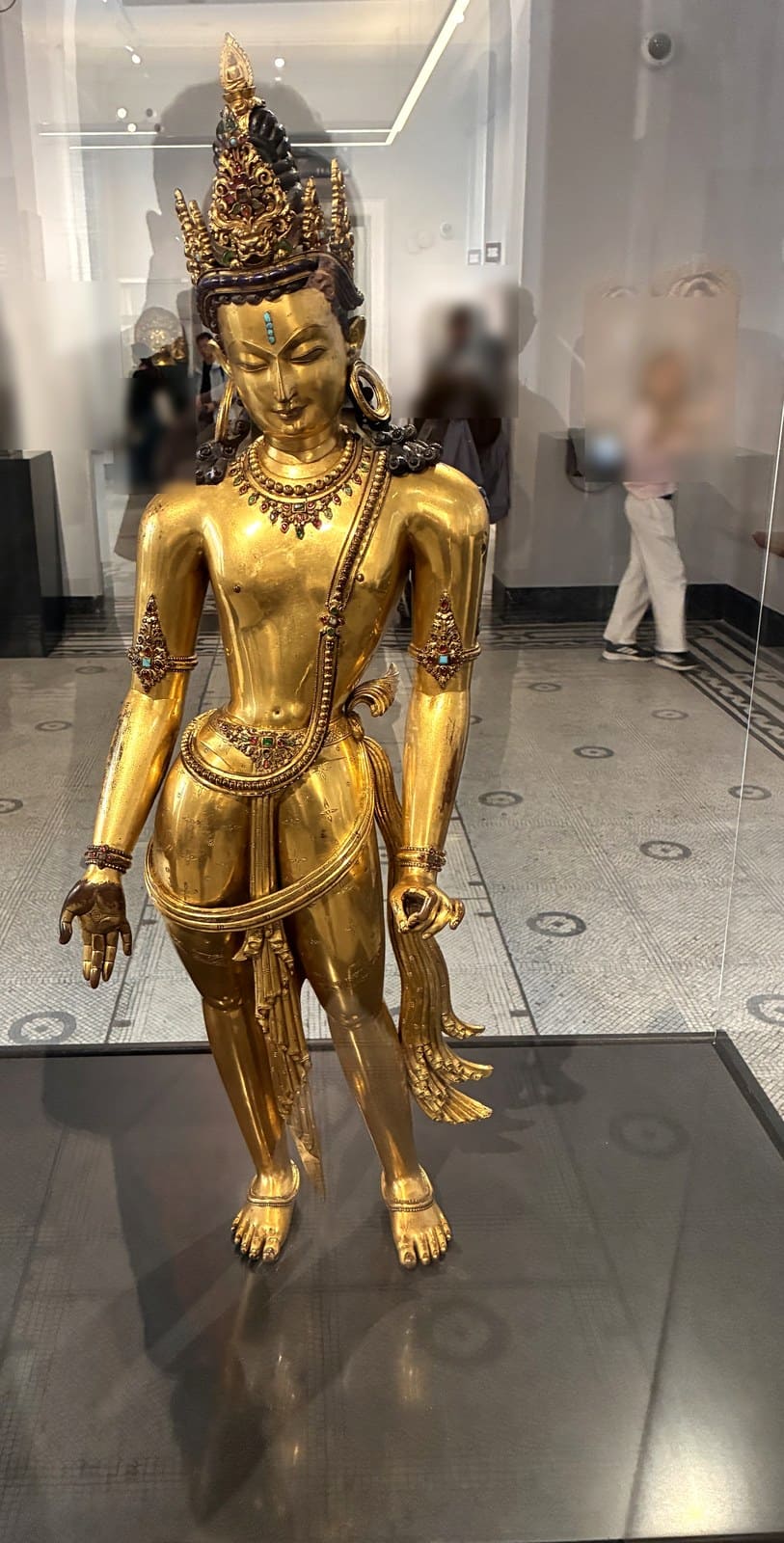
The next stop was a figure who refused to go on without everybody else. The Bodhisattva Avalokiteshvara, called Padmapani or lotus-holder, stands in gilded copper set with turquoise and garnets, made between 1300 and 1400. Bodhisattvas, our guide explained, are the ones who stop at the threshold of enlightenment and stay behind to help everyone else. So they are not quite a god. They are somebody who chose to help others over themselves, community minded you might say.
A body that was never only one thing
Travelling east, the depiction shifted. Avalokiteshvara arrived in China male in the fifth century, feminine versions appear by the tenth, and by the sixteenth the figure had become Guanyin, goddess of mercy. Scholars read that as broad localisation rather than one tidy cause. This example sits in the middle. A genderless face, large earrings, which like all clothing carry no gender but read more fem than masc to my western eye. A fairly male-ish chest, a waist any drag queen would die for, and curved hips and rounded thighs that look more female than male to me.
Which is that whole eastward shift standing in one room. Male in the fifth century, a goddess by the sixteenth, and this figure cast somewhere in the middle of the journey, holding both at once.
This bronze is not evidence of a modern trans identity, because that framework did not exist yet. It is evidence that gender fluidity has always existed. Somebody cast this one in gilded copper, set it with turquoise and garnets, and prayed to it, seven hundred years ago. And people like to say queerness is a new invention.
And a label worth reading twice
One really important thing our guide flagged here is the label. It gives the origin as Nepal, museum no. IM.239-1922, and notes that "Nepalese Newar craftsmen made this finely jewelled image for Tibetan patrons". Then it records the V&A buying the piece in 1922 from Major L. B. Rawling, whose brother fought in the 1904 Younghusband assault on Tibet and obtained the sculpture in Shigatse. Our guide stopped on that and named it: a colonial acquisition, sitting in small type on the label of a stop about identity, and troubling on its own terms.
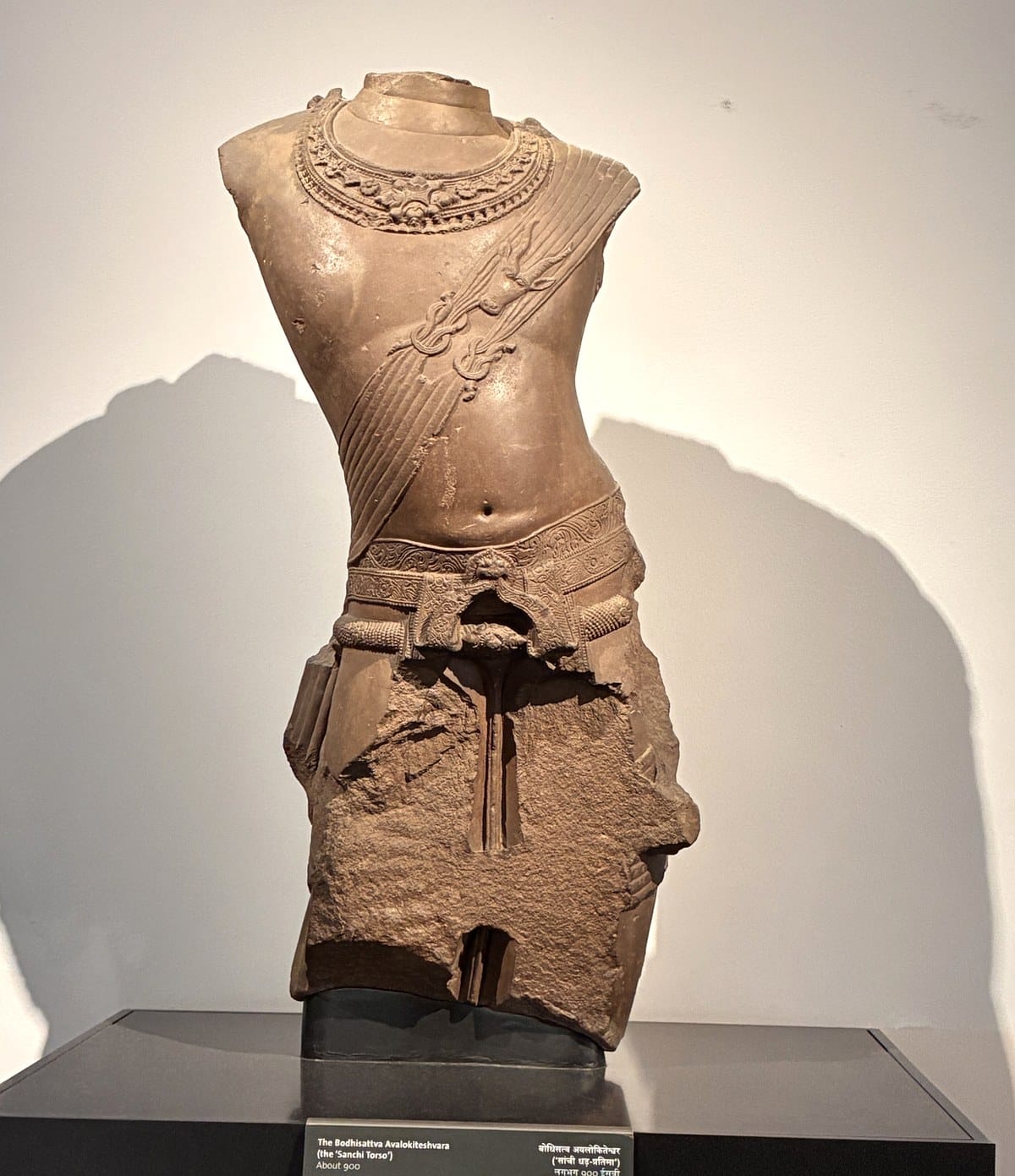
Beside the Bodhisattva Avalokiteshvara stands the Sanchi Torso, also pointed out by our guide. It was carved around 900 and dug up in 1883, with no head and no arms to identify it. For nearly ninety years nobody knew who it was. Then in 1971 somebody identified two fragments of a companion figure at the same site. They carried traces of the nagapuspa, the flower symbol of the Bodhisattva Maitreya. Maitreya and Avalokiteshvara are the two great saviour figures of Buddhism. A pair like this would have flanked a monumental Buddha inside a temple. So naming one, and finding information about it, helped name and frame the history of the other.
Stops six and eight
The Cast Courts, and three Davids
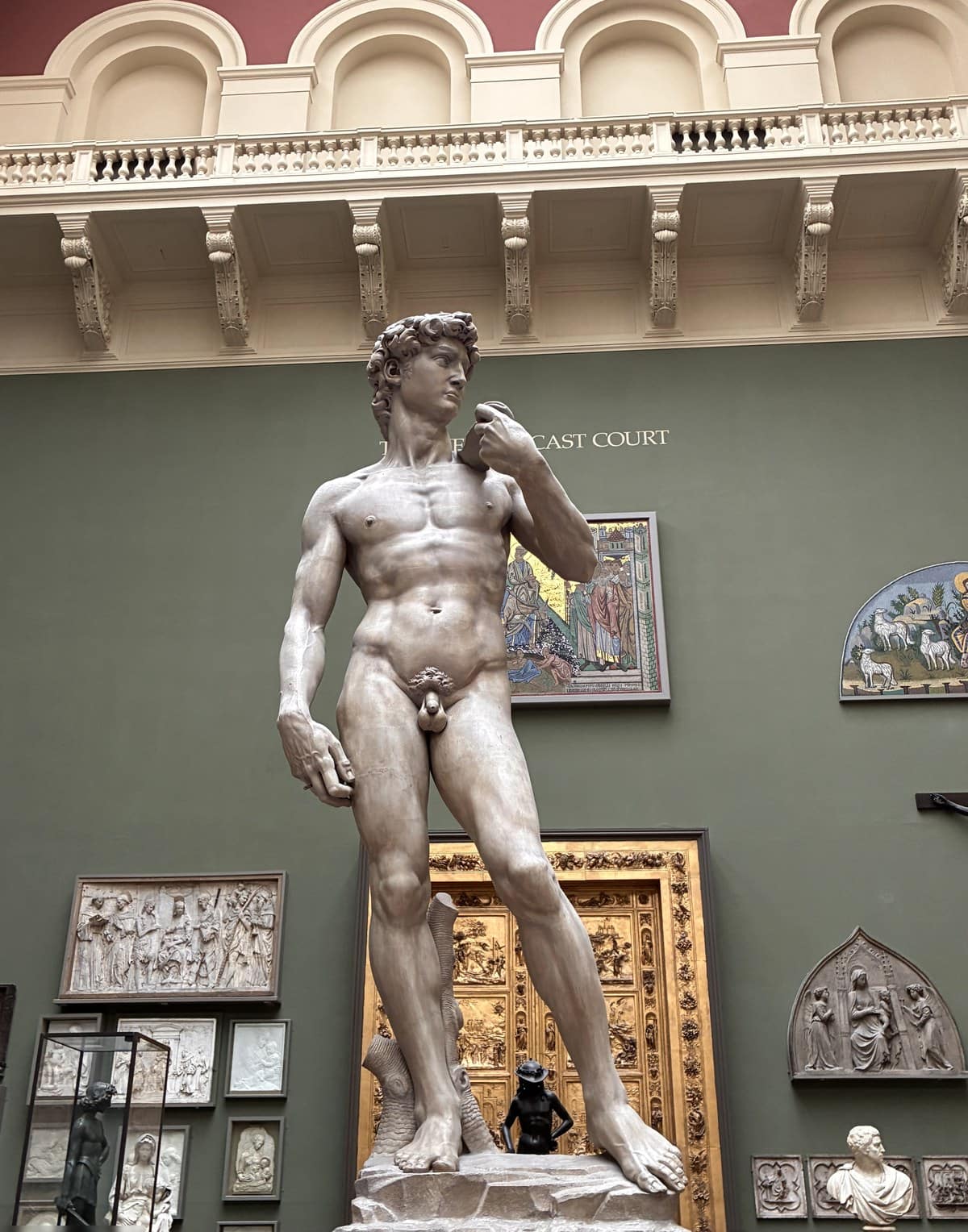
Then east across the same floor into the Cast Courts, where the temperature of the V&A LGBTQIA+ Tour changes completely. The V&A's David is a plaster cast made by Clemente Papi around 1856 and given to Queen Victoria by Leopold II, Grand Duke of Tuscany, in 1857. She passed it on to the museum. It is five and a half metres of adolescent boy standing still, before the fight rather than after it. The underdog, as our guide put it, at the moment before anybody knew he would win.
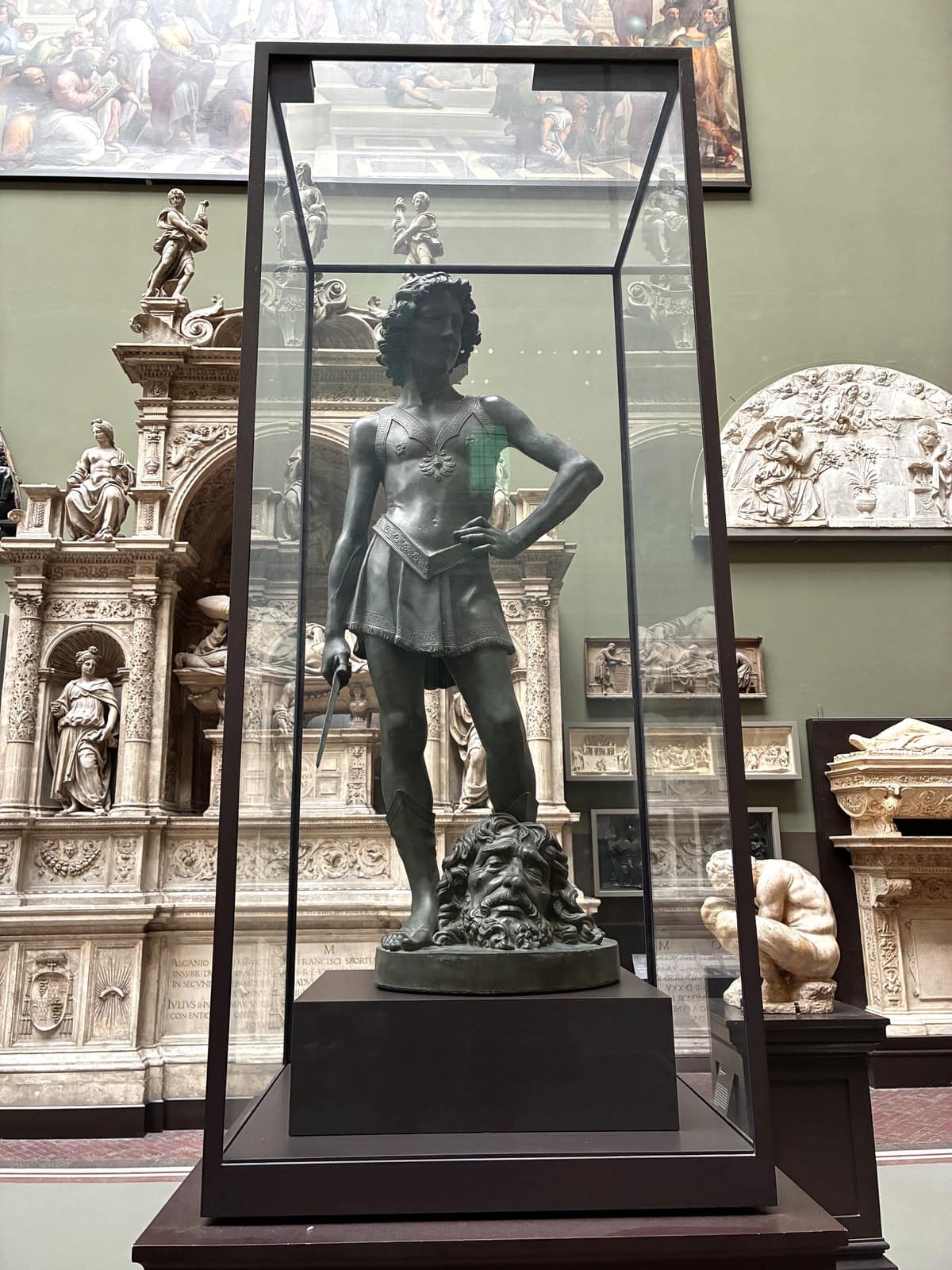
A few metres from the giant, two more Davids, and both are a different proposition entirely. Verrocchio's stands in his own tall glass case with Goliath's head at his feet, in a short tunic, unmistakably a boy.
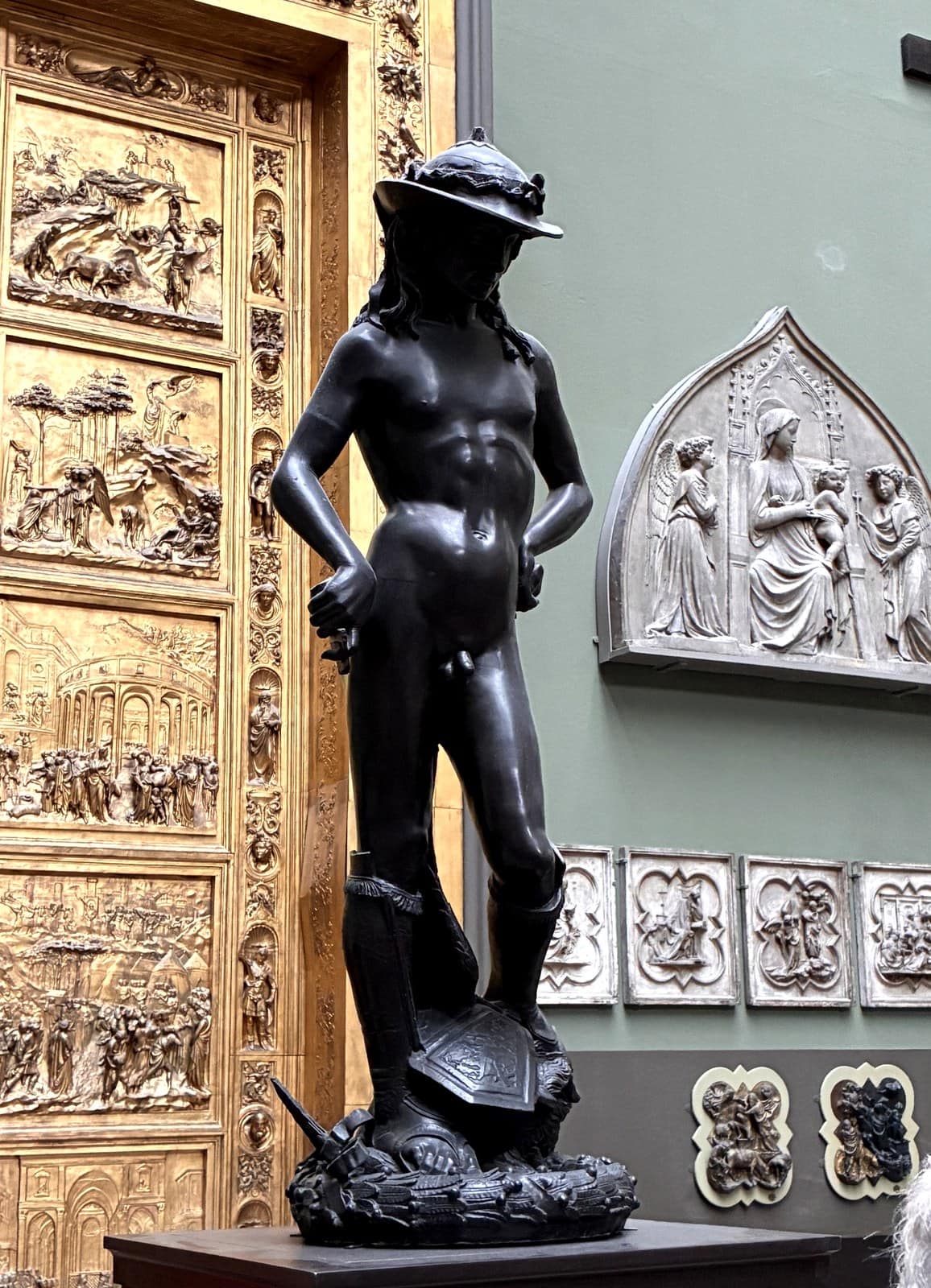
Donatello's is close by, cast about 1885. It is the famous one: hat, boots, nothing else, and a body deliberately a teenager's rather than a man's.
Our guide mentioned the old stories about Donatello only hiring assistants he found attractive. They come from the Detti piacevoli, a collection of sayings compiled around 1480 and attributed to Angelo Poliziano, at least fourteen years after Donatello died. Vasari repeats none of it. So it is gossip written down fourteen years too late by somebody who was not there, and scholars still argue about what the juiciest one even means.
The historical context of the Davids
Our guide filled in the world all three came out of, and that world matters for how we read them. The biblical imagery, the oppression, and the sexualisation that church and society have long applied to gay men and to trans people all meet in this room. Two of these Davids are unmistakably boyish. Michelangelo's five-metre one is not so much.
Sculptors of the period worked from live models, and these ones lived somewhere specific. Michael Rocke's Forbidden Friendships (Oxford University Press, 1996) is the standard account. In Florence between 1432 and 1502, roughly seventeen thousand men were investigated for sodomy in a city of about forty thousand. It was criminal, it was ordinary, and it was rigidly organised by age. Boys worked the streets, and men with money could pay for a model and for more than modelling. Everybody knew.
That is uncomfortable context. It does not mean that these men were gay, queer or predators, and reading it that way would be us applying a modern and heavily weaponised anti-LGBTQ lens. But the context of the work does matter, and it is undeniable that Michelangelo was very attentive to the male body.
Stop seven
The fig leaf, and the cover up story
Stop seven on the V&A LGBTQIA+ Tour is a plaster fig leaf kept in its own glass case.
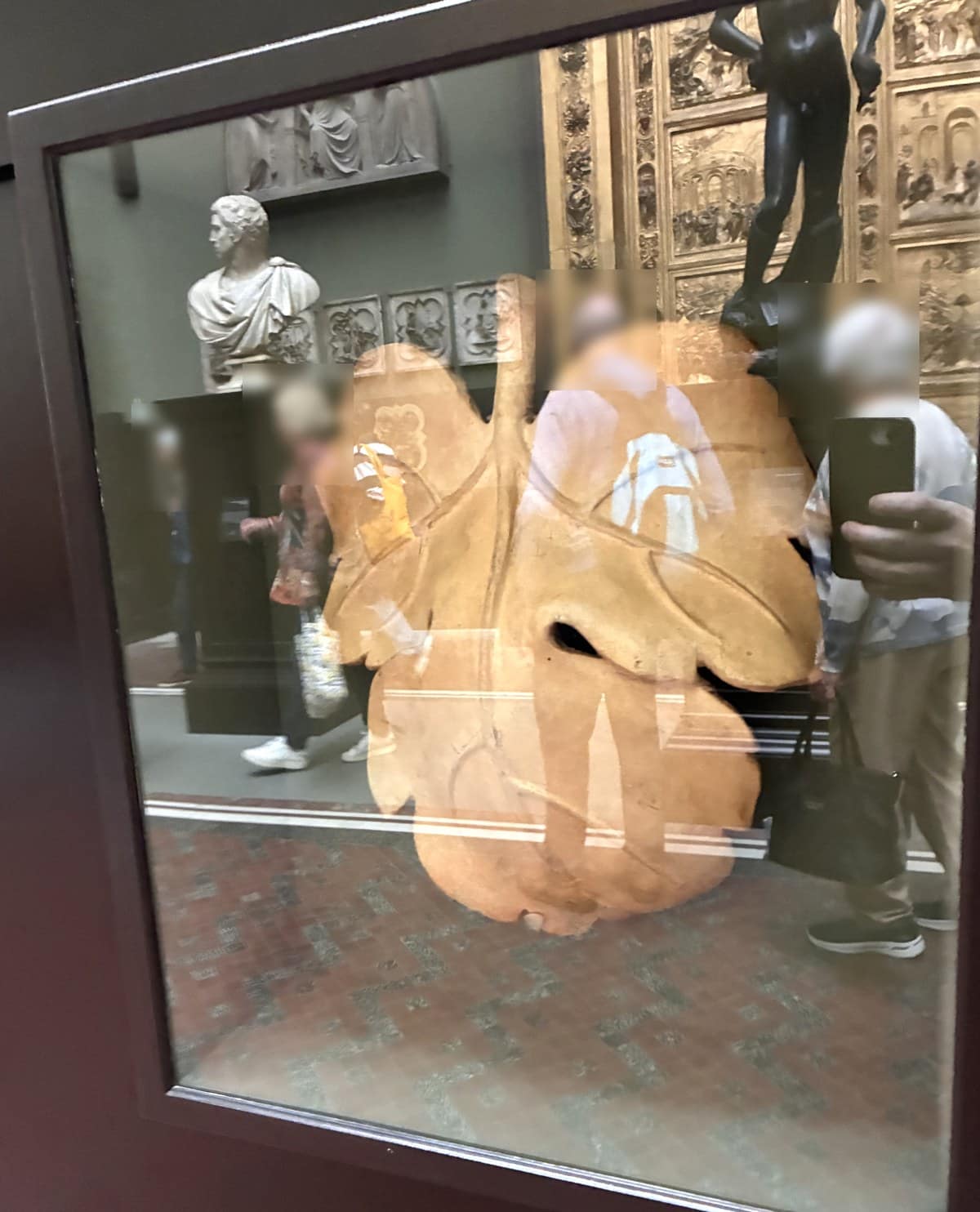
Behind the David's pedestal sits a plaster fig leaf in its own case, sized to fit and made to come off. The record says it hung on the figure "from two strategically implanted hooks" whenever royalty visited, and that it was last used in the time of Queen Mary.
Everybody tells you Queen Victoria was scandalised, and our guide told it that way too, because it is a great story. However, the museum's own gallery label calls it out: "In fact it is unlikely that the queen herself objected, since she and Prince Albert collected many works of art featuring male and female nudes." The database files the Victoria version under "anecdotal information".
Honestly, the documented version is better. Somebody decided in advance that a royal eye needed protecting, built a removable solution, and kept it in a cupboard for half a century. That says the anxiety was institutional rather than personal.
Back to Apollo and Zephyr
At the danger of going full circle, it is also important to mention that a similar cover up, and a far more destructive one, was applied to Apollo and Zephyr. The two we had opened with an hour earlier. The V&A's own object record notes that during conservation between 1957 and 1959, "it was also discovered at this time that the genitals of both figures had been removed and a fig leaf placed over the areas – once removed these fig leaves disintegrated". Nobody knows when. Nobody knows who.
So one museum holds both answers to the same discomfort, a few rooms apart on the same floor. In the Cast Courts, a leaf on two hooks, hung for a royal visit and lifted off again afterwards. Back in Room 50a, something permanent, anonymous, and done to two figures that had spent a century standing in a garden at Kew minding their own business.
Stop nine
Hercules, Antaeus, and a very serious Turkish sport
The fig leaf was the last thing we looked at in the Cast Courts, and after that was the first time all afternoon we went up any stairs. Room 62 is a level above, and it holds a bronze Hercules and Antaeus by Willem van Tetrode, made between 1562 and 1567, 46.8cm tall, bequeathed by Dr W. L. Hildburgh in 1956. The V&A's catalogue tags it "Homoerotic", so the museum has already said the quiet part.
Hercules, our guide pointed out, is rarely alone in the myths, and takes up with men and women alike across them. Proto-bisexual is the modern shorthand, though it is our word laid over their myth. Antaeus was a North African giant who drew his strength from the earth and could not lose while touching it. So Hercules lifted him, held him up until the strength drained, and crushed him. Tetrode borrowed the composition from Ammannati's fountain at the Medici villa at Castello, mirrored it, and pushed the bodies closer together. At a glance it reads as two naked men in a full-body embrace. Actually it is a killing.
Which is where the collecting comes in, and this bronze is exactly the kind of object it applied to. Statuettes of David, Ganymede and Hercules carried a second meaning for the people buying them, and the V&A says so on its own trail: figures like these "were often used to signify same sex attraction". Owning one was a quiet way of owning something about yourself, and it is the same instinct as the green carnation, three centuries earlier and in bronze.
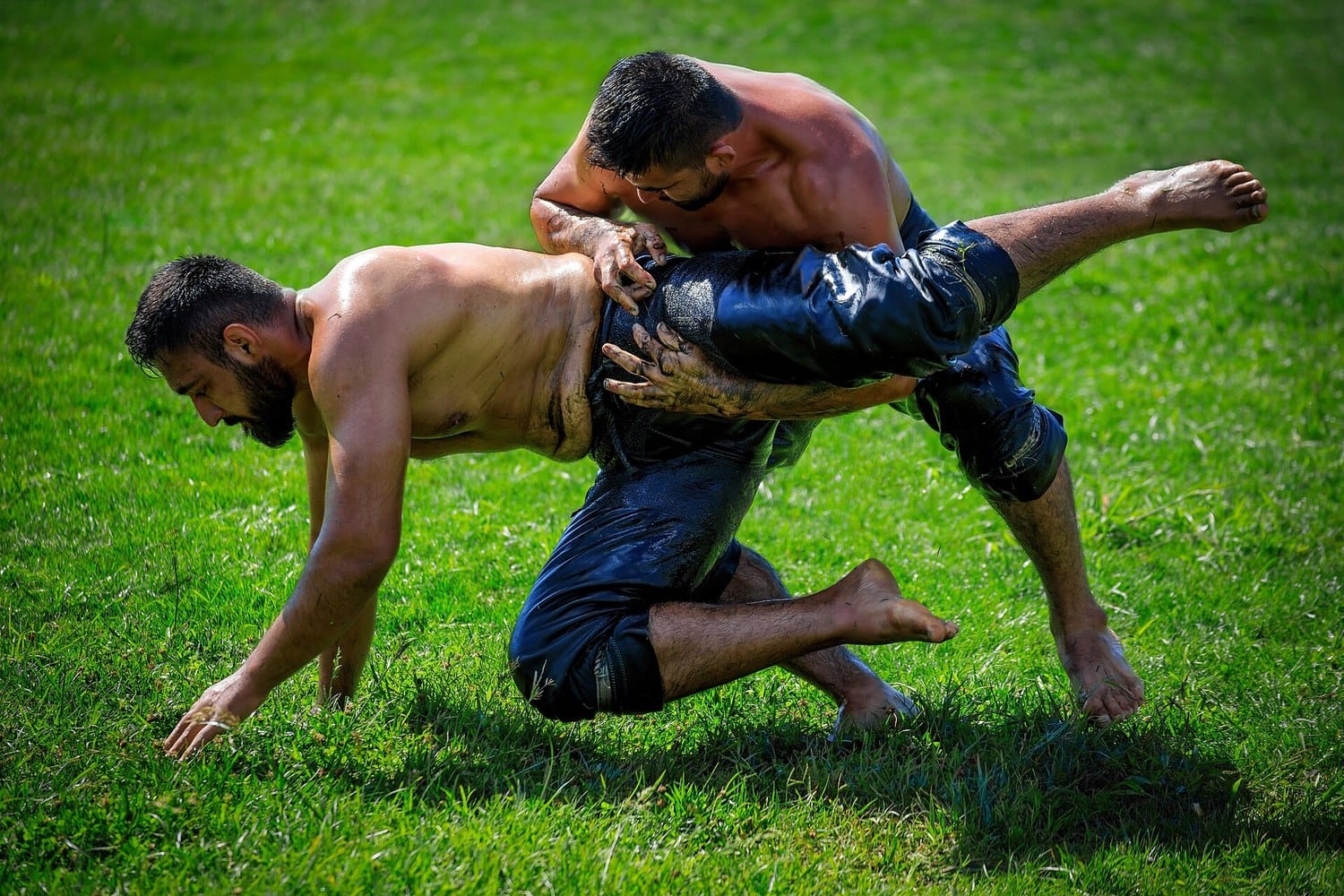
Which brings us, via our guide, to Kırkpınar
They compared it to Turkish oil wrestling, and they were right to. Yağlı güreş is a national tradition with more than six centuries behind it. The Kırkpınar festival at Edirne dates to around 1361 and sits on UNESCO's list of intangible cultural heritage. Wrestlers pour olive oil over their entire bodies and wear the kispet, hand-tailored leather trousers with no buttons and no belt, closed with a drawstring. Traditional buffalo-hide ones weighed about 13kg dry. The kispet is the gripping surface: a wrestler may put his arm inside his opponent's trousers and use it as a handle to turn him.
There is of course nothing in the slightest bit homoerotic about oiling yourself, putting your arm down another man's leather trousers and throwing him to the ground.
Grappling talk gives you holds, control, pinning and SUBmission. Oil wrestling is the exception on that last one: a bout is won only by putting your opponent's back on the ground, or lifting him and carrying him three steps. Nobody taps out at Kırkpınar. Anyway. The point is not the sport, which is revered and protected and deserves to be. The point is that the same gaze which cannot cope with a marble boy standing still has no trouble at all here, because the context tells it not to look that way.
Stop ten
Kylie's dressing room, and the importance of allyship
The tour ends in a recreated dressing room, four days after Dolly Parton died.
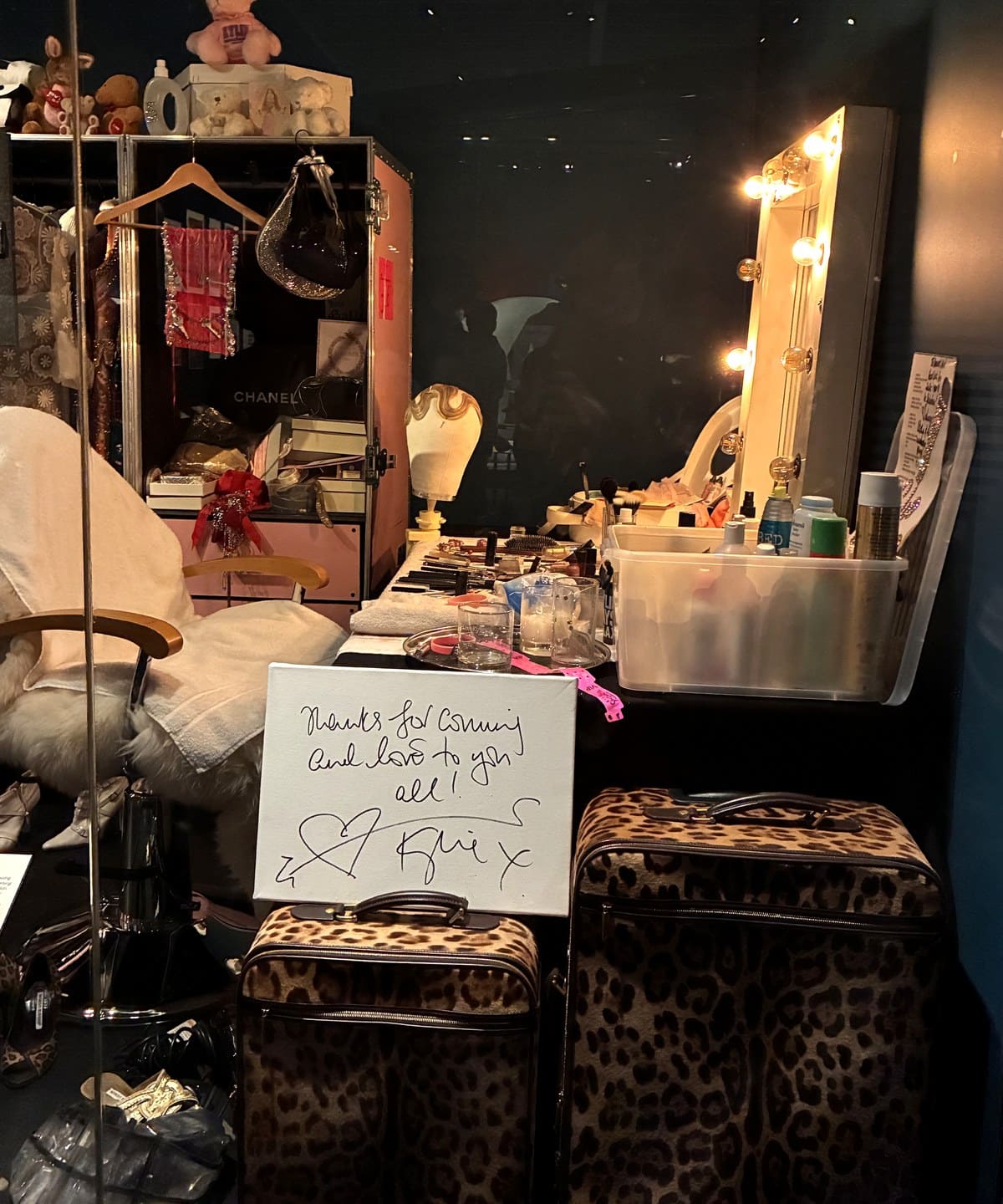
Up one more level for the last stop on the V&A LGBTQIA+ Tour, into Theatre & Performance: Kylie's dressing room, recreated from the 2006 to 2007 Showgirl: Homecoming tour and lent by her. There is a handwritten card inside reading "Thanks for coming and love to you all". After the sculpture and the censorship it should feel like a swerve. Instead it lands, because we had spent an hour on people being looked at wrongly and this is a room about being looked after.
Kylie has put it plainly herself. On the late 1990s, around the commercial failure of Impossible Princess, she told Entertainment Tonight Canada, as reported by PinkNews: "I feel like my gay audience felt some kind of solidarity there. They protected me." To GLAAD she gave the other half: "In all different communities everyone has to be heard -- understood might not be easy."
Kylie and Dolly did the same unglamorous thing for decades. They turned up, they were kind in public when it cost them something, and they never made a performance of it.
And you cannot talk about allies this week without Dolly
Dolly Parton died four days before this tour, on 25 August 2026, in Nashville, aged 80. Her publicist described a brief battle with cancer. Our guide brought her up and nobody in the group needed it explained.
Dolly held three things at once that plenty of people insist cannot be held together: a Christian faith she never played down, an enormous mainstream country audience, and open support for queer people, trans people included. She talked about it in exactly those terms. On Tennessee's anti-trans and anti-drag laws she told The Hollywood Reporter: "I know and love them all, and I do not judge... If there's something to be judged, that is God's business. But we are all God's children and how we are is who we are." The obituaries this week kept coming back to that, because she never seemed to experience it as a contradiction and she never made anybody's inclusion conditional.
Which matters, because the loud version of the argument right now paints us as a threat to family and to faith. We are not trying to unbuild anything. We are trying to widen what a family is allowed to mean and to base it on love rather than on a shape. The only structure I would happily see come down is the patriarchy, and honestly, f*ck that.
On the way home
My reflections on all of this
Walking home I kept turning the hour over, and two threads ran through all ten stops. Erasure is the first. Resistance made visible, through community and shared humanity, is the second. Most of these objects carry both at once.
The two threads, stop by stop
Hyacinth. A boy loved by two gods, retold often enough with Hyacinth as a woman that the male identity gets written out, and the relationship goes with it. Queer people answered in flowers. That is the resistance.
The Qajar paintings. A culture that did not sort beauty by gender, flattened by imported expectations and replaced with conformity. The irony is that the imported version now gets defended as tradition. The resistance is small and ongoing, and it looks like colour creeping back into what men wear.
Ardhanarishvara. A god who is both, with the acceptance built into the theology rather than argued for.
The Progress Pride flag. Visibility on purpose, and a design that keeps widening to bring more people inside it. Progression, resistance and strength in one object.
Avalokiteshvara. A gender that changes on the road east to meet the needs of the people who need help. Community again, this time inside a single body.
The Davids. A fig leaf built for one of them, and nothing on record about who modelled for any of them. Scripture is doing work here too. A biblical subject made a naked boy acceptable in a Christian city, which gave the sculptors a shield. A whole history “erased” by never being written.
Hercules and Antaeus. A statuette that worked as a sign, owned quietly by people who could not say the thing out loud.
Kylie and Dolly. Allyship, and a community held open for decades by people who kept turning up.
The sculptures, the covering up and the violence of erasure
None of these figures is doing anything sexual. Apollo leans on a lyre. Zephyr holds a piece of cloth. Michelangelo's David stands still, entirely unaroused. Even so, a leaf was built for the David, and Apollo and Zephyr were castrated.
That is not a V&A quirk. It is a long campaign with a paper trail. When Michelangelo's David went up in Florence in 1504, the authorities put a garland of twenty-eight copper leaves round his waist almost immediately. Cardinal Carafa was agitating about the nudes in the Last Judgement by 1541, and as Pope Paul IV he issued a bull mandating fig leaves in 1557. The Council of Trent condemned nudity in religious art in 1563. Daniele da Volterra then painted breeches over Michelangelo's fresco, which earned him the nickname Il Braghettone, the breeches-maker. Pius IX went further in the nineteenth century and had genitals removed outright. The V&A's leaf, made around 1857, sits in the middle of all that.
Where the sex actually came from
So the sexual content was never in the marble. After all, it is just stone. Somebody brought it, then treated the object as the problem and corrected it. The statue was made to answer for a reaction it did not cause.
The same move gets made on queer people, and the word gives it away. It is homoSEXUAL, with the act sitting inside the noun. Nobody calls a straight person a heterosexual in ordinary speech, or defines them by what they do in bed. Two women holding hands, or two men, are too often read as a sexual act; the identical gesture from a straight couple reads as affection. The viewer supplies the sexualised lens, and then the object of that gaze gets the blame and the repercussions. Cover it up. Not in front of the children.
The word itself has the same history. Karl Maria Kertbeny coined "homosexual" and "heterosexual" in a letter of 6 May 1868, expressly as neutral legal language to replace "sodomite" while campaigning against Prussian sodomy law. Medicine then took the word and made it a diagnosis. GLAAD now advises against it for that reason, and the Associated Press has restricted it since 2006. Walt Odets makes a version of this argument at book length in Out of the Shadows, which examines what he calls "the nineteenth century idea of 'the homosexual'". There is more about the book here.
It is often the male body that gets the chisel
Every intervention on that route lands on a man, and castration as a remedy is by definition a male-body remedy. John Berger's line in Ways of Seeing (1972) explains why: "Men act and women appear." The female nude had sat in Western collections for centuries as the default subject of art, because it was already understood as something for a man to look at. The male nude implicates whoever is looking, since enjoying it says something about them. So the anxious remedy gets applied to the male body.
And the women, erased a different way
The same logic ran through the law, and there it erased women by refusing to name them. England and Wales never created a specific offence for sex between women. That sounds like leniency until you look at the reasoning. In 1921 MPs added a clause on "gross indecency between females" to the Criminal Law Amendment Bill, and it was thrown out on the argument that naming it would publicise it. A former Director of Public Prosecutions warned it would "make public to thousands of people that there was this offence". Another member wanted "to leave them entirely alone, not notice them, not advertise them".
Women were still prosecuted, under indecent assault and gross indecency, so the gap in the statute book was never protection. The popular story that Queen Victoria could not believe lesbians existed is a myth as well. Judges, MPs and peers knew perfectly well. The silence was a strategy, and the strategy was erasure. Do not name it, and officially it does not exist.
Women's rights are the same fight
None of this is only queer history. The same structure that decided which bodies needed covering also decided which people needed managing. Women got that treatment for far longer, and far more comprehensively, than we did. Married women in England could not hold property separately from their husbands until 1882. Women did not get the vote on the same terms as men until 1928. It was not until the Sex Discrimination Act 1975 that refusing a woman credit or a service because she was a woman became unlawful. That is not ancient history. Plenty of people reading this were alive in 1975.
Women's rights and queer rights are not two separate campaigns. They come out of the same argument with the same thing. A patriarchy that claims the right to decide who counts. Whose body is public. Whose life gets written down. I do not think you can care about one and shrug at the other.
And their statues, worn down instead
Look at how societies treat statues of women now and the contrast is stark. Nobody covers them. They get touched instead, in one place, until the metal gives out. Verona's Juliet went up in 1972, and tourists rubbed her right breast until it cracked. The city moved the original into the Castelvecchio in 2014 and put a replica in the courtyard. Dublin's Molly Malone, by Jeanne Rynhart, has had the finish rubbed off her chest since about 2012, and in 2025 the council put stewards on her to stop it. I find that pairing hard to unsee. The male bodies get corrected by the authorities. The female ones get worn down by the crowd. That wearing down is a violence too. Nobody calls it that, because it arrives with a smile and a photograph, but thousands of hands on one part of a woman's body until the bronze fails is not affection.
None of which makes the people with the chisel homophobes, and I am not going to pretend it does. The documented campaign was about obscenity and the church's authority over images. Montaigne remembered antique statues being "gelded" in the Rome of his youth. Their reasons were about obscenity rather than about us. But the reflex to cover a body up outlasted the reasons.
And what exactly was obscene, and to whom
So what were they protecting the queen, the children, us, or maybe themselves from? Nothing in the marble was doing anything. A body standing still only becomes obscene if the person looking supplies the rest, so the men who reached for a chisel were not protecting anybody from the statue. They were managing something in themselves, and the statue paid for it. Whatever was growing in the mind of the man who commissioned a fig leaf or a chisel, it was not rooted in the plaster or the marble. It speaks to something much deeper in the viewer, something they were ashamed of and needed a quick, sometimes violent, supposedly permanent solution to.
Why could they not bear to look?
These attempts at erasure run right through queer history, and through this one hour of it. Oppression, suppression, deletion, criminalisation, fig leaves and chisels. Hyacinth gets retold as a woman. Qajar beauty gets a binary imposed on it, and the binary later gets called tradition. Breeches get painted over a fresco. Hijras get registered, policed and criminalised by an Act of 1871. Lesbians never get named in an English statute, deliberately. The models for three Davids never get written down at all. A colonial acquisition sits in small type at the bottom of a label. Then Section 28.
That is what struck me hardest on the way home. Not one big act of erasure, but a great many small ones, spread across centuries and rooms. All of it speaks very loudly, and draws far more attention to what they tried to erase, and to why they wanted it hidden. Maybe then we should all be asking ourselves why they could not bear to look at others as equals. What is wrong with a sculpture being anatomically correct? Why does it hurt so much to let other people just be themselves? Maybe the erasures say more about the viewer than the viewed.
The same trick, pointed at people
The oldest smear aimed at LGBTQIA+ people runs on the same move. Somebody sexualises a young figure, then blames us for what they brought to it. That is where the danger-to-children line comes from. Anita Bryant ran "Save Our Children" on it in 1977. Closer to home, Section 28 became law on 24 May 1988 and banned local authorities from promoting "the acceptability of homosexuality as a pretended family relationship". Scotland repealed it in 2000, England and Wales on 18 November 2003.
What the numbers actually say
The evidence never supported it. Jenny, Roesler and Poyer reviewed 352 charts at a children's sexual abuse clinic for Pediatrics in July 1994. Of 269 cases with an identifiable offender, two were a gay or lesbian adult: under 1%, with 95% confidence limits of 0% to 3.1%. Meanwhile the ONS compendium published on 5 November 2025 records perpetrators as male only in 91.3% of cases, with a stranger named in 33.2%. Two thirds of the time it was somebody the child already knew. A panic that points at a visible minority is pointing away from the data.
The same move is now aimed at trans women. This is a museum review and I am not the person to write the policy paper, but it is the same accusation with a new target. Last time somebody actually went and counted, it fell apart. These are people, like you and me, who want to get on with their lives and live without fear. The agenda is living, and being recognised as human. That is all.
Which brings me back to Ardhanarishvara, the object we could not see. A body that is both, carved eighteen hundred years ago. The idea is not new, and it was not imported.
Afterwards
Third gender, and the people who were always here
Our guide had raised third gender at the museum, and that is the thread I kept pulling on once I got home. Plenty of cultures have recognised more than two genders, long before anybody asked them to. The Abrahamic lens that arrived later did its best to erase them. British India put that in writing. The Criminal Tribes Act of 1871 created a registered category of "eunuch" covering hijras and other gender non-conforming people. Registration was compulsory. Dancing in public or wearing women's clothes could get you arrested or fined. That designation stood until 1952.
Which makes the legal recognition that exists now look very recent, because it is. The recognition is modern. The people are not. Nepal got there first in the region. On 21 December 2007 its Supreme Court ruled in Pant v Nepal that the state had to create a legal category for people who are neither male nor female. That rested on self-identification, not on a doctor's say-so. Documents caught up in 2015. India followed with NALSA v Union of India in 2014. Pakistan and Bangladesh now count more than two genders in some form too, though implementation has been patchy in all of them.
And the direction of travel here
Sadly, it currently runs the other way in the UK. Britain has never had self-identification. A gender recognition certificate still requires a dysphoria diagnosis, two years living in the acquired gender, and a panel's decision. Scotland passed a bill in 2022 to change that. The UK government blocked it with a section 35 order in January 2023, and the Court of Session upheld the block that December. Then on 16 April 2025 the Supreme Court ruled that sex in the Equality Act 2010 means biological sex. The EHRC's rewritten code of practice followed it to Parliament on 21 May 2026. The United States has moved the same way, harder and faster.
I find that very sad. The trans people I know are not trying to take anything from anybody. They want to get on with their lives. When this much national energy goes into a group this small, it looks to me more like oppressing the marginalised than protecting anyone.
Four different things, not one
All of which is worth holding next to the stops we had just walked through. Legal recognition of a third gender is a state finally acknowledging people who have always been here. Those people have been attacked and erased for as long as anybody has been counting. Ardhanarishvara, back in Room 47a, is a god who contains both, which is a statement about divinity rather than about people. Avalokiteshvara shifting on the road east is different again, a gender changing as it travels to meet the needs of those who need help. The Qajar paintings were a fourth thing, not a category at all, just a culture that did not sort beauty by gender. Our guide's warning was against collapsing them into one.
And the angels, while we are here
An aside, because this one is personal. I was raised in a wholly Christian family. I spent a long time praying my queerness away, while battling with being perfectly made in God's image, as "he" intended. Those two things do not sit together, and I was the one left holding them.
What the text actually says
Take Genesis 19, the passage still aimed at gay people more than any other. A mob surrounds Lot's house and demands the two visitors: "bring them out unto us, that we may know them". Those visitors are angels, and angels are not gendered beings. The Hebrew word is mal'akh, which simply means messenger, from a root meaning to send with a message. It names a job, not a body. Where the text needs to tell one from another it uses a name instead, Michael or Gabriel. Christian tradition went further still, and Aquinas holds that angels are incorporeal altogether, appearing in human form rather than possessing one. Jesus puts it sideways in Matthew 22:30: "in the resurrection they neither marry, nor are given in marriage, but are as the angels of God in heaven". So the scene is a threatened gang rape by a mob, of two beings that have no gender, and presumably no genitals, at all. Reading that as a verdict on two men who love each other feels like it could be a stretch. But what do I know? I would have loved to hear Dolly's view.
Pulling it together
One free hour, and a lot to think about
All of that came out of sixty minutes in a museum I have walked around for years. Ten objects, chosen by one person, and I have been thinking about them ever since. The erasure thread runs from a Greek boy retold as a woman, to models never written down, to a clause quietly dropped from a bill in 1921. The visibility thread runs from a violet in a buttonhole to a flag flying over the sculpture corridor.
What I keep landing on is how ordinary the mechanisms are. None of it needed a conspiracy. A retelling here, a name left out there, a leaf on two hooks, a law that declines to mention you. The answers were just as ordinary. A flower, a slang word, a colour, somebody turning up.
I care about this subject, so I was always going to be a good audience for it. Even so, I did not expect one free hour on the V&A LGBTQIA+ Tour to open up this much.
The people who do this
A word about the volunteers
Nobody is paid for this. It is somebody's Saturday.
All of which came from one person on one Saturday, and that is the bit I keep coming back to. The value in this hour is not in the objects. The V&A has the objects either way. It sits in a person who gave up their Saturday afternoon and read a great deal more than they needed to. Who chose ten things out of two thousand years of collection, worked out an order that builds, and then stood in a very loud room and told ten strangers about it for nothing.
Our guide knew the myths, the dates, the provenance and the scholarship, and knew which bits were contested. They told the Victoria fig-leaf story and let the museum's own label undercut it. They flagged the Abrahamic-lens problem unprompted, which is a genuinely careful thing to do and not the easy version. That is not a script. That is somebody who has thought about it.
Volunteers hold up a lot of British cultural life and mostly get thanked in the annual report. So: thank you. If you go, say so at the end.
The honest bit
What did not work on the V&A LGBTQIA+ Tour
Three things, and one of them could be fixed this month for about forty quid.
None of which made it perfect, and three things got in the way.
The guides are not miked. In a building with those ceilings that is a real problem. I lost sentences at several stops, and the Cast Courts simply eat a human voice. A cheap lapel mic and a small speaker would fix it. Until then, stand at the front.
Once a month is not enough. Eleven tours a year, because December is skipped. An hour is also short for a museum this size, and the route crosses several levels, so a decent chunk of it is walking.
You cannot find out which tour you are getting. This is the one that genuinely bothers me. Three different volunteers were working on the day I went, which almost certainly means three different tours on the same subject, in the same building, at the same time. This was my second one, and I drew the same guide both times. No complaints there, they are very good. It does mean I still have no idea what is in the other versions, though, and no way of finding out, because there is nothing published about who is leading, what they have chosen, or even how many volunteers are in the rotation. Publishing a name and a one-line theme on the What's On listing would cost nothing and would turn a monthly tour into something people collect.
Two more, and neither is the tour's fault
The printed Out On Display guide is currently withdrawn. And rooms 103 to 106 have been closing at 16.00 daily because of the heat, exactly when the tour starts, so the Kylie stop may not be available on your visit.
The money and the logistics
Value for money, and everything practical
It is free, so the only real question is what your Saturday afternoon is worth.
A comparable guided hour in a London museum runs from about £10 to £30. This costs nothing, entry costs nothing, and there is no upsell at the end. You get an hour of a genuine specialist's attention for a bus fare.
You do not need V&A Membership either, and I want to be clear because the marketing will not be. Membership buys exhibitions, the members' rooms, priority booking and shop discounts. It does not buy entry, because entry is already free. If you see three or four paid shows a year it pays for itself, and otherwise it does not. Equally, the National Art Pass is a different product from a different organisation, and it is not needed here.
- When: 16.00 to 17.00, last Saturday of the month, every month except December. Next: Saturday 26 September 2026.
- Where: V&A South Kensington, Cromwell Road, London SW7 2RL. Go in the Cromwell Road entrance, then left behind the main desk. There is a light-up sign in the corner, and that is the meeting point.
- Cost: free and unticketed. Museum admission is free too.
- Museum hours: daily 10.00 to 17.45, Fridays until 22.00, though some galleries close earlier.
- Getting there: South Kensington tube is five minutes on foot. Knightsbridge is the nearest step-free station, about fourteen minutes.
- Access: the route is step-free using the lifts. However, there is no amplification and almost no seating at the stops.
- Before you go: check the visit page for gallery closures. There are several.
The call
The verdict on the V&A LGBTQIA+ Tour
Cool Factor
★★★★★
5 out of 5
Go. Put 26 September in your calendar now, because the thing that makes this tour good also makes it easy to miss. If you liked our V&A East opening review or the Pride at the National Theatre review, this is the same instinct, given away for nothing.
Overall, a 5/5 Ice cold. The V&A LGBTQIA+ Tour earns it on three counts. It is free. A volunteer chose every one of those ten stops themselves. And it sent me back into a museum I thought I knew with a different pair of eyes. I had walked past those Davids for years without registering that all of them are boys, and I had never once wondered why the fig leaf exists.
It is not flawless. The guides need microphones, once a month is stingy, and you cannot find out which of several possible tours you are about to get. Even so, none of that is a fault in the thing itself. Those are limits of scale and budget on a volunteer-run hour that somebody gives away, and holding them against it would be like marking down a friend's cooking for the size of their kitchen. London's best museum does its best queer hour for free, on a subject I care about more than most. That is worth planning a Saturday around.
Frequently asked questions
Is the V&A LGBTQIA+ Tour free?
Yes. The tour is free, it is not ticketed, and admission to V&A South Kensington is free as well. There is no charge at any point and no upsell at the end.
Do you need to book the V&A LGBTQIA+ Tour?
No. The museum's listing carries no booking link and records the event as free and unticketed, so you simply turn up. Arrive about ten minutes early.
When is the next tour?
Saturday 26 September 2026 at 16.00, then 31 October and 28 November. It runs on the last Saturday of every month except December.
Where do you meet?
Go in the Cromwell Road entrance, the main one under the big arch rather than the tunnel from the tube. Then bear left, behind the main desk, and look for the light-up sign in the corner. That is where the group gathers, and it is easy to miss on your first visit.
How long does it last?
One hour, 16.00 to 17.00. Mine ran to time. Because the route crosses several floors, a fair share of that hour is walking.
Is it suitable for children?
Older children and teenagers would be fine, and nothing in the content is explicit. Younger children will struggle, though, because it is an hour of standing and listening.
Is the V&A LGBTQIA+ Tour accessible?
The route is step-free using the museum's lifts. However, there is no amplification and almost no seating, so it suits you better if you can stand for an hour and hear well in a big room.
Can you do the queer trail yourself instead?
You can, and the V&A publishes a ten-stop "Out in the museum" trail online. Bear in mind that the printed guide is withdrawn and the live tour covers a different selection anyway.
More from CoolCuration
- Schiaparelli at the V&A — what the museum does when it has a ticket price and a blockbuster to justify.
- Best Black British music audiobooks — where to go next when a museum sends you looking for the story behind the objects.
- The LGBTQ+ gift guide — our pick of queer-made and queer-minded things worth giving.
- The Faggots and Their Friends Between Revolutions — the strangest and most beautiful queer book on our shelves.
- 1Blocker — because reading queer history online is better without the ad tech.
- TrainPal — how to get to London without paying the full walk-up fare.
What's trending





Recent posts
- V&A LGBTQIA+ Tour Review: The Free Queer Tour Worth Planning Around
 Free, monthly, unbooked and almost unknown. A queer walk through the V&A with a volunteer guide, and the case for going in person.
 - Best Commuter Backpacks UK 2026Eleven commuter backpacks from £45 to £450, every price checked in Britain on 28 August 2026, and one honest downside named for every single pick.
- PETKIT Purobot Max 3 Review: Two Years of PuraMax, Two Weeks of ThisTwo years on a PETKIT PuraMax 2, then two weeks on the new Purobot Max 3. The odour control is the real win, the weighing is the underrated one, and Amazon is £130 cheaper than buying direct. Cool Factor 4/5. #PetkitPurobot #CatLitterBox #SelfCleaningLitterBox #CatsOfInstagram #CoolFactor


No Comments.