
Last updated: 11 October 2026
By Stiv · Design, technology and personal finance
Affiliate disclosure: This article contains affiliate and referral links, which are paid links. If you click one and buy or sign up, I earn a commission or referral bonus at no extra cost to you. Brands don't choose what I feature or what I say about them.
Twelve Hue bulbs at home, and why I prefer white to colour
The clocks go back at 2am on Sunday 25 October, according to GOV.UK, so from that evening sunset comes an hour earlier by the clock. That makes this a good week to pick out the best smart lighting UK homes can actually live with, and I have lived with mine for years. At home I run around twelve Philips Hue bulbs, a Hue gradient lightstrip, two Hue dimmer switches, and Tapo, Hue and Eve smart plugs. I own both white ambiance and colour bulbs, and I prefer white, because I feel colour isn't actually needed. Below are the eight things I would put in my own home, what each one costs today, and the bulbs I would not buy twice.
I checked every price on this page on Amazon UK on 11 October 2026. Specifications come from each maker's own product page, which is linked where it matters.
Section 01 / The hub question
Bridge or no bridge: how my Hue lights are set up
Hue bulbs work over Bluetooth on their own. The Bridge adds switches, sensors, control from outside the house and Matter.
Every Hue bulb and lightstrip here has Bluetooth as well as Zigbee, the low-power radio Hue uses to talk to its own hub. That means you can screw one in, open the Hue app and control it from your phone in the same room with no extra kit. That is a fair way to try one bulb before committing.
However, I would not run my home that way. The Hue Bridge adds control from outside the house, switches such as the wall switch module further down, automations with sensors, and Matter. Matter is the shared smart home standard from the Connectivity Standards Alliance, and Hue lists Matter as working through the Bridge. In practice, the Bridge is what puts my Hue lights into Apple Home. At home I mostly use Siri on first-generation HomePods, and Siri controls my lights through Apple Home.
The hubs Apple Home and Alexa need
Matter and Thread devices also need a hub from your own smart home system, separate from the Hue Bridge. In Apple Home that is a HomePod mini at £129 or an Apple TV 4K. Apple says Thread accessories need a Thread-enabled home hub, and on the Apple TV 4K specifications only the £249 Wi-Fi + Ethernet model has Thread, not the £199 Wi-Fi model. For Alexa, Amazon's list of Thread border routers includes the Echo Hub, at £89.99, and the Echo Dot Max, at £59.99. The standard Echo Dot is not on it. My smart speakers guide compares the HomePod and Echo ranges on sound.
Mine is the Bridge Pro, at £79.99. I reviewed it at length in my Hue Bridge Pro review, so I won't repeat that here. For a cheaper start, the Hue White starter kit bundles a standard Bridge, two white-only B22 bulbs and a Hue Smart Button for £47.99. Those bulbs do warm white only, with no cool tones. If you have not yet picked between Apple, Google and Alexa, my smart home starter kit guide covers that choice, and my smart home guides page gathers everything else in one place.
Section 02 / Bulbs
Best smart lighting UK bulbs: white first, colour second
Both bulbs below use the B22 bayonet fitting, the push-and-twist cap. Check your pendants before you order, because E27 screw and GU10 spotlight versions are separate products.

Hue White Ambiance B22, 1100 lumens, £32.16 on Amazon UK.
Philips Hue White Ambiance B22, 1100 lumens
This is my preferred Hue bulb, and the one I would buy again for almost any room. It runs from a warm 2200K up to a cool 6500K daylight white, and it is dimmable. On top of that, it gives out 1100 lumens, which Philips pitches as enough for a full living room or kitchen.
The F energy label. Hue lists an F energy label for this bulb, because it draws 11W for 1055 lumens. It also uses 0.5W in standby, since the radio stays awake so the app can turn it on. At four hours a day, that comes to about £5.19 a year per bulb. A non-smart Philips bulb rated A costs about £1.54, and section 08 sets out the sums.
For anyone who wants warm light at night and brighter, cooler light for working, without paying for colour
£32.16

Hue White and Colour Ambiance B22, 1100 lumens, £50.00 on Amazon UK.
Philips Hue White and Colour Ambiance B22, 1100 lumens
This bulb does everything the white ambiance one does, from 2000K to 6500K, and adds full colour. I own both kinds, but the only place I use colour on purpose is the bedroom. There, a colour bulb and the gradient lightstrip let me take the blue out of the light late at night. Warm white gets close, but colour lets you push past it into amber and red.
The colour premium. At £50.00 it costs £17.84 more than the white ambiance bulb. Three of them for one room is £53.52 extra. It also carries the same F energy label and 0.5W standby rating, so it costs the same £5.19 a year to run at four hours a day.
For a bedroom or a reading corner where you want amber light before sleep
£50.00
I feel colour isn't actually needed.Stiv, on his own Hue set-up
Section 03 / Strips and lamps
Lightstrips, and the lamps you already own
A strip lights a wall or the underside of a bed. A lamp you already own only needs a smart bulb or a smart plug.

Hue Gradient Lightstrip, 2 metres, £108.30 on Amazon UK.
Philips Hue Gradient Lightstrip, 2 metres
Mine is in the bedroom, next to the colour bulb. Unlike a cheap single-colour strip, a gradient strip shows more than one colour at once and blends between them along its length. Philips rates it at up to 1800 lumens and includes the power supply. The strip also works over Bluetooth or through the Bridge, and it extends up to 10 metres.
The 2-metre price. This is the most expensive single item here. Hue lists it at £139.99 and had it out of stock when I checked, so the £108.30 on Amazon is the better deal. Even so, it is a lot for 2 metres. The extensions cost extra on top, so measure the run before you buy. It also draws 20W at full brightness, about £8.65 a year at four hours a day.
For a bedroom, a bookcase or a TV wall where you want light without a lamp
£108.30
If you already own a lamp you like, keep it and change what is inside. My Anglepoise Original 1227 page covers the full-size lamp, which takes an E27 screw bulb, so the E27 version of the white ambiance bulb drops straight in. By contrast, the MADE Barbican curve table lamp takes a small E14 bulb and has an inline switch, which makes it a better fit for the smart plug route in section 05.
Section 04 / Switches
Switches for renters and for owners
If someone turns the wall switch off, a smart bulb loses power. A dimmer works around that in a rented home, and a switch module fixes it in one you own.

Hue Dimmer Switch with its magnetic wall plate, £19.08 on Amazon UK.
Philips Hue Dimmer Switch
I have two, and both work really well. The first-generation one lives in the bathroom on its wall plate, held on by a magnet. After three years it still runs on its original battery. Meanwhile the second-generation one is in the living room, and I just leave it out as a remote. It has never been on its plate. Hue's current model takes a CR2032 coin cell, needs no wiring at all and works through the Hue Bridge.
The real switch problem. The dimmer sits next to your existing light switch, not in place of it. So if a guest flicks the real switch off, the bulbs lose power and stop answering the dimmer, the app and Siri until somebody turns it back on. In a rented home that is the trade-off, and a strip of tape over the old switch stops it happening. If you want a dial rather than buttons, the Hue Tap Dial Switch is £36.08.
For a bathroom, a hallway or a sofa where you want a button rather than a phone
£19.08

Hue Wall Switch Module, £39.00 on Amazon UK.
Philips Hue Wall Switch Module
This small module goes behind an existing light switch. Once it is in, the switch stops cutting the power, so the bulbs always stay powered and reachable. Instead, flicking the switch sends a command to the Bridge. You can even set it to cycle through scenes. It runs on a CR2450 coin cell, so it needs no neutral wire.
The wiring. Fitting it means taking the switch plate off the wall, so it is a job for someone confident with mains wiring, or an electrician. If you rent, ask your landlord first. It also needs a Hue Bridge, unlike the bulbs.
For homeowners who want guests to use the light switch without thinking about it
£39.00
Section 05 / The plug route
When a £15 plug beats a £50 bulb
For a lamp that only ever needs on and off, a smart plug does the job for a third of the price.
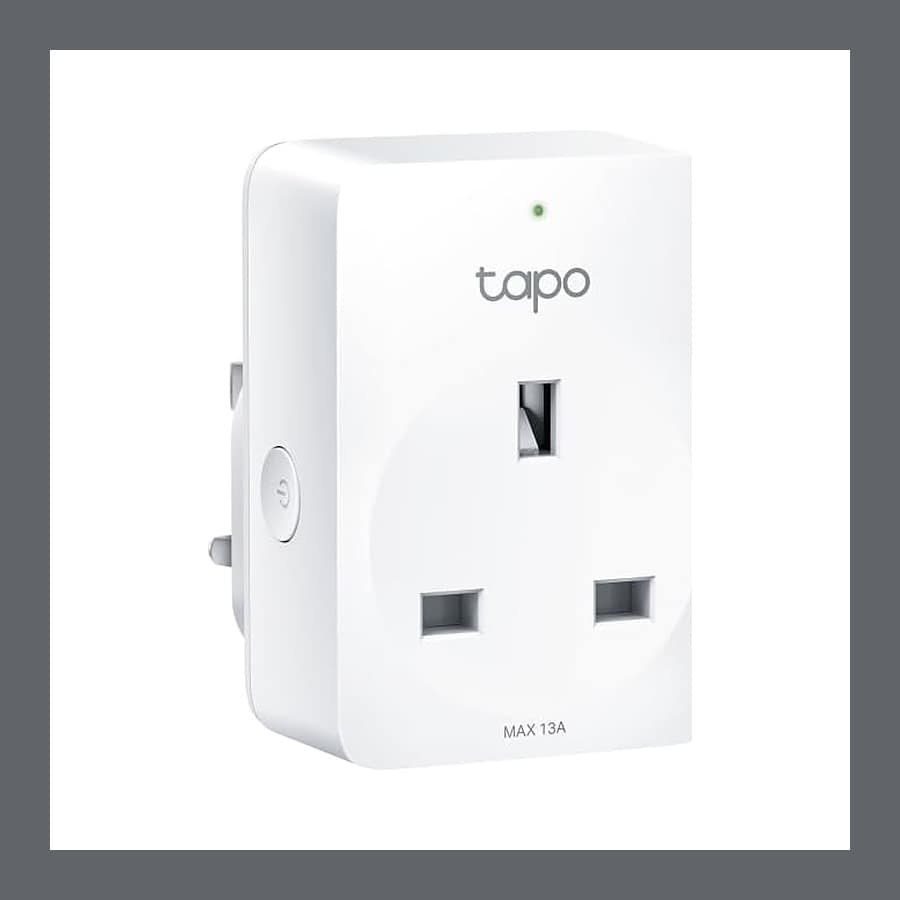
Tapo P110M smart plug, £14.98 on Amazon UK.
Tapo P110M smart plug
I have Tapo plugs and power strips, a Hue smart plug and Eve Energy plugs around the house. The Tapo P110M is the cheapest of them. It is Matter certified, works over Wi-Fi with no hub for the Tapo app, and takes up to 13A. In addition, the Tapo app tracks how much power the plug uses.
The on-off limit. A plug cannot dim the bulb or change its colour, and the lamp's own switch has to stay on. Also, Tapo says its energy monitoring does not yet show up over Matter, only in its own app. If you would rather keep everything in the Hue app, the Hue Smart Plug is £24.99 and joins Hue scenes. For a Thread plug, the Eve Energy is £39.95. The full comparison is in my best smart plugs guide, and the Tapo P110M review goes deeper on this one.
For a design lamp with a fitting or a bulb you don't want to change
£14.98
Section 06 / Sensors
Sensors, so the lights come on without you
I run an Aqara FP2 and Eve Motion sensors alongside my lights. One notices people sitting still, and the other notices people walking past.

Aqara Presence Sensor FP2, £69.99 on Amazon UK.
Aqara Presence Sensor FP2
The FP2 uses millimetre-wave radar rather than a motion sensor, so it can tell someone is in the room even when they are reading on the sofa. Aqara says it handles up to 30 zones in a room of up to 40 square metres and tracks up to five people. It has a light sensor built in, connects over Wi-Fi with no Aqara hub, and works with Apple Home.
The cable. It is wired, powered over USB-C, and Aqara says it should be powered all the time. You need a socket within reach of where it goes. Zone positioning also needs it mounted on a wall rather than the ceiling.
For a living room or a study, where a motion sensor turns the lights off on you
£69.99

Eve Motion, £44.95 on Amazon UK.
Eve Motion
Eve Motion is a battery motion sensor that talks over Thread, the low-power mesh network Matter devices use. It runs on two AAA batteries, sees 9 metres across a 120-degree angle, and carries an IPX3 rating, so it can go outside under cover. Its light sensor means an automation can wait until it is dark before turning anything on.
The hub requirement. Eve says you need a compatible hub. For Apple Home that means a Thread-capable one such as a HomePod mini, and for Alexa an Echo Hub or Echo Dot Max. Like any motion sensor, it can also lose track of you if you sit still for long, which is why the FP2 does the living room.
For a hallway or a landing you walk through rather than sit in
£44.95
Section 07 / The maths
What it costs to make one room smart
From a single plug to a full room of colour bulbs, with the Bridge counted in.
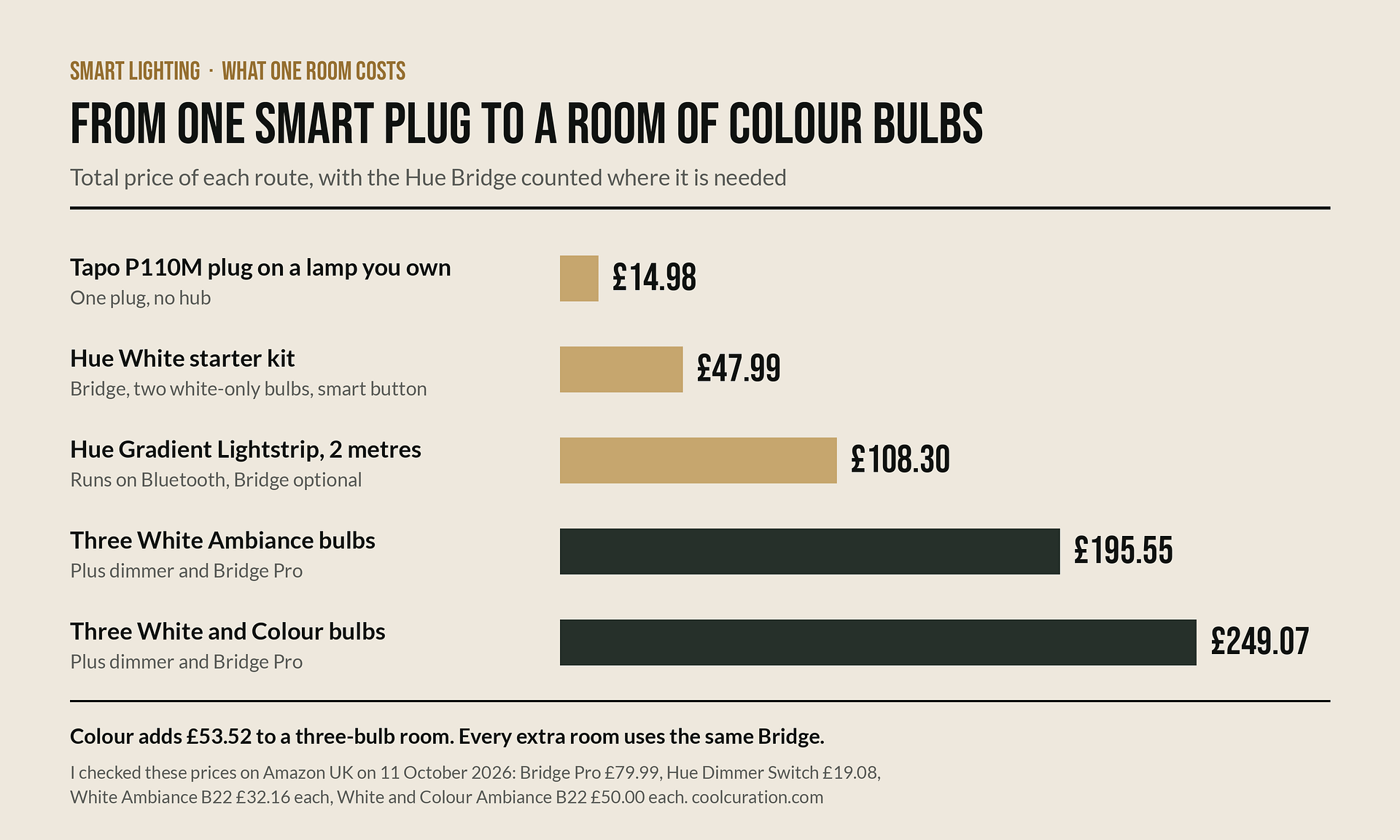
The total price of five ways to make one room smart, from Amazon UK prices. Tap or click the chart to open it full size.
The cheapest route is £14.98, and for a single lamp it is all you need. A properly smart room, with three white ambiance bulbs, a dimmer and the Bridge Pro, comes to £195.55. Switching those three bulbs to colour adds £53.52, which is a big part of why I prefer white ambiance. Once you own a Bridge, every room after the first costs only the bulbs and a switch.
| Pick | What it does | Needs a hub? | Matter | Price |
|---|---|---|---|---|
| Hue White Ambiance B22 | Warm to cool white, dimmable | No, Bridge adds more | Through the Bridge | £32.16 |
| Hue White and Colour Ambiance B22 | White plus full colour | No, Bridge adds more | Through the Bridge | £50.00 |
| Hue Gradient Lightstrip 2m | More than one colour at once | No, Bridge adds more | Through the Bridge | £108.30 |
| Hue Dimmer Switch | Battery remote and wall switch | Yes, Hue Bridge | Through the Bridge | £19.08 |
| Hue Wall Switch Module | Makes an existing switch smart | Yes, Hue Bridge | Through the Bridge | £39.00 |
| Tapo P110M | On and off for any lamp | No | Yes, over Wi-Fi | £14.98 |
| Aqara Presence Sensor FP2 | Knows someone is in the room | No | Apple Home directly | £69.99 |
| Eve Motion | Motion and light level | Yes, a Thread hub | Yes, over Thread | £44.95 |
| Hue Bridge Pro | The Hue hub | It is the hub | Yes | £79.99 |
Section 08 / Running costs
What smart bulbs cost to run
The Hue bulbs here use more electricity than the most efficient ordinary bulbs, both when they are on and when they are off.
Every bulb sold in Great Britain carries an energy label from A to G, worked out from how many lumens it gives per watt. Under the labelling rules, A needs at least 210 lumens per watt and F covers 85 to 110. Both Hue B22 bulbs in this guide manage about 96, so they are rated F. By contrast, Philips' own non-smart Ultra Efficient B22 gives 840 lumens from 4W, which earns an A. Hue's newer White Ambiance A67 B22 does better than the older bulb, at 1600 lumens from 11.8W, a D rating, and 0.2W in standby. It costs £49.99 at Hue.
To turn that into pounds, I assumed each light is on for four hours a day and off for the other twenty. I priced the electricity at 26.32p per kWh, the average rate under Ofgem's October to December 2026 price cap. The wattage, brightness and standby figures come from each maker's own product page.
| Bulb | Energy label | On | Brightness | Standby | A year at 4 hours a day |
|---|---|---|---|---|---|
| Hue White Ambiance B22, 1100 | F | 11W | 1055 lumens | 0.5W | £5.19 |
| Hue White and Colour Ambiance B22, 1100 | F | 11W | 1055 lumens | 0.5W | £5.19 |
| Hue White Ambiance A67 B22, 1600 | D | 11.8W | 1600 lumens | 0.2W | £4.92 |
| Hue Gradient Lightstrip, 2m | Not listed by Hue | 20W | 1800 lumens | 0.5W | £8.65 |
| Philips Ultra Efficient B22, not smart | A | 4W | 840 lumens | None | £1.54 |
The yearly gap with an A-rated bulb
So a Hue White Ambiance bulb costs about £3.65 a year more to run than the A-rated Philips bulb. Across twelve bulbs used that way, the gap comes to about £44 a year. Part of it is brightness, since the Hue gives out 1055 lumens to the Philips bulb's 840. Even so, the standby draw alone costs about 96p a year per Hue bulb, for light you never see. Hue also rates its bulbs for 25,000 hours, against 50,000 for the Ultra Efficient. That is a real running cost to weigh against the switches, scenes and voice control.
The cheapest lamp to run
For a lamp that only needs on and off, the cheapest set-up to run is an A-rated bulb like the Philips Ultra Efficient B22, £9.59, on a Tapo P110M. It cannot dim, but it does not need to. TP-Link does not publish the plug's own standby draw, so I have left it out of the sums. For context, the Energy Saving Trust says any LED bulb uses 80% less electricity than a halogen of the same brightness. So every bulb on this page is still a big saving on an old halogen.
Section 09 / What I'd skip
The bulbs I would not buy again
Nanoleaf Essentials, which I bought for Thread and regret.
I bought four Nanoleaf Essentials bulbs because they support Thread natively. They join a Thread network on their own, with no Nanoleaf bridge, which sounded like the future. Two of the four have since broken. They also run hot, the bulb quality feels lower than Hue's, and firmware updates fail. Thread was a great idea, but not at the cost of a bulb that doesn't last. From now on I will always go Hue, and these are the only bulbs on this page I would tell you to leave on the shelf.
Best smart lighting UK FAQs
Do I need a hub for smart lights?
Not to start. Every Hue bulb here also works over Bluetooth from the Hue app, and the Tapo plug needs no hub for its own app. However, a hub is what lets lights work with switches like the Hue wall switch module, respond from outside the house and join Apple Home, Google Home or Alexa through Matter. For more than a couple of lights, I would buy the Bridge.
Are smart bulbs worth it in a rented home?
Yes, because nothing gets wired in. Swap the bulbs, stick a battery dimmer switch on the wall next to the old one, and take everything with you when you move. The one thing to avoid is the wall switch module, which goes behind the switch plate, unless your landlord says yes. Also, tape over the old switch or tell your housemates, because turning it off kills the smart bulbs.
Do smart bulbs use power when they are off?
Yes, a little, because the radio stays on to listen for commands. Hue lists 0.5W in standby for the B22 bulbs here. Over a year that is about 4.4kWh, or roughly £1.15 a bulb at the 26.32p per kWh average electricity rate in Ofgem's October to December 2026 price cap. Twelve bulbs come to about £14 a year.
Are Philips Hue bulbs energy efficient?
Not by the energy label. Both Hue B22 bulbs here are rated F, and Philips' own non-smart Ultra Efficient B22 is rated A. At four hours a day, a Hue White Ambiance B22 costs about £5.19 a year to run against £1.54 for the Ultra Efficient, including the Hue bulb's standby draw. Hue's newer A67 bulb is rated D, so it closes some of that gap.
Matter vs Hue: which should I buy?
You don't have to choose. Matter is a standard, not a brand, and Hue lights join Matter through the Hue Bridge. The real choice is whether you want a lighting system with its own hub, like Hue, or bulbs that join a Thread network directly. I tried the second with Nanoleaf and went back to Hue, because two of my four Nanoleaf bulbs failed.
How much does it cost to start with smart lighting?
From £14.98 for a Tapo plug on a lamp you already own. A Hue White starter kit with a Bridge, two white bulbs and a smart button was £47.99, and three white ambiance bulbs with a dimmer and the Bridge Pro came to £195.55. I checked those prices on Amazon UK on 11 October 2026.
More from CoolCuration
- Winter energy saving tips - draught-proofing, heating and tariff fixes for the months your lights are on longest.
- Loftie alarm clock - a wake-up light for darker mornings, with a discount code.
- Octopus Energy referral - £50 credit when you switch, if you are rethinking your electricity supplier this winter.
- Gifts for a new home - useful and good-looking ideas for someone setting up a place of their own.
- Airtime Rewards - earn money off your phone bill when you shop at more than 200 UK retailers.
Disclaimer. Prices and stock change, so check the current price before you buy. Running costs depend on your own electricity tariff. Mains wiring work, including the Hue wall switch module, is best left to a qualified electrician if you are not confident. This article contains affiliate and referral links, which are paid links. If you click one and buy or sign up, I earn a commission or referral bonus at no extra cost to you. Brands don't choose what I feature or what I say about them.
What's trending




Recent posts
- Best Smart Lighting UK: What I Use at Home, and What I’d Skip
 The best smart lighting UK picks from my own home: Hue bulbs, a lightstrip, switches and sensors, with prices and running costs.
- Frieze London 2026 Review: Why It Only Gets Two StarsThree visits to Frieze London 2026, a Deutsche Bank lounge full of Studio Lenca, and why the fair only gets two stars.
- Frieze Masters Review 2026: Old Masters, Queering Modernism and Alice NeelFrieze Masters review 2026: a few visits to Regent's Park, from a 1520s royal portrait to Alice Neel and the new Queering Modernism strand. 4/5 Stone cold.


No Comments.