
Last updated: 14 October 2026
By Tristan · Arts, exhibitions and creative culture
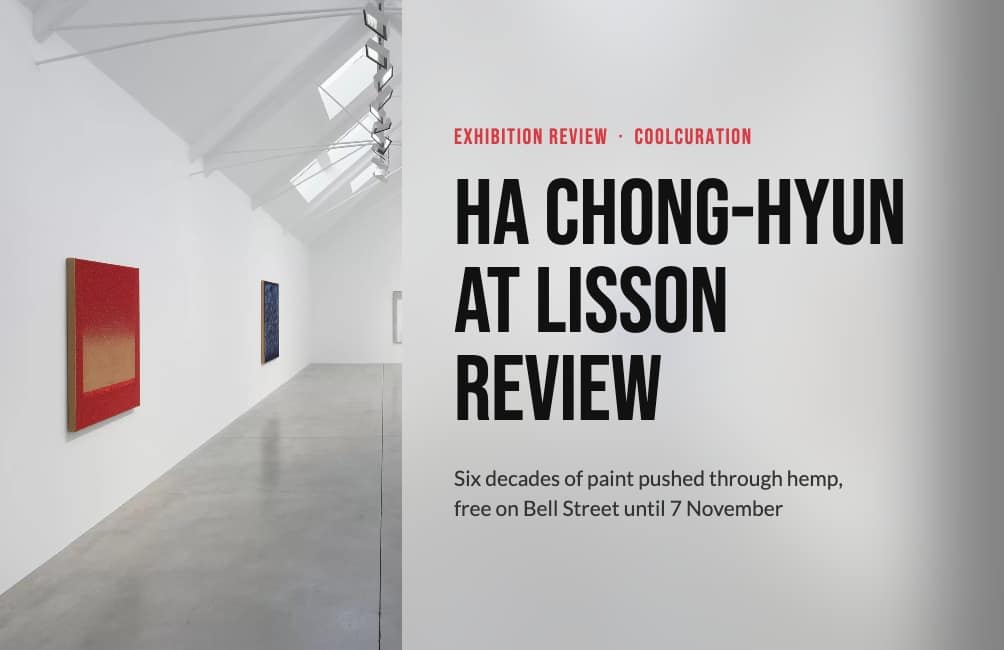
Six decades of paint pushed through the back of the canvas.
This is an opinion piece. Views expressed are the author's own and do not constitute professional advice.
Cool Factor: 4/5
I went to the private view of Ha Chong-Hyun at Lisson on Thursday 24 September 2026. It is the Korean painter's first show with the gallery and his first in London since 2020. The survey covers six decades of work, spread across the ground floor and basement at 27 Bell Street. It runs until 7 November 2026, and entry is free. It is one of the big shows Lisson has on during Frieze London. I give it four out of five.
What's on: Ha Chong-Hyun at Lisson
Lisson calls the show a "wide-ranging yet succinct survey", running from some of Ha's earliest surviving works up to the present day. According to the gallery's exhibition page, it includes a folded and rippled canvas from the late 1960s and burnt, wired works from the 1970s. There are also more than a dozen paintings from his Conjunction series, plus later Post Conjunction works.
His last London show was at Almine Rech, from 6 October to 14 November 2020, as The Korea Times reported at the time. The day after it opened, the Asian Art Museum in San Francisco launched Ha Chong-Hyun: Retrospective, his first museum exhibition in North America. That show runs until 25 January 2027.
Who Ha Chong-Hyun is
Ha was born in 1935 in Sancheong, in the south of Korea, and graduated from Hongik University in Seoul in 1959. He has lived and worked in Seoul ever since. In 1969 he became a founding member and chairman of the Korean Avant-Garde Association, a group of artists who pushed abstract and experimental art in Korea.
He is usually filed under Dansaekhwa, the Korean monochrome painting movement of the 1970s. However, Lisson's press release notes that he was never entirely convinced by the label. When the San Francisco show was announced in April, the Asian Art Museum's director, Soyoung Lee, made the same point to reporters in Seoul. "Being labeled a dansaekhwa master does not do him justice," she said, according to Korea JoongAng Daily.
Ha explained what he was after in a 2019 interview with The Korea Times. "When people think of painting, whether they are from the East or the West, they immediately relate it to filling up the blank space on canvas or paper. However, I wanted to escape these basics," he said. His work is now in the collections of the Museum of Modern Art and the Guggenheim in New York, and the Centre Pompidou in Paris.
Opening night on Bell Street
Nicholas Logsdail founded Lisson on Bell Street in 1967, just north of Marylebone Road. The private view ran from 6pm to 8pm, and it was busy, with a steady flow of people in and out all evening.
Part of the reason was that Lisson opened two shows that night. Round the corner at 67 Lisson Street, Carmen Herrera: Pulse, Pause, Repeat opened at the same time. The art historian Marie Perennès curated it. It brings together drawings, paintings and sculpture from the last ten years of Herrera's life. Herrera was born in Havana in 1915 and only got wide recognition in the 2010s. Both shows close on 7 November, so you can see the two in one trip.
Stop one: the main room and the recent work
Ground floor, main gallery
I started in the big main gallery, the long white room with the skylights in its pitched roof. This is where Lisson has hung the recent work. It is also where the colour is.
On one wall there is a red canvas with a band of bare hemp left showing across it. The red thins out towards the edge of that band. Further along are a deep blue painting and a work made of white vertical strips. Opposite them sits a large white canvas covered in thick, clotted marks. A second vertical-strip work, in bright blue, hangs on the end wall.
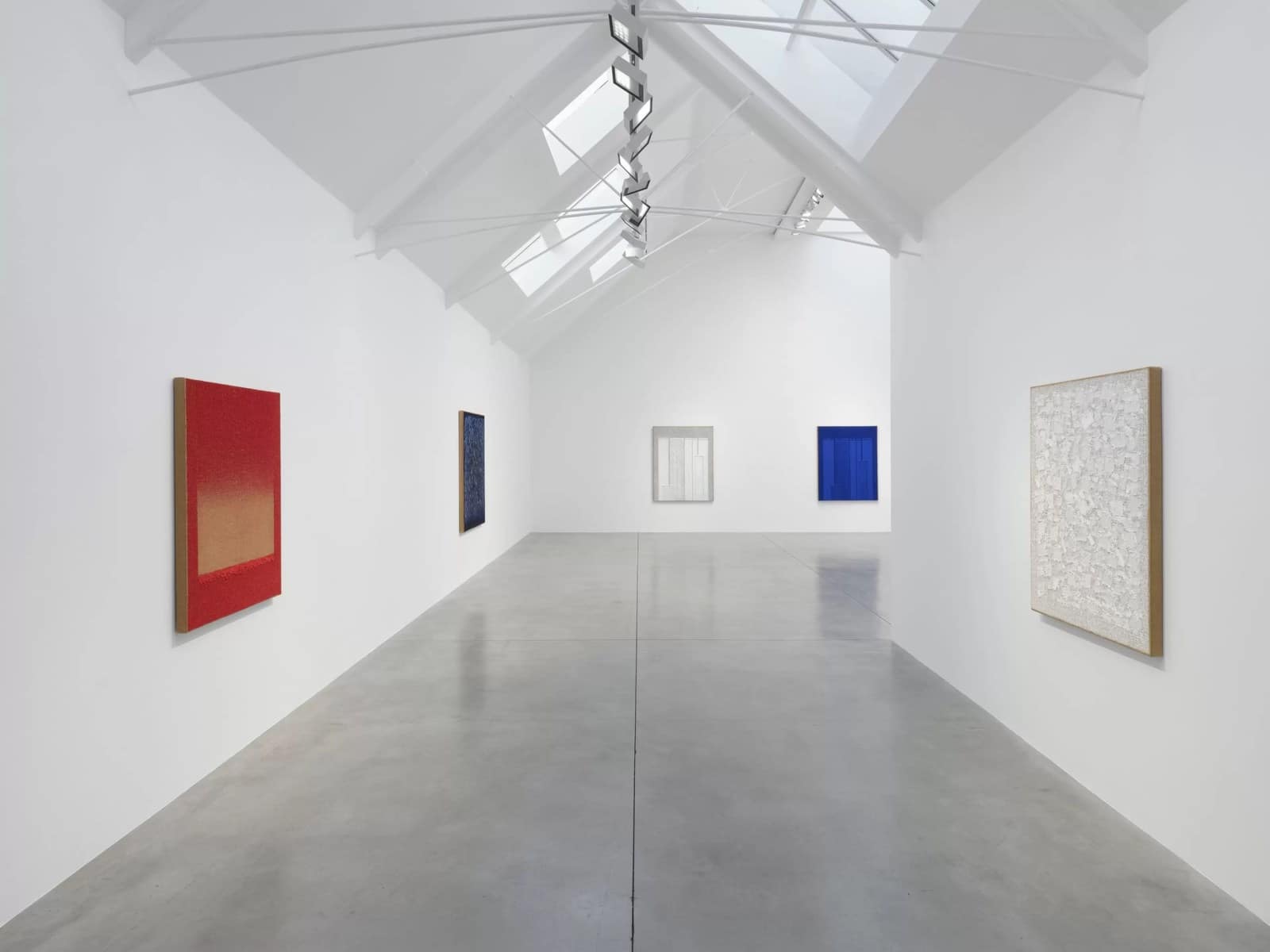
The colour is a fairly recent development. According to the Asian Art Museum's press release, Ha began using vivid primary colours in the 2010s. That took him well beyond the muted palette Dansaekhwa is known for.
The vertical-strip works belong to the Post Conjunction series, which he started in the 2000s. At a 2022 show at Kukje Gallery in Seoul, he explained the method to The Korea Herald. "I covered wood sticks with canvas and put oil paints between the sticks. The oil paints ooze out as if they are squeezed," he said.
How a Conjunction painting is made
Almost everything in the show grows out of one idea. In 1974, Ha started his Conjunction series, and he is still making them. Instead of painting on the front of the canvas, he pushes thick oil paint through from the back. The paint forces its way through the coarse weave and comes out on the front in beads and ridges.
He calls it baeapbeop, the back-pressure method. As he told The Korea Times in 2019, "I had to break away from Western painting methods, so I chose to paint from the back."
The hemp has a history too. "Hemp cloth was derived from burlap bags that carried grains such as wheat and barley after the war. For me, hemp cloth is a revolution against traditional canvas," he said in the same interview. You can see that cloth bare in the band across the red painting in the main room.
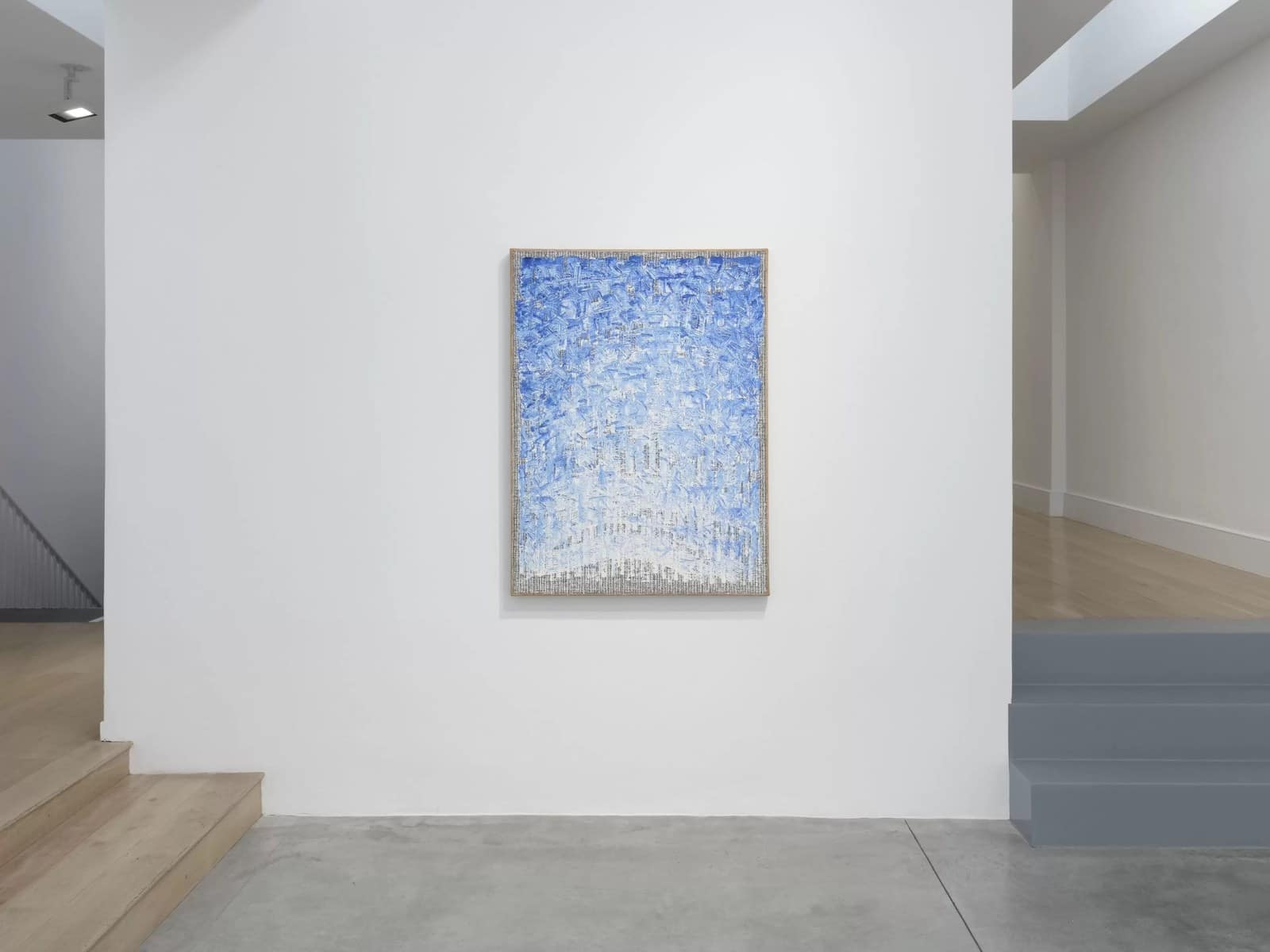
"I cannot control how much the paint seeps through." Ha Chong-Hyun
He also accepts a lot of chance. Ha never makes sketches, and he told the paper that he does not know what the composition will be until he has made it. For a visitor, that means no two surfaces are alike, even across a room of paintings in the same colour.
Stop two: the front rooms on the ground floor
Ground floor, front galleries
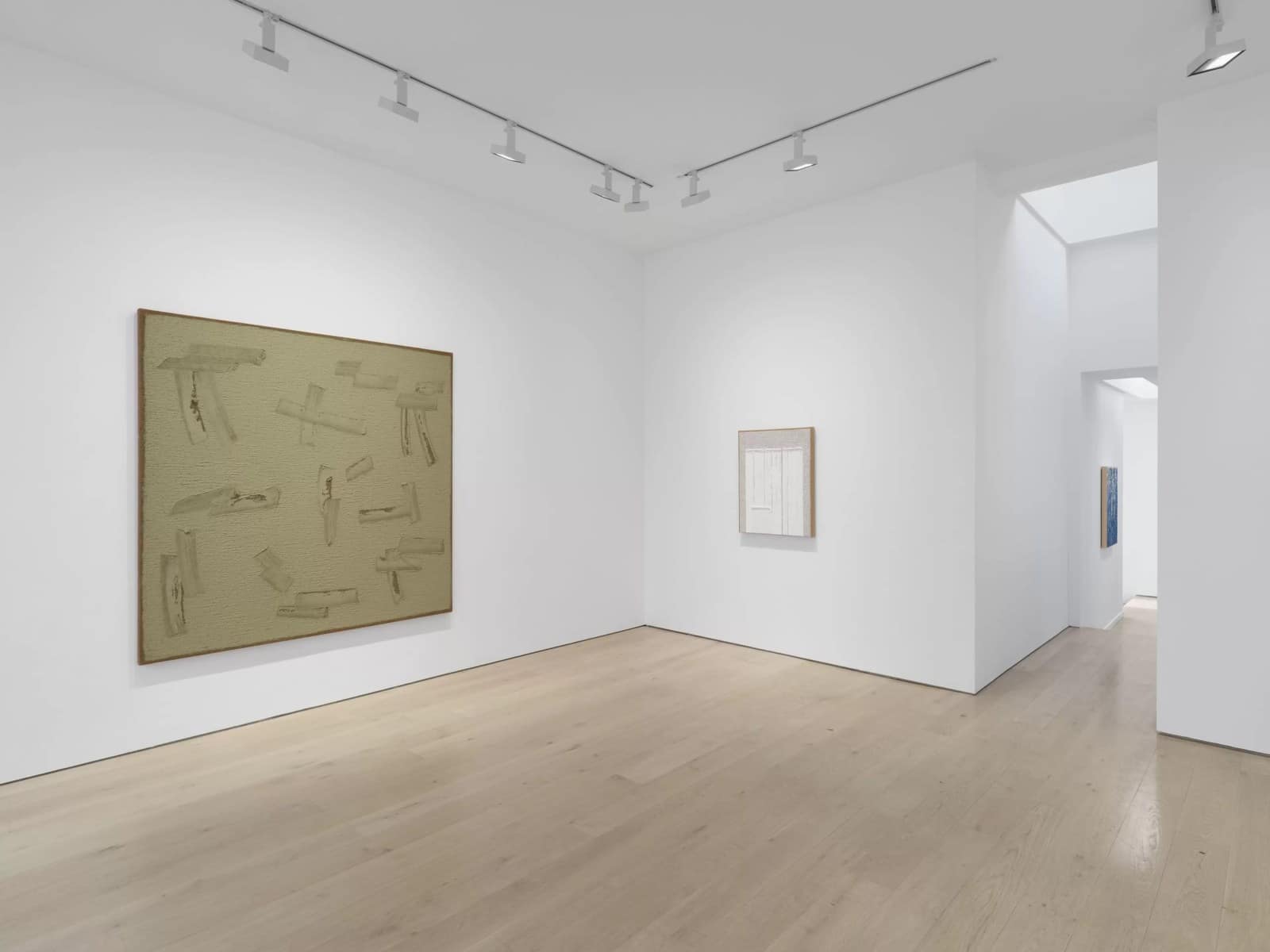
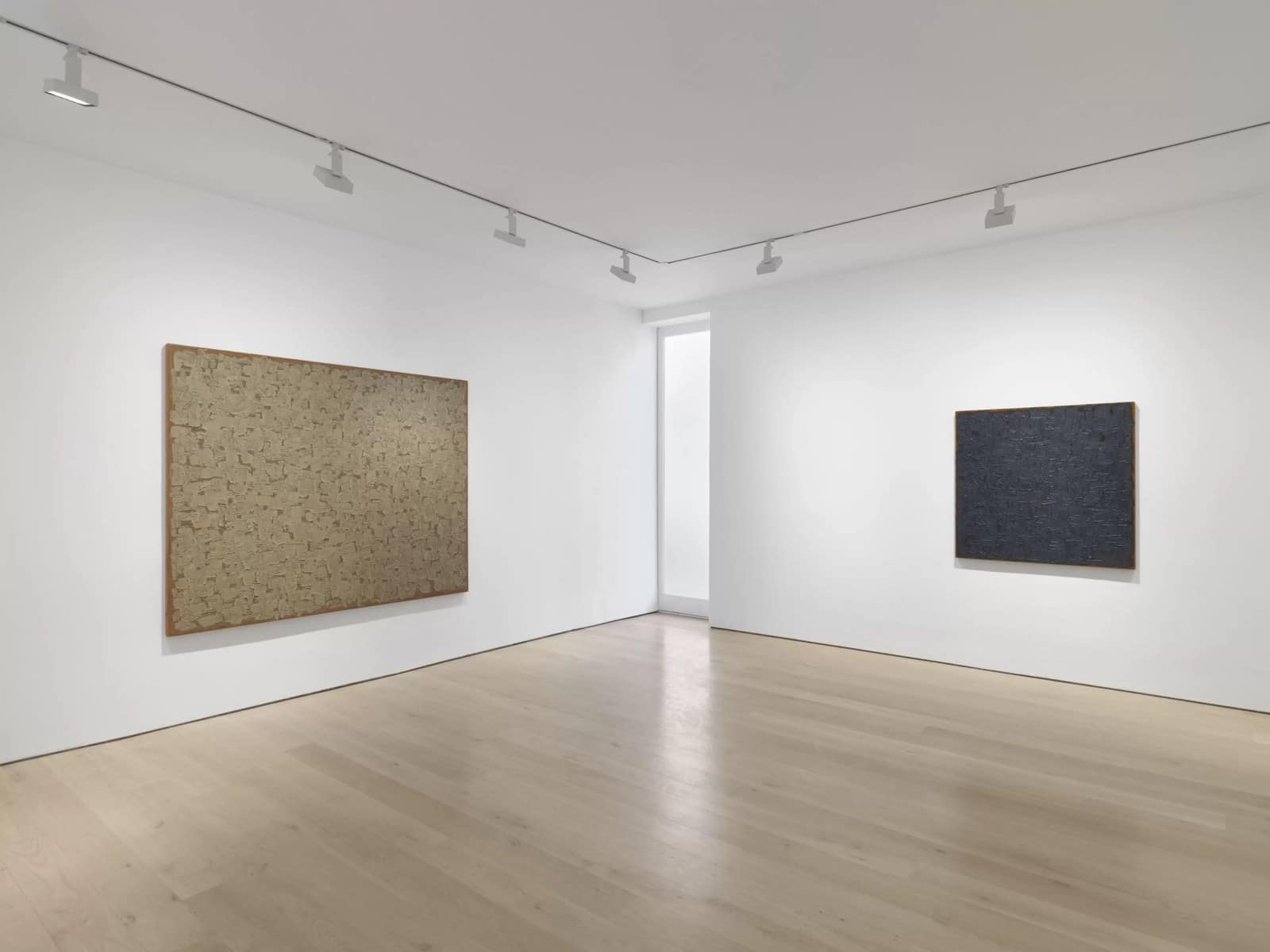
Next, I went through to the smaller front rooms on the ground floor. The biggest canvas here is an olive-green Conjunction, with broad flat strokes scattered across it at different angles. Near it is a smaller white work made in vertical bands.
Lisson's press release says the Conjunction paintings in the show vary in direction as well as colour. Some run vertical or horizontal, while others are perpendicular, radiating or freeform. With more than a dozen of them in one building, you can compare how differently the same method turns out.
Stop three: down to the basement and the 1970s
Lower ground floor
Finally, I went downstairs. The basement holds the 1970s works, which are the ones tied most directly to Korea's recent history. In the 1970s, Ha burnt the thick paint on his surfaces and fixed coiled springs and barbed wire straight onto the canvas.
According to Lisson, those works reflect South Korea's long periods of martial law and military dictatorship. They also reflect how hard it was to get materials at the time. Ha told The Korea Times: "After the Korean War, most Koreans suffered from a shortage of commodities. I had to look for the residue of the war to find materials for my work."
He had mixed feelings about the wire, too. "It has a certain charm, but at the same time, it suppressed people during the war. Postwar life was the subject of my work, but expressed in an abstract way," he said.
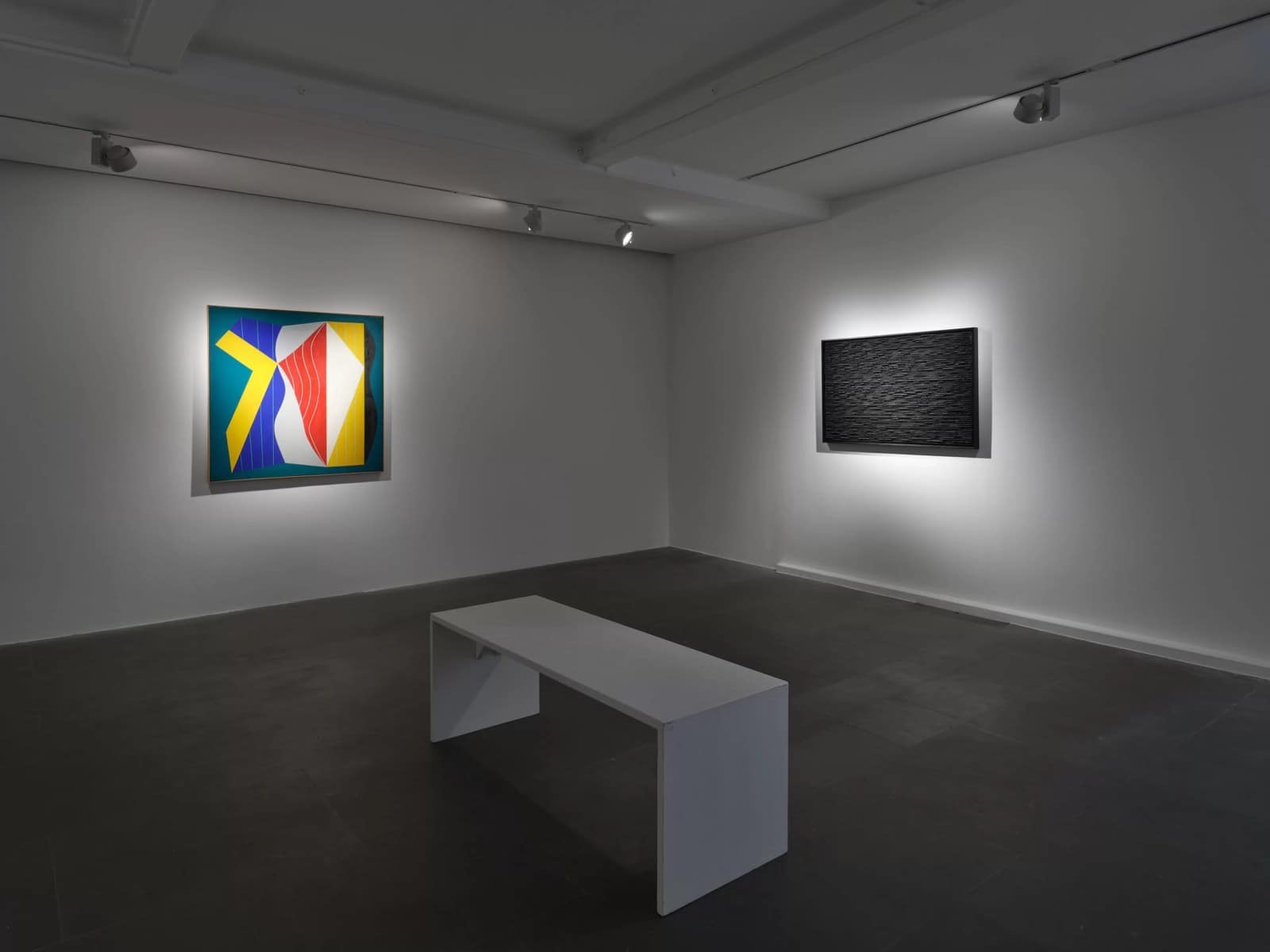
Down here, it felt as if these works had been relegated and hidden away. That is my main problem with the show, and it gets its own section below.
What did not work
The critique
Lisson's own press release calls the early pieces "key early works". Yet the burnt surfaces, the springs and the barbed wire are all in the basement, as if they were relegated and hidden away. Upstairs gets the skylights and the big colourful recent paintings.
That matters because the 1970s works show where the hemp, the pressure and the rough handling came from. They are the works that explain the rest of the building. If you go, make sure you go downstairs.
The second limit is one of scale. This is a commercial gallery show across two floors. So it is a sample of the career rather than the whole of it. The full retrospective is in San Francisco. For London, though, this is the fullest look at his work since 2020, and it covers every decade from the 1960s on.
Why Ha Chong-Hyun matters now
Ha is in his nineties and still working. The San Francisco retrospective opened a day after the Lisson show. Recent solo shows include Château La Coste in France and Art Sonje Center in Seoul, both in 2025. In 2022 he had a collateral exhibition at the Venice Biennale, at the Palazzetto Tito.
Meanwhile, interest in Korean experimental art of the 1960s and 1970s has grown fast. Ha was in Only the Young: Experimental Art in Korea, 1960s–1970s, which went from the National Museum of Modern and Contemporary Art in Seoul to the Guggenheim in New York in 2023, and then to the Hammer Museum in Los Angeles in 2024. The basement at Lisson is a small version of that story, which is one more reason it deserved a better spot.
As Lisson puts it, he was questioning "where the painting's surfaces and supports might really begin and end" as early as the late 1960s.
Is it worth the trip?
Entry is free, according to London Korean Links' listing. For no money, you get six decades of one painter's work, and Carmen Herrera's late work round the corner as well.
If you are in London for Frieze, the timing works well. Frieze London and Frieze Masters run in Regent's Park from 14 to 18 October 2026, according to The Royal Parks. Lisson held a panel discussion on Ha with ArtReview magazine on 13 October, the day before the fair opened. For the fair itself, our Frieze London 2026 guide has tickets and times, and our Frieze week exhibitions round-up covers nine more gallery shows to see this week.
If you want a bigger, ticketed painting show to pair it with, our Rose Wylie review from the Royal Academy covers another painter with a long career behind them.
Practical information
Ha Chong-Hyun is at Lisson, 27 Bell Street, London NW1 5BY, until 7 November 2026. The gallery opens Tuesday to Saturday, 11am to 6pm, and by appointment. It is closed on Sundays and Mondays.
Carmen Herrera: Pulse, Pause, Repeat is at 67 Lisson Street, London NW1 5DA, with the same dates and hours. Part of the Ha show is in the basement, so if you need step-free access, call the gallery on 020 7724 2739 or email [email protected] before you go. Details on this page were checked on 14 October 2026.
The verdict
Four out of five, Stone cold. Ha Chong-Hyun at Lisson is a free, well-chosen survey of six decades of work. It covers his colourful recent paintings, more than a dozen Conjunction works and the burnt and wired pieces from the 1970s. The downside is that those 1970s works are hung in the basement.
Cool Factor
★★★★☆
4 out of 5
Overall, it is a solid 4/5 Stone cold. It earns that by covering six decades of work for free, from the burnt and wired 1970s pieces to the bright recent paintings in the main room. It stops short of five because the key early works, the burnt and wired paintings from the 1970s, are tucked away in the basement. Go before 7 November and start downstairs if you can. Then walk round the corner to the Carmen Herrera show while you are there.
Ha Chong-Hyun at Lisson: common questions
Is the Ha Chong-Hyun exhibition at Lisson worth seeing?
Yes. I gave it four out of five. It is his first London show since 2020 and covers six decades of work for free. The main drawback is that the important 1970s works are tucked away in the basement.
How much does it cost to see Ha Chong-Hyun at Lisson?
Nothing. As of 14 October 2026, entry is free and the gallery is open Tuesday to Saturday, 11am to 6pm.
When does the Ha Chong-Hyun show close?
It runs until 7 November 2026 at 27 Bell Street, London NW1 5BY.
What is a Conjunction painting?
It is Ha's signature series, begun in 1974. He pushes thick oil paint through the back of coarse hemp canvas, so it comes out on the front in beads and ridges. He calls the method baeapbeop, meaning back-pressure.
Is Ha Chong-Hyun a Dansaekhwa artist?
He is usually grouped with Dansaekhwa, the Korean monochrome painting movement of the 1970s. However, he was never entirely convinced by the label, and his recent work uses strong reds and blues.
Can I see the Carmen Herrera show on the same visit?
Yes. Carmen Herrera: Pulse, Pause, Repeat is at Lisson's other space, 67 Lisson Street, a short walk away. It has the same dates and opening hours.
More from CoolCuration
- David Hockney in London. Our review of the Hockney exhibition, and whether it was worth the ticket.
- Veronica Ryan at the Whitechapel Gallery. Another London show where the hang made a big difference to the work.
- Howard Hodgkin Indian Leaves print. A limited-edition Tate print by the British painter, at £600.
- An alternative to Yves Klein blue paint. For anyone who leaves the main room wanting that bright blue at home.
- The gift guide for designers. Presents for people who notice texture, colour and materials.
What's trending



Recent posts
- Ha Chong-Hyun at Lisson Review: Six Decades of Paint
 Last updated: 14 October 2026 By Tristan · Arts, exhibitions and creative culture Exhibition reviewLisson, Bell Street Six decades of paint pushed through the back of the canvas. This is an opinion piece. Views expressed are the author's own and do not constitute professional advice. Cool Factor: 4/5 I went to the private view of… Read more: Ha Chong-Hyun at Lisson Review: Six Decades of Paint
 - BFI London Film Festival 2026: What’s Worth SeeingTen BFI London Film Festival 2026 films for 14 to 18 October, the four that still had seats on 13 October, the sold-out titles, ticket prices and how the standby queue works.
- Best Affordable Art UK 2026: 15 Prints and Originals Under £500Fifteen prints and originals under £500 from UK gallery shops, print studios and Saatchi Art, plus how editions, framing and Own Art work.

No Comments.