
Last updated: 11 April 2026
By Tristan · Arts, exhibitions and creative culture
This is an opinion piece. Views expressed are the author's own and do not constitute professional advice.
This article contains affiliate or referral links. If you click through and sign up I may earn a commission or referral bonus at no extra cost to you. It does not affect my editorial view.
Cool Factor
★★☆☆☆
2 out of 5
Two weeks ago I walked out of Hurvin Anderson's show at Tate Britain buzzing. It was focused, beautifully paced, and one of the best things I have seen in London this year. Then I paid £16.50 to see Veronica Ryan: Multiple Conversations at Whitechapel Gallery. I walked out feeling flat. Ryan is a Turner Prize winner with four decades of serious, compelling work behind her. So what went wrong? In short, the Veronica Ryan Whitechapel survey tries to say everything at once and ends up saying very little clearly. Here is why.
What's on?
Veronica Ryan: Multiple Conversations is one of the most extensive presentations of the artist's work to date. Spread across all three gallery spaces at Whitechapel, it brings together more than 100 works spanning four decades of sculpture, textiles, drawings, and works on paper. Crucially, it also features recently rediscovered pieces from the 1980s. Some of these were unearthed in Colchester, where Ryan had left work behind in a shared barn studio after a relationship broke down. Others surfaced at Kettle's Yard in Cambridge, where she held a residency in 1988. Many more were destroyed in the 2004 Momart warehouse fire, a loss that went largely unreported at the time.
Ryan (b. 1956, Plymouth, Montserrat) trained at the Slade School of Fine Art and now splits her time between London and New York. She won the Turner Prize in 2022 and is best known publicly for her Windrush Generation public sculpture in Hackney: giant marble and bronze casts of a custard apple, breadfruit, and soursop. This Whitechapel show marks the gallery's 125th anniversary programme and is her largest UK presentation to date.
Alongside the main ticketed exhibition, two free shows are also running. Senga Nengudi: Performance Works 1972-1982 sits in the archive space with photographs, film, and archival material from the pioneering American artist's early career. Gabriel Chaile: Archaeology of Memory, a free commission of monumental adobe sculptures, is also on display through to September. Both are worth your time.
First impressions
I visited on a Tuesday at midday. The gallery was quiet, which should have worked in the show's favour. Whitechapel is a beautiful building. Gallery 1 on the ground floor has high ceilings, generous proportions, and a calm that rewards confident, spacious installations. So walking in and feeling immediately crowded was not the start I was hoping for.
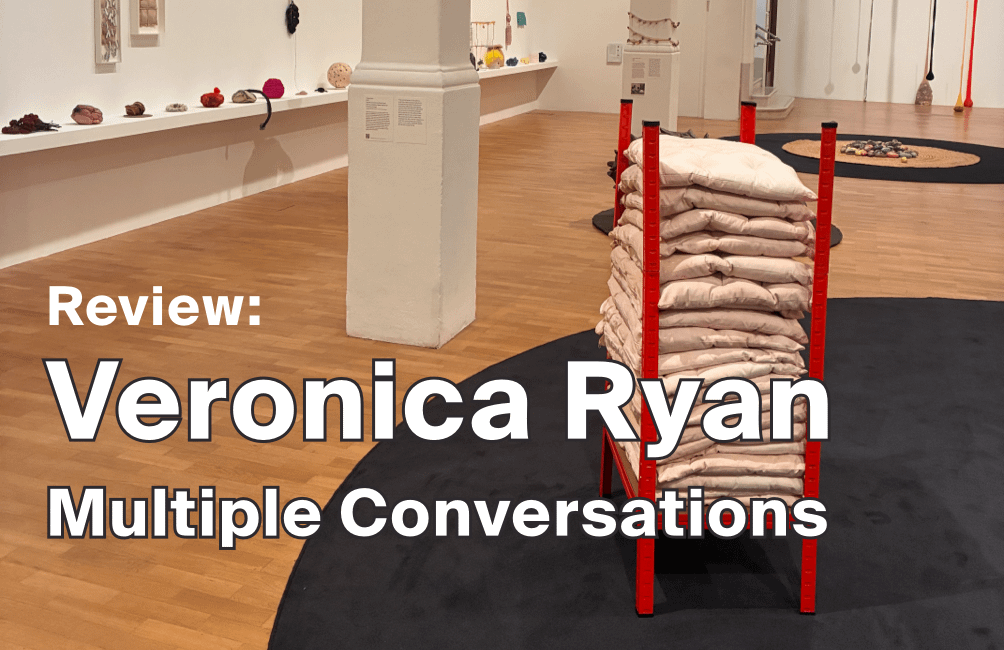
The newer work hits you first. Long, thin coloured sacks dangle from the ceiling on wires, bulbously weighed down by plastic bottles and seed pods inside. Cardboard avocado trays are stacked into improvised geometric forms. Plastic bottles in the corner turn out to be ceramic. Teabags are arranged into a grid on the wall. Little objects sit wrapped in bandages. At a glance, some of it looks almost like everyday rubbish. On closer inspection the materials shift and slip out of register. That trompe-l'oeil material play is interesting in isolation. In a room this packed, though, the effect dilutes fast.
The experience
Downstairs: Gallery 1
Gallery 1 houses Ryan's newest work, including several pieces made specifically for this show. Among them is Totem (2025-26), a ceramic sculpture derived from casts of stacked plastic bottles that echoes the gallery's own columns. Nearby sits Residue (1988), a crumpled bronze form with vivid blue patina, alongside The End of All Things (2025), an indigo-dyed duvet cover gathered and shaped with elastic hairbands. Along the length of the gallery runs a shelf featuring the Multiple Conversations series (2019-present), from which the exhibition takes its name: tightly wound spindles pierced by clay pods, clusters of teabags threaded together, stacks of plaster-cast leaves bound in green thread.
Ryan uses avocados, tea, and mango seed pods as symbols of global trade and colonial legacies. The way "over there" becomes "over here" and gets consumed. When she wraps things in string and bandages, the intent is to symbolise repair and healing. When she recycles plastic, it is to suggest that even discarded things can hold value. I understand this intellectually. Standing in the room, though, the ideas did not always translate into a physical experience that held me.
The problem is one of legibility. The first bit of wall text in the show is Ryan stating she refuses to give specific meanings to her work. And yet many of the newer pieces only begin to make sense once you read the materials list. You find out there is a mango stone concealed inside a dangling sack, or drift seeds hidden inside a crocheted pouch, and the idea clicks. But a piece of art that only lands with a handout in your hand is working hard for the wrong reasons. The gorgeous multicoloured ceramic cocoa pods and the giant bronze magnolia seed communicate their ideas directly, confidently, and boldly. They do not need explaining. Too much else in this room does.
The crocheted hanging works, which Ryan developed during a residency at Porthmeor Studios in St Ives, are striking in form. She noticed how traditional fishing nets echoed the crochet techniques her mother taught her, and these bulbous stocking-like structures conceal crystal rocks, drift seeds, and crushed bottles inside. It is a beautiful idea. But surrounded by so many competing voices in the room, the impact faded. It felt less like multiple conversations and more like multiple monologues happening at once.
Upstairs: Galleries 2 and 3
Then I went upstairs, and the show shifted significantly.
Gallery 2 houses a selection of Ryan's drawings, photo-collages, and works on paper. A large patchwork quilt titled Safe Spaces (1988-2019) was shown near a series of small gouache paintings of cushions and pillows. There were also rarely displayed collages incorporating family photographs overpainted with dense black clouds that obscure personal features. The works have a psychological intensity, alluding to repressed desires and traumas. A small acrylic and ink drawing of a pin cushion from 2002 was quietly absorbing. The fact that Ryan returns to earlier ideas and remakes them, trusting that the work will change because she has changed, gives the upstairs galleries a sense of purpose that the ground floor lacked.
Gallery 3 is where the show really found its voice. It opens with works engaging directly with Ryan's birthplace of Montserrat, including a series of gouache and pastel drawings depicting the aftermath of the devastating Soufrière Hills volcanic eruption that struck the island in the 1990s. These carried real emotional weight. The mark-making felt personal and specific in a way the downstairs installation did not.
On the far side of the room, a large, bright orange textile work hung pinned and flowing from the wall. It stopped me in my tracks. Beside it hung similar flowing pieces. The wall text noted that some had been remade after originals were lost.
The rediscovered 1980s works are the real highlight, and they sit in the final sections of Gallery 3. Attempts to Fill Vacant Spaces (1986) is a series of plaster bean-shaped pods, each supporting a small bronze object. It had not been shown since the year it was made. Relics in the Pillow of Dreams (1985) features a plaster pillow with bronze pod-like forms placed on top. There are seed-like bronze forms laid on metallic pillows, soursop pods nestled on slabs of marble, and lead sheets perforated with organic-looking slits. Ryan is combining symbols of Montserrat and the Caribbean with the sculptural language of Barbara Hepworth, Eva Hesse, and Henry Moore. These pieces have a rawness and material intelligence that felt genuinely urgent and honest.
The lead foil works from the Kettle's Yard residency sat alongside them. Ryan has described lead foil as being like fabric, and you can see exactly what she means. Lead is a toxic material, and watching it twisted into something aesthetic and sculptural is the moment the show clicks. You realise what Ryan is doing at her best: reshaping the material world to help it heal. That idea, when it lands, is powerful.
If the entire exhibition had been edited to this level of intensity, we would be talking about a very different show.
Value for money
This is where things get uncomfortable. Standard tickets are £16.50, with concessions at £9.50. For a show that left me cold on the ground floor and only truly engaged me upstairs, that is a tough spend. Especially when you look at what else is running in London right now.
Hurvin Anderson at Tate Britain? Ticketed, but free for Tate Members and just £5 for under-25s via Tate Collective, and a genuine 5/5 Ice cold. David Hockney at the Serpentine? Free. Rose Wylie at the Royal Academy? Free and full of personality. If you have a limited exhibition budget this spring, I would point you towards any of those first.
The free Senga Nengudi spotlight next door is worth seeing, and I plan to go back for it. Gabriel Chaile's commission is also free and runs through to September. If you are heading to Whitechapel anyway, factor those in alongside your visit.
The verdict
Ryan is a significant artist. The Turner Prize, the Hackney Windrush commission, and four decades of ambitious, materially inventive work all deserve recognition and serious engagement. The Guardian's review landed in a broadly similar place to ours, praising the earlier work upstairs while finding the newer pieces downstairs harder to connect with. I suspect other critics may be warmer. I hope they are, because Ryan's practice deserves a big audience. But a major survey show needs more than gathering everything together in one space. It needs editing, pacing, and a curatorial hand that guides you through. Multiple Conversations, at least in Gallery 1, felt like it lacked all three.
Cool Factor
★★☆☆☆
2 out of 5
Overall, 2/5 Lukewarm. The rediscovered 1980s works upstairs are genuinely worth seeing and almost pulled this to a 3. Attempts to Fill Vacant Spaces, the lead foil pieces from Kettle's Yard, and the bright orange flowing textile in Gallery 3 all linger in the memory. The Montserrat drawings in Gallery 3 carry real emotional weight too. But the cluttered, unfocused ground-floor gallery undermined the whole experience. At £16.50, with so many stronger shows running in London right now, this is a tough sell. If you do go, head upstairs first. And if you have not yet seen Hurvin Anderson at Tate Britain, consider that instead. It is focused, beautifully paced, and the benchmark for what a great London exhibition looks like in 2026.
Frequently asked questions
Is the Veronica Ryan exhibition worth visiting?
It depends on your budget and expectations. The upstairs galleries are strong, particularly the rediscovered 1980s sculptures and the Montserrat drawings. However, the ground-floor gallery felt cluttered and unfocused. If you are short on time or money, several London exhibitions offer a more rewarding experience right now, including Hurvin Anderson at Tate Britain.
How long do you need at the Veronica Ryan Whitechapel show?
Around 45 minutes to an hour is enough to see everything across the three galleries. Allow extra time if the works on paper in Gallery 2 draw you in. It is also worth factoring in the free Senga Nengudi spotlight and the Gabriel Chaile commission alongside your visit.
Is Whitechapel Gallery free?
The gallery itself is free to enter, and many of its exhibitions are free throughout the year. However, Veronica Ryan: Multiple Conversations is a ticketed show. Standard admission is £16.50, with concessions at £9.50. Under 16s go free. The Senga Nengudi and Gabriel Chaile shows running alongside are both free.
What is the Veronica Ryan exhibition about?
Multiple Conversations is a survey of Ryan's four-decade career, featuring more than 100 works across sculpture, textiles, and works on paper. It explores themes of memory, displacement, trauma, colonial trade legacies, and the natural world. Ryan was born in Montserrat, raised in London, and won the Turner Prize in 2022. She is also known for her Windrush Generation public sculpture in Hackney.
How much are tickets for Veronica Ryan at Whitechapel?
Standard tickets cost £16.50. Concessions are £9.50. Under 16s are free. The exhibition runs from 1 April to 14 June 2026. Opening hours are Tuesday to Sunday, 11am to 6pm, with late opening on Thursdays until 9pm.
Is the Senga Nengudi show at Whitechapel free?
Yes. Senga Nengudi: Performance Works 1972-1982 is a free spotlight exhibition running alongside the Veronica Ryan show on the same dates. It features photographs, archival materials, and film from the 1970s and 1980s.
More from CoolCuration
- William Nicholson at Pallant House Gallery - A beautifully curated show outside London that proves less really is more.
- AeroPress Coffee Maker - The best cup of coffee you will make at home. A perfect post-gallery pick-me-up.
- Audible free trial - Fill your commute with something worth listening to. Start with a free 30-day trial.
- Gift guide for artists and creatives - Curated picks for anyone who loves galleries, studios, and making things.
- Chip savings app - Automatically save towards your next exhibition trip without thinking about it.
What's trending




Recent posts
- Best Audiobooks October 2026: 10 UK Listens Ranked
 Ten new audiobooks for October 2026, from a full-cast Dracula with Jonathan Bailey to Russell T Davies reading his own television memoir.
 - Louis Fratino at David Zwirner ReviewLast updated: 4 October 2026 By Tristan · Arts, exhibitions and creative culture This is an opinion piece. Views expressed are the author's own and do not constitute professional advice. Exhibition reviewMayfair Saunas, subway cars and a lot of skin in Mayfair Louis Fratino at Zwirner is the American painter's first solo show in London,… Read more: Louis Fratino at David Zwirner Review
- What Is a Sprive Boost? Seven Days, and What It Actually PaysA Sprive boost lifts your cashback rate for seven days, and it arrives on its own. What mine paid, and why Supercharge is a display toggle rather than extra cashback.

No Comments.