
Last updated: 2 October 2026
By Tristan · Arts, exhibitions and creative culture
This is an opinion piece. Views expressed are the author's own and do not constitute professional advice.
Cool Factor: 3/5
The Anish Kapoor Hayward Gallery show is his first solo exhibition there since 1998. It fills the whole building, both outdoor terraces included. I went on a Wednesday afternoon at the end of September. It starts strong, with a ballooning red inflated piece so big you can't walk round it. By the final room, though, it felt like a somewhat confused show. It comes from an artist who was once at the top of his game, and who now feels like he's slid into a late stage of dabbling in every medium.
It runs until 18 October 2026 and tickets cost £22. In the final weeks, the gallery stays open until 9pm on Wednesdays and Fridays.
Cool Factor
★★★☆☆
3 out of 5
What is the Anish Kapoor Hayward Gallery show?
The Anish Kapoor Hayward exhibition is a large solo show of sculpture, installation and painting. It runs at the Hayward Gallery on the Southbank from 16 June to 18 October 2026. Ralph Rugoff curated it as his last show for the Hayward, after 20 years as Director of the Hayward Gallery. It also forms part of the Southbank Centre's 75th anniversary programme.
The Hayward gave Kapoor his first major UK survey in 1998. So this is a return, 28 years later. Kapoor said he was "both excited and a little terrified" about it in a Guardian interview before the opening. However, he is hardly short of big museum shows. Since 2020 alone, he has filled Houghton Hall in Norfolk, two venues in Venice and Palazzo Strozzi in Florence. London audiences have had other chances to see him recently, even if not in London itself.
Despite the "career-spanning" billing, this is mostly new work. Kapoor told Apollo magazine: "There are one or two older works, but it's almost all new." For me, the variety and formal qualities of the new work are where the show wobbles, and why it dips in Cool Factor.
Where it sits: the Hayward and the Southbank
The Hayward opened in 1968 and is one of London's best-known Brutalist buildings. In February 2026, Historic England gave it Grade II listing, along with the Queen Elizabeth Hall and its terraces.
Kapoor's UK gallery is Lisson. He also works with Kamel Mennour in Paris, Regen Projects in Los Angeles and Galleria Continua in Italy. He represented Britain at the 1990 Venice Biennale and won the Turner Prize in 1991. He is also behind Cloud Gate in Chicago and the ArcelorMittal Orbit in the Olympic Park.
First impressions: a balloon in the way
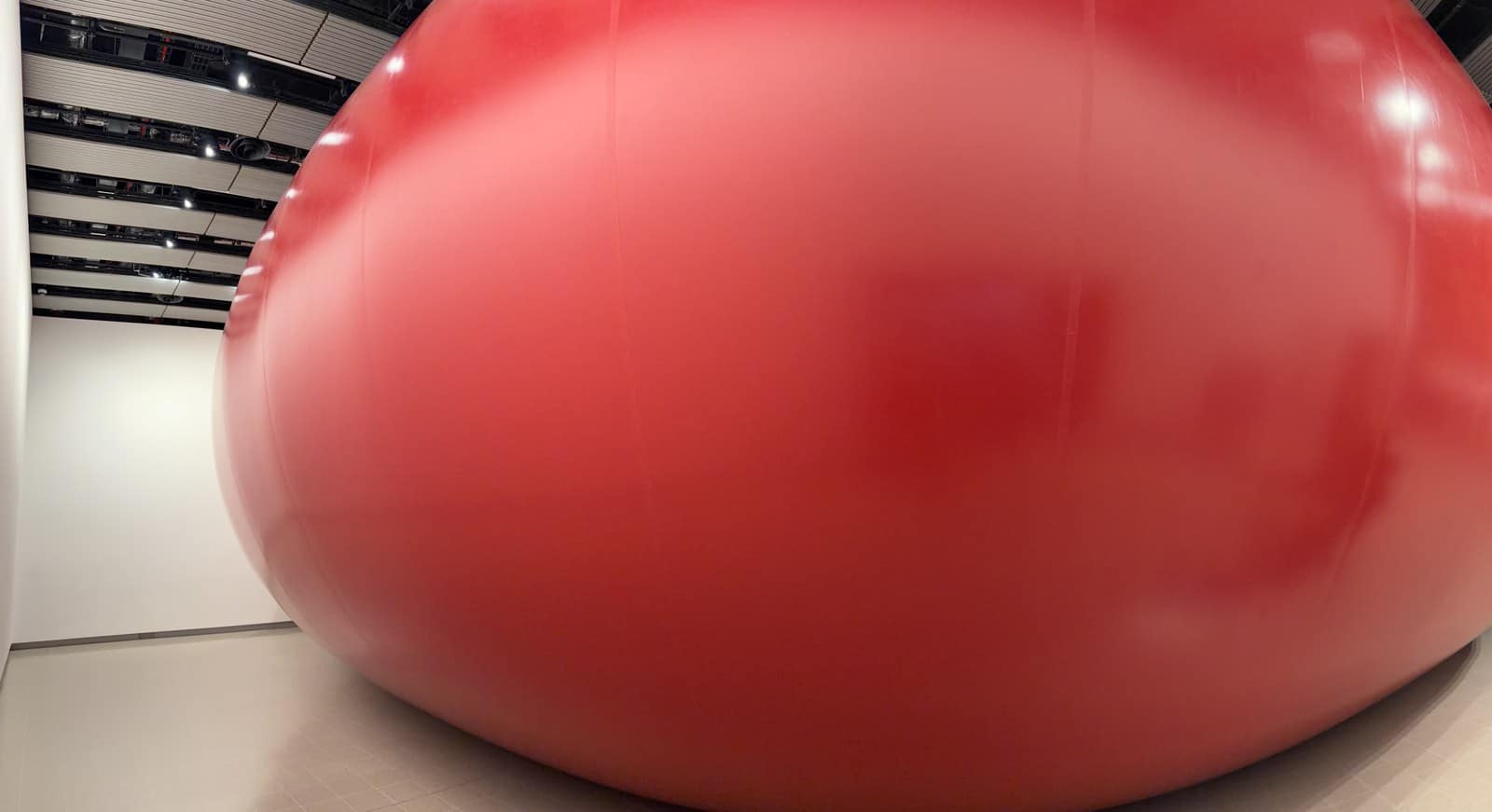
The show opens with All of Nothing (2026), a vivid red PVC balloon-like form that fills most of the six-metre-high first gallery. You can't see all of it at once, and you can't walk round it either. Instead, you edge along the side. The usual way to navigate these largest of galleries is blocked, so Kapoor is playfully frustrating us from the get-go.
For me, the show starts strong here. It is humorous, and almost a two-fingers-up to the usual route round a gallery. Kapoor seems to enjoy that. On the title, he told The Art Newspaper: "It is a big huge thing, but it's also nothing. It's a stupid balloon at one level."
At the press view, Rugoff described it as "squeezed by this brutalist corset". He also said it took several days to inflate.
Room 2: the sandstone block and the voids
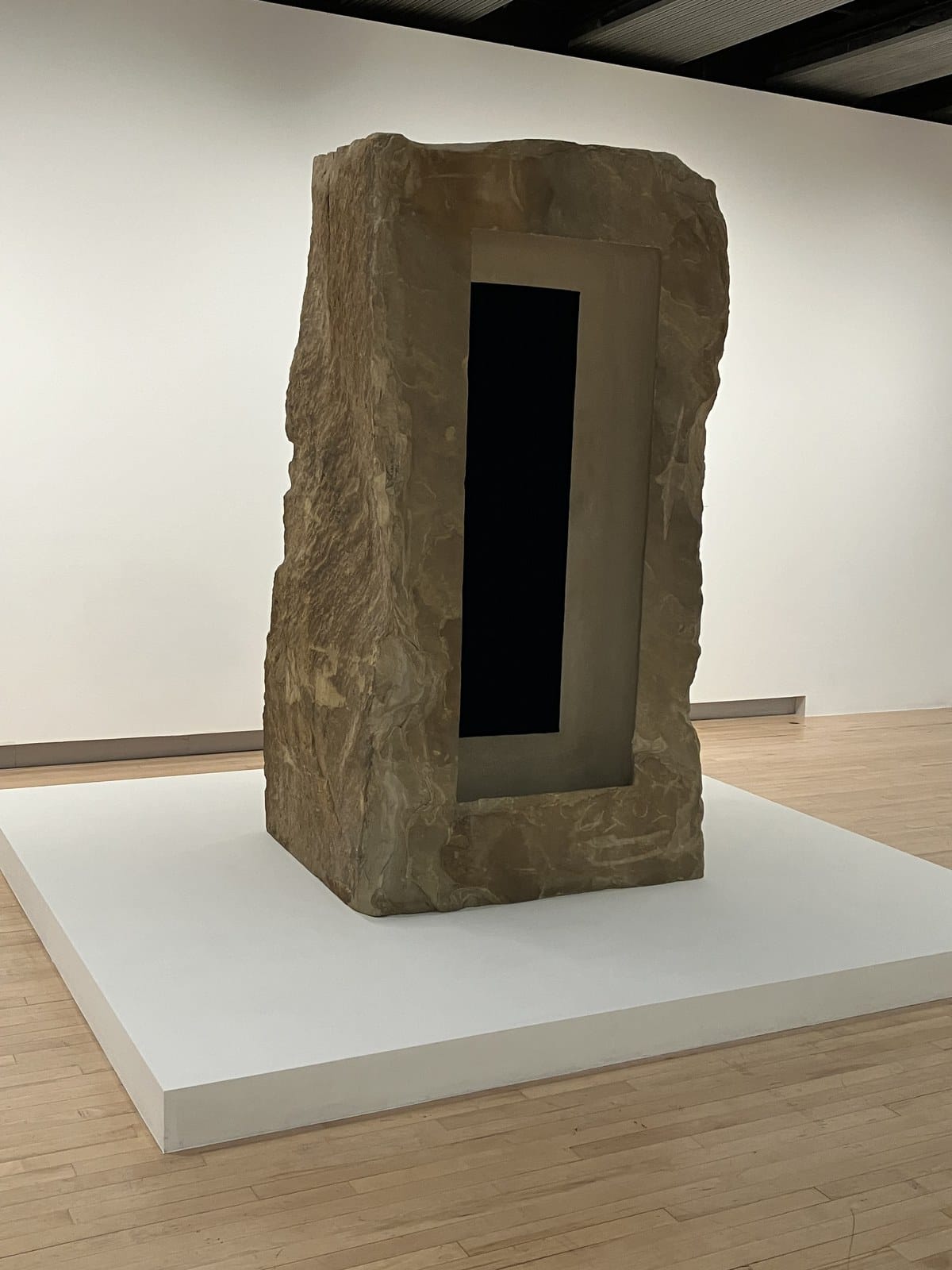
Roughly in the middle of Room 2 stands Untitled (1992), with the newer non-object pieces on the walls around it. It is a rough sandstone block about the height of a door frame, with a stepped doorway cut into its face. The innermost rectangle is coated in deep pigment, so it reads as a hole rather than a surface.
Set against the more recent pigment pieces, there is a conceptual and technical prowess in this piece that is lacking in all the other sculptures in the show. Here we see Kapoor thinking, sculpting and provoking. It links back to the sandstone blocks he showed in Venice in 1990, each with a small black void sunk into it.
The rest of the room is given over to what the wall text calls "non-objects". The wall text quotes Kapoor describing the void as "a space full of what doesn't exist". It adds his line: "Perhaps the darkest black is the black we carry within ourselves." There is a flat black square on the far wall, a jagged black rip in another wall, and a white wall that seems to hold a black oval.
Walk round that oval, though, and it turns out to be a white bowl jutting out from the wall. Its front is coated in Vantablack. Head on, it looks completely flat. From the side it shrinks into a circle and the bowl appears. Vantablack reflects almost no light. Kapoor holds the only artistic licence to use it, and he insists "it is a technology, not a paint."
The room also holds Iris (1998), a polished steel concave mirror that turns the room upside down as you walk towards it. It was in his 1998 Hayward show too.
Descent into Limbo: the hole in the floor
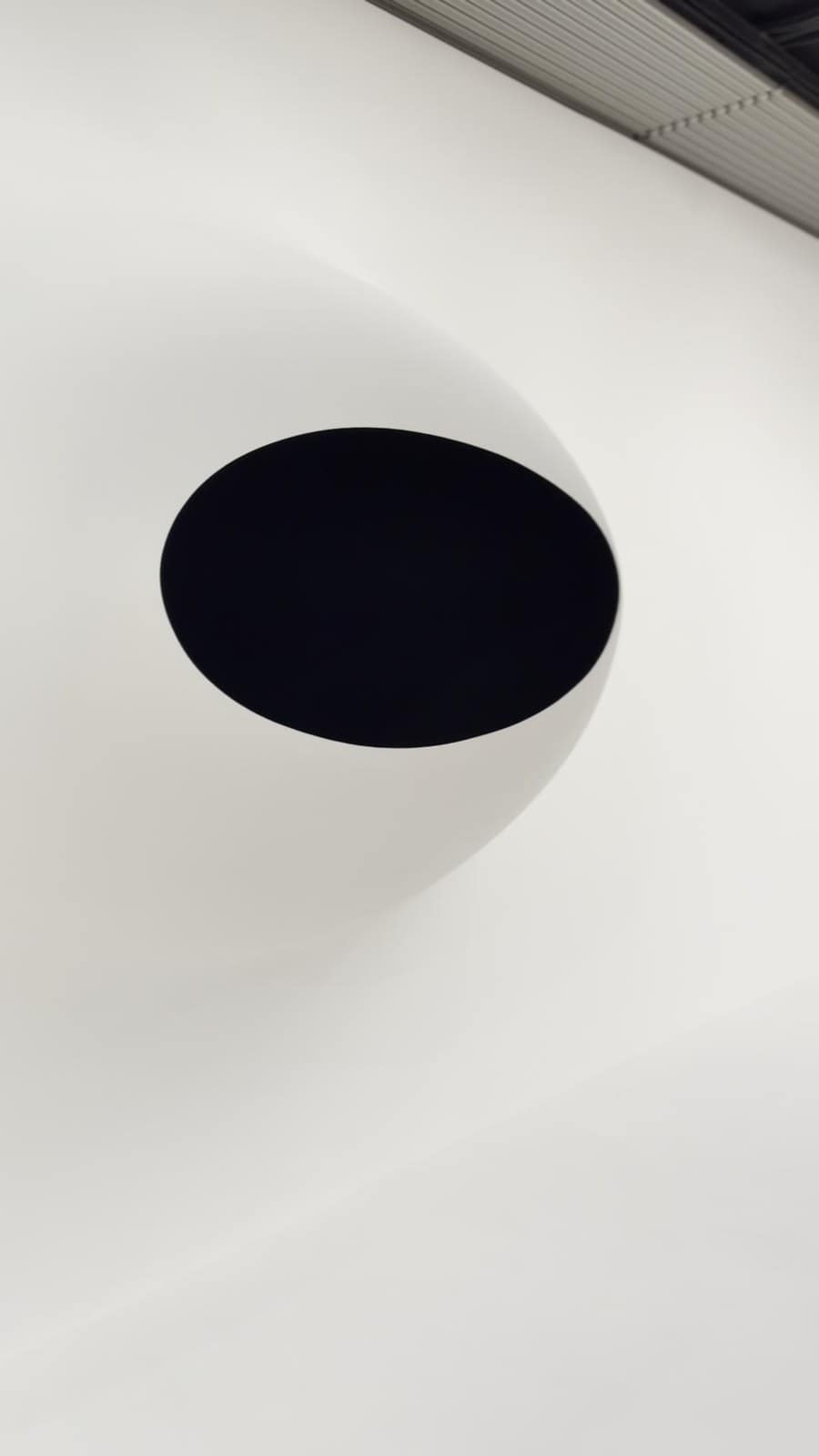
Also in Room 2 sits Descent into Limbo, first made in 1992. It is a real hole in the gallery floor. Dark pigment lines it, so it looks like a flat black disc lying on the floorboards. The Hayward drilled out a 1.5-metre-wide section of its floor to install it.
A low steel rail now keeps visitors back, and with good reason. In 2018, a visitor stepped into the same work at the Serralves Museum in Porto and fell around eight feet, as Artnet reported at the time. So stay behind the rail. This does kill some of the Looney Tunes vibe Descent into Limbo is giving, though.
This is where I felt Kapoor indulges himself. Each Vantablack piece makes a 3D shape look flat head on. By the fourth, it is the same optical trick in a different shape. The room starts to feel like a showroom for a material rather than a set of ideas.
Upstairs: Mount Moriah and the Plastic Sacrifices
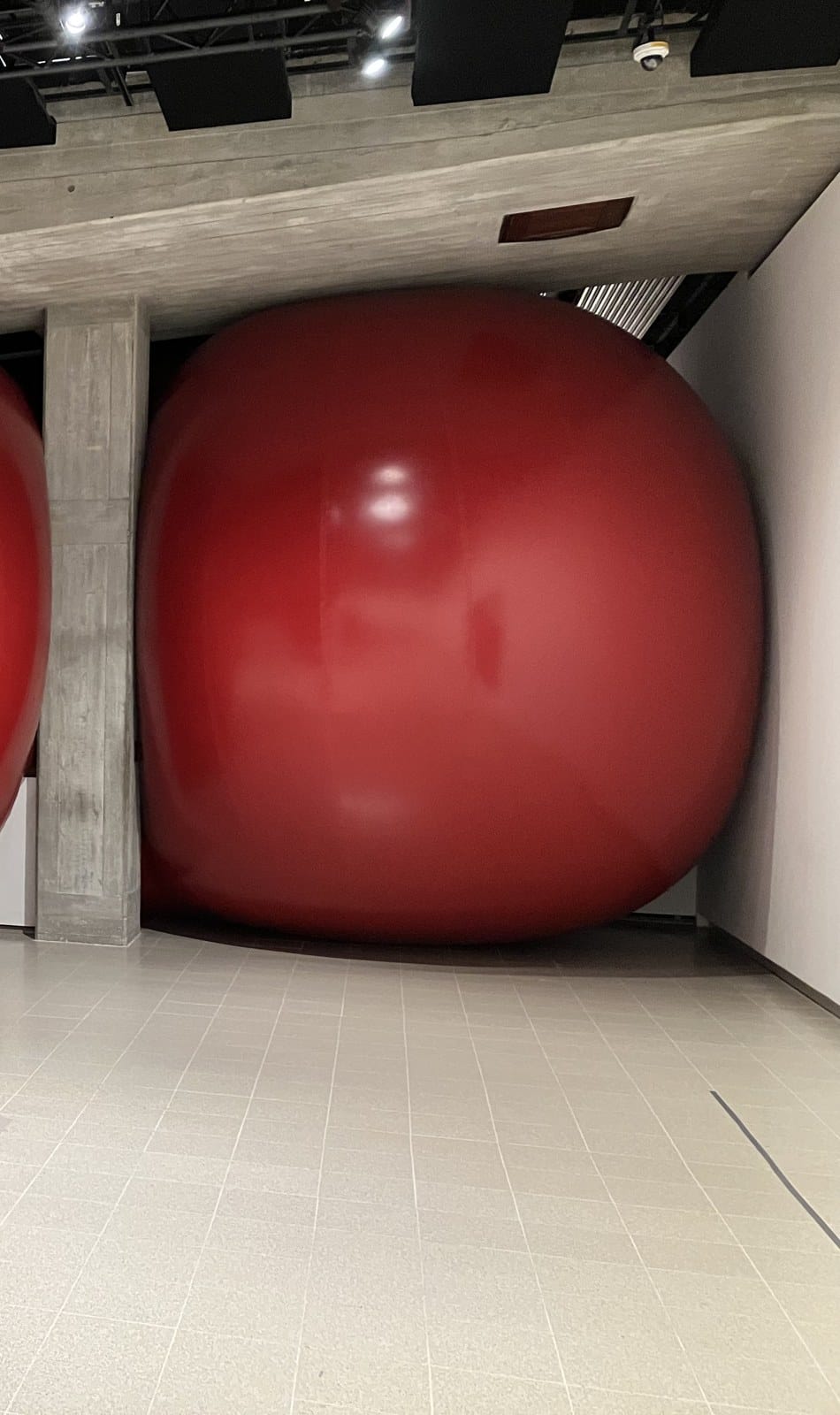
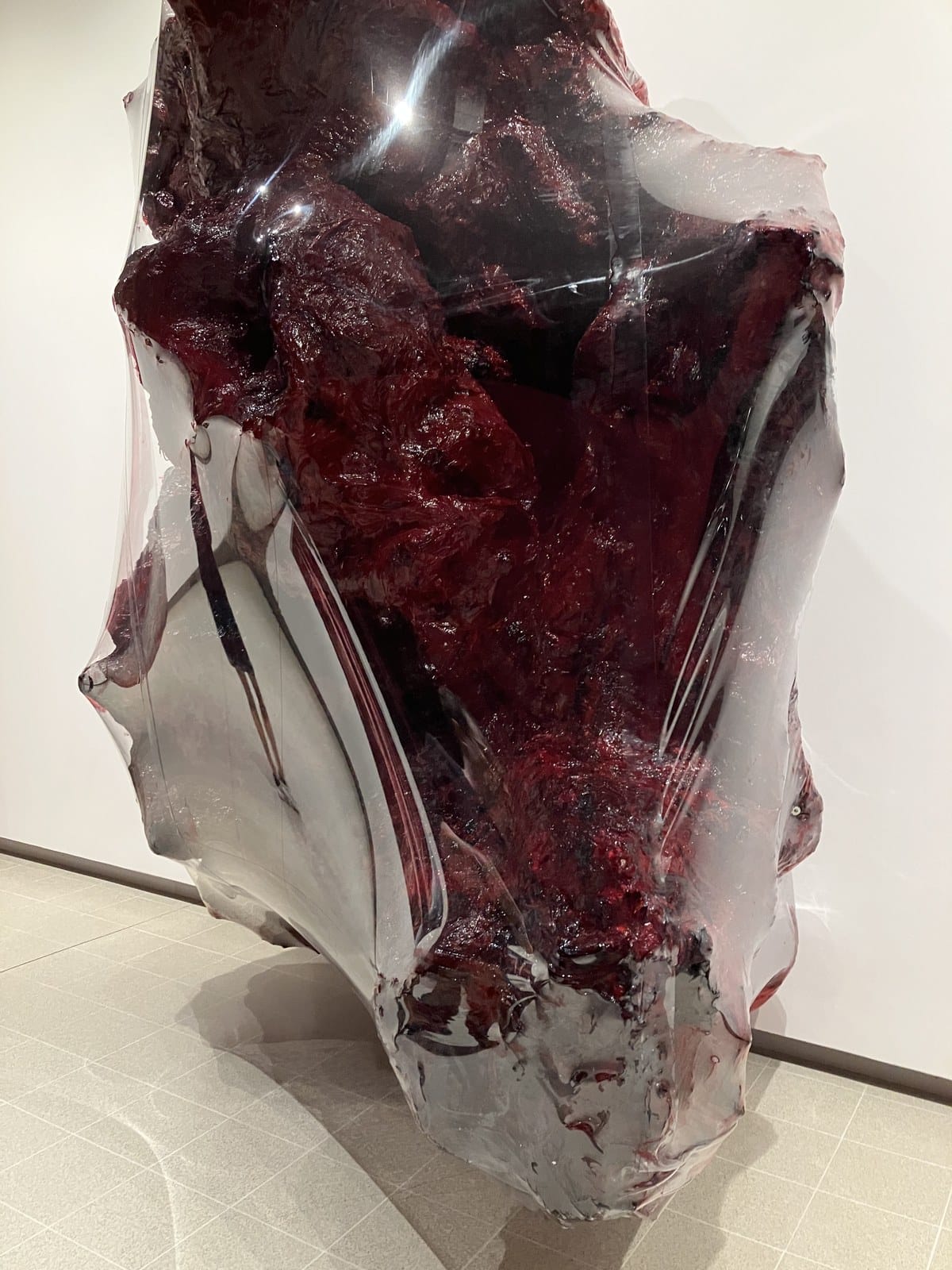
Upstairs, the top of that bright red balloon pushes into the room. Above it hangs Mount Moriah at the Gate of the Ghetto (2022). It is an upside-down mountain of red and black paint on silicone, dropping from the ceiling to just above the floor. It was first shown at Palazzo Manfrin in Venice. The "ghetto" in the title is the old Jewish quarter next to his studio there.
On the walls nearby are the three Plastic Sacrifice works (2026). Each is a relief, somewhere between a painting and a sculpture. Thick oil paint in dark reds is worked over silicone forms, then the whole thing is shrink-wrapped tightly in clear PVC. Up close, the plastic catches the light and the red underneath looks wet. A large painting, The Dark, hangs in the same room.
With these meaty paintings and sculptures, Kapoor seems caught between making Francis Bacon's gore a physical reality and touting himself as a prop maker for Stranger Things. I can just imagine Mount Moriah at the Gate of the Ghetto looking really wet and dripping on screen, with some post-production filters knocking back the plastic, waxy depth.
Ha Makom: a red mountain with a doorway
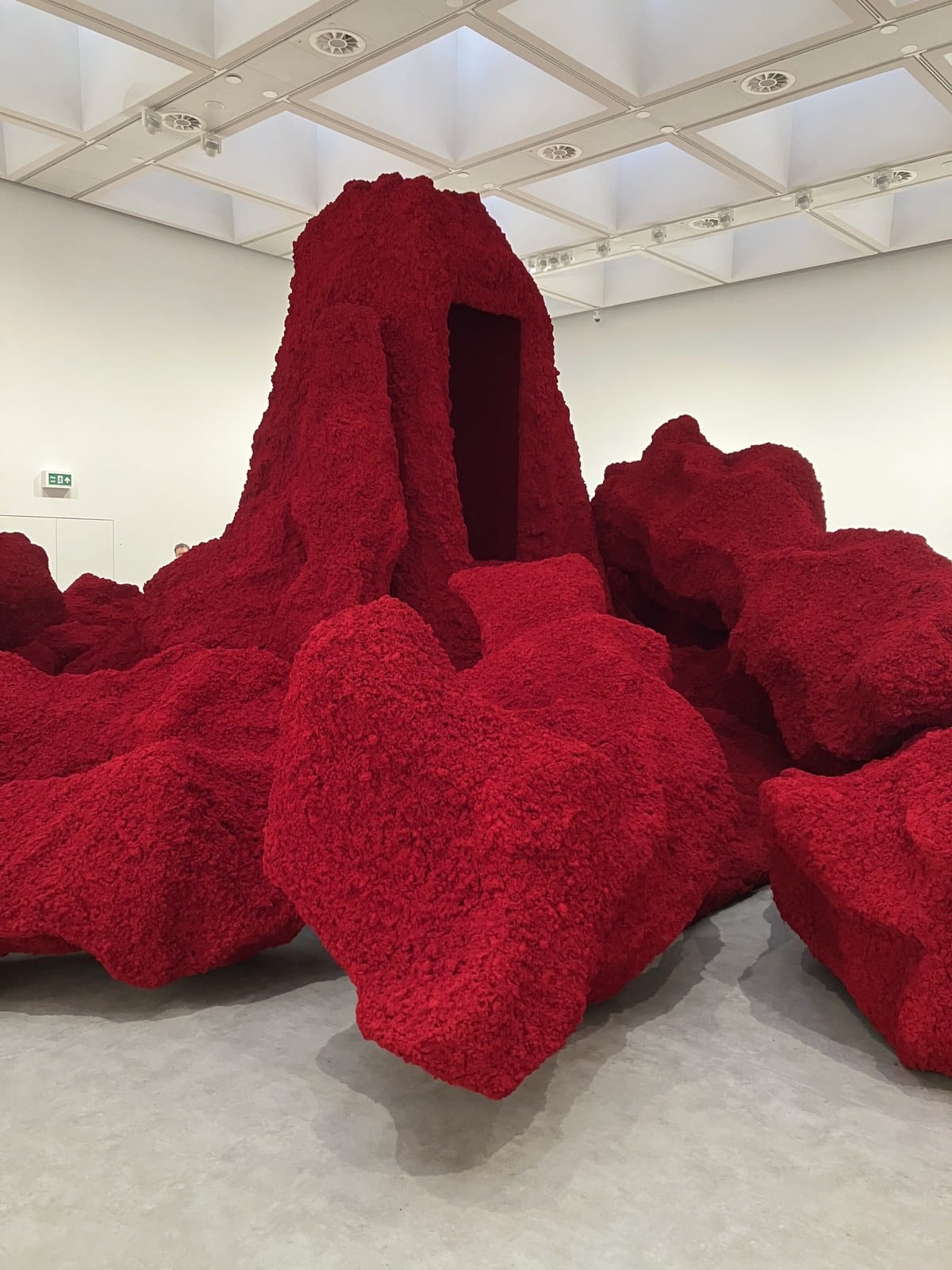
The big upper gallery holds Ha Makom (2026). It is a sprawling red landscape in 31 separate parts, with a dark doorway cut into its central peak. The surface is rough and crumbly, a bit like coral, and it is made of pigment, so it stains. The attendants keep visitors from touching it or climbing on it.
Kapoor told The Art Newspaper it is "a very emphatic, insistent red made of bits that all sit in relation to each other and fill most of that room upstairs." The doorway is the same idea as the 1992 sandstone block downstairs, a dark opening cut into solid matter, only this time at the scale of a landscape. His own website lists it as mixed media and pigment.
The title is Hebrew for "the place". It also appears in the traditional words said when leaving the home of mourners sitting shiva, the Jewish week of mourning. In the Guardian interview Kapoor explained: "Makom in kabbalistic language literally means 'place'. But it's also one of the names of God. I like that strange overlap."
Out on the terraces: the mirrors
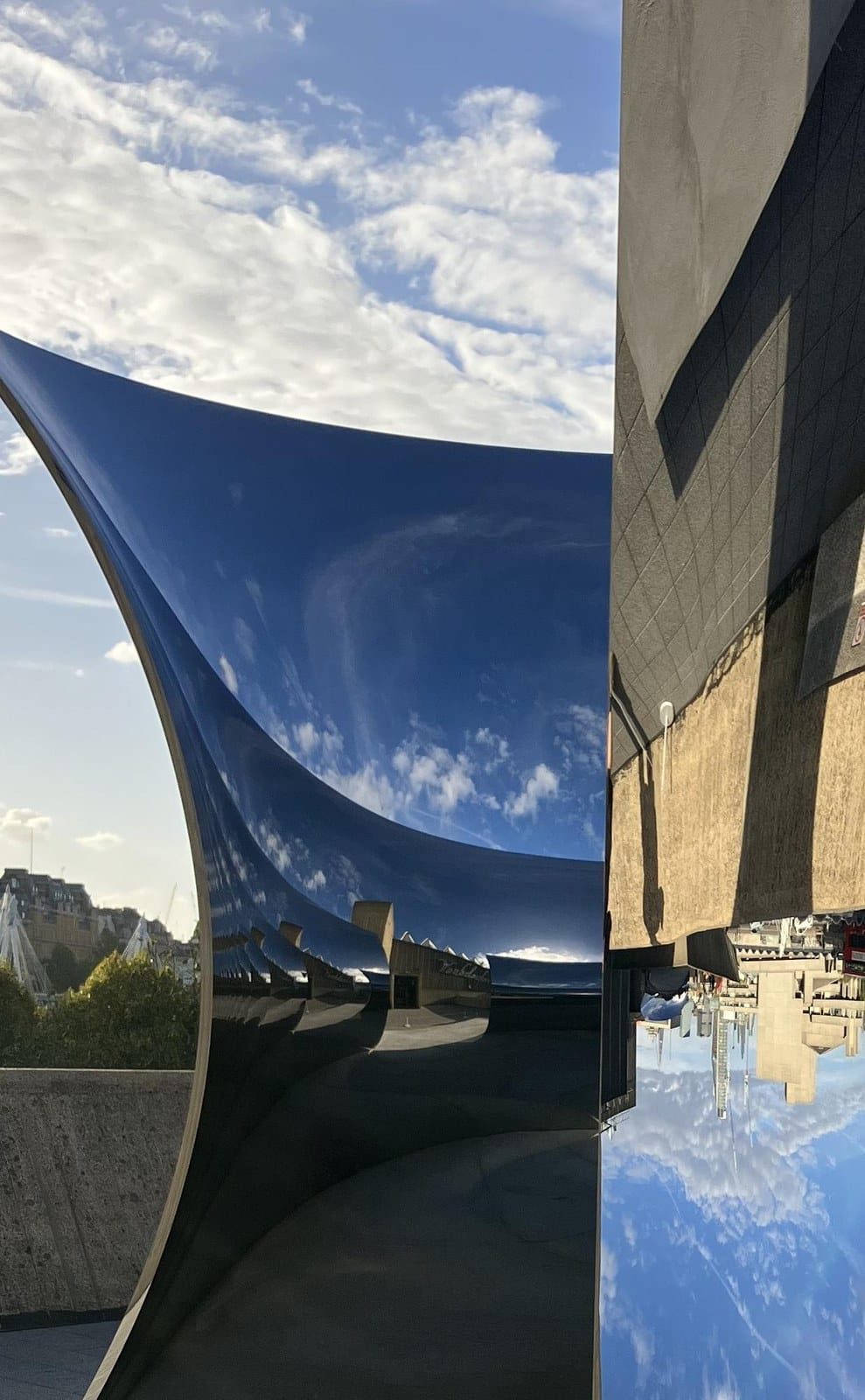
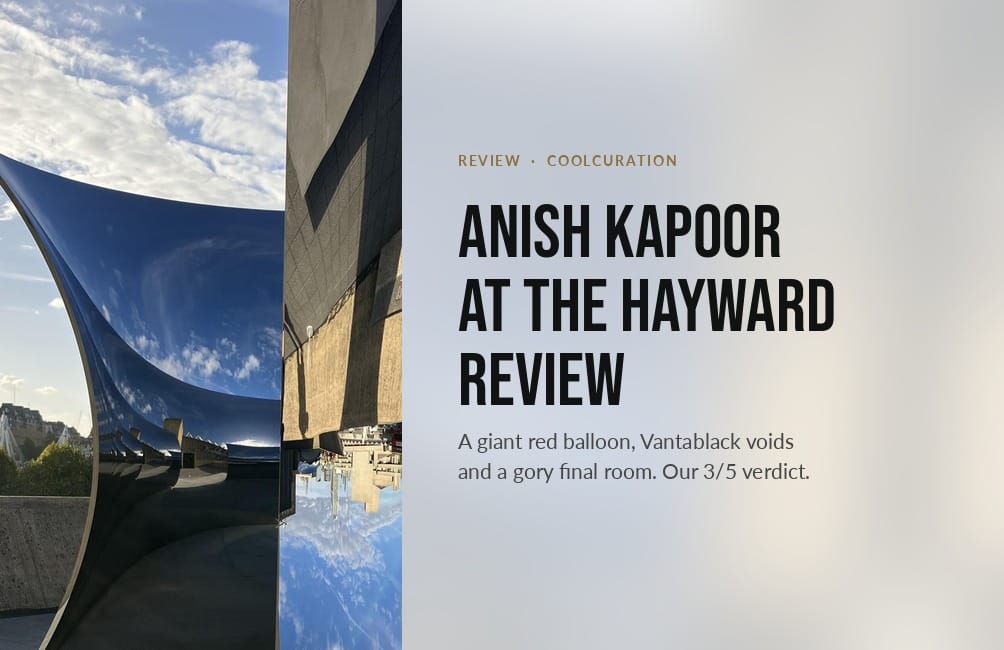
Each of the Hayward's two sculpture terraces holds a large polished steel piece: Tsunami (2025) and Cloak (2026). One is a tilted concave dish rising out of a concrete slab. Look into it and the sky drops below your feet, and the people around it hang upside down, along with the Hayward's pyramid rooflights.
The other is a pair of curved mirrored wings, about twice the height of the people walking round it. One wing fills with blue sky, while the other bends the grey concrete of the Southbank into long, stretched reflections. On a bright afternoon the two halves look like different materials.
These are the Kapoor works most people already know, from Cloud Gate in Chicago to Sky Mirror in Nottingham. The terrace is a fitting spot: his 1998 Hayward show also put a mirror work, Turning the World Upside Down III, out here. They also give you a break outdoors between the heavier rooms. The terraces are open to the weather, so pick a dry day if you can.
The final room: Ritual Expiation
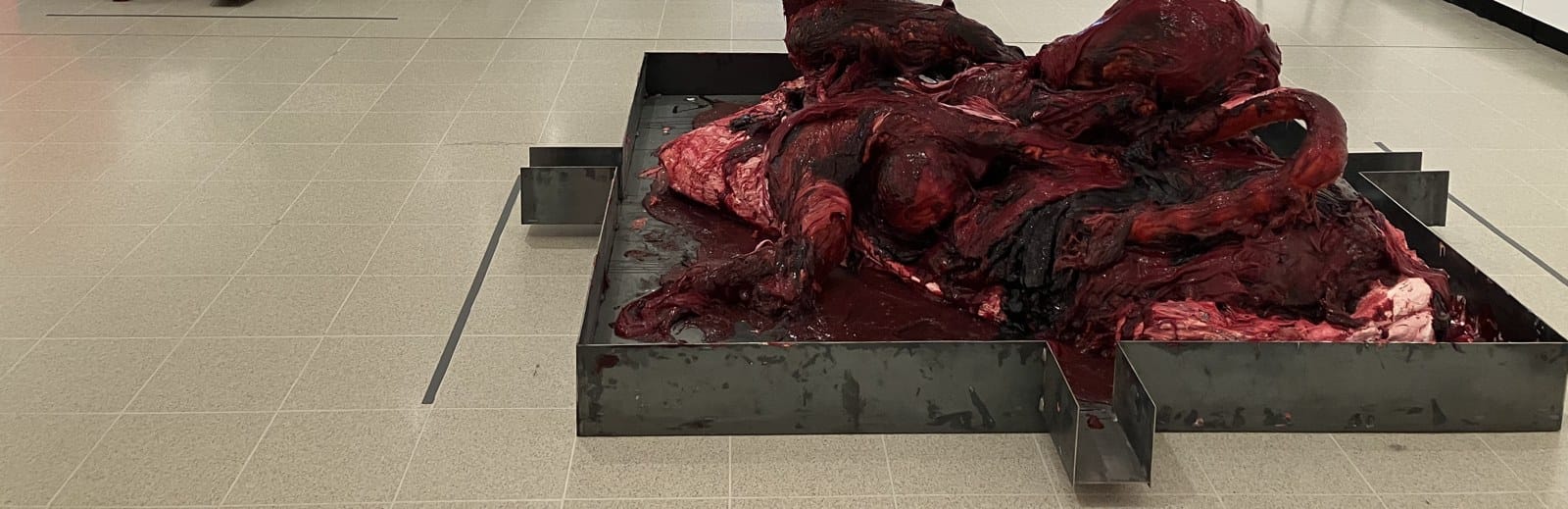
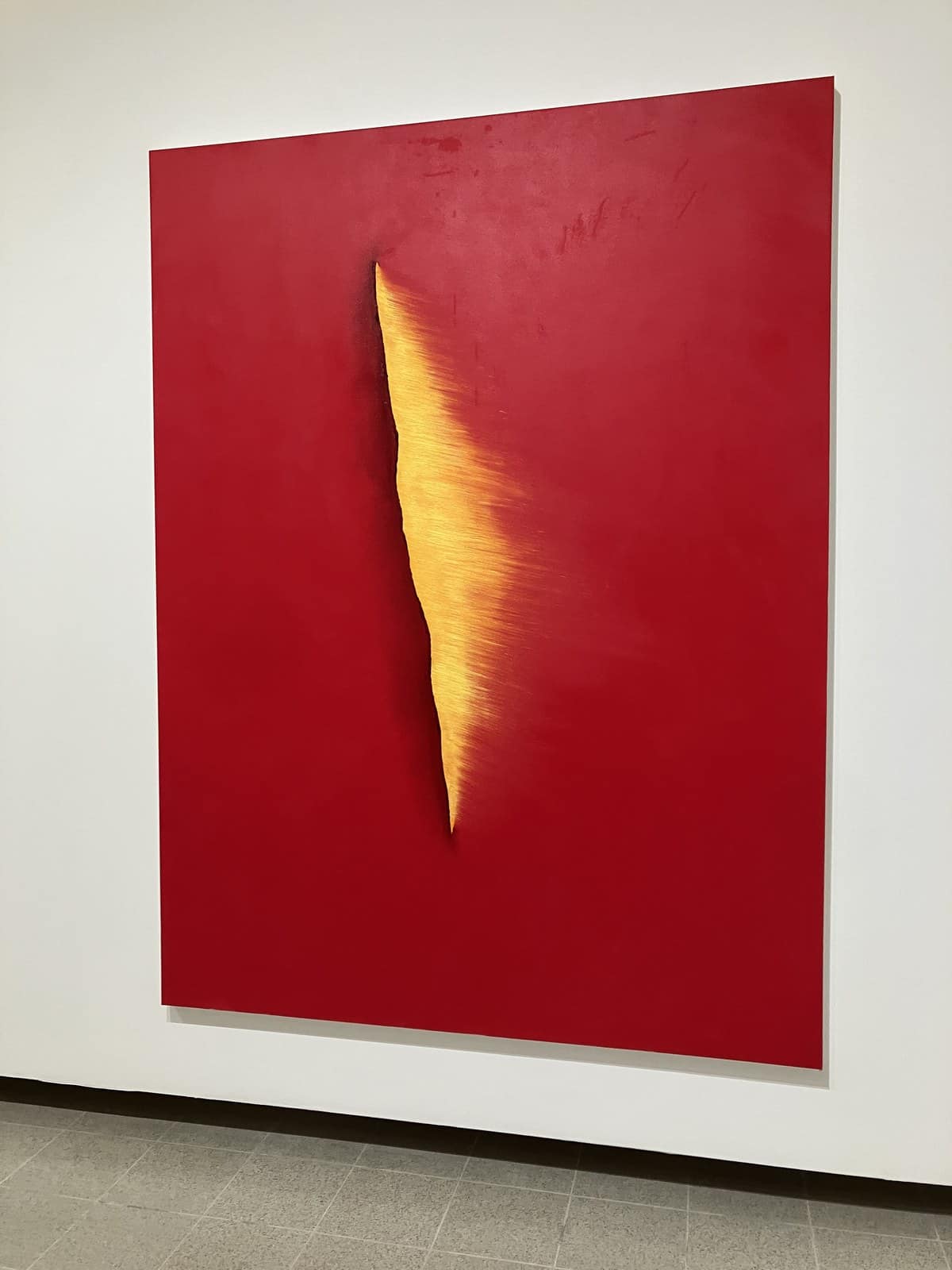
The show ends with Ritual Expiation (2025), a series of floor sculptures and paintings. The sculptures are heaps of dark red silicone and paint, lying in low steel trays with spouts. One climbs up a steel pyramid, another spills round a dark oval. They look like slabs of wax. The Southbank Centre carries a content warning for "artworks suggestive of blood and entrails".
In The Art Newspaper interview, Kapoor called it "carnage" and added that "none of them are real, of course." On the walls are red and pink paintings from the same series, one with a single gold slit running down a red canvas. The paintings are so weak. Again, it feels like Kapoor is seeking to insert himself into the painterly canon of Western art history, but clumsily, in oil and gold leaf more suited to hotel lobbies. A fiery, Fontana-esque painted slit, anyone? These really did not need to be in the show.
For me, many of these pieces, yet again, appear as Bacon-esque Stranger Things props. Along with the recent paintings, they feel like the swansong of someone once at the top of his game.
Honest critical observations
Overall, this is a somewhat confused offering. It has three or four strong ideas, but they never build into a story. Instead, you go from a joke (the balloon) to a material demonstration (the Vantablack) to a room of fake gore. The show never explains why those belong together.
It is also a very Instagrammable show, especially the balloon and the mirrors on the terraces. That is fun, but it can make the work feel built for a phone screen rather than for looking at.
The structural problem is that the Anish Kapoor Hayward return is mostly new work. Yet the older pieces, like the 1992 sandstone block and Iris from 1998, carry more weight than the new ones. Meanwhile, the newest work is where the show feels overly playful and overly engineered.
In the creative world, whether visual art, music or literature, people rarely retire. They keep on keeping on. Kapoor might be a good argument for some artists bowing out gracefully. Otherwise the work descends into the overly playful and the overly engineered.
Plenty of critics disagree with me. Jonathan Jones gave it five stars in the Guardian, though Time Out landed on three.
Why this show matters now
This is Ralph Rugoff's farewell to the Hayward after two decades. Sally Tallant took over as director in July 2026. For anyone who follows the Southbank, that gives the show some weight beyond Kapoor himself.
It is also a useful look at a famous artist late in his career. Kapoor turned 72 in March 2026. He still makes work at enormous scale, with a south London studio of 23 staff. For me, the scale of the newest pieces is bigger than the ideas behind them.
Is the Anish Kapoor Hayward show worth the money?
Standard tickets are £22. Concessions cost £18, Art Fund members pay £16.50, 12 to 16-year-olds pay £8 and under-12s go free. Southbank Centre members also go free. Prices were checked on 1 October 2026 and the Hayward says they can change with demand.
For me, the opening balloon and the outdoor steel pieces are the main reasons to visit. So the Anish Kapoor Hayward show makes most sense if you are already on the Southbank. An Art Fund National Art Pass cuts the price to £16.50 here. It suits anyone who visits paid exhibitions regularly.
For comparison, our Chiharu Shiota and Yin Xiuzhen review covers a very different show in the same rooms.
Practical info
- Dates: until 18 October 2026.
- Opening hours: Tuesday to Friday 10am to 6pm, Saturday 10am to 8pm, Sunday 10am to 6pm, closed Mondays. Late openings run to 9pm on Wednesdays and Fridays up to 14 October. The final weekend, 17 and 18 October, is also late.
- Tickets: book on the Southbank Centre website.
- Getting there: Waterloo and Embankment are the nearest Tube stations. From Embankment, cross the Golden Jubilee footbridges.
- Access: step-free throughout, with accessible toilets. The cloakroom costs £2 per item and is cashless.
- Content warning: the final room includes works suggestive of blood and entrails.
- Free tours: Wednesdays and Fridays at noon.
- Time needed: I went round in about 40 minutes, terraces included.
The verdict on Anish Kapoor at the Hayward
Kapoor's Hayward return starts with a humorous balloon. It ends with a room of silicone gore that looks like a TV prop store. In between, there are good older works, a lot of Vantablack and two big mirrors outside. Cool Factor: 3/5.
Overall, a 3/5 Cool. The Anish Kapoor Hayward show earns that for its opening, its older pieces and the steel on the terraces. It falls short of Stone cold because it is a somewhat confused offering. The newest work, especially the final room, feels like an artist who doesn't know when to stop. Go for the balloon and the mirrors if you are on the Southbank before 18 October, but keep your expectations low for the rest.
FAQs
Is the Anish Kapoor Hayward Gallery exhibition worth it?
In my opinion, the Anish Kapoor Hayward show earns its £22 if you are near the Southbank, mainly for the giant inflatable at the start and the steel mirrors on the terraces. The final room is the weakest part.
How much are tickets for Anish Kapoor at the Hayward?
Standard tickets are £22 and concessions £18 (prices checked 1 October 2026). Art Fund members pay £16.50, ages 12 to 16 pay £8, and under-12s and Southbank Centre members go free.
When does the Anish Kapoor Hayward show close?
The Anish Kapoor Hayward exhibition closes on Sunday 18 October 2026. In the final weeks it is open until 9pm on Wednesdays, Fridays and the final weekend.
Is the Anish Kapoor exhibition suitable for children?
Under-12s go free and nothing in the first rooms is gory. However, the final room has works suggestive of blood and entrails, so check the content warning first.
What is Vantablack and why can only Kapoor use it?
Vantablack is a coating that absorbs almost all visible light, so 3D shapes look completely flat. Kapoor's sole artistic licence to it was announced in 2016, which annoyed many other artists.
How long do you need at the Anish Kapoor Hayward exhibition?
I took about 40 minutes for every room and both terraces. Allow an hour if you want to read the wall texts.
More from CoolCuration
- Enemies and Rascals at Artangel. Another 3/5 London art outing, a sound installation inside a sealed police cell.
- Whistler at Tate Britain. Our review of the Whistler exhibition, if you want a painter's show after all that silicone.
- The Hayward Gallery heart brooch. A small gift from the Hayward shop for anyone who loves the building.
- Olafur Eliasson Lifeworld edition. Another artist who plays with light and perception, in print form.
- The gift guide for artists. Presents for people who make things and notice materials.
What's trending




Recent posts
- Best Audiobooks October 2026: 10 UK Listens Ranked
 Ten new audiobooks for October 2026, from a full-cast Dracula with Jonathan Bailey to Russell T Davies reading his own television memoir.
 - Louis Fratino at David Zwirner ReviewLast updated: 4 October 2026 By Tristan · Arts, exhibitions and creative culture This is an opinion piece. Views expressed are the author's own and do not constitute professional advice. Exhibition reviewMayfair Saunas, subway cars and a lot of skin in Mayfair Louis Fratino at Zwirner is the American painter's first solo show in London,… Read more: Louis Fratino at David Zwirner Review
- What Is a Sprive Boost? Seven Days, and What It Actually PaysA Sprive boost lifts your cashback rate for seven days, and it arrives on its own. What mine paid, and why Supercharge is a display toggle rather than extra cashback.



No Comments.